Gemology Books Bibliography

Gemology Books Bibliography

Explore books on gems, gemology, jewelry and mineralogy in Four Treasures, the Lotus Gemology reference database. This bibliography brings together matching book records from the collection, with publication details, abstracts and cover images where available.

Gemology Book References

The list below matches books concerning gemology and related subjects in the database's searchable fields. Some works cover several branches of gems, jewelry or mineralogy.
2,681–2,700 of 3,454 matching references

Are synthetic red spinels available?

Journal Article
Gübelin, E.J. (1950) Are synthetic red spinels available? Gems & Gemology, Vol. 6, No. 10, Summer, pp. 307–309, 322.
Record No. 2036  |  ISBN/ISSN: 0016626X  |  RWHL

Cleavage and the structure of gem minerals
Journal Article
Mitchell, R.K. (1950) Cleavage and the structure of gem minerals. Journal of Gemmology, Vol. 2, No. 6, April, pp. 251–252.
Record No. 1284  |  ISBN/ISSN: 221252  |  RWHL

American synthetic crystals – Sapphire to titania
Journal Article
Seemann, A.K. (1949) American synthetic crystals – Sapphire to titania. Gems & Gemology, Vol. 6, No. 5, Spring, pp. 151–159.
Record No. 1573  |  ISBN/ISSN: 0016626X  |  RWHL

Observations on reconstructed rubies

Journal Article
Gübelin, E.J. (1949) Observations on reconstructed rubies. Gems & Gemology, Vol. 6, No. 6, Summer, pp. 186–187.
Record No. 879  |  ISBN/ISSN: 0016626X  |  RWHL

Reconstructed rubies in rod and faceted form
Journal Article
Alexander, A.E. (1949) Reconstructed rubies in rod and faceted form. Gems & Gemology, Vol. 6, pp. 184–185.
Record No. 224  |  ISBN/ISSN: 0016626X  |  RWHL

A Handbook of Precious Stones

Book
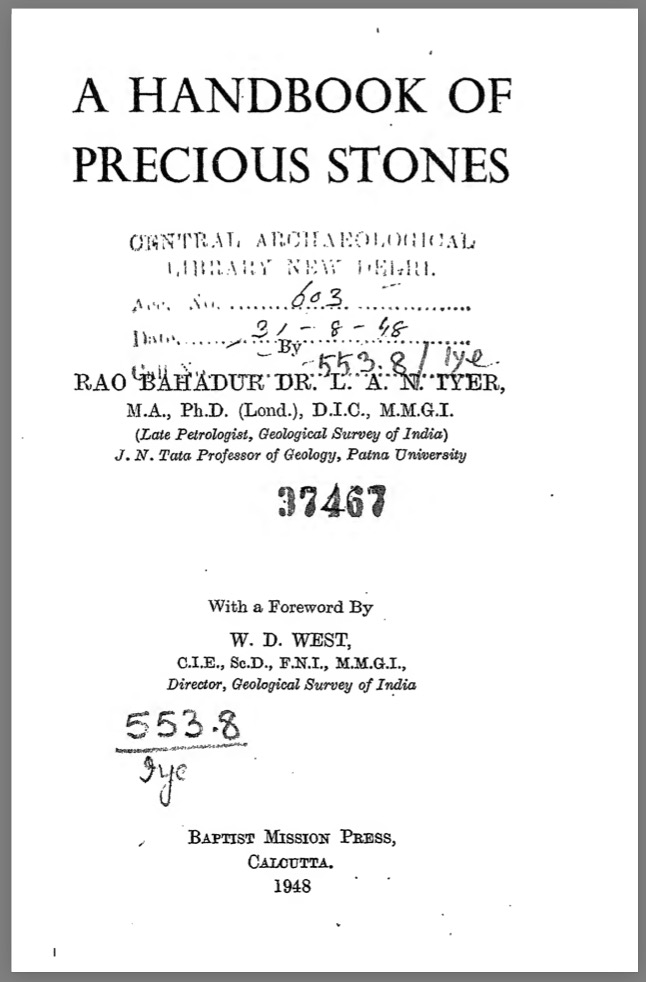
Iyer, L.A.N. (1948) A Handbook of Precious Stones. Calcutta, Baptist Mission Press, 188 pp.
Record No. 3184  |  Sinkankas/Born No.: 3151; NIB  |  RWHL
Sinkankas: A fairly complete general treatment of gemology written in popular terms and presumably meant to replace or supplant the somewhat similar publications above, especially insofar as Iyer emphasizes the gemstones that occur in India, Burma, and Ceylon. The first part treats principles and is followed by a second part on descriptions. Because of the author’s familiarity with native gemstones, this work remains a valuable reference. Commendable features include descriptions of native mining methods used, histories of previous mining attempts in the countries named, and a bibliography that is large, detailed, and paginated! This work is scarce.

The diagnostic importance of inclusions in gemstones
Journal Article
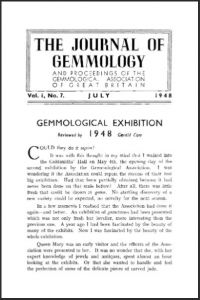
Gübelin, E.J. (1948) The diagnostic importance of inclusions in gemstones. Journal of Gemmology, Vol. 1, No. 7, July, pp. 1–23.
Record No. 878  |  ISBN/ISSN: 221252  |  RWHL
COULD they do it again? It was with this thought in m y mind that I walked into It was with this thought in my mind that I walked into the Goldsmiths' Hall on May 4th ,the opening day of the the Goldsmiths' Hall on May 4th, the opening day of the second exhibition by the Gemmological Association. I was second exhibition by the Gemmological Association. I was wondering if the Association could repeat t h e success of their first wondering if the Association could repeat the success of their first big exhibition. Had that been partially obtained because it had big exhibition. Had that been partially obtained because it had never been done on that scale before? After alll,, there wass little fresh that could be shown in gems. No startling discovery of a new variety could be expected, no novelty for the next season. In a few moments I realised that the Association had done it again and better. An exhibition of gemstones had been presented which was not only fresh butt lovelier, more interesting than the previous one. A year ago I had been fascinated by the beauty off many of the exhibits. Now I was fascinated by the beauty of thee whole exhibition. Queen Mary was an early visitor and the officers of the Association were presented to her. It was no wonder that she, with her expert knowledge of jewels and antiques, spent almost an hour looking at the exhibits. Or that she wanted to handle and feel the perfection of some of the delicate pieces of carved jade.

Spectrochemical and spectrophotometric analyses of rubies and sapphires
Journal Article
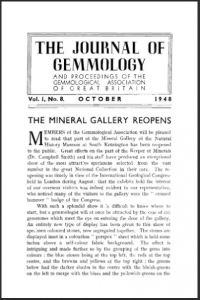
Alexander, A.E. (1948) Spectrochemical and spectrophotometric analyses of rubies and sapphires. Journal of Gemmology, Vol. 1, No. 8, October, pp. 4–8.
Record No. 223  |  ISBN/ISSN: 221252  |  RWHL

Mexico South: The Isthmus of Tehuantepec
Book
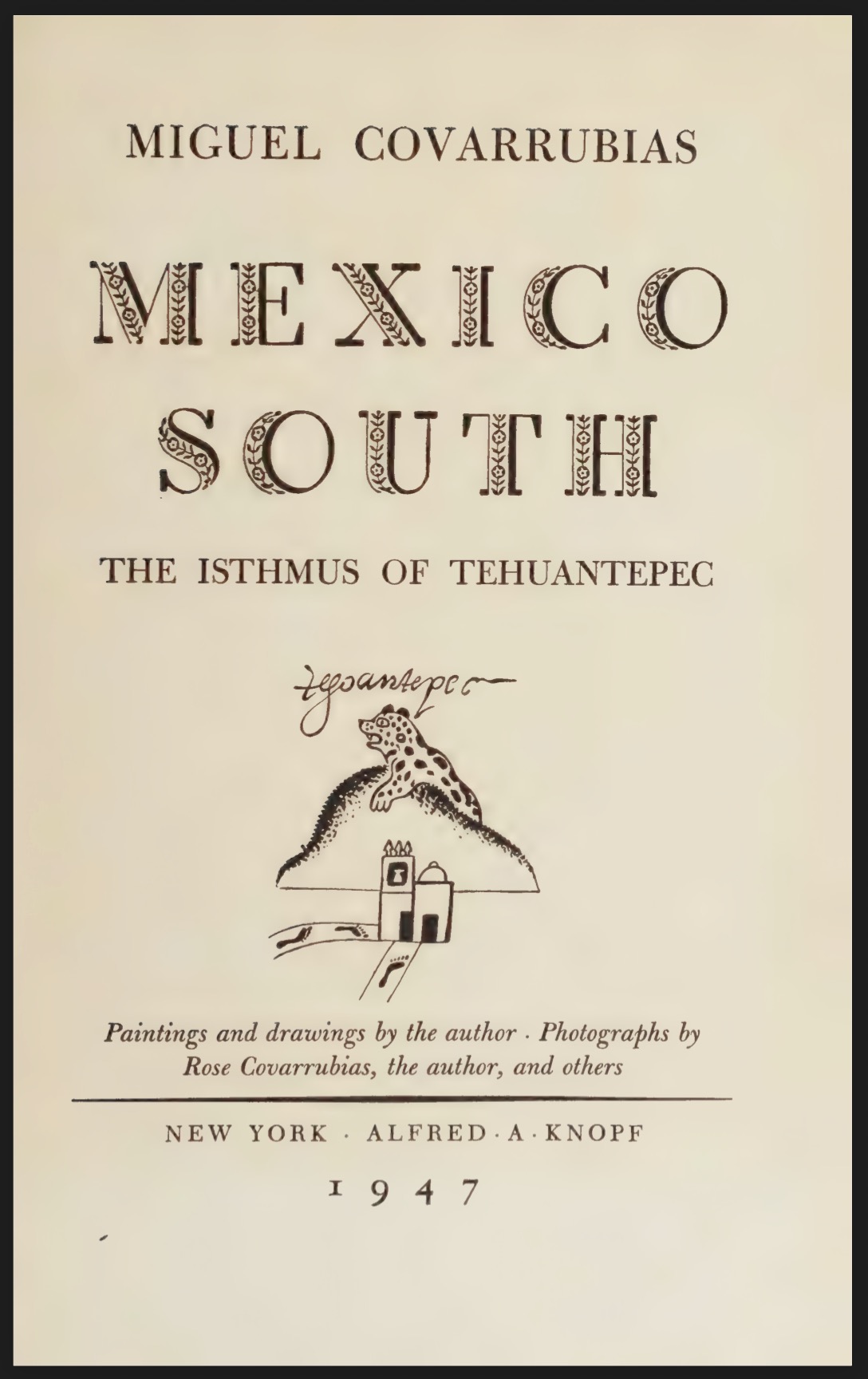
Covarrubias, M. (1947) Mexico South: The Isthmus of Tehuantepec. New York, Alfred A. Knopf
Record No. 28558  |  Sinkankas/Born No.: NIS/NIB  |  RWHL
It used to be customary to think of Mexico as a barren land—great stretches of semi-desert bristling with cactus and maguey plants, a place of rattlesnakes and burros; of enigmatic black eyes peering out between straw sombreros and garish sarapes; of gentle-mannered, shy women flitting by like shadows in their blue rebozos; of D’Artagnanesque cattle rustlers strumming guitars and dressed in silver-studded, skin-tight trousers. It was a sort of musical-comedy nation, where browbeaten peons periodically rose in revolt against their Spanish grandee masters and were led by bandit generals with magnificent moustaches and oily complexions, whose ruthless and sanguinary exterior concealed a patriotic heart of gold. This romantic picture has gradually given way to a less gaudy and increasingly accurate understanding of the country, acquired through the personal experience of travellers and a deeper insight into Mexican art and history, economy, and sociology gained by a new generation of more liberal and open-minded scholars and students. Nearly everybody has heard of the Aztecs and their emperor Moctezuma, and of the Maya, builders of what is often considered the most highly developed Indigenous civilization of the American continent. Maya cities buried in the tropical jungle have become the special province of American archaeologists; libraries have been filled with novels set in Mexico, with accounts of Mexico’s bewildering revolutions, with controversial studies of Mexican politics, religious conflicts, agrarian struggles, and oil crises, and with countless new books on Mexican art and archaeology.

The new Linde stars

Journal Article
Holmes, R.J. (1947) The new Linde stars. Gems & Gemology, Vol. 5, No. 11, Fall, pp. 452–456.
Record No. 1002  |  ISBN/ISSN: 0016626X  |  RWHL

Gemological Digests: German synthetic gem production

Journal Article
Anonymous (1947) Gemological Digests: German synthetic gem production. Gems & Gemology, Vol. 5, No. 10, Summer, pp. 435–436.
Record No. 286  |  ISBN/ISSN: 0016626X  |  RWHL

The Story of Diamonds

Book
Austin, A.C., Mercer, M. and Shipley, R.M. (1946) The Story of Diamonds. Los Angeles, Gemological Institute of America, 101 pp.
Record No. 7709  |  Sinkankas/Born No.: 251  |  RWHL

Identification of synthetic gems, parts I–III
Journal Article
Gübelin, E.J. and Liddicoat, R.T. (1946–7) Identification of synthetic gems, parts I–III. Gems & Gemology, Vol. 5, No. 7, Fall, pp. 349–353 (corundum); No. 9, Spring, pp. 399–402 (corundum); No. 10, Summer, pp. 421–427 (spinel & emerald).
Record No. 5040  |  ISBN/ISSN: 0016626X  |  RWHL

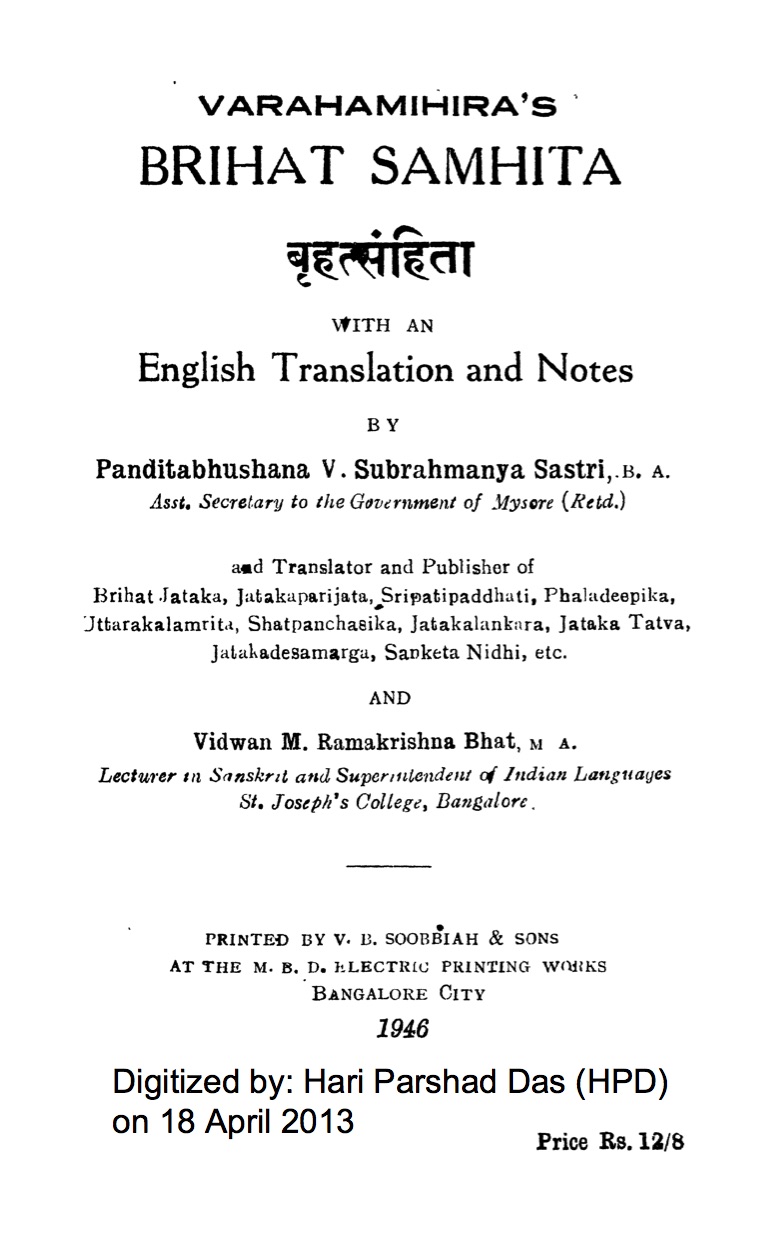
Varāhamihira’s Bṛhat Saṁhitā

Book
Varāhamihira, Subrahmanya, P.V. and Bhat, M.R. (1946) Varāhamihira’s Bṛhat Saṁhitā. Bangalore, V.B. Soobbiah & Sons, 2 Vols., 804, 214 pp.
Record No. 5012  |  RWHL
Varāhamihira’s Bṛhat Saṁhitā is a seminal Sanskrit encyclopedic text composed in the 6th century CE, reflecting the confluence of science, astrology, geography, meteorology, architecture, and social customs in early classical India. Written by the polymath Varāhamihira, the work comprises over a hundred chapters that explore a wide range of subjects, from celestial omens and planetary motions to water divination, gemology, and rituals. As both a scientific treatise and a cultural document, the Bṛhat Saṁhitā offers valuable insights into the intellectual landscape of Gupta-period India. This abstract surveys the structure, content, and historical significance of the text, highlighting its role in the transmission of knowledge across disciplines and its enduring influence on Indian astronomical and astrological traditions.

[The Gübelin laboratory]

The Gübelin laboratory
Journal Article
Gübelin, E.J. (1946) [The Gübelin laboratory]. Gems & Gemology, Vol. 5, No. 6, Summer, pp. 326–327.
Record No. 2030  |  ISBN/ISSN: 0016626X  |  RWHL

Jewels of the Russian Diamond Fund

Journal Article
Fersman, A.E. (1946–47) Jewels of the Russian Diamond Fund. Gems & Gemology, Trans. by Marie Pavlovna Warner, Vol. 5, Part I: No. 8, Winter, pp. 363, 372–376; Part II: No. 9, Spring, pp. 403–405; Part III: No. 10, Summer, pp. 432–434; Part IV: No. 11, Fall, pp. 467–470.
Record No. 760  |  ISBN/ISSN: 0016626X  |  RWHL

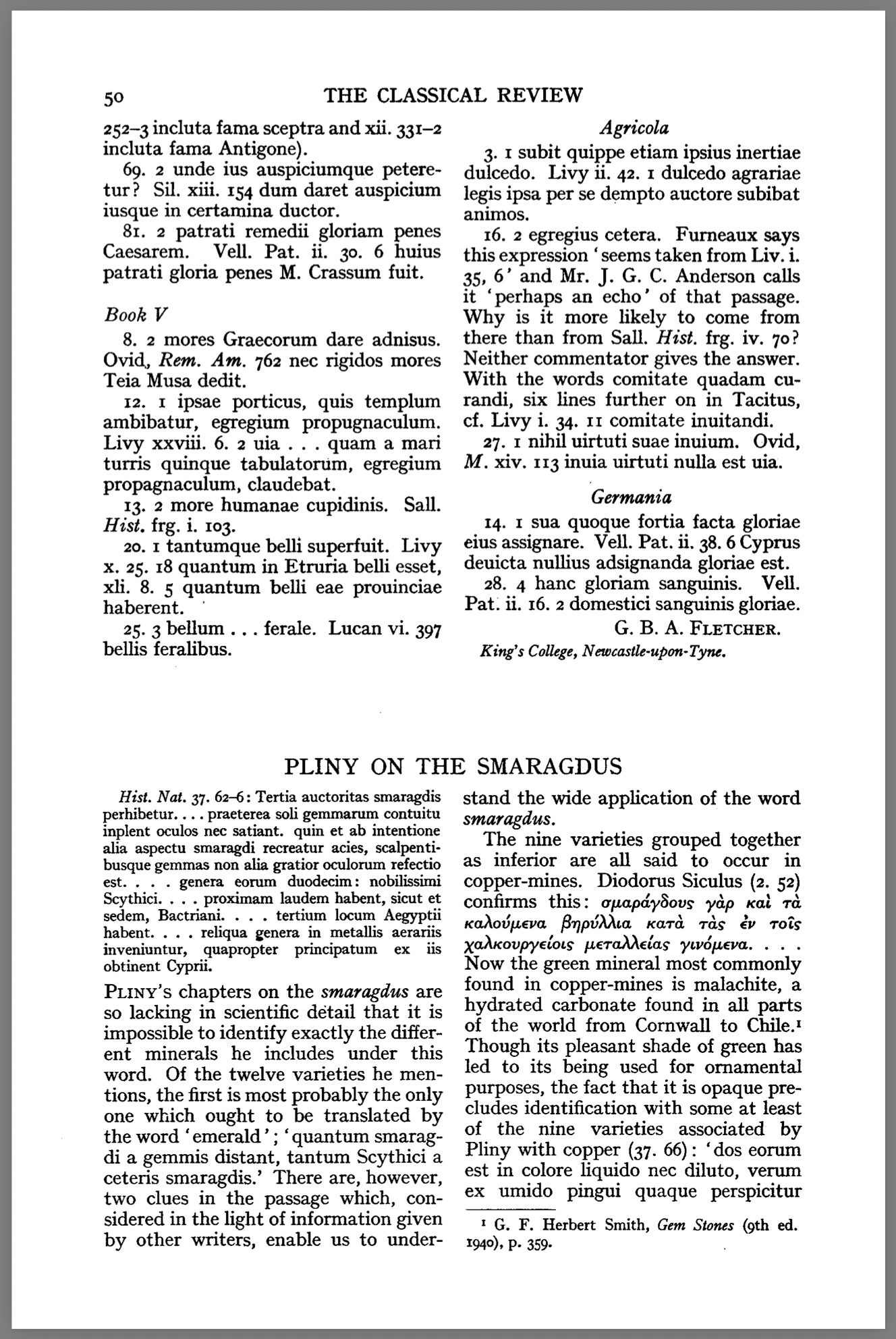
Pliny on the smaragdus

Journal Article
Meadows, J.W. (1945) Pliny on the smaragdus. Classical Review, Vol. 59, pp. 50–51.
Record No. 28817  |  Sinkankas/Born No.: NIS/NIB  |  RWHL
Pliny the Elder’s chapters on the smaragdus are so lacking in scientific detail that it is impossible to identify exactly the different minerals he includes under this term. Of the twelve varieties he mentions, the first is most probably the only one that ought properly to be translated as “emerald”: quantum smaragdi a gemmis distant, tantum Scythici a ceteris smaragdis. There are, however, two clues in the passage which, considered in light of information provided by other writers, help explain the broad application of the word smaragdus. The mineral in question may have been a hydrated carbonate found in many parts of the world, from Cornwall to Chile. Although its pleasing green color led to its use for ornamental purposes, its opacity excludes identification with at least some of the nine varieties associated by Pliny with copper (37.66): dos eorum est in colore liquido nec diluto, verum ex umido pingui quaque perspicitur.

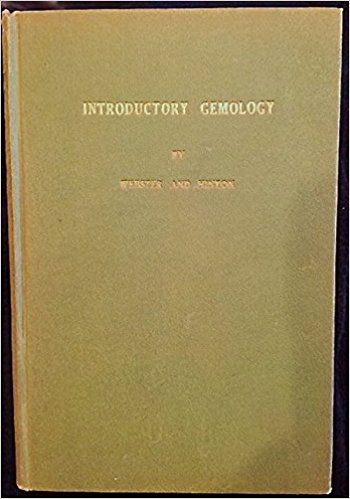
Introductory Gemology

Book
Webster, R. and Hinton, V.V. (1945) Introductory Gemology. Los Angeles, Gemological Institute of America, Vol. 5 , 181 pp.
Record No. 4678  |  Sinkankas/Born No.: 7103  |  RWHL

Inclusions as a means of identification
Journal Article
Gübelin, E.J. (1945–46) Inclusions as a means of identification. Gems & Gemology, Vol. 5, 1945: No. 2, Summer, pp. 226–231 (garnet); No. 3, Fall, pp. 242–247 (garnet); No. 4, Winter, pp. 270–274 (garnet),
Record No. 2029  |  ISBN/ISSN: 0016626X  |  RWHL

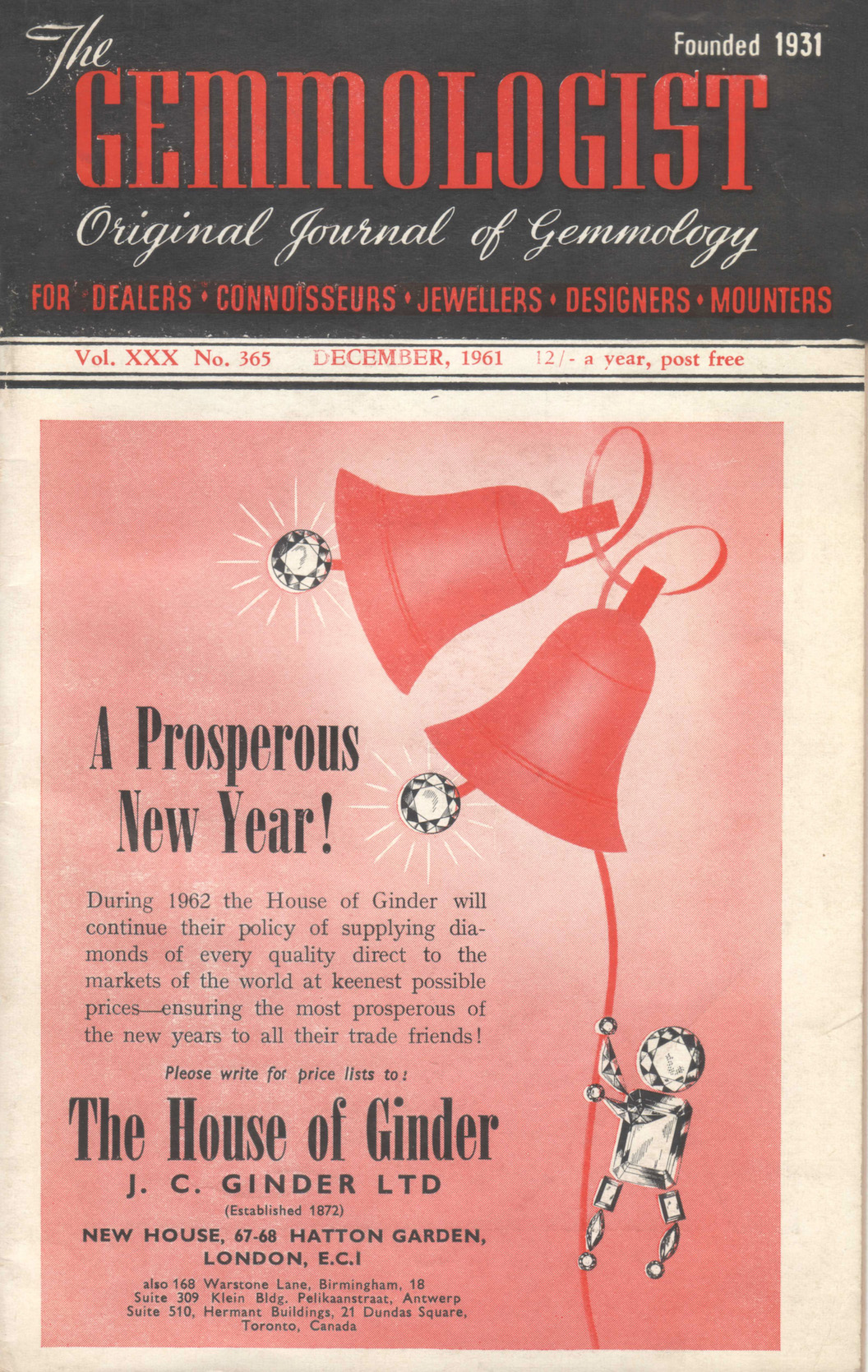
Coral: Its occurrence and collection

Journal Article
Halford-Watkins, J.F. (1944) Coral: Its occurrence and collection. The Gemmologist, Vol. 13, No. 153–155, April, May, June, pp. 39–41, 47, 55.
Record No. 2457  |  RWHL

Building a Gemological Library

Gemological books range from general identification manuals and textbooks to specialized works on individual gems, mineralogy, jewelry, treatments, synthesis, history and gem-producing regions.

For a curated selection of particularly useful books, read The Gemologist's Core Library — Classic Books on Gemology, Jewelry and Mineralogy.

About Four Treasures

Four Treasures is Lotus Gemology's freely accessible gemological reference database. Use the full database to search by author, title or keyword and explore literature on gemology, mineralogy, jewelry and related fields. Where available, hyperlinks on titles may lead directly to the full publication.

Search the Complete Four Treasures Database