Gemology Books Bibliography

Gemology Books Bibliography

Explore books on gems, gemology, jewelry and mineralogy in Four Treasures, the Lotus Gemology reference database. This bibliography brings together matching book records from the collection, with publication details, abstracts and cover images where available.

Gemology Book References

The list below matches books concerning gemology and related subjects in the database's searchable fields. Some works cover several branches of gems, jewelry or mineralogy.
2,701–2,720 of 3,454 matching references

The cleavage in crystals

Journal Article
Halford-Watkins, J.F. (1944) The cleavage in crystals. The Gemmologist, Vol. 13, No. 150, January, pp. 21–22, 24.
Record No. 2456  |  RWHL

Gemstone inclusions

Journal Article
Gübelin, E.J. (1944–46) Gemstone inclusions. Gems & Gemology, Vol. 4–5, Vol. 4, No. 10, Summer, pp. 142–149 (sapphire); No. 11, Fall, pp. 158–163 (ruby); No. 12, Winter, pp. 174–179 (emerald); Vol. 5, No. 1, Spring, pp. 205–210 (diamond); No. 5, Spring, p. 294; No. 6, Summer, pp. 318–323 (various gems).
Record No. 2027  |  ISBN/ISSN: 0016626X  |  RWHL

American-made synthetic crystals

Journal Article
Seemann, A.K. (1944) American-made synthetic crystals. Gems & Gemology, Vol. 4, No. 9, Spring, pp. 129–133.
Record No. 1572  |  ISBN/ISSN: 0016626X  |  RWHL

Medieval American Art

Book
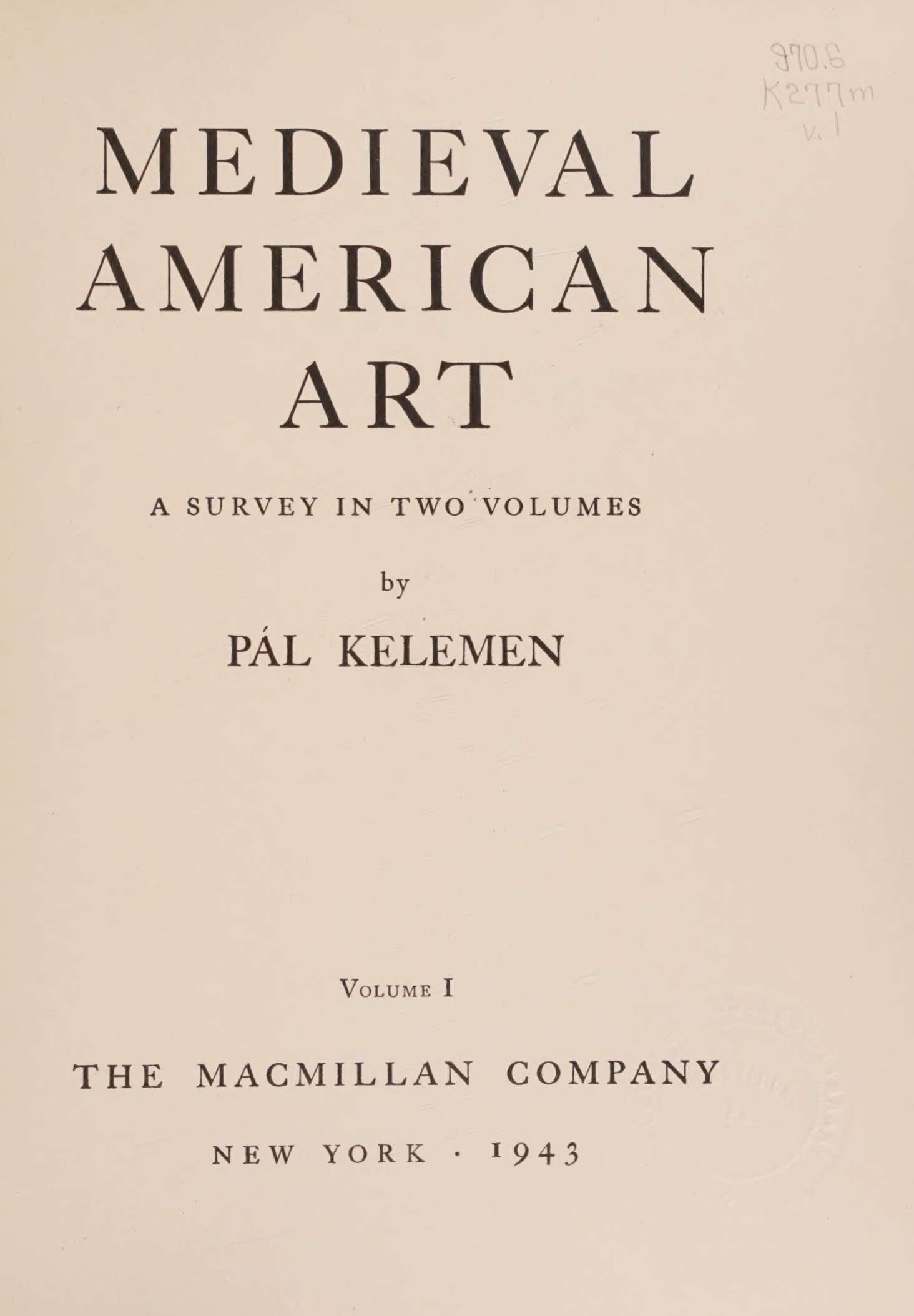
Kelemen, P. (1943) Medieval American Art. New York, Macmillan, 2 Vols., 414, 33 pp., 306 plates
Record No. 28775  |  Sinkankas/Born No.: 3348; NIB  |  RWHL
Sinkankas: Ch. 8, p. 283–311, on “Jade and other semiprecious stones,” with illustrations for the same being in the plates volume, Pls. 235–58 (not seen). Most of this text treats jade, its nature, types, and artistic significance, then describes the many objects depicted according to their artistic merits. Other gemstones are rock crystal, turquoise, obsidian, serpentine, amber, calcite onyx, and cryptocrystalline quartz varieties.

Explorations in the Motagua valley, Guatemala
Journal Article
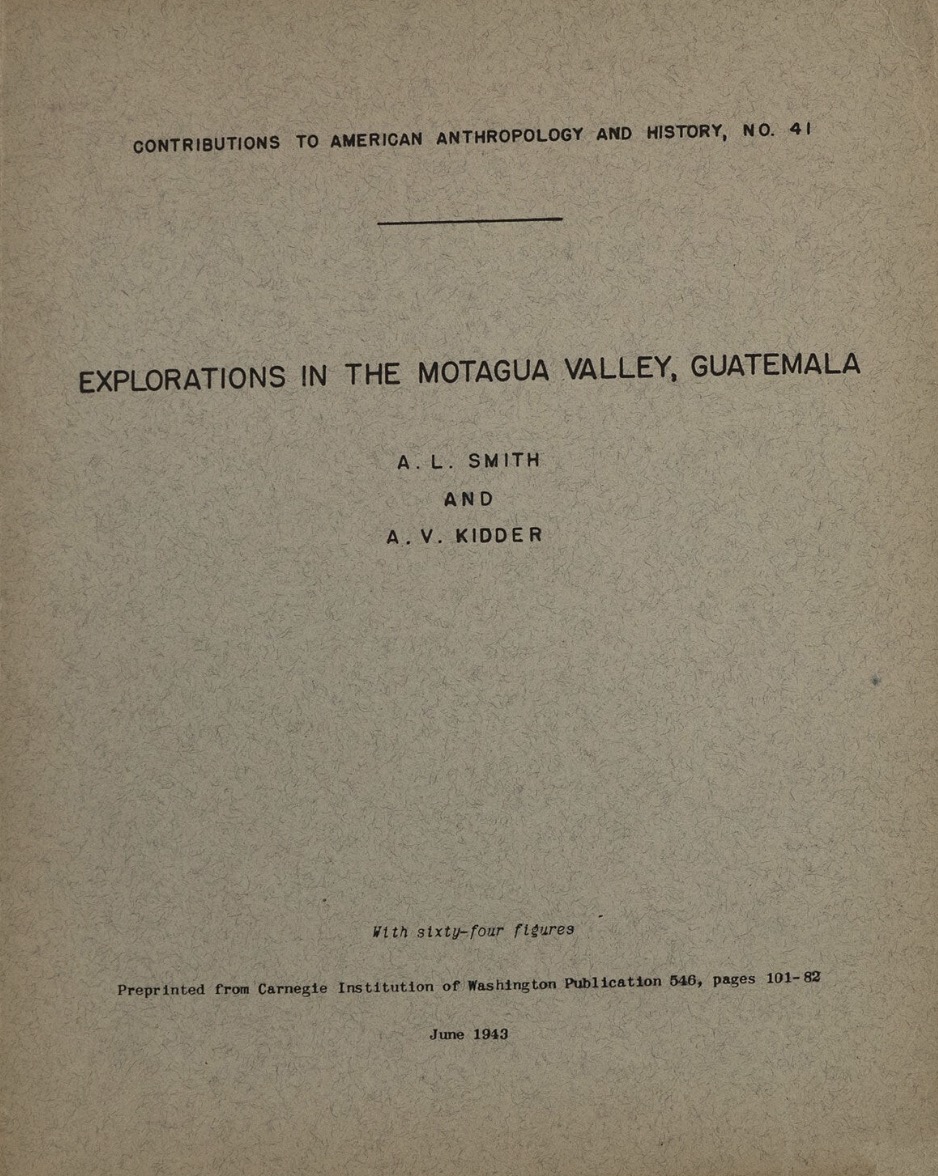
Smith, A.L. and Kidder, A.V. (1943) Explorations in the Motagua valley, Guatemala. American Anthropology and History, Contributions to American Anthropology and History, No. 41, pp. 101–182.
Record No. 28425  |  Sinkankas/Born No.: NIS/NIB  |  RWHL

Survey of the genesis of gem stones

Journal Article
Gübelin, E.J. (1943) Survey of the genesis of gem stones. Gems & Gemology, Vol. 4, No. 8, Winter, pp. 110–113.
Record No. 2022  |  ISBN/ISSN: 0016626X  |  RWHL

The chemical compounds of some liquid inclusions
Journal Article
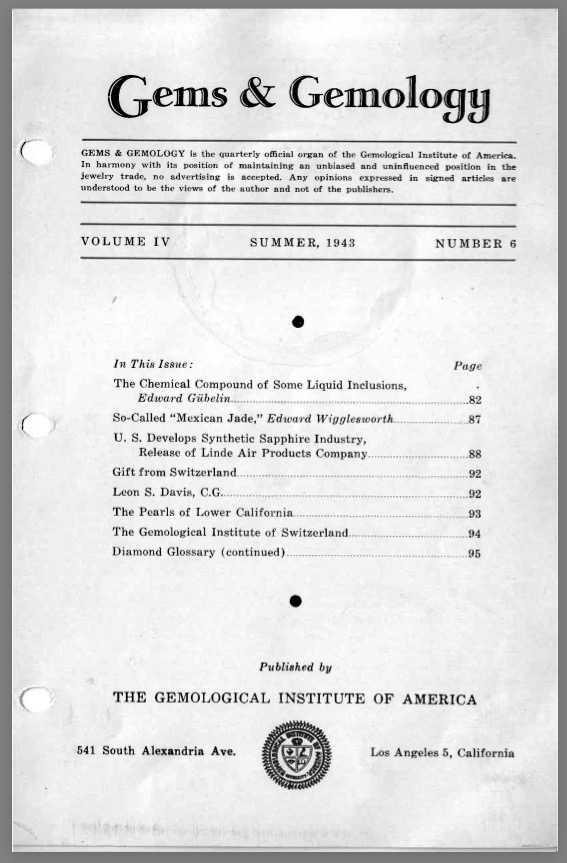
Gübelin, E.J. (1943) The chemical compounds of some liquid inclusions. Gems & Gemology, Vol. 4, No. 6, Summer, pp. 82–86; No. 7, Fall, pp. 98–100.
Record No. 2021  |  ISBN/ISSN: 0016626X  |  RWHL

U.S. develops synthetic sapphire industry
Journal Article
Linde Air Products Co. (1943) U.S. develops synthetic sapphire industry. Gems & Gemology, Vol. 4, No. 6, Summer, pp. 88–91.
Record No. 1192  |  ISBN/ISSN: 0016626X  |  RWHL

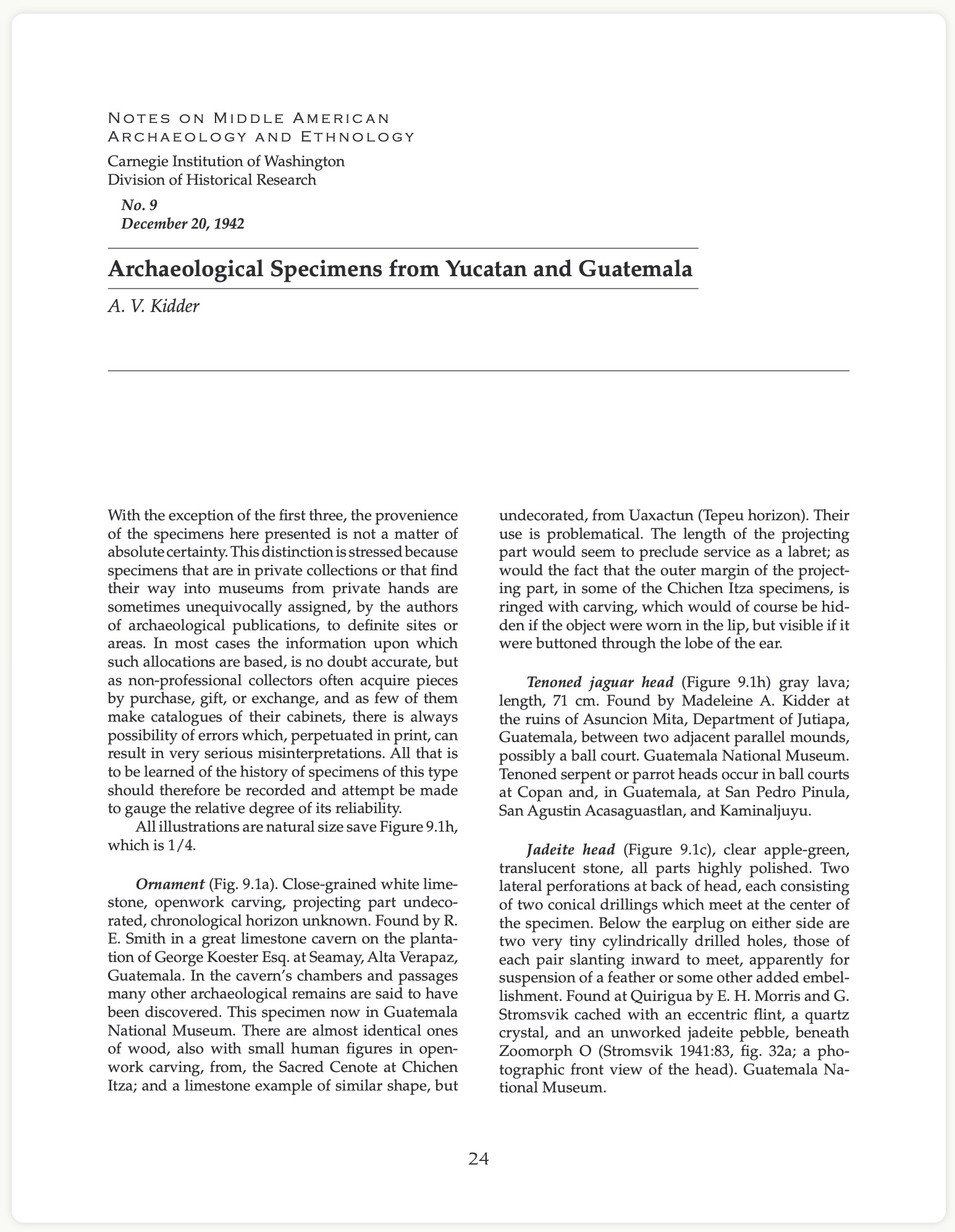
Archaeological specimens from Yucatan and Guatemala
Journal Article
Kidder, A.V. (1942) Archaeological specimens from Yucatan and Guatemala. Notes on Middle American Archaeology and Ethnology, December 20, pp. 24–27.
Record No. 28610  |  Sinkankas/Born No.: NIS/NIB  |  RWHL
With the exception of the first three, the provenience of the specimens here presented is not a matter of absolute certainty. This distinction is stressed because specimens that are in private collections or that find their way into museums from private hands are sometimes unequivocally assigned, by the authors of archaeological publications, to definite sites or areas. In most cases the information upon which such allocations are based, is no doubt accurate, but as non-professional collectors often acquire pieces by purchase, gift, or exchange, and as few of them make catalogues of their cabinets, there is always possibility of errors...

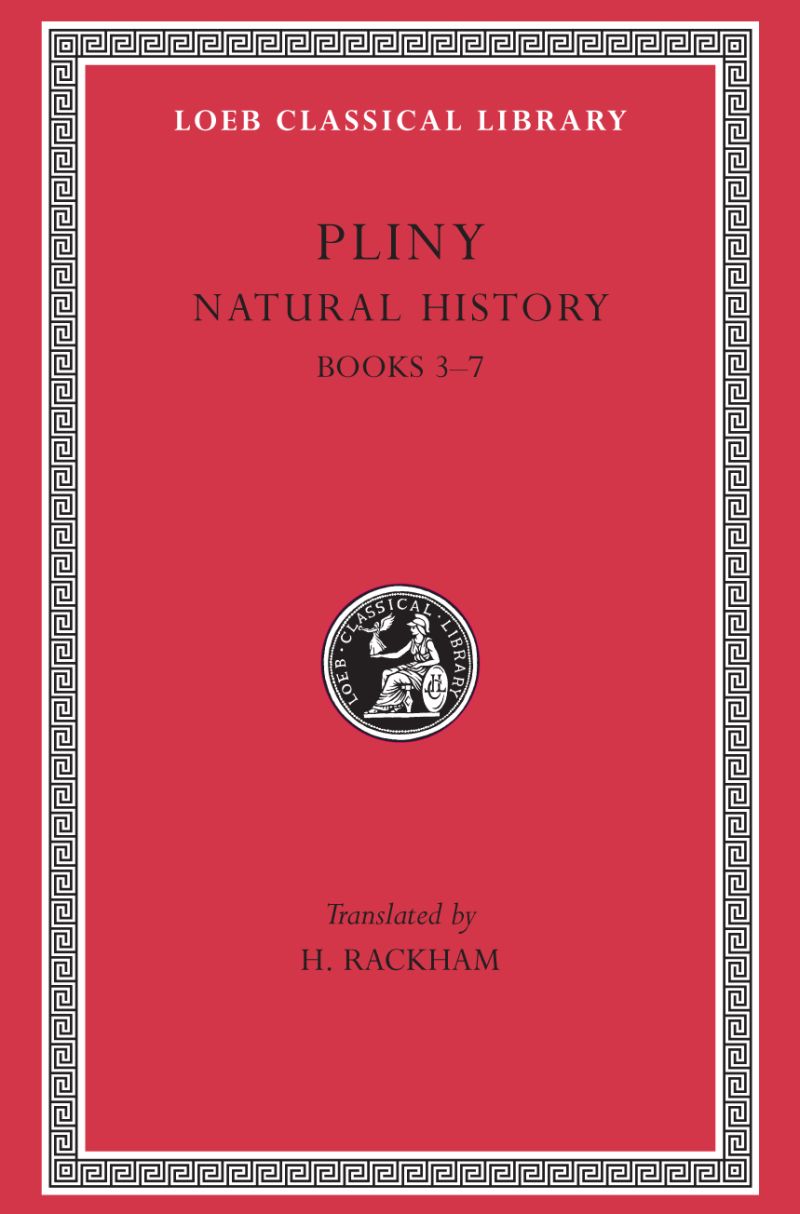
Natural History, Books 3–7

Book
Rackham, H. and Pliny the Elder (1942) Natural History, Books 3–7. Cambridge, MA, Harvard University Press, 10 Volumes, 37 Books, Vol. 2 , 664 pp.
Record No. 17189  |  Sinkankas/Born No.: NIS/NIB  |  Language: parallel Latin and English texts  |  RWHL
Rackham’s Loeb Classical Library edition presents Books 3–7 of Pliny the Elder’s Natural History in parallel Latin and English texts. These books comprise Pliny’s geographical and ethnographical survey of the known world: Books 3–6 describe Europe, Africa, and Asia, including the Mediterranean lands, the Near East, India, and regions beyond, while Book 7 turns to humanity, discussing human characteristics, unusual peoples, remarkable births, longevity, exceptional physical and intellectual abilities, inventions, and other notable features of human life. Pliny draws extensively upon earlier Greek and Roman authorities, travelers, administrators, and geographical writings, preserving a large body of ancient geographical and ethnographic information, often intermingled with reports of marvels and fabulous peoples. For the history of gems and precious materials, these books provide geographical context for the regions from which luxury goods and mineral products reached the Roman world, although Pliny’s systematic treatment of stones and gemstones occurs later in Book 37.

Ancient mining processes as illustrated by a Japanese scroll
Journal Article
Bromehead, C.E.N. (1942) Ancient mining processes as illustrated by a Japanese scroll. Antiquity, Vol. 16, No. 63, pp. 193–207.
Record No. 17130  |  DOI: https://doi.org/10.1017/S0003598X00017695  |  RWHL
In the Geographical journal for August 1940 I published a brief summary of the ‘Evidence for Ancient Mining’, one illustration for which was taken from a Japanese colour-print by Hiroshigi of the interior of a gold mine. As a result of reading this article, Dr H. J. Osborne White, a well-known geologist, sent me the scroll which forms the subject of the present paper. It is about 22 feet long and I foot broad and illustrates, in a series of attractively coloured drawings, every process from the extraction of gold-ore in the mine on Sado Island to the minting of refined gold. Mr Matsumoto of the Japanese Embassy kindly examined the scroll and was able to translate most of the captions to the pictures and other writings. Though the archaic script sometimes puzzled him, the fact that his family had been connected with mining for several generations was a compensating advantage.

Chatoyant phenomena – II

Journal Article
Halford-Watkins, J.F. (1942) Chatoyant phenomena – II. The Gemmologist, Vol. 12, No. 136, November, pp. 13–15.
Record No. 2454  |  RWHL

Chatoyant phenomena

Journal Article
Halford-Watkins, J.F. (1942) Chatoyant phenomena. The Gemmologist, Vol. 12, No. 135, October, pp. 9–10.
Record No. 2453  |  RWHL

Local peculiarities of sapphires

Journal Article
Gübelin, E.J. (1942–43) Local peculiarities of sapphires. Gems & Gemology, Vol. 4, No. 3, Fall, pp. 34–39; No. 4, Winter, pp. 50–54; No. 5, Spring, pp. 66–69.
Record No. 877  |  ISBN/ISSN: 0016626X  |  RWHL

Genuine type inclusions in new European synthetics
Journal Article
Gübelin, E.J. (1942) Genuine type inclusions in new European synthetics. Gems & Gemology, Vol. 4, No. 2, Summer, pp. 18–21.
Record No. 876  |  ISBN/ISSN: 0016626X  |  RWHL

The apocrypha and Chaucer's House of Fame
Journal Article
Henkin, L.J. (1941) The apocrypha and Chaucer's House of Fame. Modern Language Notes, Vol. 56, No. 8, pp. 583–588.
Record No. 27951  |  ISBN/ISSN: 1496611  |  DOI: https://doi.org/10.2307/2911154  |  Sinkankas/Born No.: NIS/NIB  |  RWHL
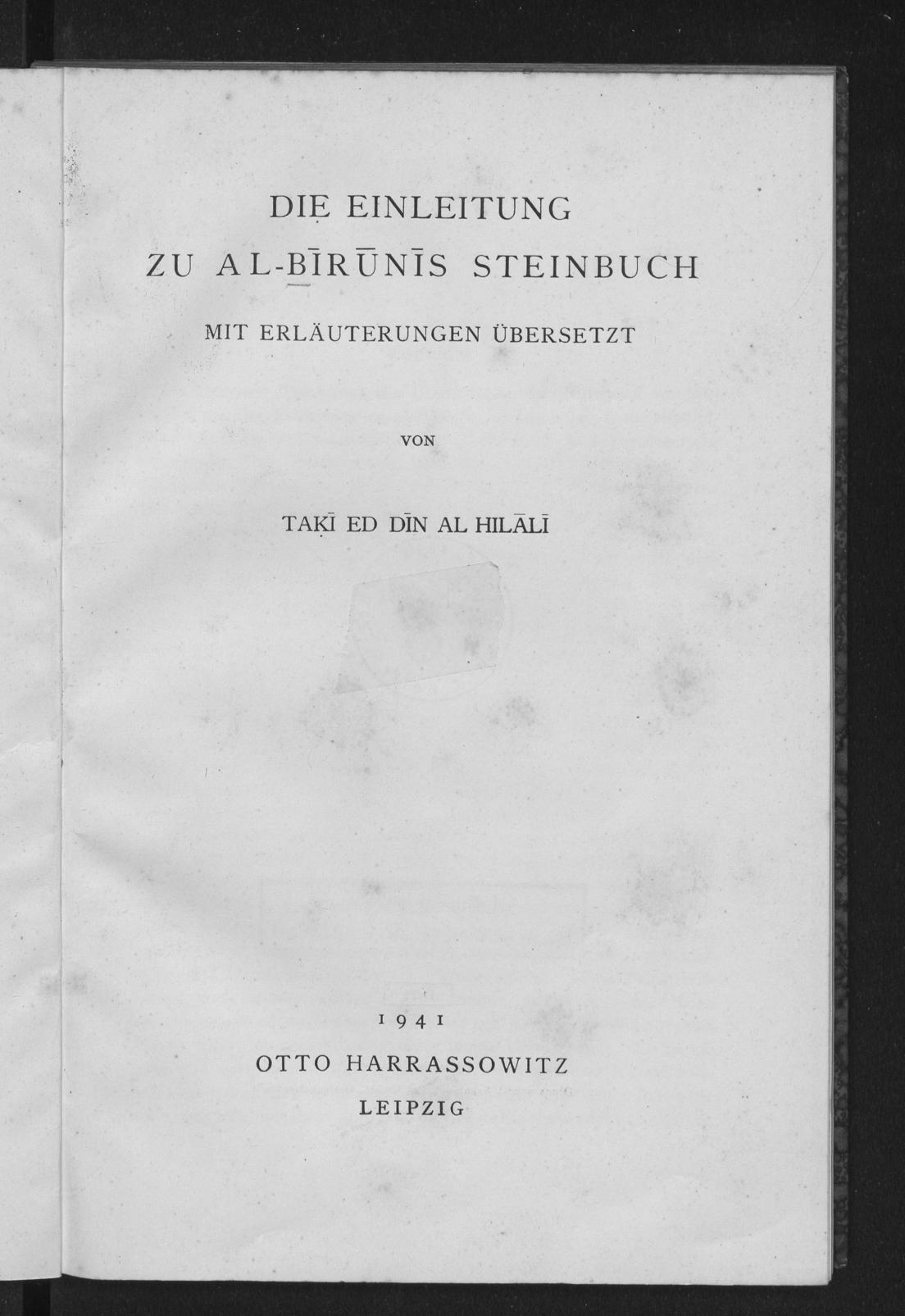
To the long-established list of analogues to Chaucer’s House of Fame, I propose still another: the apocalyptic vision of St. John in the New Testament. Though largely lacking in direct verbal similarities, the Revelation of St. John presents numerous compelling parallels that cannot be dismissed as mere coincidence. The sparse details from Ovid, Vergil, and Boethius are acknowledged to fall short of accounting for the grandeur of Chaucer’s portrayal of Lady Fame in Book III. Rambeau’s argument that Chaucer modeled his goddess on the Virgin Mary as depicted in Dante’s heaven is unconvincing, given how scattered and dissimilar the cited resemblances are. Cummings has thoroughly refuted the identifications by Koeppel and Child of Chaucer’s Fame with the Gloria del popolo mondano in Boccaccio’s Amorosa Visione. Evidence from the poem itself supports the view that Chaucer had the vision of St. John in mind when composing the palace of Fame. In describing the enthroned goddess, Chaucer draws on Vergil’s image of the many-eyed deity (Aeneid IV, 180–183), a detail that recalls the Revelation’s account (IV.6) of the four beasts “full of eyes before and behind,” which Chaucer explicitly references: “the bestes foure / That Goddes trone gunne honoure / As John writ in th’ Apocalips” (House of Fame, 1384–85).

Die Einleitung zu al-Bīrūnīs Steinbuch: mit Erläuterungen übersetzt
Introduction To Al-Biruni's Stone Book
Book
al-Hilālī, T.e.-D. (1941) Die Einleitung zu al-Bīrūnīs Steinbuch: mit Erläuterungen übersetzt. [Introduction To Al-Biruni's Stone Book] Leipzig, Otto Harrassowitz, 41 pp.
Record No. 4571  |  Sinkankas/Born No.: NIS/NIB  |  Language: in German  |  RWHL
Al-Hilālī presents a German translation, with explanatory notes, of the introduction to al-Bīrūnī’s Kitāb al-Jamāhir fī maʿrifat al-jawāhir (Book of the Multitudes on the Knowledge of Precious Stones), al-Bīrūnī’s major work on gemstones, minerals, and related substances. The introduction sets out al-Bīrūnī’s conception of wealth and precious materials and the principles underlying his treatment of stones and metals, placing their desirability and value within a broader discussion of human needs, luxury, exchange, and the social use of valuable objects. Al-Hilālī supplies philological and explanatory commentary intended to clarify al-Bīrūnī’s terminology and references. The work originated as al-Hilālī’s doctoral dissertation and provides an important German-language study and translation of the introductory portion of one of the principal medieval Islamic sources on gemology and mineralogy.

More about asterism

Journal Article
Halford-Watkins, J.F. (1941) More about asterism. The Gemmologist, Vol. 11, No. 125, December, p. 34.
Record No. 2452  |  RWHL

Chalcedony

Journal Article
Halford-Watkins, J.F. (1941) Chalcedony. The Gemmologist, Vol. 10, No. 118, May, pp. 88–91.
Record No. 2451  |  RWHL

Fusibility of gemstones

Journal Article
Halford-Watkins, J.F. (1941) Fusibility of gemstones. The Gemmologist, Vol. 10, No. 115, February, pp. 67–68.
Record No. 2450  |  RWHL

Building a Gemological Library

Gemological books range from general identification manuals and textbooks to specialized works on individual gems, mineralogy, jewelry, treatments, synthesis, history and gem-producing regions.

For a curated selection of particularly useful books, read The Gemologist's Core Library — Classic Books on Gemology, Jewelry and Mineralogy.

About Four Treasures

Four Treasures is Lotus Gemology's freely accessible gemological reference database. Use the full database to search by author, title or keyword and explore literature on gemology, mineralogy, jewelry and related fields. Where available, hyperlinks on titles may lead directly to the full publication.

Search the Complete Four Treasures Database