Gemology Books Bibliography

Gemology Books Bibliography

Explore books on gems, gemology, jewelry and mineralogy in Four Treasures, the Lotus Gemology reference database. This bibliography brings together matching book records from the collection, with publication details, abstracts and cover images where available.

Gemology Book References

The list below matches books concerning gemology and related subjects in the database's searchable fields. Some works cover several branches of gems, jewelry or mineralogy.
2,721–2,740 of 3,454 matching references

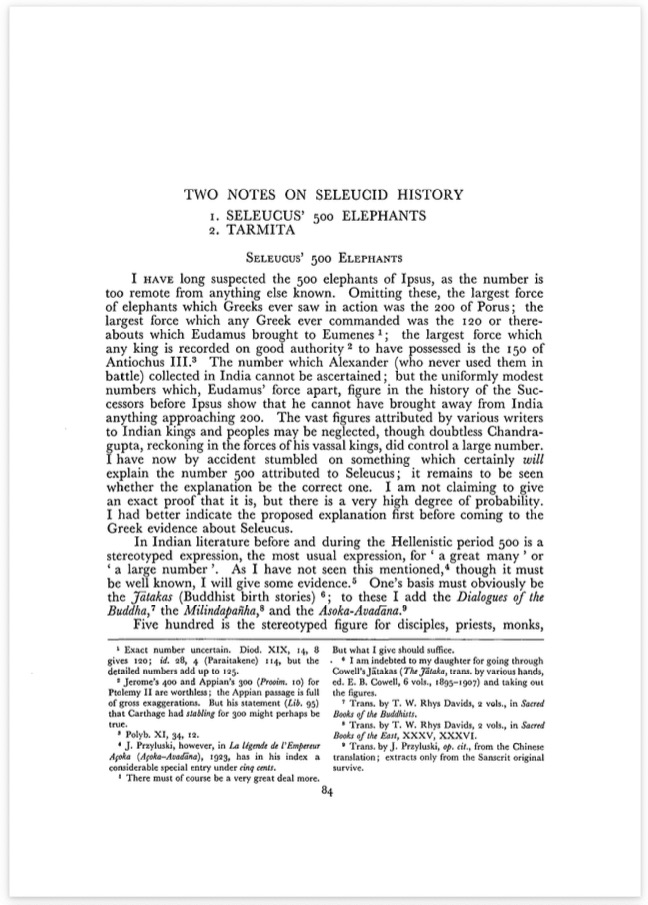
Two notes on Seleucid history: 1. Seleucus’ 500 Elephants, 2. Tarmita
Journal Article
Tarn, W.W. (1940) Two notes on Seleucid history: 1. Seleucus’ 500 Elephants, 2. Tarmita. Journal of Hellenic Studies,
Record No. 27267  |  DOI: https://doi.org/10.2307/626263  |  Sinkankas/Born No.: NIS/NIB  |  RWHL
Megasthenes likely served as the original Greek source for the figure of 500 elephants given by Chandragupta to Seleucus, which became a significant number in historical accounts despite its uncertain origins. “I have long suspected the 500 elephants of Ipsus, as the number is too remote from anything else known. Omitting these, the largest force of elephants which Greeks ever saw in action was the 200 of Porus; the largest force which any Greek ever commanded was the 120 or thereabouts which Eudamus brought to Eumenes; the largest force which any king is recorded on good authority to have possessed is the 150 of Antiochus III. The number which Alexander (who never used them in battle) collected in India cannot be ascertained; but the uniformly modest numbers which, Eudamus’ force apart, figure in the history of the Successors before Ipsus show that he cannot have brought away from India anything approaching 200. The vast figures attributed by various writers to Indian kings and peoples may be neglected, though doubtless Chandragupta, reckoning in the forces of his vassal kings, did control a large number. I have now by accident stumbled on something which certainly will explain the number 500 attributed to Seleucus; it remains to be seen whether the explanation be the correct one. I am not claiming to give an exact proof that it is, but there is a very high degree of probability. I had better indicate the proposed explanation first before coming to the Greek evidence about Seleucus.”

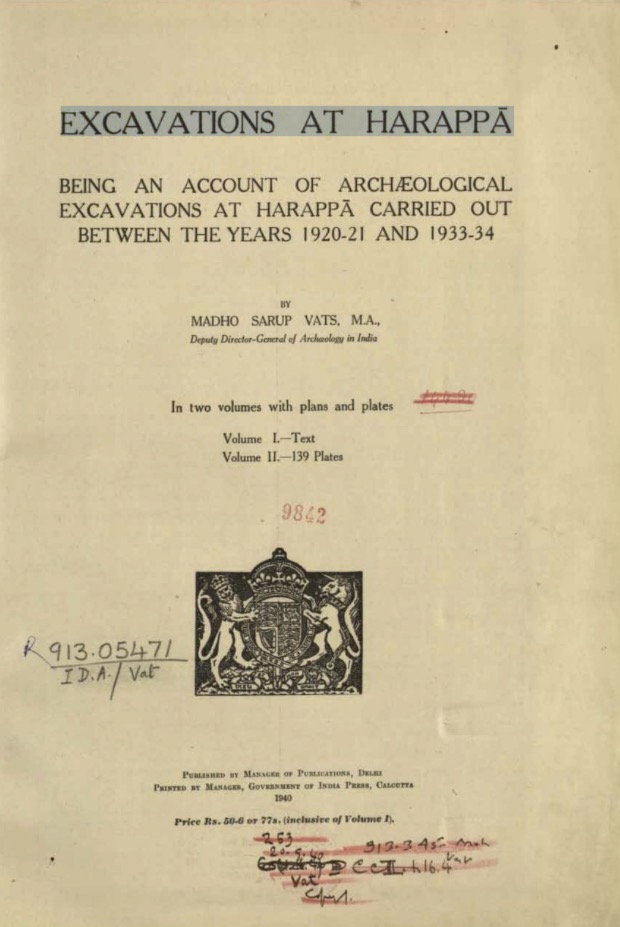
Excavations at Harappa | Being an Account of Archaeological Excavations at Harappa carried out between the Years 1920–21 and 1933–34
Book
Vats, M.S. (1940) Excavations at Harappa | Being an Account of Archaeological Excavations at Harappa carried out between the Years 1920–21 and 1933–34. Delhi, Government of India Press, 2 Vols., 288 pp., 139 plates
Record No. 26991  |  Sinkankas/Born No.: NIS/NIB  |  RWHL
The excavations at Harappa described in this Volume were carried out between the years 1920–21 and 1933–34. Being one of the two best known and important sites of the Indus Valley Culture, large scale work was undertaken here by the Archæological Department and the excavations have contributed not a little to our knowledge of the prehistoric civilization of India. On account of the close relation and mutual dependence of the discoveries made at Harappa and Mohenjo-daro, this monograph has been planned as a complement to the three* monumental volumes on Mohenjo-daro and the Indus Civilization edited by Sir John Marshall and the two volumes of Further Excavations at Mohenjo-daro by Dr. E. J. H. Mackay. The arrangement of Chapters and Plates follows the former work as far as possible. In Mohenjo-daro and the Indus Civilization, Sir John Marshall has most ably dealt with the Art, Religion, Disposal of the Dead, Extent and the Age and Authors of the Indus Civilization mainly on the basis of the discoveries made at the above two sites, while Dr. Mackay has fully described and illustrated numerous finds, mostly identical with those of Harappa — notably Plain and Painted Pottery and other experts have written on the Indus Script, System of Weights, Minerals and Metals, etc. To that extent, not only has it been possible for me to avoid much needless duplication and to curtail my own work, but what is more, I have derived infinite help and guidance from their masterly handling of so many difficult problems for which I am greatly beholden to them all. To Sir John Marshall I owe a very special and infinite debt of gratitude not only for the thorough guidance and inspiration I received from his great work and the instructions given by him from time to time both in the conduct of excavations and for the preparation of these volumes, but also for the very great trouble he generously undertook (at the sacrifice of much valuable time when he was fully occupied with several pressing works of his own) in preliminarily editing my work, in course of which he made numerous corrections and many valuable suggestions which I have gratefully incorporated.

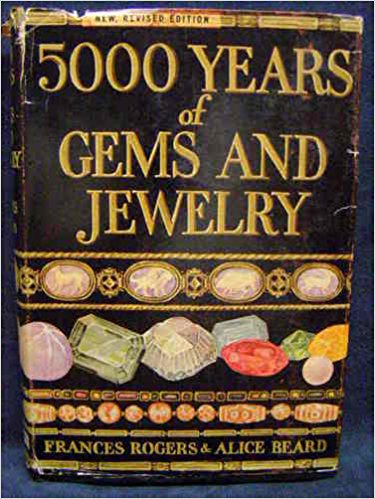
5000 Years of Gems and Jewelry

Book
Rogers, F. and Beard, A. (1940) 5000 Years of Gems and Jewelry. New York, Frederick A. Stokes, 309 pp.
Record No. 4644  |  Sinkankas/Born No.: 5517  |  RWHL
The authors, having written on other applied arts subjects, do not pretend to be experts in gemology, but as the present work indicates, they have been careful in their research, discriminating in their choice of material, and accurate in its paraphrasing. For these reasons, this work has retained a high esteem and remains a useful reference today. The text is in three parts, the first devoted to the history of jewelry in its many manifestations throughout the ages, but prefaced by a short chapter on the fascination of gemstones, and elsewhere in the text imparting considerable information on engraved gems, rings, and ringstones. However, the concentration of gemological material is in the last two parts, wherein gemstone properties, crystals, imperfections, falsifications, and other topics are briefly treated, followed by descriptions of gemstones in the categories of precious, semi-precious, quartz gems, and ornamental stones, and also “marine” gems—here referring to pearl, coral, but also to amber and jet. The appendices provide a tabular overview of gemstones and their characteristics, a list of birthstones, and the bibliography. Most plates depict items of jewelry. Reviewed G & G, 3, 9, 1941, 138.

Differentiation between Russian and Colombian emerald
Journal Article
Gübelin, E.J. (1940) Differentiation between Russian and Colombian emerald. Gems & Gemology, Vol. 3, No. 6, Summer, pp. 89–92.
Record No. 2018  |  ISBN/ISSN: 0016626X  |  RWHL

Characteristics of Ceylon rubies

Journal Article
Gübelin, E.J. (1940) Characteristics of Ceylon rubies. Gems & Gemology, Vol. 3, No. 8, Winter, pp. 121–124.
Record No. 2017  |  ISBN/ISSN: 0016626X  |  RWHL

Pre-Columbian jades

Journal Article
Kelemen, P. (1939) Pre-Columbian jades. Parnassus, Vol. 11, No. 4, pp. 4–10.
Record No. 28321  |  DOI: https://doi.org/10.2307/771622  |  Sinkankas/Born No.: NIS/NIB  |  RWHL
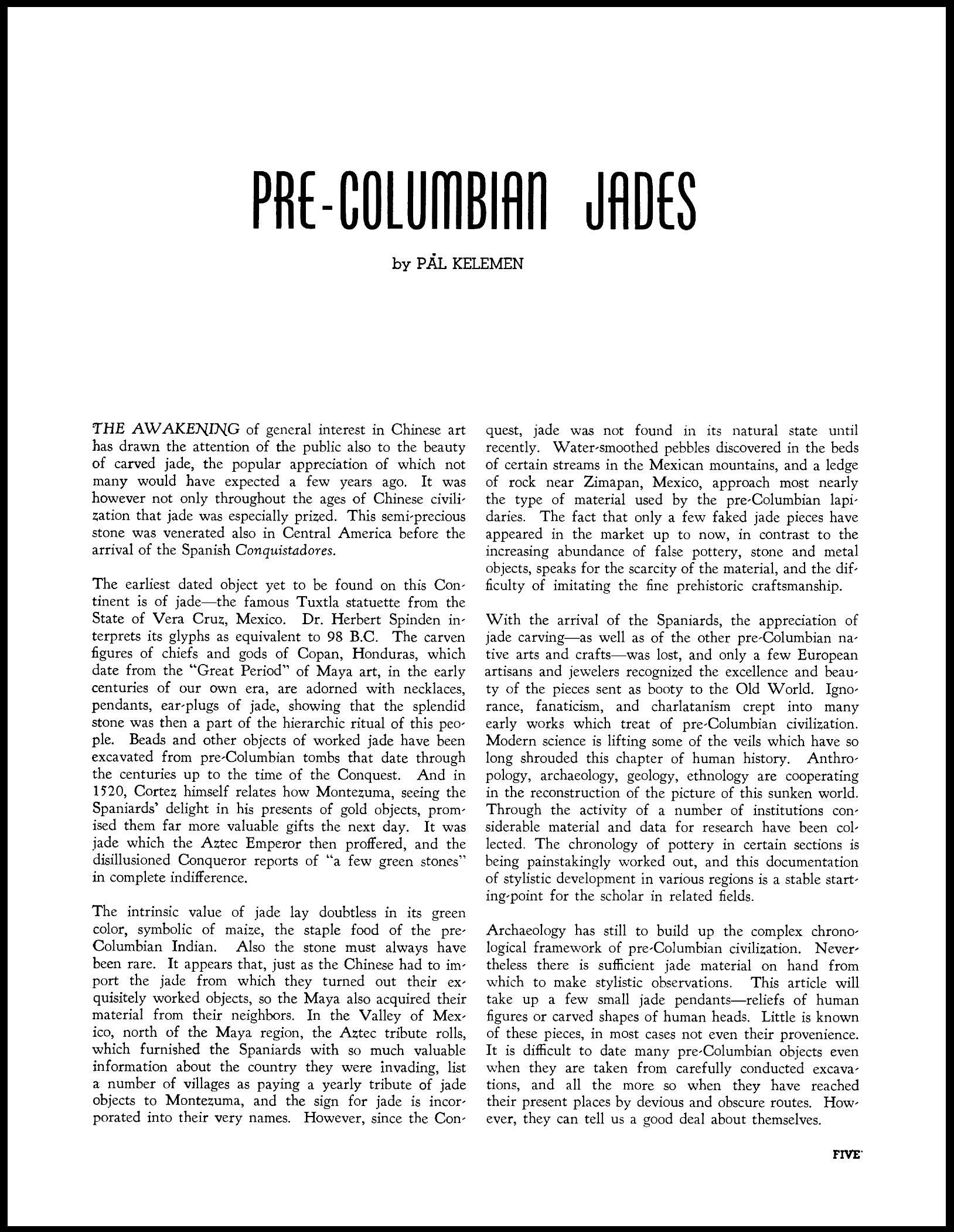
The awakening of general interest in Chinese art has drawn the attention of the public also to the beauty of carved jade, the popular appreciation of which not many would have expected a few years ago. It was, however, not only throughout the ages of Chinese civilization that jade was especially prized. This semi-precious stone was venerated also in Central America before the arrival of the Spanish Conquistadores. The earliest dated object yet to be found on this continent is of jade—the famous Tuxtla statuette from the State of Vera Cruz, Mexico. Dr. Herbert Spinden interprets its glyphs as equivalent to 98 B.C. The carven figures of chiefs and gods of Copán, Honduras, which date from the “Great Period” of Maya art, in the early centuries of our own era, are adorned with necklaces, pendants, and ear-plugs of jade, showing that the splendid stone was then a part of the hierarchic ritual of this people. Beads and other objects of worked jade have been excavated from pre-Columbian tombs that date through the centuries up to the time of the Conquest. And in 1520, Cortés himself relates how Montezuma, seeing the Spaniards’ delight in his presents of gold objects, promised them far more valuable gifts the next day. It was jade which the Aztec Emperor then proffered, and the disillusioned Conqueror reports of “a few green stones” in complete indifference.

The interference of light

Journal Article
Halford-Watkins, J.F. (1939) The interference of light. The Gemmologist, Vol. 8, No. 96, July, pp. 193–196.
Record No. 2449  |  RWHL

The hardness of gems

Journal Article
Halford-Watkins, J.F. (1939) The hardness of gems. The Gemmologist, Vol. 8, No. 95, June, pp. 182–185.
Record No. 2448  |  RWHL

Polarised light: Its production and uses in gemmology
Journal Article
Halford-Watkins, J.F. (1939) Polarised light: Its production and uses in gemmology. The Gemmologist, Vol. 8, No. 92, January, pp. 131–137.
Record No. 2447  |  RWHL

Gemming in Ceylon

Journal Article
Ratnavira, H.V.S. (1939) Gemming in Ceylon. Gems & Gemology, Vol. 3, No. 4, Winter, pp. 51–52.
Record No. 1464  |  ISBN/ISSN: 0016626X  |  RWHL

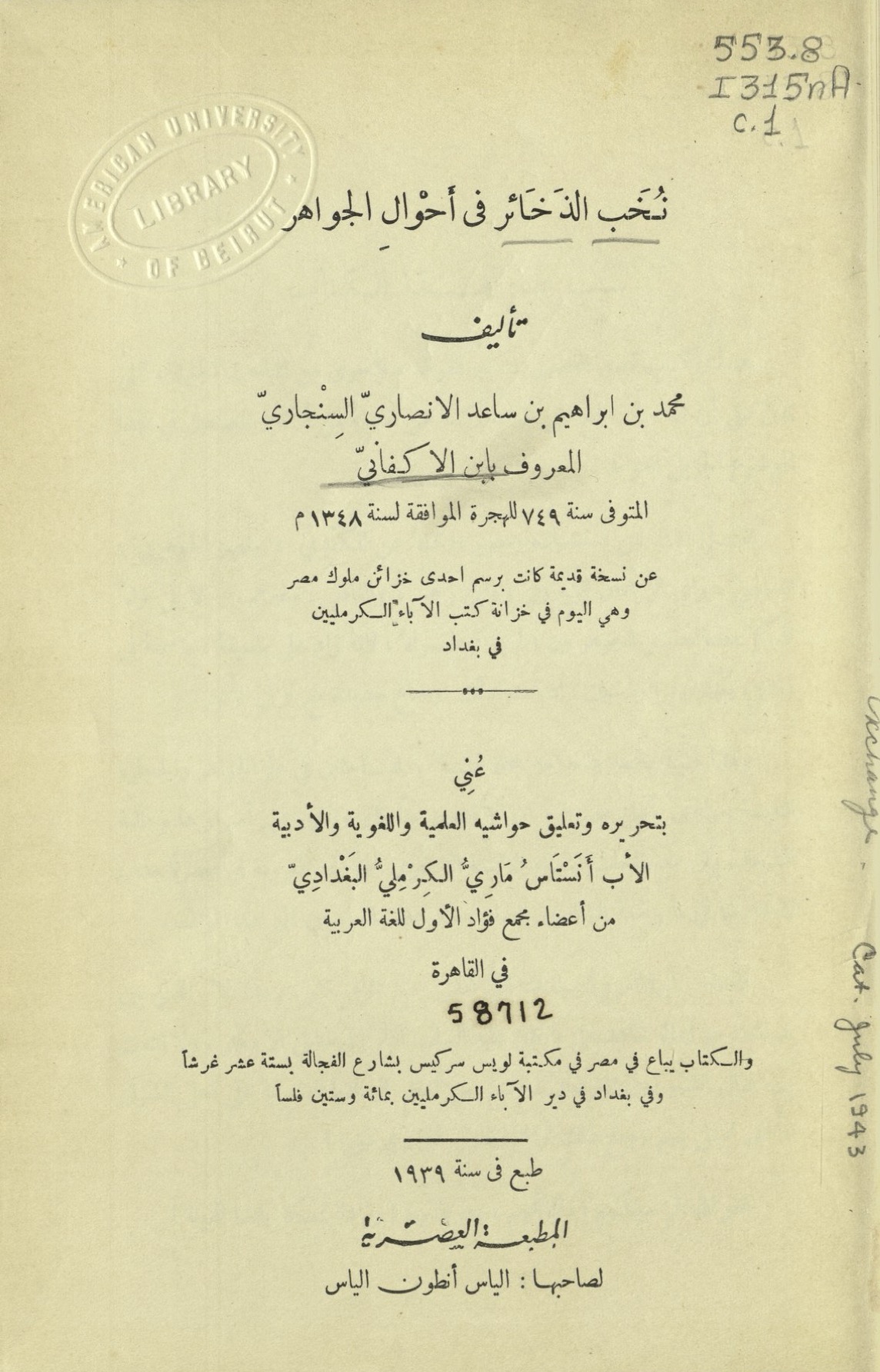
The Choice of Treasures on the Conditions of Gemstones
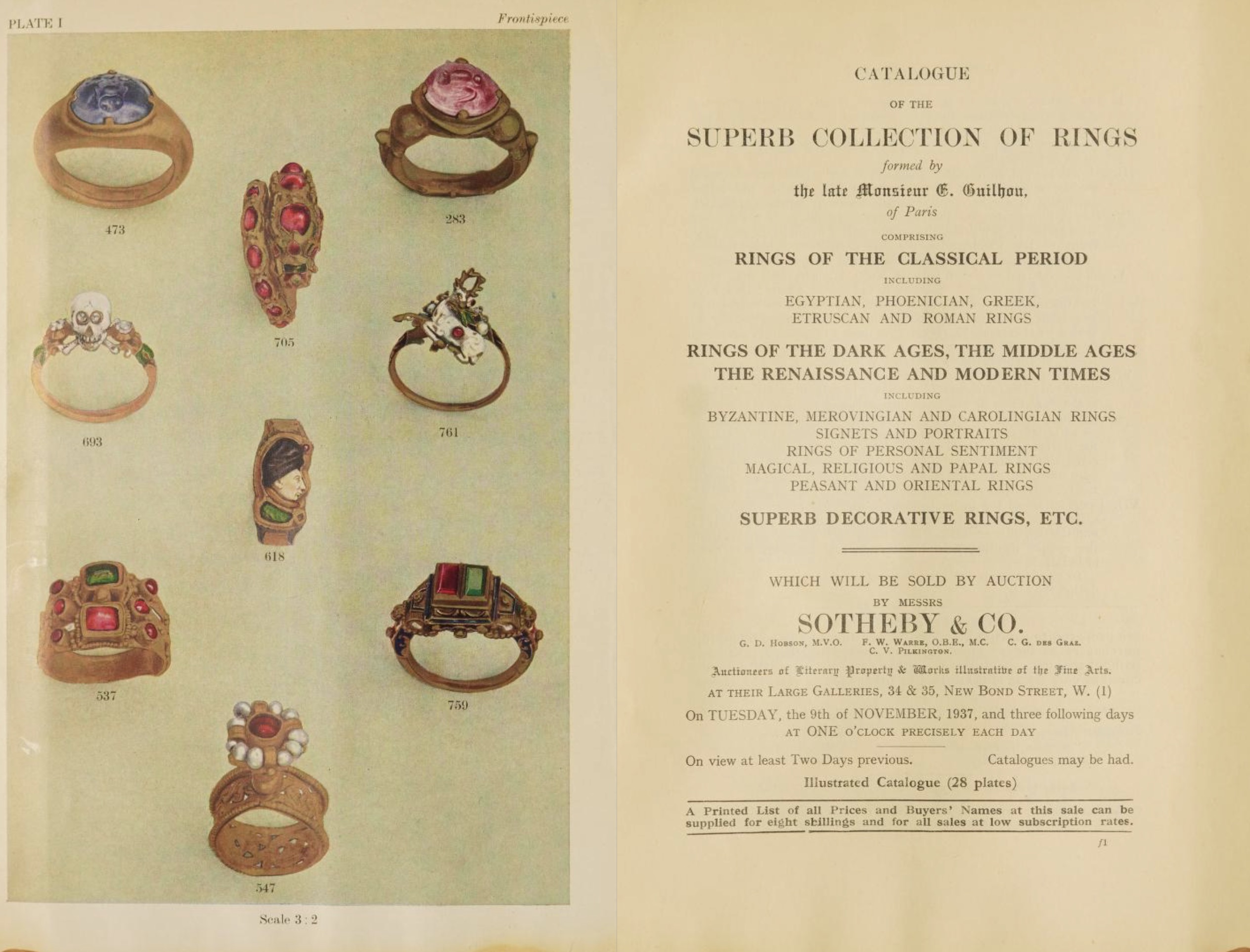
Nukhab al-dhakhair fi ahwal al-jawahir
Book
Ibn al-Akfānī, M.i.M.i.a.-ʿ. (1939) The Choice of Treasures on the Conditions of Gemstones. [Nukhab al-dhakhair fi ahwal al-jawahir] [al-Qahirah], al-Matbaah al-Asriyah, 188 pp.
Record No. 221  |  Sinkankas/Born No.: NIS/NIB  |  Language: in Arabic  |  RWHL
Ibn al-Akfānī presents a concise medieval Arabic treatise on precious stones, summarizing earlier authorities while adding observations of his own. He treats ruby (yāqūt), balas ruby, garnet, diamond, pearl, emerald, peridot, turquoise, rock crystal, agate, malachite, jasper, bezoar, and other materials, describing their varieties, colors and qualities, principal sources, methods of testing and working, relative values, and reputed medicinal or talismanic properties. Commercial information is particularly valuable, including distinctions of quality and contemporary systems of valuation; diamonds are also discussed as tools for drilling other gemstones. Although traditional lore is repeated, Ibn al-Akfānī sometimes tests inherited claims critically—for example, he reports experimenting with the supposed effect of emerald on snakes and finding it untrue. The work thus combines mineralogical and gemological observation, trade knowledge, lapidary practice, medicine, and traditional stone lore, providing an important account of gemstone knowledge and commerce in the fourteenth-century Islamic world.

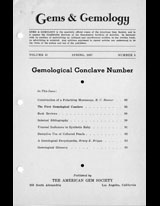
Catalogue of the Superb Collection of Rings formed by the late Monsieur G. Guilhou
Book
Sotheby's (1937) Catalogue of the Superb Collection of Rings formed by the late Monsieur G. Guilhou. London, Sotheby & Co., 178 pp., 28 plates
Record No. 28826  |  Sinkankas/Born No.: NIS/NIB  |  RWHL
Rings of the classical period; rings of the Dark Ages, the Middle Ages, the Renaissance and modern times; superb decorative rings.

Unusual inclusions in synthetic ruby

Journal Article
Anonymous (1937) Unusual inclusions in synthetic ruby. Gems & Gemology, Vol. 2, No. 5, Spring, pp. 91–92.
Record No. 277  |  ISBN/ISSN: 0016626X  |  RWHL

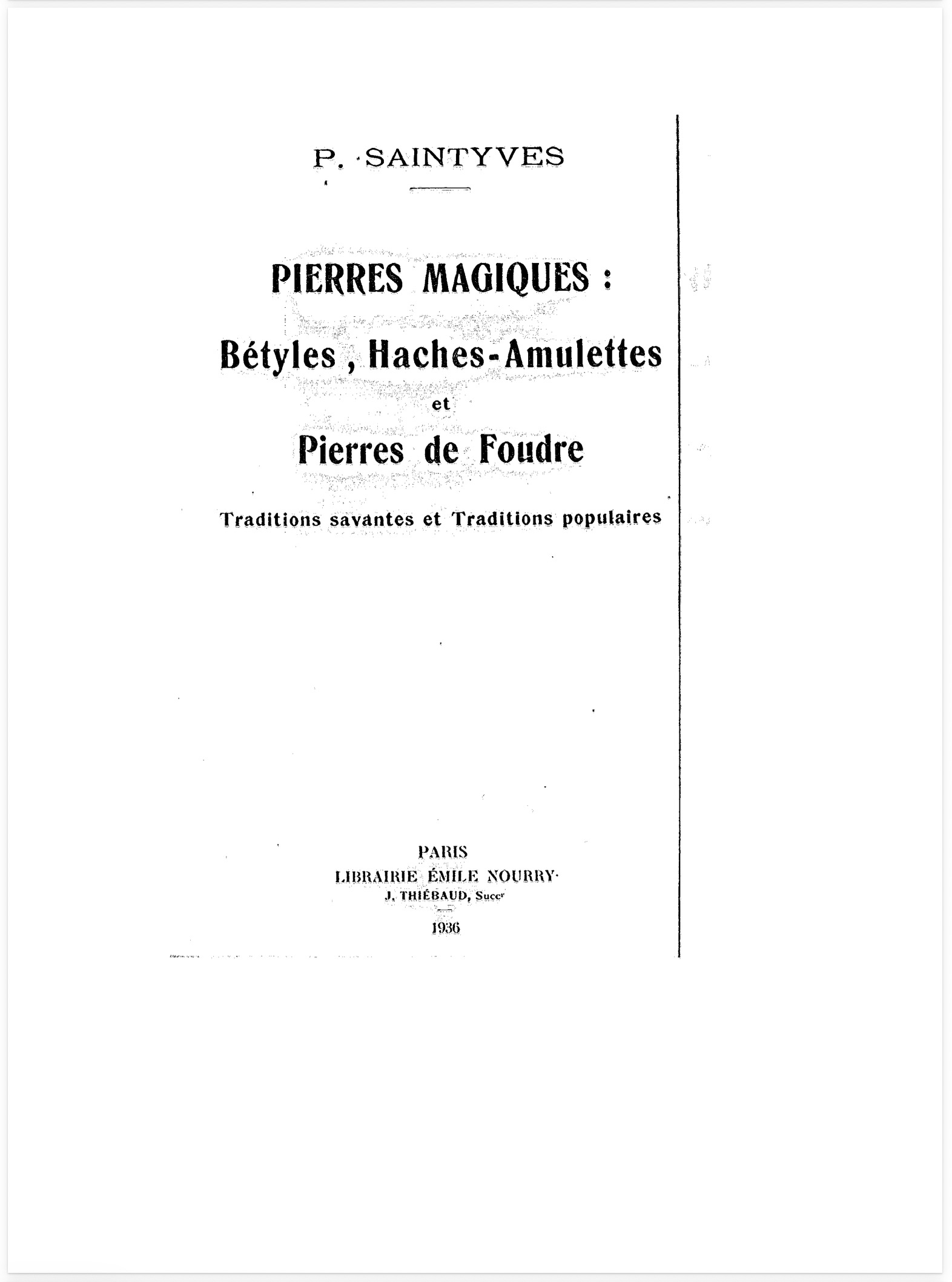
Pierres magiques: Bétyles, haches-amulettes et pierres de foudre : traditions savantes et traditions populaires
Magic Stones: Betyls, Amulet Axes, and Thunderstones: Learned Traditions and Popular Traditions
Book
Saintyves, P. (1936) Pierres magiques: Bétyles, haches-amulettes et pierres de foudre : traditions savantes et traditions populaires. [Magic Stones: Betyls, Amulet Axes, and Thunderstones: Learned Traditions and Popular Traditions] Paris, J. Thiébaud, 296 pp.
Record No. 28738  |  Sinkankas/Born No.: 5692 (not seen); NIB  |  Language: in French  |  RWHL
Belief in thunderstones left no trace among the writers of Classical Antiquity before Epicurus (341–280 BC); indeed, one might even say not before the beginning of the Christian era, and this is an important point. Homer, who is said to have lived around 850 BC, frequently sang of the wrath of Zeus and delighted in portraying him hurling thunderbolts; yet, despite so many favourable opportunities, he never made the slightest allusion to the material projectile itself, of which the Greeks would speak only much later. Anaximander of Miletus (610–547 BC), Heraclitus (c. 500 BC), and Aristotle (384–322 BC), all of whom discussed lightning at greater or lesser length, do not say a single word about the ceraunia, or thunderstone. All the scholars of Greece and ancient Italy, up to the dawn of the Christian era, knew that peoples living on the fringes of the civilised world still used stone tools and weapons. Moreover, they also knew that certain peoples who already employed bronze or iron continued to use stone for religious purposes. “The embalmers of Ancient Egypt opened corpses by making an incision with an Ethiopian stone (Herodotus II, 86), and tombs have yielded flint knives ([1]) that can hardly have differed from those used for this purpose. Zipporah, the wife of Moses, used a stone knife (ṣûr or ṣōr) to circumcise her son (Exodus 4:25). At Gilgal, Yahweh commanded Joshua to make stone knives in order to circumcise the Israelites (Joshua 5:2–3). According to an addition found in the Septuagint, these knives were later gathered and placed in his tomb (Joshua 21:40 and 24:30). It was with a sharp stone that the priests of Baal cut themselves in order to gain the favour of their god, and that the priests of Cybele inflicted dreadful mutilations upon themselves. Stone daggers formed part of the sacred equipment of temples; on all solemn occasions they were used to strike the sacrificial victim, as when the alliance between Alba and Rome was concluded. The same customs are said to have prevailed among the Carthaginians. Hannibal struck the sacrificial lamb upon the altar with a flint knife after his famous oath to Hasdrubal and before the Battle of the Ticinus, having struck the lamb with a flint stone, holding the flint in his right hand, and calling upon Jupiter and the other gods as witnesses while dashing the victim’s head against the stone.” Among the divine stones, many were thunderstones; this was undoubtedly the case in the temple of Jupiter Feretrius, where a flint stone—the god himself, Iuppiter lapis, a representation of the thunderbolt—sanctioned oaths by its presence. “Thus religion, conservative of ancient customs, continued to make use, in the full Iron Age, of the misunderstood relics of a distant and forgotten past, preserving the unconscious tradition of the ancestors of the Stone Age. When this tradition had become almost completely obscured, people began to ask where these stone tools and weapons came from. The theories concerning the nature and origin of lightning proposed by scholars during the four centuries preceding the Christian era may have suggested the answer. Epicurus (341–280 BC) already expressed an opinion that points the way toward this belief.”

The ruby mines of Burma

Journal Article
Scott, W.H. (1936) The ruby mines of Burma. Gems & Gemology, Vol. 2, No. 1, Spring, pp. 3–6; No. 2, Summer, pp. 31–34.
Record No. 1570  |  ISBN/ISSN: 0016626X  |  RWHL
Fernand de Mély (1852-1935)

Fernand de Mély (1852-1935)

Journal Article
M, A. (1935) Fernand de Mély (1852-1935). Revue Archéologique, Vol. 6, July–December, pp. 87–89.
Record No. 29431  |  ISBN/ISSN: 00350737, 21043868  |  Sinkankas/Born No.: NIS/NIB  |  RWHL
Fernand de Mély, who died on March 25 last as the result of an accident, was born in 1852 and, while still very young, had occupied himself, under the direction of Anatole de Montaiglon, with the philology, history, and art of the Middle Ages. His communications to the Société nationale des Antiquaires de France, of which he had been elected a resident member on February 4, 1903, the articles he contributed to the Bulletin de l’Académie des Inscriptions and the Monuments Piot, to the Revue de l’art chrétien, the Bulletin monumental, the Revue de l’Art, and the Gazette des Beaux-Arts, show the breadth of the subjects in which he was interested. A great number of these studies are devoted to the treasures of our churches and museums, precious stones and objects of goldsmiths’ work, ivories, tapestries, paintings, sculptures, miniatures; technical, iconographic, and liturgical studies. His tireless activity continually broadened the field of his research, and the liveliness of his mind led him to publish, sometimes even before he had fully exhausted their significance, the hypotheses suggested to him by ancient texts or by the examination of objects. Gradually, his research turned toward miniaturists and the early masters; he endeavored to recover their names and published, in 1913, Volume I, devoted to miniaturists, of a work in which he intended to bring together all his discoveries: Les Primitifs et leurs signatures. As early as 1910, he had published here an important article in which he presented a kind of summary of the book he was then engaged in writing. Ten years later, the Revue archéologique published a second article that supplements the first and provides an overview of his research on our ancient monuments and the artists who worked on them: Nos vieilles cathédrales et leurs maîtres d’œuvre. He had also published in our journal, in 1890, a curious memoir on Les reliques du lait de la Vierge et la galactite. The Académie française had recognized the merit of his persistent labor by awarding him the Prix Jules Janin, and the Académie des Inscriptions the Prix Saintour. Fernand de Mély rests in the small cemetery of Le Mesnil-Germain (Calvados), very near the property to which he so loved to retire for peace and work, and part of which he had given to the City of Paris as early as 1932, with a view to establishing a preventorium for young women fatigued by administrative work.

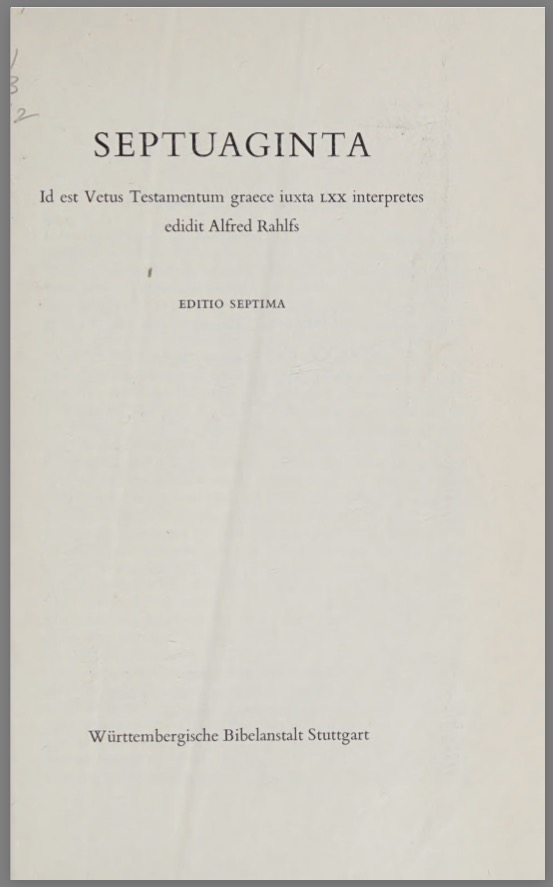
Septuaginta: Id est Vetus Testamentum Graece iuxta LXX Interpretes
The Septuagint: That is, the Old Testament in Greek according to the seventy translators
Book
Rahlfs, A. and Hanhart, R. (1935) Septuaginta: Id est Vetus Testamentum Graece iuxta LXX Interpretes. [The Septuagint: That is, the Old Testament in Greek according to the seventy translators] Stuttgart, Privilegierte württembergische Bibelanstalt, 2 Vols., Vol. 1: Leges et historiae; Vol. 2: Libri poetici et prophetic , 1184, 941 pp.
Record No. 26370  |  ISBN/ISSN: 3438051206  |  Sinkankas/Born No.: NIS/NIB  |  Language: in Greek and German  |  RWHL
The Septuagint, or Vetus Testamentum Graece iuxta LXX Interpretes, is the ancient Greek translation of the Hebrew Scriptures, traditionally attributed to seventy (or seventy-two) Jewish scholars in the 3rd to 2nd centuries BCE. This edition presents the Old Testament text in its Greek form, preserving the linguistic and textual heritage that significantly influenced early Jewish and Christian traditions. It is a foundational text for biblical studies, particularly for understanding the development of the Hebrew Bible, its reception in the Hellenistic world, and its use in early Christianity, where it often served as the primary scriptural source.

Orientalische Steinbücher und Persische Fayencetechnik
Oriental stone books and Persian faience technique
Journal Article
Ritter, H., Sarre, F., Ruska, J. and Winderlich, R. (1935) Orientalische Steinbücher und Persische Fayencetechnik. [Oriental stone books and Persian faience technique] Instalbuler Mitteilungen, Vol. 3, pp. 1–70, 4 plates.
Record No. 8127  |  Sinkankas/Born No.: NIS  |  Language: in German  |  RWHL
This substantial collection brings together studies by Hellmut Ritter, Friedrich Sarre, Julius Ruska, and Rudolf Winderlich concerning Oriental lapidaries and Persian ceramic technology. The sections devoted to stone books examine Arabic and Persian mineralogical and lapidary literature, including the transmission of Greek traditions into Islamic scholarship, the identification and nomenclature of stones, and descriptions of their properties, uses, and supposed medicinal or magical virtues. Ruska’s contribution is particularly concerned with the history and textual transmission of mineralogical knowledge and the relationship between Arabic sources and earlier Greek writings. The technological portion examines Persian faience and related ceramic techniques, discussing materials, glazes, pigments, firing, and methods used to produce colored and lustred surfaces. Textual evidence is compared with surviving objects and practical experimentation in an attempt to understand historical manufacturing processes. The volume is important for the history of gemology and mineralogy because it makes Oriental source material accessible and places medieval Islamic knowledge of stones within the broader history of science and technology, while the four plates illustrate relevant manuscripts, objects, or technical material.

Greek Geography

Book
Warmington, E.H. (1934) Greek Geography. London, J.M. Dent, 269 pp.
Record No. 26377  |  Sinkankas/Born No.: NIS/NIB  |  RWHL
The book highlights the growth of Greek geographic knowledge and thought to Graeco-Roman geography. Examples of Physical and Political Geography, Cosmology, Mathematical Geography and Cartography.

Jade

Journal Article
Anonymous (1934) Jade. Gems & Gemology, Vol. 1, No. 3, May–June, pp. 80–83.
Record No. 3636  |  ISBN/ISSN: 0016626X  |  RWHL

Building a Gemological Library

Gemological books range from general identification manuals and textbooks to specialized works on individual gems, mineralogy, jewelry, treatments, synthesis, history and gem-producing regions.

For a curated selection of particularly useful books, read The Gemologist's Core Library — Classic Books on Gemology, Jewelry and Mineralogy.

About Four Treasures

Four Treasures is Lotus Gemology's freely accessible gemological reference database. Use the full database to search by author, title or keyword and explore literature on gemology, mineralogy, jewelry and related fields. Where available, hyperlinks on titles may lead directly to the full publication.

Search the Complete Four Treasures Database