Explore books on gems, gemology, jewelry and mineralogy in Four Treasures, the Lotus Gemology reference database. This bibliography brings together matching book records from the collection, with publication details, abstracts and cover images where available.
Gemology Book References
The list below matches books concerning gemology and related subjects in the database's searchable fields. Some works cover several branches of gems, jewelry or mineralogy.
2,741–2,760 of 3,454 matching references
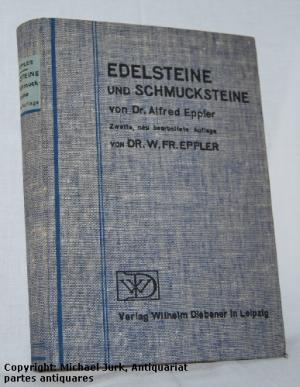
Edelsteine und Schmucksteine
Gemstones and ornamental stones
Book
Eppler, A. (1934)Edelsteine und Schmucksteine. [Gemstones and ornamental stones] Leipzig, Wilhelm Diebener, see pp. 319–343
Record No. 714 | Sinkankas/Born No.: 1918; NIB | Language: in German | RWHL
Reference copied to clipboard!
corundum, synthetic corundum.7, gems
Eppler provides a practical and scientific survey of gemstones and ornamental stones, discussing their identification, physical and optical properties, occurrence, cutting, treatment, imitation, and commercial use. The section on pp. 319–343 deals particularly with artificial and synthetic gemstones, reviewing attempts to reproduce natural gem minerals and the methods by which manufactured products can be distinguished from their natural counterparts. Considerable attention is given to synthetic corundum, especially ruby and sapphire produced by the Verneuil process, including the manufacture of boules, coloration, characteristic structures, and diagnostic features. Synthetic spinel and other artificial gem materials are also treated, together with glass imitations, assembled stones, and other substitutes encountered in the gem trade. Eppler emphasizes practical identification through optical and physical examination and discusses the characteristic features by which synthetic and imitation stones may be separated from natural gems. The work reflects the increasing importance during the early twentieth century of synthetic gem materials and the corresponding development of systematic gemological methods for their detection.
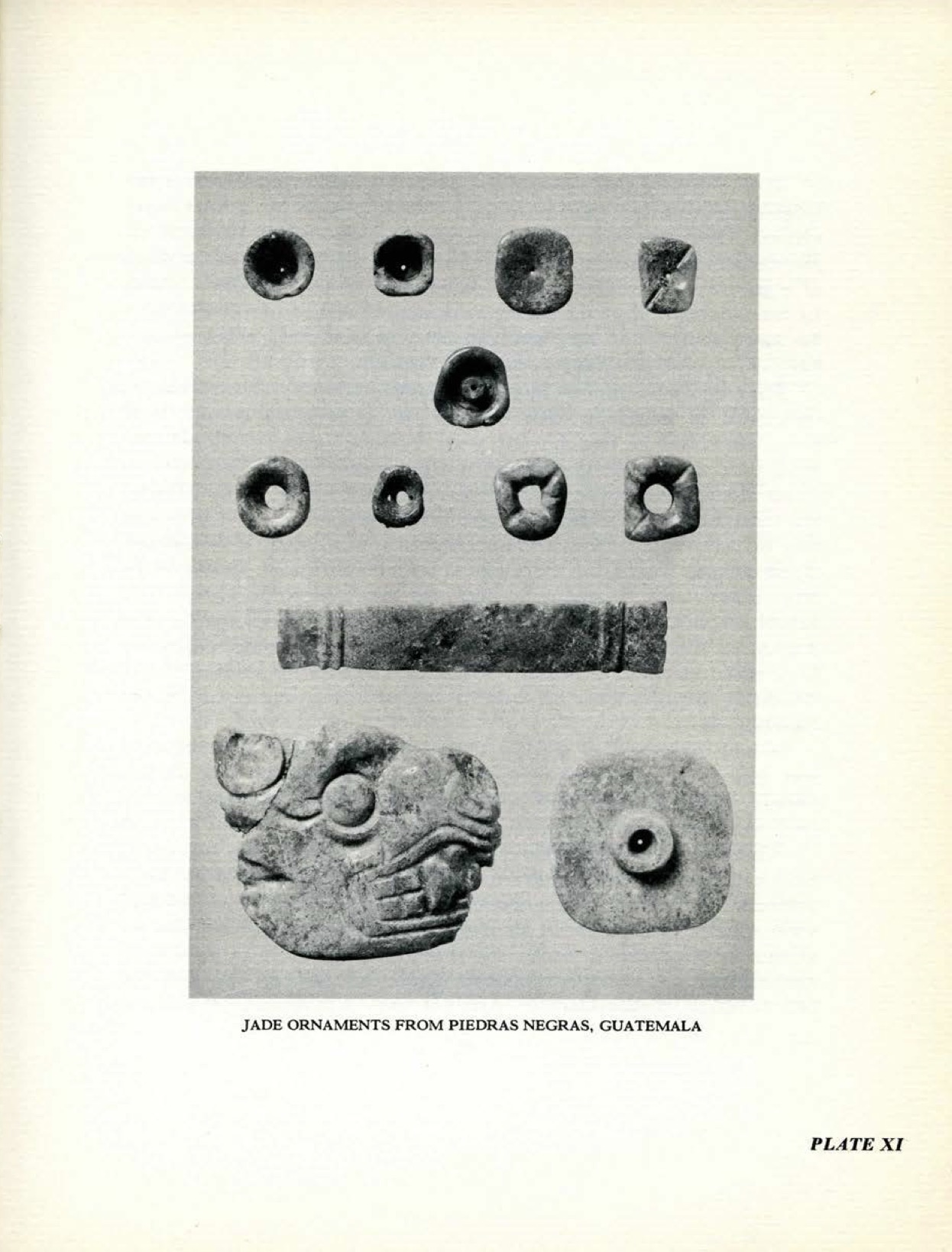
Prized by the ancient peoples of Mexico and Central America, jade was regarded as even more precious than gold (see “Native American Jades,” Museum Journal, March 1927). Although the source of Mexican jade had never been determined, there was no question that it was native, since it was considered mineralogically distinct from Asiatic jade, and jade ornaments were demanded in tribute by the Aztecs from certain regions of southern Mexico. Jade is a generic term that includes two chemically distinct species, jadeite and nephrite. Ornaments made from both stones are found in the Americas, but Mexican jade was believed to be jadeite and almost certainly a product of the highlands. The Maya of the Early Empire were unfamiliar with gold but apparently prized jade above all other materials, carving it into ornaments displaying their characteristic artistic style. This was a remarkable achievement for a people without metal tools, since jade is harder than steel. The jade ornaments of important individuals were buried with them, often placed in the mouth in a manner comparable to the Greek obolus; for this reason many Maya jades have been recovered through excavation. A large number of jade ornaments were discovered by the Eldridge R. Johnson Expedition at the Maya city of Piedras Negras, usually in ceremonial caches placed in pottery vessels beneath temple floors, although these examples were generally of relatively poor-quality jade. During one season, however, a burial vault containing the remains of a young man of evidently high rank was uncovered. Buried with him were approximately thirty ornaments of exceptionally fine, translucent apple-green jade, together with numerous carved heads. In accordance with the expedition’s agreement with the Guatemalan government, half of the objects were sent to Guatemala, while most of the remaining half was retained by the museum. Many of the ornaments occurred in pairs, allowing a nearly equal division. Only three outstanding objects were unique: a jaguar-head pendant retained by the museum, a human-figure pendant sent to Guatemala, and a large scalloped ring that remained in the museum collection. The human figure was probably originally worn as a pendant, although its position suggested that it may have been placed in the mouth according to Maya mortuary custom. The jaguar head, found face down beneath the body, was probably a back ornament. Carved in profile and in relatively high relief, it has a perfectly flat reverse bearing seven blocks of incised hieroglyphs, one of the very few known inscriptions on jade, though its meaning remained undeciphered. On the chest were found the scalloped ring, badly broken and unrestored, and two long rectangular beads, one measuring four inches in length and drilled throughout. On either side of the skull lay large quasi-circular ornaments with short tenons on the reverse, probably inserted into the earlobes as ear ornaments. Around the forehead were twenty small ornaments of the finest jade. Although apparently strung together as a fillet, their form resembles that of ear plugs, and the fact that they consist of ten pairs of slightly different shapes suggests that they were originally ear ornaments later reused as a headband.
Anselmus de Boodt as Scientist and Natural Philosopher
Journal Article
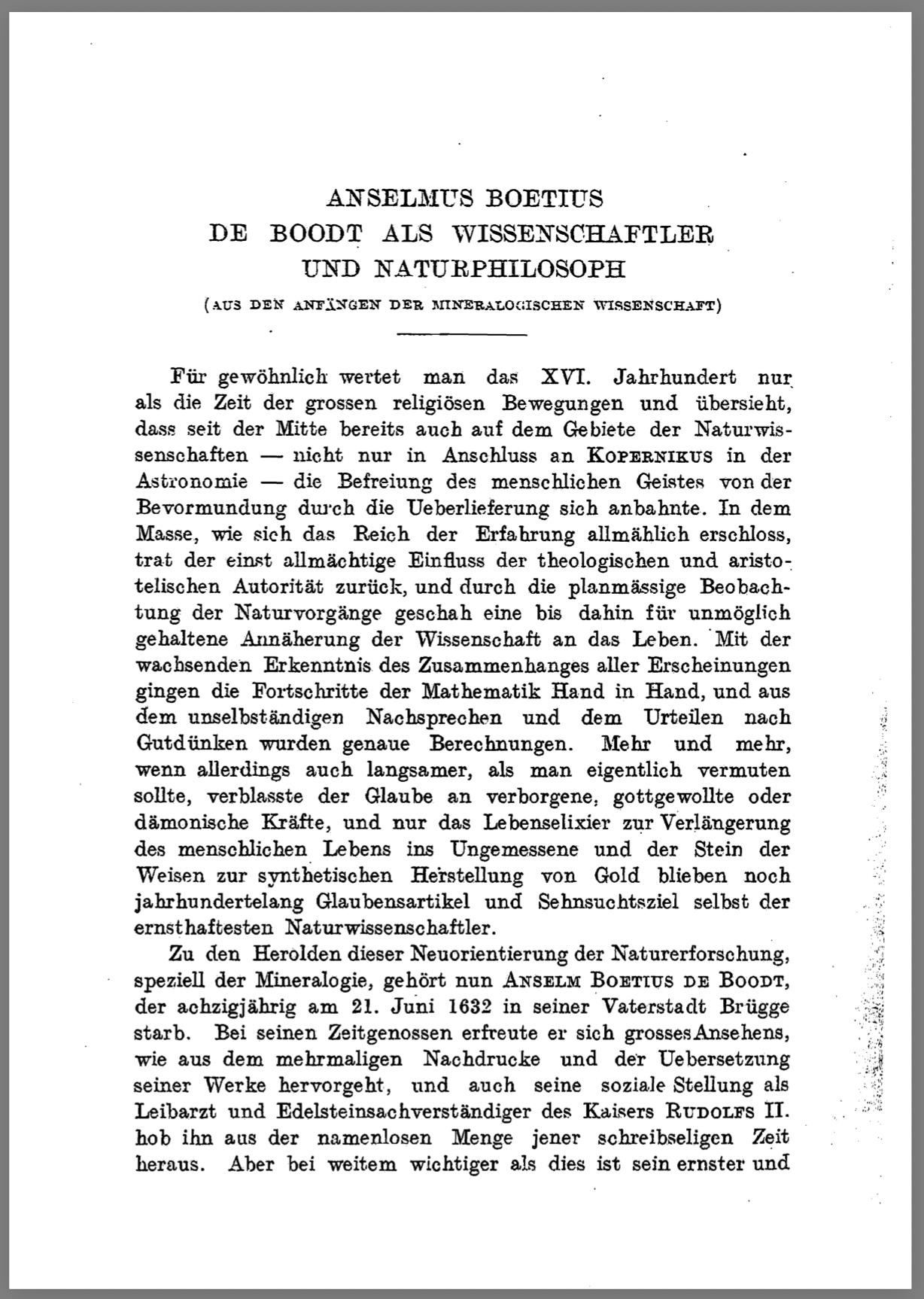
Hiller, J.E. (1933) Anselmus de Boodt als Wissenschafter und Naturphilosoph. [Anselmus de Boodt as Scientist and Natural Philosopher]Archeion, Vol. 15, No. 3, pp. 348–368.
Record No. 28362 | Sinkankas/Born No.: NIS/NIB | Language: in German | RWHL
Reference copied to clipboard!
gems, early gem trade, early gemology, history of gemology, de Boodt
Hiller examines Anselmus de Boodt (1550–1632) as a scientist and natural philosopher, placing his work within the intellectual transition from Renaissance natural philosophy toward more empirical approaches to the natural sciences. Particular attention is devoted to de Boodt’s Gemmarum et lapidum historia (1609), his major work on gems and stones, and to his methods of observation, description, classification, and explanation. Hiller discusses the coexistence in de Boodt’s thought of careful firsthand observation and practical mineralogical knowledge with inherited classical and medieval concepts, including occult qualities, medicinal virtues, sympathies, and antipathies. De Boodt nevertheless displays considerable skepticism toward many traditional claims about the magical powers of gemstones and attempts to distinguish demonstrable properties from superstition and unsupported authority. His treatment of stones encompasses their physical characteristics, colors, hardness, formation, geographic occurrence, imitation, cutting, and uses, illustrating an unusually broad conception of mineralogical study for the early seventeenth century. Hiller presents de Boodt as an important transitional figure whose work retains elements of Aristotelian and Renaissance natural philosophy while showing an increasing reliance upon observation, experience, critical judgment, and the systematic description of natural objects.
Cennini, C.D.A. and Thompson, D.V. (1933)Il Libro’ Dell Arte. [The Craftman’s Handbook] New Haven, Yale Univeristy Press, Vol. 2, 142 pp.
Record No. 28064 | Sinkankas/Born No.: NIS/NIB | Language: in English | RWHL
Reference copied to clipboard!
gems, lapis lazuli, history of gem use, pigments, art
Cennini’s practical handbook presents detailed instructions for the materials and techniques of the painter and craftsman, including drawing, preparation and use of colors, fresco and oil painting, glues and cements, panel painting, gilding, illumination, work on cloth and glass, mosaic, and casting. Particular attention is given to mineral pigments, including azurite, malachite, vermilion, and ultramarine, with descriptions of their preparation, grinding, properties, and appropriate uses. Ultramarine is praised as the finest of colors and its preparation is described in considerable detail. Of particular gemological interest is Cennini’s discussion of stones used for burnishing gold: hematite is recommended, but sapphire, emerald, balas ruby, topaz, ruby, and garnet are said to be even better, with the choicer stones preferred. Thompson’s translation is based on his revised Italian text and attempts to render Cennini’s technical vocabulary in terminology useful to modern practicing artists and craftsmen.
gems, ancient gemology, ancient jewelry, early metallurgy, gold mining in Egypt
Diodorus is frequently cited as the only ancient account of Egyptian gold mining. He states he tried to check his sources, but he relied on Agatharcides' account from the 2nd century B.C. It is not clear whether either writer ever saw a gold mine; however, Diodorus wrote approximately half a millennium before the Byzantine/Coptic operations at Bir Umm Fawakhir. If nothing else, the political and economic situation had changed. Diodorus' kings and queens of Egypt (the last of whom was Cleopatra) had long been replaced by distant emperors in Rome or Constantinople, and Egypt had been reduced to a province.
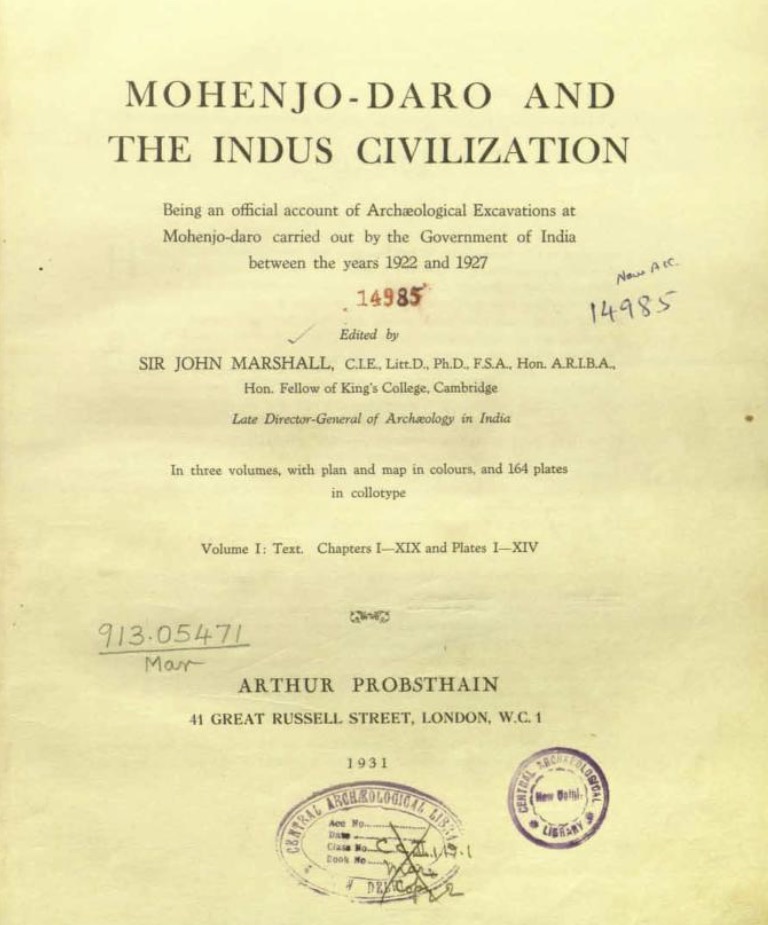
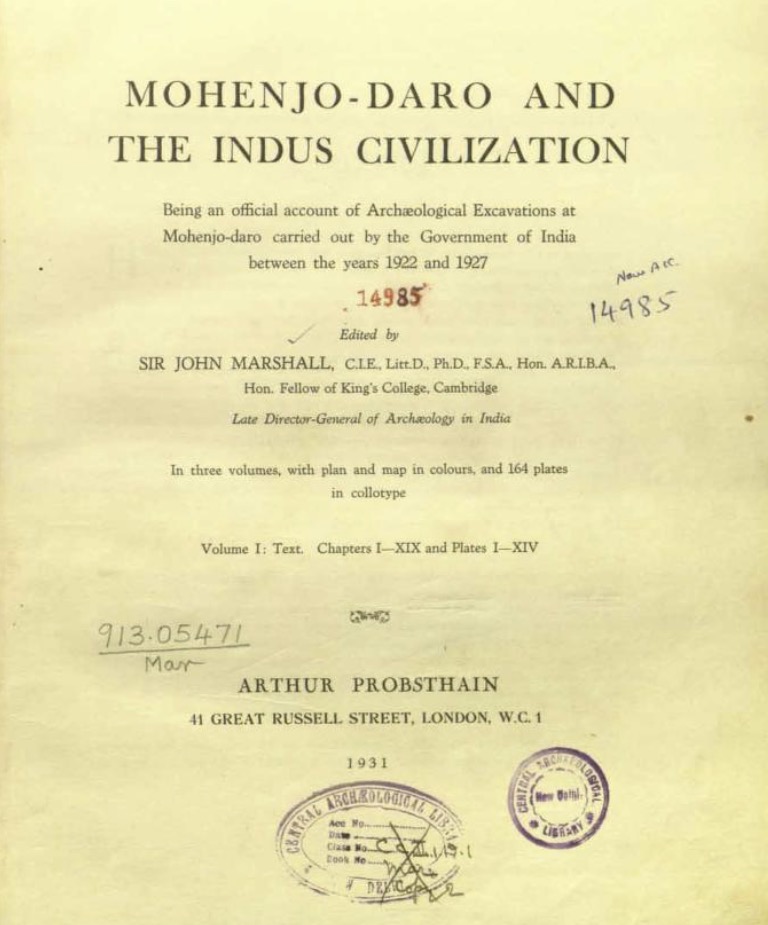
Mackay, E.J.H. and Coulson, A.L. (1931) Personal ornaments. In: Mohenjo-daro and the Indus Civilization: Being an official account of archæological excavations at Mohenjo-daro carried out by the government of India between the years 1922 and 1927, London: A. Probsthain, 3 Vols., Vol. 2, pp. 509–548.
Record No. 27449 | Sinkankas/Born No.: NIS/NIB | RWHL
Reference copied to clipboard!
gems, ancient gemology, ancient jewelry, early metallurgy, India, Indus, green stones, green grossular, hydrogrossular, jade
Hitherto it has commonly been supposed that the pre-Aryan peoples of India were on an altogether lower plane of civilization than their Aryan conquerors; that to the latter they were much what the Helots were to the Spartans, or the Slavs to their Byzantine overlords—a race so servile and degraded, that they were commonly known as Dasas or slaves. The picture of them gleaned from the Hymns of the Rigveda was that of black skinned, flat-nosed barbarians, as different from the fair Aryans in physical aspect as they were in speech and religion, though at the same time it was evident that they must have been rich in cattle, good fighters, and possessed of many forts in which they defended themselves against the invaders. These “forts”, however, were explained by Vedic scholars as being no more than occasional places of refuge—simple earthworks, that is to say, surrounded, may be, by palisades or rough stone walls; for, seeing that the Aryans themselves were still in the village State and that their society was in other respects correspondingly primitive, it was deemed impossible that the older races of India—the contemptible, outcast Dasas—could already have been living in well-built cities or fortresses, or in other respects have attained to a higher state of culture. Mentally, physically, socially, and religiously, their inferiority to their conquerors was taken for granted, and little or no credit was given them for the achievements of Indian civilization. Never for a moment was it imagined that five thousand years ago, before ever the Aryans were heard of, the Panjab and Sind, if not other parts of India as well, were enjoying an advanced and singularly uniform civilization of their own, closely akin but in some respects even superior to that of contemporary Mesopotamia and Egypt. Yet this is what the discoveries at Harappa and Mohenjo-daro have now placed beyond question. They exhibit the Indus peoples of the fourth and third millennia B.C., in possession of a highly developed culture in which no vestige of Indo-Aryan influence is to be found. Like the rest of Western Asia, the Indus country is still in the Chalcolithic Age—that age in which arms and utensils of stone continue to be used side by side with those of copper or bronze. Their society is organized in cities; their wealth derived mainly from agriculture and trade, which appears to have extended far and wide in all directions. They cultivate wheat and barley as well as the date palm. They have domesticated the humped zebu, buffalo, and short-horned bull, besides the sheep, pig, dog, elephant, and camel; but the cat and probably the horse are unknown to them. For transport they have wheeled vehicles, to which oxen doubtless were yoked. They are skilful metal workers, with a plentiful supply of gold, silver, and copper. Lead, too, and tin are in use, but the latter only as an alloy in the making of bronze. With spinning and weaving they are thoroughly conversant. Their weapons of war and of the chase are the bow and arrow, spear, axe, dagger, and mace. The sword they have not yet evolved; nor is there any evidence of defensive body armour. Among their other implements, hatchets, sickles, saws, chisels, and razors are made of both copper and bronze; knives and celts sometimes of these metals, sometimes of chert or other hard stones. For the crushing of grain they have the muller and saddle-quern but not the circular grindstone. Their domestic vessels are commonly of earthenware turned on the wheel and not infrequently painted with encaustic designs; more rarely they are of copper, bronze, or silver. The ornaments of the rich are made of the precious metals or of copper, sometimes overlaid with gold, of faience, ivory, carnelian, and other stones; for the poor, they are usually of shell or terra-cotta. Figurines and toys, for which there is a wide vogue, are of terra-cotta, and shell and faience are freely used, as they are in Sumer and the West generally, not only for personal ornaments but for inlay work and other purposes. With the invention of writing the Indus peoples are also familiar, and employ for this purpose a form of script which, though peculiar to India, is evidently analogous to other contemporary scripts of Western Asia and the Nearer East.
Marshall, J. (1931)Mohenjo-daro and the Indus Civilization: Being an official account of archæological excavations at Mohenjo-daro carried out by the government of India between the years 1922 and 1927. London, A. Probsthain, 3 Vols., 364 pp.
Record No. 26960 | Sinkankas/Born No.: 4227; NIB | RWHL
Reference copied to clipboard!
gems, ancient gemology, ancient jewelry, early metallurgy, India, Indus, green stones, green grossular, hydrogrossular, jade
Hitherto it has commonly been supposed that the pre-Aryan peoples of India were on an altogether lower plane of civilization than their Aryan conquerors; that to the latter they were much what the Helots were to the Spartans, or the Slavs to their Byzantine overlords—a race so servile and degraded, that they were commonly known as Dasas or slaves. The picture of them gleaned from the Hymns of the Rigveda was that of black skinned, flat-nosed barbarians, as different from the fair Aryans in physical aspect as they were in speech and religion, though at the same time it was evident that they must have been rich in cattle, good fighters, and possessed of many forts in which they defended themselves against the invaders. These “forts”, however, were explained by Vedic scholars as being no more than occasional places of refuge—simple earthworks, that is to say, surrounded, may be, by palisades or rough stone walls; for, seeing that the Aryans themselves were still in the village State and that their society was in other respects correspondingly primitive, it was deemed impossible that the older races of India—the contemptible, outcast Dasas—could already have been living in well-built cities or fortresses, or in other respects have attained to a higher state of culture. Mentally, physically, socially, and religiously, their inferiority to their conquerors was taken for granted, and little or no credit was given them for the achievements of Indian civilization. Never for a moment was it imagined that five thousand years ago, before ever the Aryans were heard of, the Panjab and Sind, if not other parts of India as well, were enjoying an advanced and singularly uniform civilization of their own, closely akin but in some respects even superior to that of contemporary Mesopotamia and Egypt. Yet this is what the discoveries at Harappa and Mohenjo-daro have now placed beyond question. They exhibit the Indus peoples of the fourth and third millennia B.C., in possession of a highly developed culture in which no vestige of Indo-Aryan influence is to be found. Like the rest of Western Asia, the Indus country is still in the Chalcolithic Age—that age in which arms and utensils of stone continue to be used side by side with those of copper or bronze. Their society is organized in cities; their wealth derived mainly from agriculture and trade, which appears to have extended far and wide in all directions. They cultivate wheat and barley as well as the date palm. They have domesticated the humped zebu, buffalo, and short-horned bull, besides the sheep, pig, dog, elephant, and camel; but the cat and probably the horse are unknown to them. For transport they have wheeled vehicles, to which oxen doubtless were yoked. They are skilful metal workers, with a plentiful supply of gold, silver, and copper. Lead, too, and tin are in use, but the latter only as an alloy in the making of bronze. With spinning and weaving they are thoroughly conversant. Their weapons of war and of the chase are the bow and arrow, spear, axe, dagger, and mace. The sword they have not yet evolved; nor is there any evidence of defensive body armour. Among their other implements, hatchets, sickles, saws, chisels, and razors are made of both copper and bronze; knives and celts sometimes of these metals, sometimes of chert or other hard stones. For the crushing of grain they have the muller and saddle-quern but not the circular grindstone. Their domestic vessels are commonly of earthenware turned on the wheel and not infrequently painted with encaustic designs; more rarely they are of copper, bronze, or silver. The ornaments of the rich are made of the precious metals or of copper, sometimes overlaid with gold, of faience, ivory, carnelian, and other stones; for the poor, they are usually of shell or terra-cotta. Figurines and toys, for which there is a wide vogue, are of terra-cotta, and shell and faience are freely used, as they are in Sumer and the West generally, not only for personal ornaments but for inlay work and other purposes. With the invention of writing the Indus peoples are also familiar, and employ for this purpose a form of script which, though peculiar to India, is evidently analogous to other contemporary scripts of Western Asia and the Nearer East. Sinkankas: An account of the archaeological remains at Mohenjo-Daro in the Indus Valley unearthed by the Government of India between 1922 and 1927. Age fixed between 3250–2750 B.C. Chalcedony in all its forms prominent among the objects and frequently display an advanced degree of lapidary skill. Other gemstone objects are made from rock crystal, amethyst, jadeite, turquoise, lapis, amazonite, steatite, alabaster, and also non-gem materials. “Not seen; my reference to source lost.”
Absorption and Refraction of Light in Red, Blue and Violet Spinels from Ceylon
Journal Article
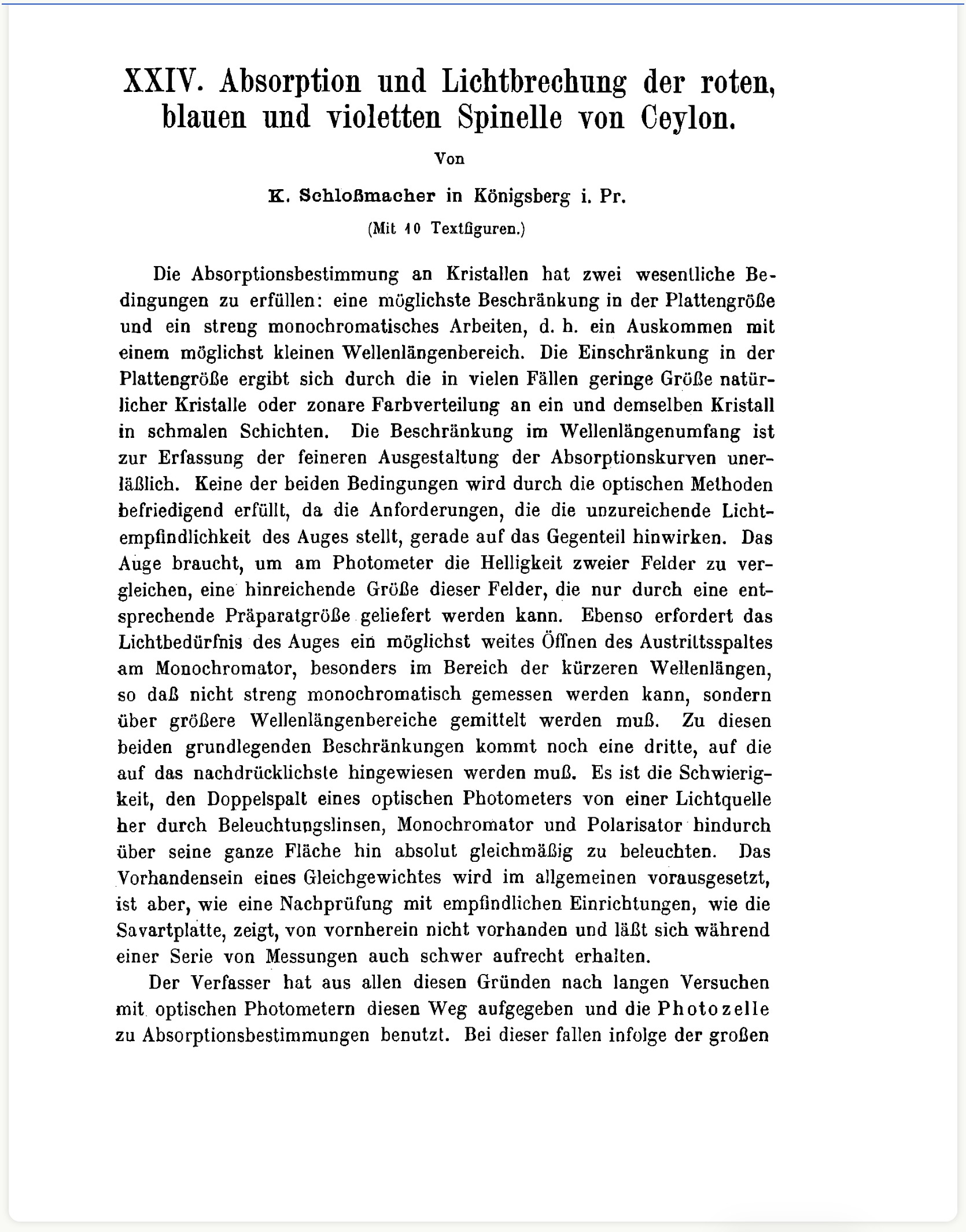
Schlossmacher, K. (1930) Absorption und Lichtbrechung der Roten, Blauen und Violetten Spinelle von Ceylon. [Absorption and Refraction of Light in Red, Blue and Violet Spinels from Ceylon]Zeitschrift für Kristallographie, Mineralogie und Petrographie, Vol. 72, No. 5/6, pp. 447–475.
Record No. 29575 | Sinkankas/Born No.: NIS / NIB | Language: in German | RWHL
Reference copied to clipboard!
gems, spinel, Ceylon, Sri Lanka,
Study of the optical properties of red, blue and violet spinels from Ceylon (Sri Lanka), examining their absorption and refractive behavior in relation to color. Schlossmacher presents measurements and observations of differently colored natural spinels and compares their optical absorption and refractive indices, seeking systematic relationships between color and optical properties. The work forms part of his broader investigation of the causes of color in Ceylon spinels, subsequently extended to brown material and to the substances responsible for coloration. It provides an early quantitative treatment of colored spinel using optical measurements rather than color description alone and is particularly relevant to the historical development of gemological research on spinel.
gems, early lapidaries, early gemology, early mineralogy, topaz, etymology, Chaucer
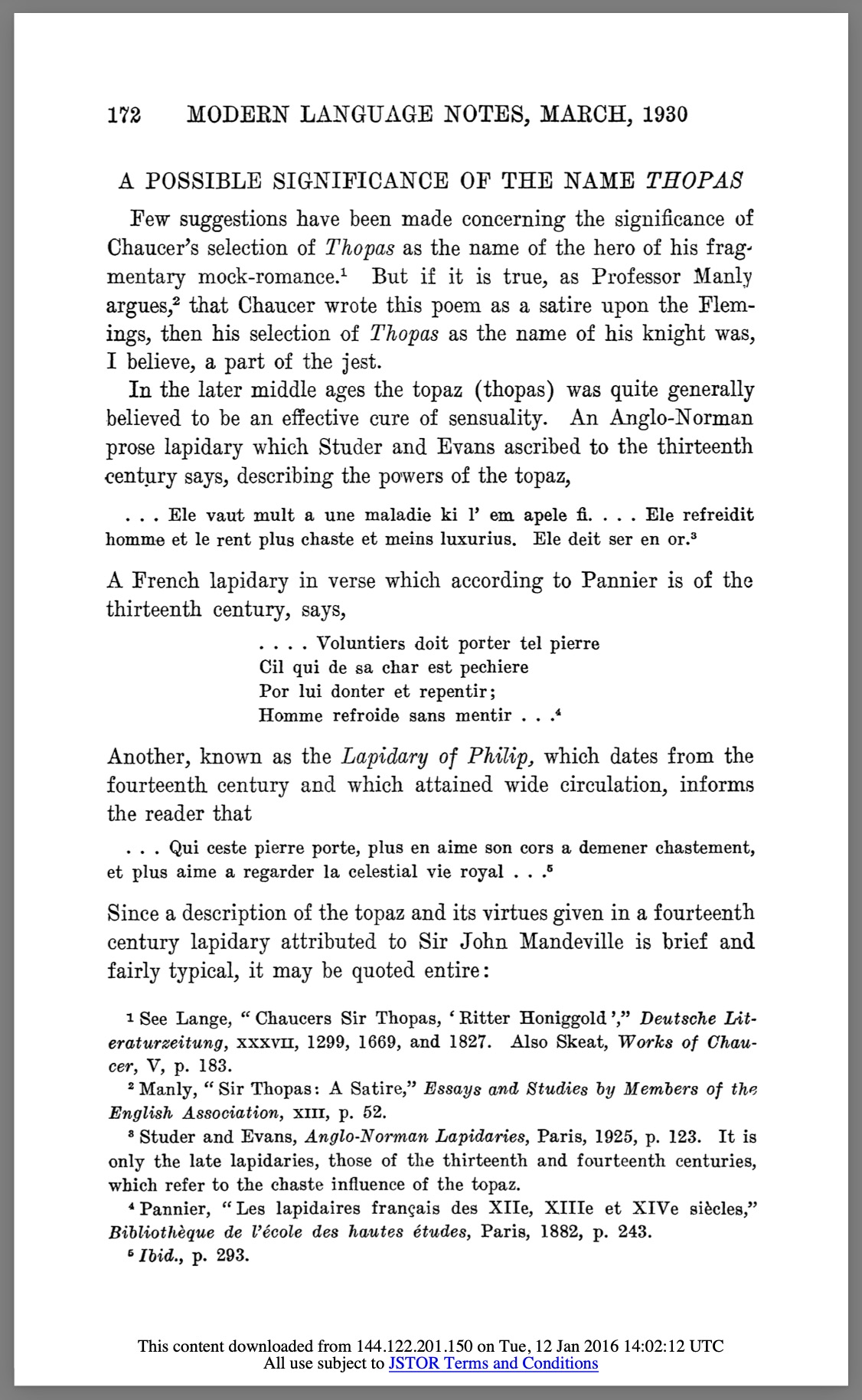
Few suggestions have been made concerning the significance of Chaucer’s selection of Thopas as the name of the hero of his fragmentary mock-romance. But if it is true, as Professor Manly argues, that Chaucer wrote this poem as a satire upon the Flemings, then his selection of Thopas as the name of his knight was, I believe, a part of the jest. In the later Middle Ages the topaz (thopas) was quite generally believed to be an effective cure for sensuality. An Anglo-Norman prose lapidary which Studer and Evans ascribed to the thirteenth century says, describing the powers of the topaz: Ele vaut mult a une maladie ki l’em apele fi…. Ele refreidit homme et le rent plus chaste et meins luxurius. Ele deit ser en or. A French lapidary in verse, which according to Pannier is of the thirteenth century, says: Voluntiers doit porter tel pierre / Cil qui de sa char est pechiere / Por lui donter et repentir; / Homme refroide sans mentir. Another, known as the Lapidary of Philip, which dates from the fourteenth century and attained wide circulation, informs the reader that Qui ceste pierre porte, plus en aime son cors a demener chastement, et plus aime a regarder la celestial vie royal. Since a description of the topaz and its virtues given in a fourteenth-century lapidary attributed to Sir John Mandeville is brief and fairly typical, it may be quoted entire: Topace d’Arabie vient des fleuves de l’Orient; il y en a de deux manieres, et sont semblables a or vierge; l’une l’est plus que l’autre; elles valent a une maladie qu’on appelle fiel; elle sent la lune, car quand la lune doit etre pluvieuse, la pierre est relente (de mauvaise odeur), mais quand il doit faire beau temps, elle est claire et reluisante; elle refroidit l’homme, le rend plus chaste et moins luxurieux, et doit seoir en or.
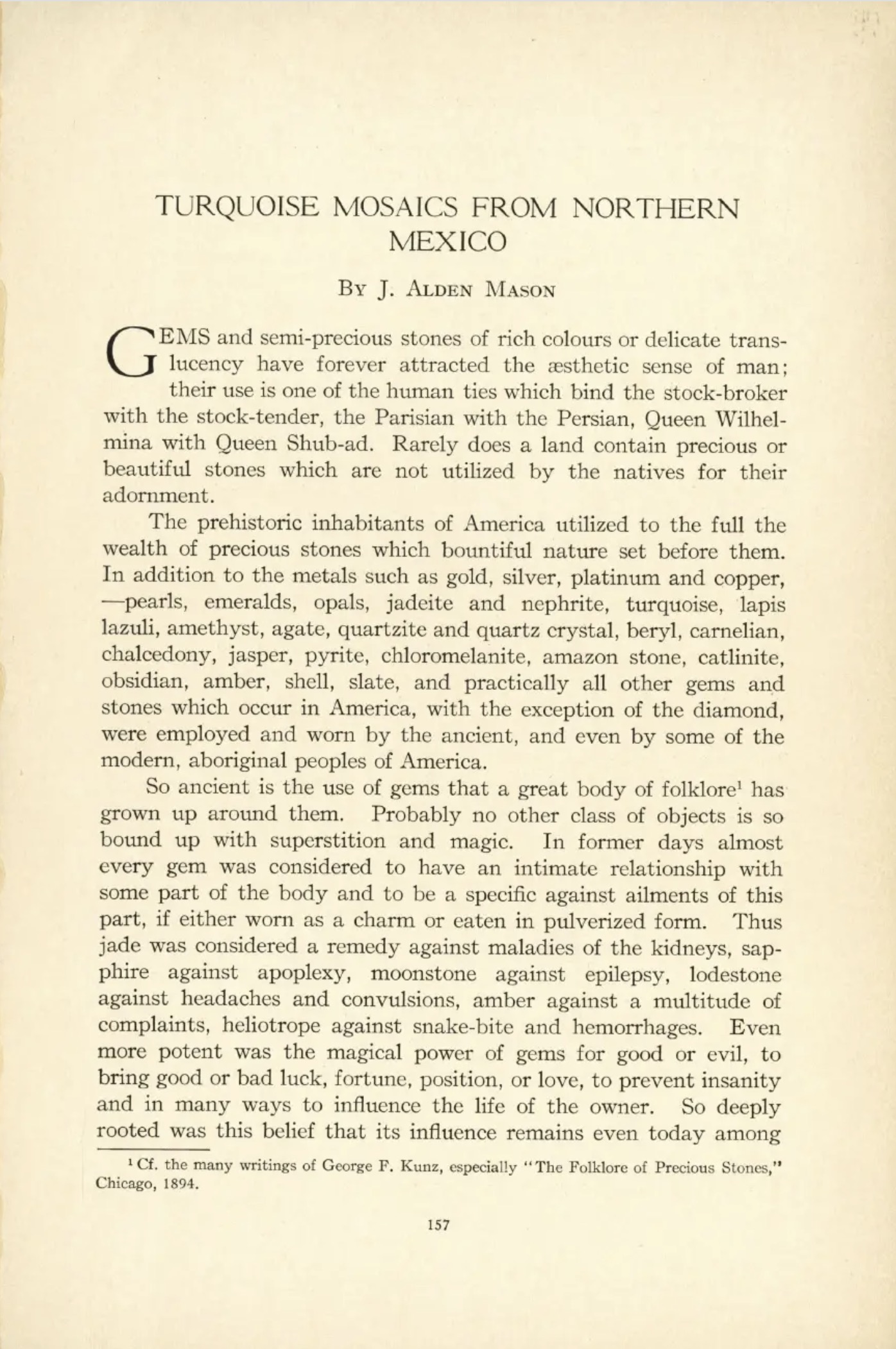
Gems and semi-precious stones of rich colours or delicate translucency have always appealed to the aesthetic sense of humanity; their use is one of the cultural threads that links the stockbroker with the shepherd, the Parisian with the Persian, Queen Wilhelmina with Queen Shub-ad. Few lands possess precious or beautiful stones that are not used by their inhabitants for personal adornment. The prehistoric peoples of the Americas made full use of the wealth of gemstones that nature provided. In addition to metals such as gold, silver, platinum, and copper, pearls, emeralds, opals, jadeite and nephrite, turquoise, lapis lazuli, amethyst, agate, quartzite and rock crystal, beryl, carnelian, chalcedony, jasper, pyrite, chloromelanite, amazonite, catlinite, obsidian, amber, shell, slate, and virtually every other gem material and ornamental stone found in the Americas—except the diamond—were used and worn by the ancient inhabitants and, in some cases, continue to be used by Indigenous peoples today.
Porcelain Pagodas and Palaces of Jade: Musings of an Old Collector
Book
Grantham, A.E. (1929)Porcelain Pagodas and Palaces of Jade: Musings of an Old Collector. New York, Dutton & Co., xii + 210 pp.
Record No. 7435 | RWHL
Reference copied to clipboard!
jade, jadeite, fei cui, nephrite, cutting, gems
O “Lapidario Del Rey D. Alfonso X El Sabio”
The “Lapidary of King D. Alfonso X the Wise”
Book
Alfonso X and Gonçalves, J.C. (1929)O “Lapidario Del Rey D. Alfonso X El Sabio”. [The “Lapidary of King D. Alfonso X the Wise”] Lisboa, Self-published, 68 pp.
Record No. 831 | Sinkankas/Born No.: NIS/NIB | Language: in Spanish | RWHL
Reference copied to clipboard!
corundum, history.1, gems
Gonçalves presents and discusses the Lapidario of Alfonso X “the Wise” (1221–1284), the celebrated thirteenth-century Castilian lapidary traditionally associated with the king’s scholarly circle. The work introduces the manuscript and its historical setting and examines the Lapidario as a compilation of medieval knowledge concerning stones, combining descriptions of their physical characteristics and geographic origins with medicinal, magical, and astrological properties. Central to the text is the association of individual stones with the signs and degrees of the zodiac and with particular stars, reflecting the close relationship between mineralogy, medicine, and astrology in medieval lapidary literature. Gonçalves discusses the sources and transmission of this material, much of which reached Alfonso’s court through Arabic scientific and lapidary traditions derived in turn from Greek and eastern sources. The volume is particularly relevant to the history of gemology because it documents an early European attempt to organize extensive information about precious and ornamental stones systematically, while illustrating how observation of minerals coexisted with astrological and therapeutic beliefs. This privately published Lisbon edition was limited to 350 copies.
Gellius, A. (1927)Noctes Atticae (Attic Nights), Vol. 1: Books 1–5. Cambridge, MA, Harvard University Press, 3 Vols., 528 pp.
Record No. 27604 | ISBN/ISSN: 9780670000000 | Sinkankas/Born No.: NIS/NIB | Language: in Latin and English | RWHL
Reference copied to clipboard!
gems, ancient texts, Greek, Greece, ancient geography
Aulus Gellius’ Noctes Atticae (Attic Nights), written in the second century AD, is a miscellany of observations and extracts from Greek and Roman authors assembled from notes made during Gellius’ studies and travels. The work preserves information from many ancient writings that are now lost and ranges widely over philosophy, history, law, language, medicine, natural history, mathematics, and antiquarian lore. Vol. 1 of the Loeb edition contains Books 1–5, with the Latin text and English translation on facing pages. Of gemological interest are passages reflecting ancient beliefs about stones and other natural substances and, more broadly, the methods by which Greek and Roman writers described and explained unusual natural phenomena. Gellius frequently quotes or discusses earlier authorities, making the work valuable for tracing the transmission of classical scientific and mineralogical traditions as well as for preserving fragments of otherwise lost authors. This Loeb edition was translated by John C. Rolfe.
Ramsay, A. (1925)In Search of the Precious Stone. New York, Albert Ramsay & Co., 50 pp.
Record No. 1458 | Sinkankas/Born No.: 5338 | RWHL
Reference copied to clipboard!
corundum, Burma.12, Sri Lanka.12, gems, quality.10, gems
Handsome promotional booklet by a New York gem merchant who achieved considerable fame for his travels into remote places to look for gem rough. Describes his adventures seeking opal in Australia, sapphire in Indo-China and Burma, rubies in Burma, star sapphires and other gemstones in Ceylon, and emerald in Colombia. Remaining material is standard gemological fare. A so-called “second” edition, so identified on the final page of text, was “produced by Gem Creations Pub. Co. 36 West 47th Street New York” and is an identical reprint but bound in dark blue morocco-like cloth and bright yellow panels in the text. It is by far the more commonly encountered version.
Herbordt, O. (1925) Über nutzbare lagerstätten in Afghanistan. [On exploitable deposits in Afghanistan]Zeitschrift für Praktische Geologie, Vol. 33, pp. 193–198.
Record No. 967 | Sinkankas/Born No.: NIS/NIB | Language: In German | RWHL
Reference copied to clipboard!
corundum, Afghanistan.12, gems
Herbordt surveys Afghanistan’s economically useful mineral deposits from his own observations, specimens collected during exploration, and material preserved in Kabul, placing them within a brief account of the country’s geology. [193–194] He describes gold in Badakhshan, where native miners wash river gravels, and notes reported silver and argentiferous lead deposits in the Herat region. Copper is described as widespread, occurring principally in quartz veins and mineralized schists, with occurrences near Kabul, Chilseitu, Maidan, Urusgan, Kandahar, and elsewhere; malachite, copper pyrites, limonite, and other associated minerals are recorded. [195] Iron ores, graphite-bearing rocks, asbestos, rubies, lapis lazuli, coal, bituminous rocks, and petroleum are also discussed. Of particular gemological interest, Herbordt records ruby occurrences at Jagdalak, east of Kabul, in white mica-bearing limestone or crystalline marble containing spinel and corundum; mining had previously been conducted by the Afghan government but had ceased about twelve years before his report. He also mentions another ruby occurrence in Badakhshan near the upper Amu Darya, while lapis lazuli occurs in Badakhshan on the upper Kokcha River in crystalline limestone, where large deposits had been worked for many years. [196] In his summary, Herbordt states that Afghanistan possesses widely distributed ores, minerals, and fuels, with especially rich iron ore and coal near Kabul; he specifically identifies lapis lazuli and ruby from Badakhshan as gemstones known since antiquity and notes that lapis and rubies had also been washed from gold-bearing alluvium. He concludes that Afghanistan’s immediate mining prospects were constrained by shortages of fuel, transportation difficulties, and the lack of an indigenous metallurgical industry, suggesting that easily won minerals such as mica, asbestos, lapis lazuli, and gemstones offered better prospects than large-scale metal mining. [197–198]
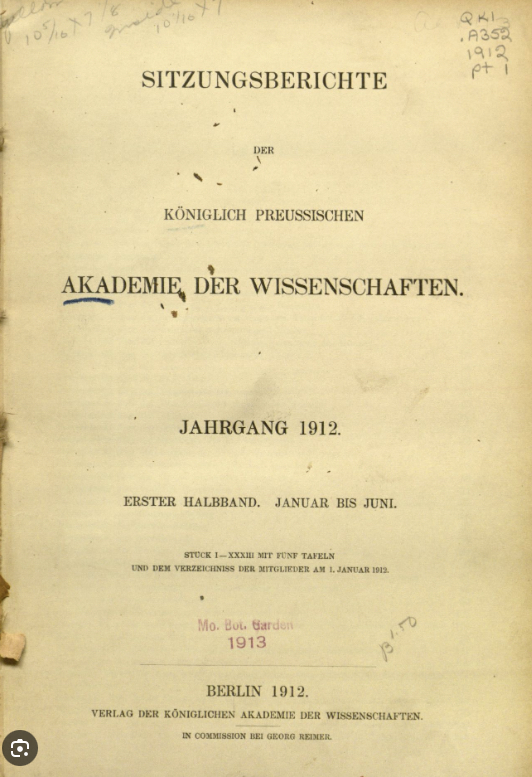
Wellmann, M. (1924) Aristoteles « De lapidibus ». [Aristotle “On stones”]Sitzungsberichte der preussischen Akademie der Wissenschaften. Philosophisch-Historische Klasse, No. 1, January–June, pp. 79–82.
Record No. 27986 | Sinkankas/Born No.: NIS/NIB | Language: in German | RWHL
Reference copied to clipboard!
gems, early lapidaries, early gemology, early mineralogy
Wellmann reexamines the origins of the Pseudo-Aristotelian De lapidibus, building upon V. Rose’s 1875 study and Julius Ruska’s 1912 publication of the Arabic text of Parisinus 2772. He accepts Ruska’s demonstration that the work originated not in Byzantium but in Syria before the middle of the ninth century, but argues more specifically that the stone book was originally not an independent work but part of a larger natural-scientific compilation concerned with the occult properties of stones, metals, animals, and plants and ultimately rooted in the Alexandrian tradition of sympathy, antipathy, magic, and talismanic lore associated particularly with Bolos Demokritos and later Neopythagorean literature. [79] Wellmann identifies a surviving companion to the stone book in the Syriac Buch der Naturgegenstände (Book of Natural Objects), published in German translation by K. Ahrens in 1892. This work, also attributed pseudonymously to Aristotle, treats animals and was subsequently used by Arabic writers including Bar-Bahlul, al-Damīrī, and Qazwīnī. Wellmann argues from similarities of title, organization, and content that it and De lapidibus originally constituted portions of the same work. [80] Further evidence comes from a pharmacological work associated with Ḥunayn ibn Isḥāq, which draws independently upon both the Aristotelian stone book—including passages concerning the eagle-stone, diamond, and Indian stone—and the Buch der Naturgegenstände. [81] Wellmann regards the parallel accounts of pearl formation in the two traditions as decisive evidence for their common origin; the greater elaboration of the surviving De lapidibus is attributed to later additions and interpolations. Since Ḥunayn (d. 873) used an Arabic translation that must postdate the foundation of Baghdad in 763, while the latest source incorporated into the Syriac compilation dates to about 550, Wellmann concludes that the Syriac original from which the Pseudo-Aristotelian stone book ultimately derives was probably composed around 600 AD. [82]
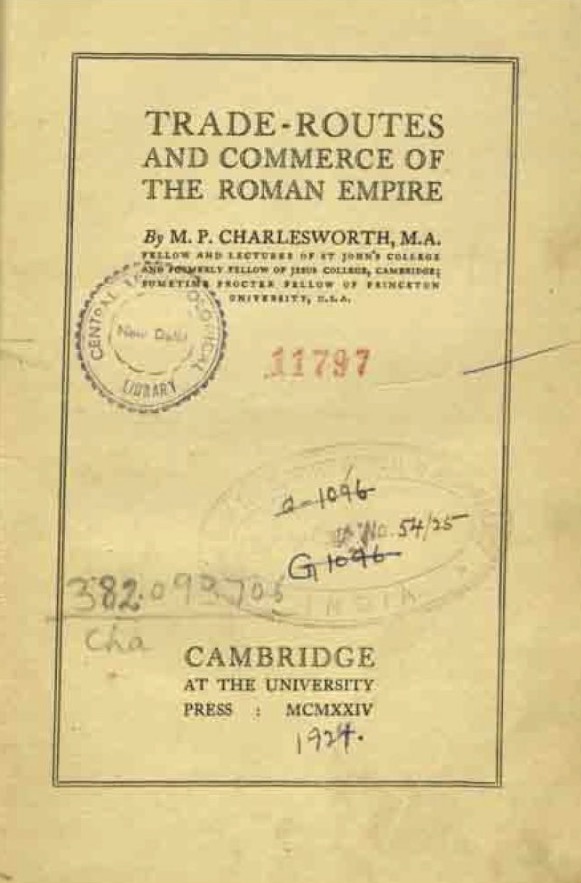
Charlesworth, M.P. (1924)Trade Routes and Commerce of the Roman Empire. Cambridge, Cambridge University Press, 288 pp.
Record No. 26382 | Sinkankas/Born No.: NIS/NIB | RWHL
Reference copied to clipboard!
gems, ancient gemology, early gemology, ancient mineralogy, early trade, Rome, Romans, Greeks, ancient trade, commerce
Trade-Routes and Commerce of the Roman Empire by M. P. Charlesworth offers a comprehensive examination of the Roman Empire’s economic landscape during its first two centuries. Structured geographically, the book delves into various regions under Roman influence, including Italy, the Eastern provinces, Egypt, Syria, Asia Minor, Greece, Africa, Spain, Gaul, and Britain. Charlesworth explores the intricate network of trade routes—both overland and maritime—that connected these regions, facilitating the movement of goods and cultural exchange. He also investigates Rome’s commercial interactions with distant territories such as India and China, highlighting the empire’s far-reaching economic connections. Utilizing a diverse array of ancient sources, from literary works to technical treatises, Charlesworth illuminates the complexities of Roman trade and its pivotal role in the empire’s prosperity.
Turquoise Mosaic Art in Ancient Mexico
Book
Saville, M.H. (1922)Turquoise Mosaic Art in Ancient Mexico. New York, Museum of the American Museum, 110 pp.
Record No. 28623 | Sinkankas/Born No.: 5742; NIB | RWHL
Sinkankas: The most thorough study made on this aspect of lapidary art among the pre-Columbian Indians is by E. Carmichael (1970), although see also the smaller work by the same author. There are several excellent colour plates and high-quality black-and-white photographic plates that show a number of inlaid objects in good detail. The historical data were extracted from early Spanish accounts. The text discusses possible sources of turquoise and describes important objects still preserved in museums around the world. An excellent description of Mexican lapidary work appears on pages 29–39. Very scarce.
Nippur’s gold treasure
Journal Article
Legrain, L. (1920) Nippur’s gold treasure.The Museum Journal, pp. 133–139.
Record No. 26654 | Sinkankas/Born No.: NIS/NIB | RWHL
Reference copied to clipboard!
gems, ancient gemology, ancient jewelry, Egypt, Egyptian jewelry, glyptic, engraved gems, Babylon, agate, chalcedony, lapis lazuli
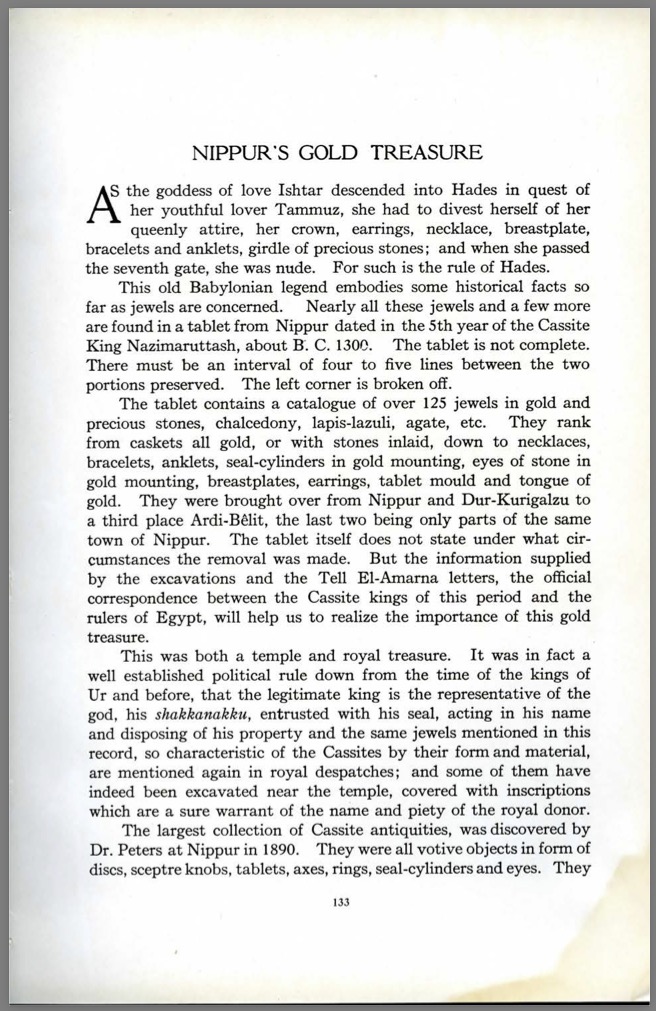
As the goddess of love Ishtar descended into Hades in quest of her youthful lover Tammuz, she had to divest herself of her queenly attire, her crown, earrings, necklace, breastplate, bracelets and anklets, girdle of precious stones; and when she passed the seventh gate, she was nude. For such is the rule of Hades. This old Babylonian legend embodies some historical facts so far as jewels are concerned. Nearly all these jewels and a few more are found in a tablet from Nippur dated in the 5th year of the Cassite King Nazimaruttash, about B.C. 1300. The tablet is not complete. There must be an interval of four to five lines between the two portions preserved. The left corner is broken off. The tablet contains a catalogue of over 125 jewels in gold and precious stones, chalcedony, lapis-lazuli, agate, etc. They rank from caskets all gold, or with stones inlaid, down to necklaces, bracelets, anklets, seal-cylinders in gold mounting, eyes of stone in gold mounting, breastplates, earrings, tablet mould and tongue of gold. They were brought over from Nippur and Dur-Kurigalzu to a third place Ardi-Bêlit, the last two being only parts of the same town of Nippur. The tablet itself does not state under what circumstances the removal was made. But the information supplied by the excavations and the Tell El-Amarna letters, the official correspondence between the Cassite kings of this period and the rulers of Egypt, will help us to realize the importance of this gold treasure.
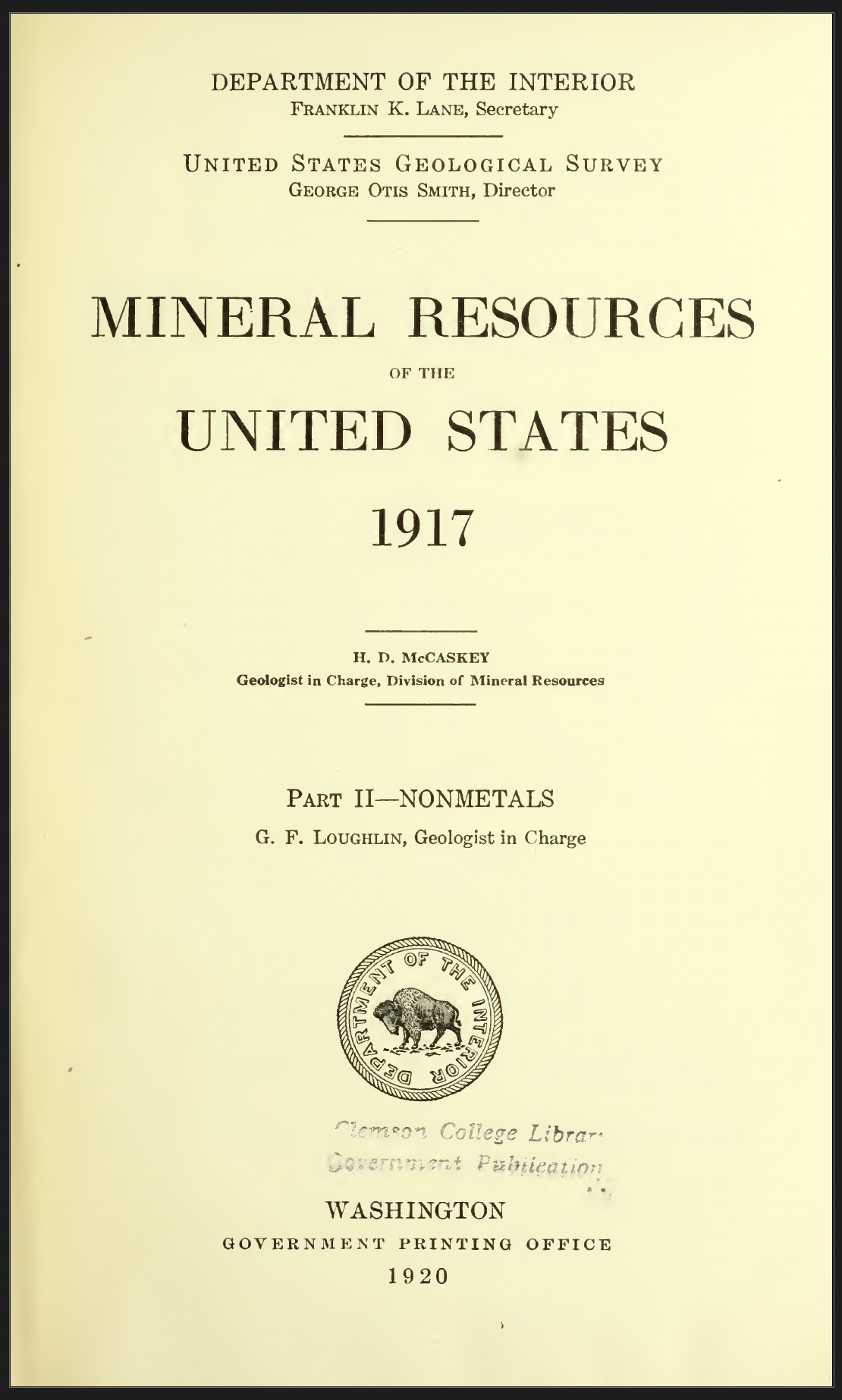
An annual review of the United States gem and precious-stone industry for 1917, followed by an extensive glossary of gemological nomenclature. Domestic production was valued at $131,012, a sharp decline from 1916 and, except for 1914, the lowest annual value since 1897. Corundum, quartz, turquoise, and tourmaline together accounted for 83% of production, with Montana leading chiefly through sapphire, followed by Nevada and California. Imports of precious stones excluding pearls were valued at $34.85 million. Most of the paper is devoted to a two-part dictionary of gem names: first identifying the mineral species represented by hundreds of commercial, historical, and local names, and then listing the corresponding names under their correct mineral species. Schaller strongly criticizes misleading trade names such as “Alaska diamond” for quartz and “Arizona ruby” for garnet, emphasizing that such terminology obscures the true mineralogical identity of gemstones. The glossary is particularly valuable as a contemporary record of early twentieth-century gem nomenclature, including numerous obsolete, regional, and deceptive commercial names.
Gemological books range from general identification manuals and textbooks to specialized works on individual gems, mineralogy, jewelry, treatments, synthesis, history and gem-producing regions.
Four Treasures is Lotus Gemology's freely accessible gemological reference database. Use the full database to search by author, title or keyword and explore literature on gemology, mineralogy, jewelry and related fields. Where available, hyperlinks on titles may lead directly to the full publication.