Gemology Books Bibliography

Gemology Books Bibliography

Explore books on gems, gemology, jewelry and mineralogy in Four Treasures, the Lotus Gemology reference database. This bibliography brings together matching book records from the collection, with publication details, abstracts and cover images where available.

Gemology Book References

The list below matches books concerning gemology and related subjects in the database's searchable fields. Some works cover several branches of gems, jewelry or mineralogy.
2,761–2,780 of 3,454 matching references

Precious stones

Book Section
Schaller, W.T. (1919) Precious stones. In: Mineral Resources of the United States | 1916, Part 2—Nonmetals , pp. 887–899.
Record No. 17029  |  Sinkankas/Born No.: 5767; NIB  |  RWHL
Schaller argues at the outset that there is no valid scientific distinction between “precious” and “semiprecious” stones, since beauty, rarity, hardness, price, and fashion provide no consistent basis for such a division. The report then reviews U.S. gem production for 1916, valued at $217,793, an increase of 28% over 1915, with corundum, quartz, tourmaline, and turquoise accounting for most of the output. Montana again ranked first, chiefly through sapphire production, followed by California, while 34 mineral species and 79 named gem varieties were reported from 27 states. Detailed notes cover beryl, Arkansas and California diamonds, including a 1.48-carat diamond from Indiana, newly reported dumortierite deposits in New Mexico and Nevada, garnet, quartz varieties, tourmaline, and turquoise. The report also describes the gem-bearing pegmatites and tourmaline deposits of southern California and a National Museum exhibit illustrating their geology and mineral assemblages. Imports of precious stones excluding pearls were valued at $38.93 million, nearly recovering to prewar levels, and the paper concludes with a selected bibliography of recent gemological literature.

Juvenal and Persius

Book
Ramsay, G.G. (1918) Juvenal and Persius. London, William Heinemann, 497 pp.
Record No. 17085  |  RWHL
Juvenal and Persius, with an English translation by G. G. Ramsay (1918; reprinted 1924), in 499 bookmarked and searchable pdf pages. Loeb Classical Library volume L91N. Wikipedia has entries on both Roman satirists: Juvenal (60-140 A.D.) and Persius (34-62 A.D.). Juvenal's satires, in particular, have his observations of Roman life, sexual mores, women, homosexuality, literary patrons, aristocrats, along with many occasional remarks of historical importance about Rome's endless wars and scandals.

Navigation to the Far East under the Roman Empire
Journal Article
Schoff, W.H. (1917) Navigation to the Far East under the Roman Empire. Journal of the American Oriental Society, Vol. 37, pp. 240–249.
Record No. 29907  |  DOI: 10.2307/592924  |  Sinkankas/Born No.: NIS/NIB  |  RWHL
Schoff examines maritime communication between the Mediterranean, India, Ceylon, Southeast Asia and China during the Roman Empire, arguing that trade expanded greatly between the first and third centuries CE through exploitation of the seasonal monsoon winds. He reconstructs the sea routes from Egypt through the Red Sea to southern India and Ceylon and onward across the Bay of Bengal, comparing Graeco-Roman accounts with Indian literature, coinage and Chinese records. Ceylon appears as an important link in this maritime network, connecting western commerce with routes extending farther east. Of gemological interest, Schoff notes that gold, silver and precious stones came from Yunnan and describes Indian literary evidence for an active jewelry trade in which craftsmen examined pearls, topazes, sapphires, beryls, rubies, lapis lazuli and coral, set rubies in gold, strung pearls and cut lapis lazuli. He concludes that Roman ships regularly reached the Tamil kingdoms and Ceylon, but voyages by Roman vessels into the Bay of Bengal and China Sea were exceptionally rare; much Roman geographical knowledge of the Far East therefore depended on hearsay transmitted through Indian and other Asian mariners.

Precious stones

Book Section
Schaller, W.T. (1917) Precious stones. In: Mineral Resources of the United States | 1915, Part 2—Nonmetals , pp. 843–858.
Record No. 17028  |  Sinkankas/Born No.: 5766; NIB  |  RWHL
An annual review of the United States gem and precious-stone industry for 1915, with production statistics, comparisons with the preceding five years, and detailed notes on individual gem materials and localities. Schaller records a total domestic production valued at $170,431, the second-lowest figure since 1898; Montana ranked first, chiefly because of sapphire production, followed by California. The report discusses beryl and aquamarine, sapphire, Arkansas and California diamonds, feldspar gems, garnet, opal, numerous quartz varieties, jasper, rhodonite, staurolite, thomsonite, topaz, tourmaline, turquoise, californite, and thulite, giving information on new discoveries, mining activity, quality, cutting, and marketing. Of particular interest are accounts of Montana sapphires, Arkansas diamonds, California tourmalines, Maine and Massachusetts beryl, and the diverse agates and chalcedonies of the western states. It concludes with import statistics—precious-stone imports in 1915 were valued at $26.19 million—brief notes on the foreign gem industry, and a useful contemporary bibliography of gemological literature.

A Study of Maya Art: Its Subject Matter and Historical Development
Book
Spinden, H.J. (1913) A Study of Maya Art: Its Subject Matter and Historical Development. Washington, DC, Peabody Museum of American Archaeology and Ethnology, 285 pp.
Record No. 28675  |  Sinkankas/Born No.: NIS/NIB  |  RWHL
The study of Maya art, here presented, is based upon a thesis for the degree of Doctor of Philosophy submitted May 1, 1909, at Harvard University. While the matter has expanded greatly under further study, the thesis as presented contained an exposition of the chronological sequence of the monuments, which the writer considers the most noteworthy contribution, as well as chapters on the analysis of the designs and the principles of the architecture. It was thought wise to present the portion relating to the historical development of art at Copán before the Congress of Americanists at Mexico City in September 1910; otherwise the subject matter has not been given to the public. The attempt has been made to be precise and exoteric in the discussion of this most involved subject. It is with gratitude that the writer acknowledges his indebtedness to the many persons who have aided and encouraged him in this work. The inception of this research took place in Anthropology 9, a course on Mexican and Central American archaeology offered at Harvard University by Dr. A. M. Tozzer. Its continuance has been largely due to the support and cooperation of the small band of students of Maya culture headed by Mr. C. P. Bowditch. Thanks are also due to Mrs. Zelia Nuttall of Mexico City, to Mr. E. H. Thompson of Chichén Itzá, Yucatán, and to Mrs. W. M. James of Mérida, Yucatán, as well as to many other persons in Mexico, Guatemala, and Honduras. In the revision of the manuscript the writer received valued assistance from Dr. Tozzer. For the revision of the proof he is indebted to Professor Putnam and to Miss Mead, and to the latter also for the preparation of the index. Mr. C. C. Willoughby has given his kind attention to the preparation of the plates and to the making of the blocks for the illustrations in the text. The map of the region covered by the Maya civilization was drawn by Mr. L. M. Hendrick, Jr., according to data compiled from several sources. Since his connection with the American Museum of Natural History, the writer has been greatly indebted to his superiors in the Museum, who have done everything in their power to further his labours in this field.

Calendar of the Patent Rolls preserved in the Public Record Office: Henry III 1266–1272
Edited Book
Lyte, H.C.M., editor (1913) Calendar of the Patent Rolls preserved in the Public Record Office: Henry III 1266–1272.. London, H.M. Stationery Office, 6 Vols., Vol. 6 , 42 pp..
Record No. 17079  |  RWHL

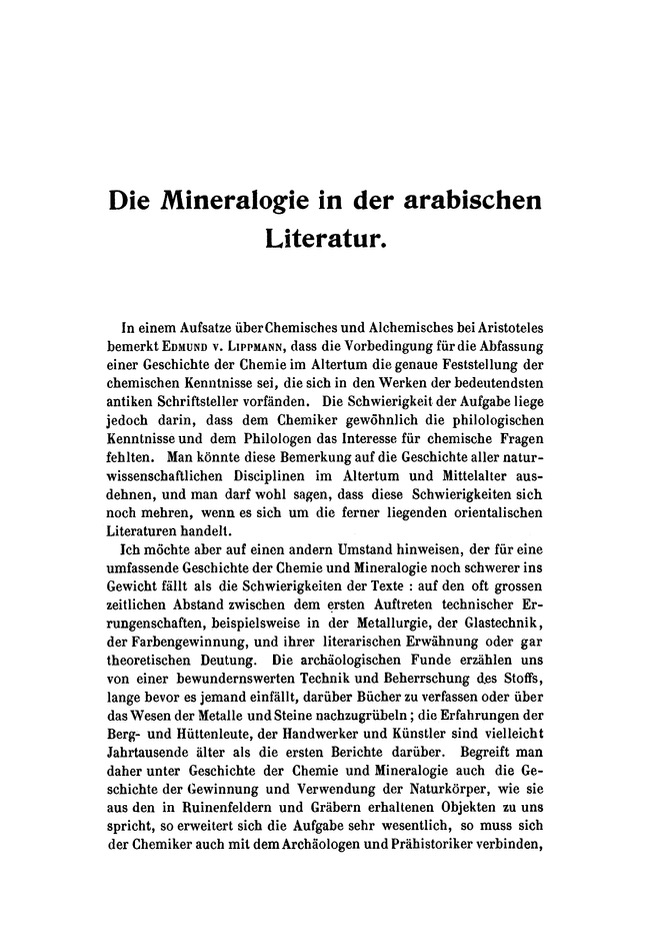
Die Mineralogie in der arabischen Literatur
Mineralogy in Arabic literature
Journal Article
Ruska, J. (1913–14) Die Mineralogie in der arabischen Literatur. [Mineralogy in Arabic literature] Isis, Vol. 1, pp. 341–350.
Record No. 8129  |  Sinkankas/Born No.: NIS/NIB  |  Language: in German  |  RWHL
Ruska surveys the character and development of mineralogical knowledge in Arabic literature, emphasizing that medieval “mineralogy” embraced not only stones and ores but also technically produced substances, pearls, coral, and fossils, and differed fundamentally from modern mineralogy in its emphasis on readily observable physical properties, behavior in fire and acids, medicinal uses, magical powers, localities, varieties, and practical applications rather than crystallography. He traces this knowledge through Arabic pharmacological, cosmographical, natural-philosophical, and astrological writings, including Ibn Sīnā, Ibn al-Baiṭār, Qazwīnī, the Ikhwān al-Ṣafāʾ, and Arabic lapidaries attributed to Aristotle, Ḥunain ibn Isḥāq, and others. Particularly interesting are accounts assigning particular stones and metals to the planets and prescribing engraved images and astrological conditions for their use; Ruska connects this Arabic tradition with the Spanish Lapidario of Alfonso X and with later works of Albertus Magnus, Thomas of Cantimpré, and Konrad von Megenberg. He devotes substantial attention to al-Tīfāshī’s lapidary, which treats 25 precious and semiprecious stones according to their formation, localities, qualities, powers, and commercial value. As an example, Ruska discusses al-Tīfāshī’s account of emerald, including the medieval theory of its formation, the Egyptian emerald mines near the Red Sea, mining conditions, varieties and defects, medicinal and legendary properties, and valuation; the finest “beetle-green” emerald is stated to average four gold dinars per carat. Ruska closes by stressing the exceptional importance of al-Bīrūnī’s eleventh-century Kitāb al-jamāhir fī maʿrifat al-jawāhir, particularly for the history of gemstones and information concerning important stones of India, and expresses his intention to make the work accessible through an edition and translation.

Kazwīnīstudien

Kazwīnī studies
Journal Article
Ruska, J. (1913) Kazwīnīstudien. [Kazwīnī studies] Der Islam, Vol. 4, No. 1, pp. 14–66, 236–262.
Record No. 4587  |  Sinkankas/Born No.: NIS/NIB  |  Language: in German  |  RWHL
Ruska studies the textual history and scientific content of Zakariyyā al-Qazwīnī’s (1203–1283) celebrated cosmography, ʿAjāʾib al-makhlūqāt wa-gharāʾib al-mawjūdāt (The Wonders of Creation and the Rarities of Existing Things), comparing manuscripts and related Arabic scientific works in an attempt to distinguish Qazwīnī’s original text from later revisions and interpolations. He identifies at least four distinct recensions of the Arabic cosmography and demonstrates that Wüstenfeld’s nineteenth-century edition was based largely on a late recension and incorporated material from different manuscripts, making it an unreliable representation of Qazwīnī’s original work. Of particular gemological interest is Ruska’s discussion of precious stones, where he compares parallel passages in Qazwīnī with al-Bīrūnī, al-Khāzinī, and al-Tīfāshī, providing evidence for the transmission and borrowing of mineralogical and gemological knowledge among medieval Islamic authors. The study is therefore important not only for establishing the textual history of Qazwīnī’s cosmography, but also for tracing the sources and transmission of medieval Arabic knowledge concerning minerals and precious stones.

Rubies and the ruby mines of Mogok

Journal Article
Darte, G.L. (1913) Rubies and the ruby mines of Mogok. Jewelers’ Circular-Weekly, Feb. 5, pp. 125–133.
Record No. 2426  |  Sinkankas/Born No.: NIS/NIB  |  RWHL
A richly illustrated contemporary account of rubies and the Mogok mining district of Upper Burma. Darte begins with the ruby’s historical reputation, folklore, gemological properties, color varieties, dichroism, and distinction from spinel and garnet, identifying the deep, slightly bluish carmine-red Burmese “pigeon-blood” as the most prized color. He notes a revival in the American ruby market beginning in 1912, attributed partly to the prominence of “ruby-red” during the coronation of George V and to fashions employing calibre-cut colored stones with diamonds. The principal focus is Mogok, regarded as the source of the finest rubies. Darte describes the district, its history and traditional royal monopoly, and three types of workings: “Twin-lone” pits exploiting alluvial byon or ruby-bearing earth; hillside “Hmyaw-Dwin” workings; and limestone cave or “Loo-Dwin” deposits, where fewer but larger and better-quality stones were reportedly recovered. Traditional washing methods are contrasted with the mechanized operations of the Burma Ruby Mines company, employing pumps, trucks, rotary pans, and a pulsator. Considerable attention is given to celebrated large rubies, their weights, values, and historical owners, although some accounts are explicitly acknowledged as unverified. The article concludes with the secrecy historically surrounding Mogok, the marketing of its production through London and Paris, and the cutting and recutting of Burmese rubies in Europe. Particularly valuable are contemporary photographs showing a native ruby market, a Mogok cutting shop, a ruby merchant and his family, the transport of byon in mine cars, and the mechanized ruby-washing plant.

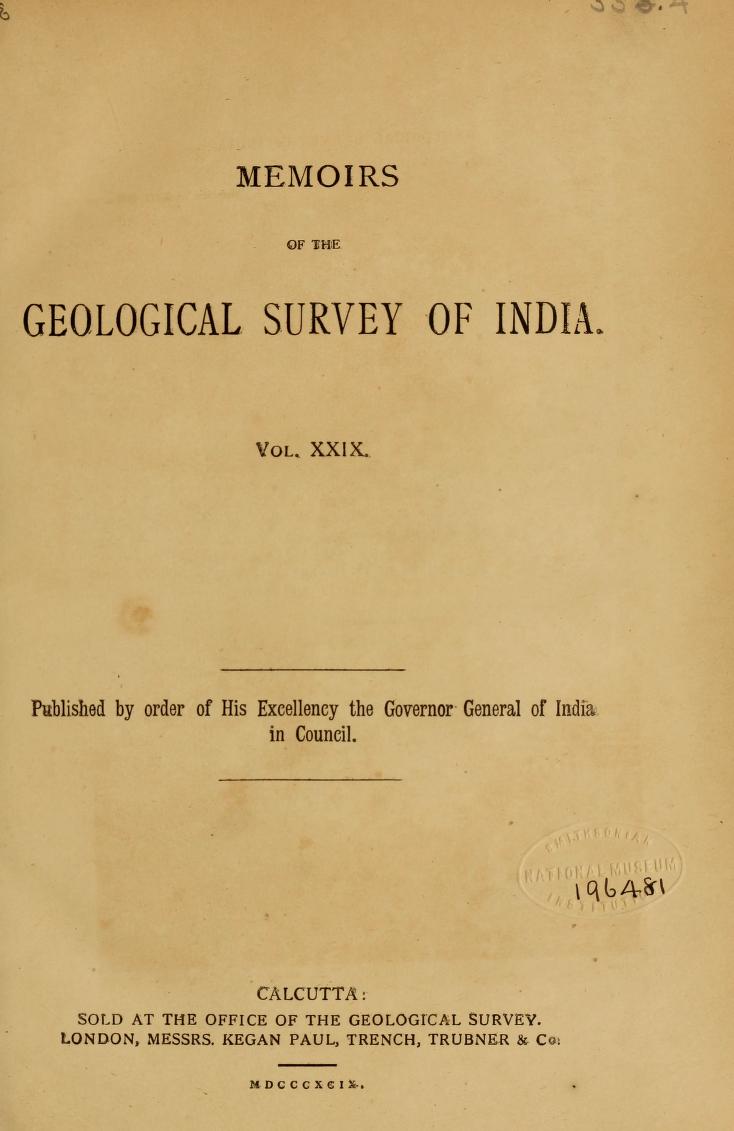
Geology of the northern Shan States

Journal Article
La Touche, T.H.D. (1913) Geology of the northern Shan States. Memoirs, Geological Survey of India, Vol. 39, Pt. 2, 379 pp..
Record No. 1160  |  Sinkankas/Born No.: NIS/NIB  |  RWHL
La Touche provides a comprehensive geological account of the Northern Shan States of Burma, describing the region’s physical geography, stratigraphy, geological structure, and mineral resources on the basis of Geological Survey of India field investigations. The memoir treats the principal rock formations and their distribution and discusses the geological history and structural relationships of the region, with attention to economically important mineral occurrences. Of particular gemological interest is the treatment of the ruby-bearing districts, including the occurrence of ruby and associated minerals in crystalline limestone and related deposits, as well as accounts of mining localities and methods. Other mineral resources described include lead, silver, zinc, iron, coal, and various building and ornamental materials. The volume is an important early systematic geological survey of the Northern Shan States and provides historical evidence for the geology, mineral occurrences, and mining activity of this important mineral-producing region.

Catalogue of a Collection of Ancient Rings Formed by the Late E. Guilhou
Book
Ricci, S., de (1912) Catalogue of a Collection of Ancient Rings Formed by the Late E. Guilhou. Paris, 194 pp.
Record No. 28827  |  Sinkankas/Born No.: 5440 (not seen); NIB  |  RWHL
The collection of rings described in this catalogue was the work of a lifetime: the late Monsieur Guilhou spent many years and the better part of his fortune buying rings, ancient and modern, of every description; at the time of his death, he had brought together a stupendous series of one thousand six hundred and thirty-six ancient rings, a total probably unrivalled in any public museum or private collection. Every age and every country is represented in this extraordinary assemblage, and it was no easy task for the compiler of the present catalogue to assign each ring to its proper date, to sort this great series which the collector had left in the utmost disorder, and to divide the collection chronologically into twenty-four cases, grouped in four large folding boxes. Although it was not possible for the compiler (in the absence of any note or catalogue by the hand of Monsieur Guilhou) to discover the provenance and history of every single ring, it was nevertheless most satisfactory to be able to identify not only twenty beautiful Renaissance rings from the celebrated Spitzer collection, sold in 1893, but also nearly all the important items described in Baron Jérôme Pichon’s sale catalogue (1897). Baron Pichon’s collection of rings was considered the finest in France: nearly forty of his choicest specimens were ultimately bought by Monsieur Guilhou, including the celebrated ring of the Black Prince. As late as 1909, Monsieur Guilhou purchased at the Victor Gay auction nearly every ring in the sale, paying as much as seven thousand francs for a finger-ring of which he had already several examples.

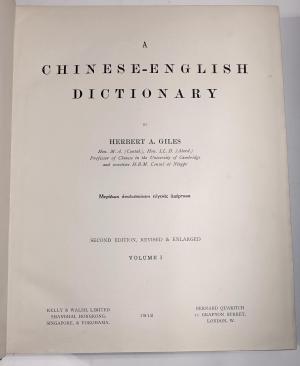
A Chinese-English Dictionary

Book
Giles, H.A. (1912) A Chinese-English Dictionary. London, 1712 pp.
Record No. 2776  |  Sinkankas/Born No.: NIS/NIB  |  RWHL
The second, revised and enlarged edition of Herbert A. Giles’s monumental Chinese–English dictionary, originally published in 1892. Entries are arranged according to Chinese characters, with pronunciations, definitions, compounds, idiomatic usages, and literary references, while the introductory material includes tables, the 214 radicals, and a radical index. Giles’s system of romanization, developed from that of Thomas Wade, became known as Wade–Giles and was enormously influential in Western sinology. For gemological research the dictionary is particularly valuable for determining the meanings and historical usages of Chinese terms for jade, precious stones, minerals, colors, and objects fashioned from them, although its English equivalents must be interpreted in the context of early twentieth-century terminology. The 1912 edition was issued as the second edition, revised and enlarged, by Kelly & Walsh and Bernard Quaritch.

The Pacification of Burma

Book
Crosthwaite, C.E. (1912) The Pacification of Burma. London, Frank Cass & Co., 355 pp.
Record No. 2745  |  Sinkankas/Born No.: NIS/NIB  |  RWHL
Written by Sir Charles Crosthwaite, Chief Commissioner of Burma from 1887 to 1890, this is a firsthand account of the British pacification and administration of Upper Burma following its annexation in 1885. Crosthwaite describes the suppression of armed resistance, disarmament, establishment of civil government and police, and British dealings with the Shan States, Chins, Bhamo, Mogaung, and other frontier regions. Of particular interest for gemological history is the treatment of the Ruby Mines district and Mogok, which was established as a separate administrative district following the annexation, and the account of W. Warry, the Chinese-speaking official who accompanied expeditions into the Mogaung region and later provided an important description of Burma’s jade mines.

Periplus of the Erythraean Sea

Book
Periplus Maris Erythraei and Schoff, W.H. (1912) Periplus of the Erythraean Sea. London, Longmans, Green, and Co., 323 pp.; see p. 39
Record No. 1557  |  Sinkankas/Born No.: 5855; NIB  |  RWHL
Sinkankas: The word periplus means “voyage description,” somewhat like a modern navigational “pilot,” and in this case relating a voyage around the Red Sea. It was written about 60 AD, although Wilfred H. Schoff is careful to record differing opinions. The writer remains unknown. Among the variety of goods, raw materials, and objects of trade that are mentioned in the text are gemstones and precious materials commonly discussed in the same breath as mineral treasures. More or less extended commentaries on these are found among the notes and thus form the principal reference value of this work insofar as gemological material is concerned. These are ivory 61, 193; obsidian 66; murrhine 68; tortoise-shell, rhino horn 73, 227; copal 80; alabaster 114; coral 128, 168; pearls 148, 156; topaz (in part peridot) 167; turquoise 170; lapis lazuli 170–171; agate & carnelian 193–194; transparent gemstones 222–224; diamonds 224–226; sapphires 226–227; pearl fisheries 239–241. See also Periplus Maris Erythraei, 1989, LC 88-15178, ISBN 0-691-04060-5, which covers the same subject and provides a new translation as well as an extensive commentary.

Precious stones

Book Section
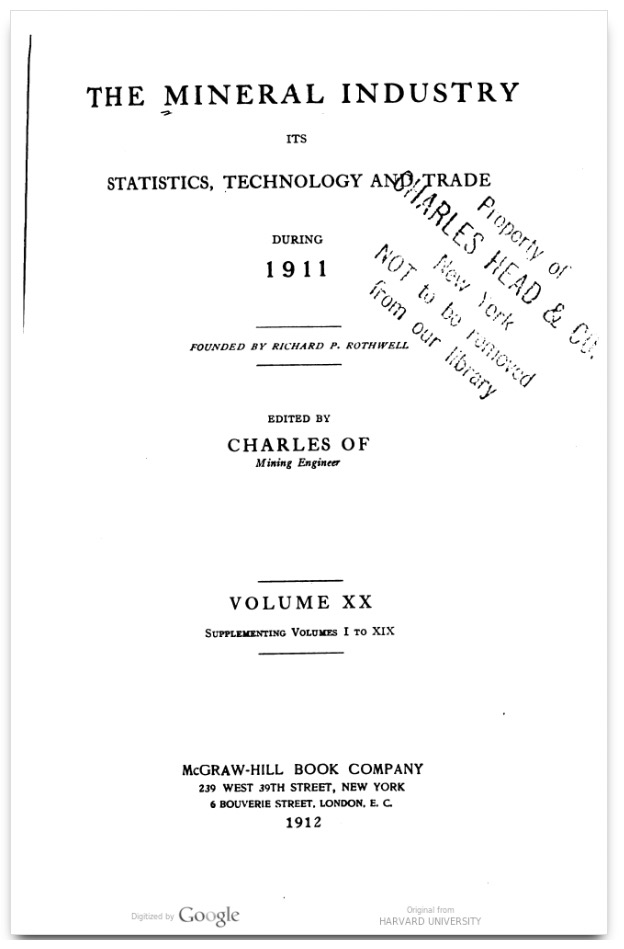
Kunz, G.F. (1911) Precious stones. In: The Mineral Industry… During 1910, Vol. 19 , pp. 563–589.
Record No. 17039  |  Sinkankas/Born No.: 3628; NIB  |  RWHL
A broad review of the international precious-stone industry during 1910, emphasizing diamond production, markets, cutting, and major new gem discoveries. Kunz criticizes misleading trade names and undisclosed artificial gems, discusses the growing use of platinum in jewelry, and notes strong demand for emerald, pearl, sapphire, and other colored stones. Diamond coverage is extensive, including De Beers, Premier, Voorspoed, the Vaal River diggings, German Southwest Africa, the Belgian Congo, Australia, Brazil, British Guiana, Canada, and the developing Arkansas field, together with production statistics and the diamond-cutting industries of Antwerp, Amsterdam, and Germany. Of particular gemological importance is the account of microscopic diamonds in chromite-bearing altered peridotite from British Columbia. Colored stones include the Burma Ruby Mines at Mogok, Montana sapphires, and an extraordinary 110.5-kg transparent aquamarine crystal from Minas Gerais, Brazil. Kunz also introduces the name morganite for the fine rose-colored beryl newly mined in Madagascar, describing its occurrence, properties, and association with tourmaline and kunzite. Further sections treat moldavite and tektites, tourmaline, peridot, jade and jadeite, Ceylon moonstone, Lightning Ridge black opal, Baltic amber, Whitby jet, and pearl fisheries in Bahrain, Ceylon, and the United States.

Morganite, a rose-colored beryl

Journal Article
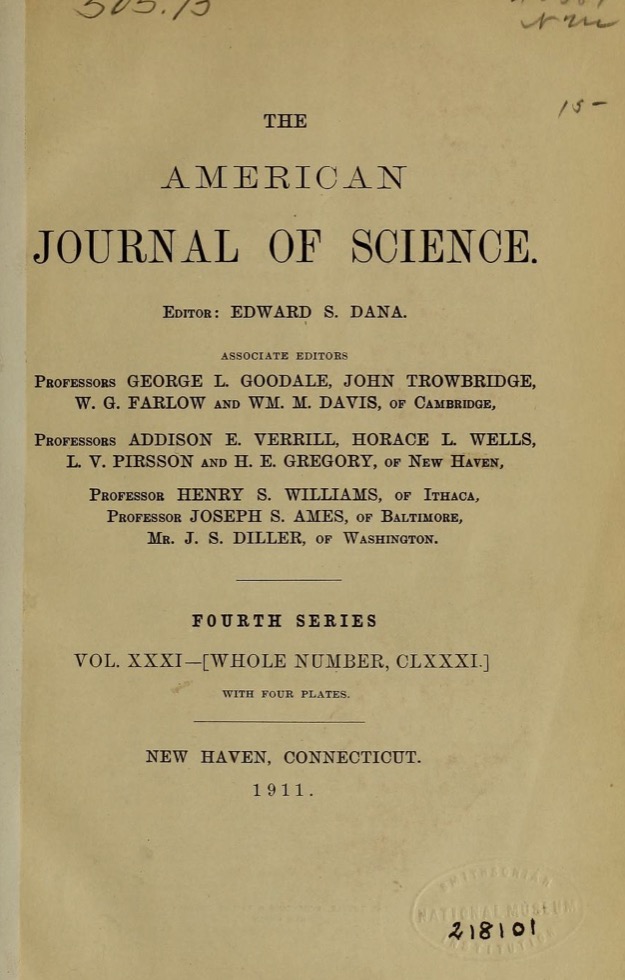
Ford, W.E. (1911) Morganite, a rose-colored beryl. American Journal of Science, Vol. 31, January, p. 81.
Record No. 7342  |  Sinkankas/Born No.: PDF  |  RWHL
The brief notice reports the naming of the newly recognized rose-colored variety of beryl as “morganite,” in honor of J. Pierpont Morgan. It describes the material as a gem variety distinguished by its delicate rose or pink coloration and records the introduction of the name into gemological usage. The note is an early contemporary reference to morganite shortly after the discovery and recognition of this variety of beryl.

The Devil’s Dictionary

Book
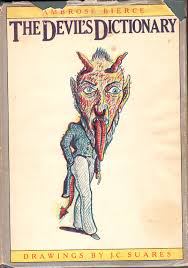
Bierce, A. (1911) The Devil’s Dictionary. New York, Thomas Y. Crowell, 157 pp.
Record No. 2712  |  ISBN/ISSN: 690017642  |  Sinkankas/Born No.: NIS/NIB  |  RWHL
A collection of satirical definitions by American writer Ambrose Bierce, exposing hypocrisy, pretension, sentimentality, and self-interest through concise, frequently cynical reinterpretations of familiar words. Originally developed over many years and first published in book form as The Cynic’s Word Book (1906), the work ranges widely across politics, religion, society, literature, law, marriage, morality, and human behavior. Of gemological interest is Bierce’s celebrated definition of the diamond as “A mineral that frequently makes a woman of a man and a man of a woman.” The work has no scientific significance for gemology, but provides an entertaining example of gemstones, particularly diamonds, as cultural symbols in early twentieth-century American literature.

Über den wert von edelsteinen bei den Muslimen
On the value of precious stones among Muslims
Journal Article
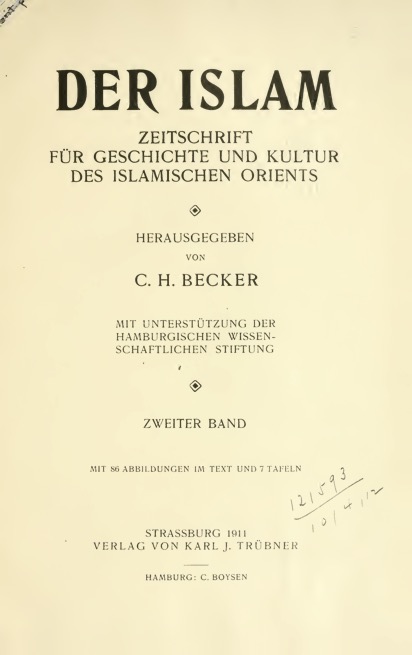
Wiedemann, E. (1911) Über den wert von edelsteinen bei den Muslimen. [On the value of precious stones among Muslims] Der Islam, Vol. 2, pp. 345–358.
Record No. 1851  |  Sinkankas/Born No.: 7186 (not seen); NIB  |  Language: in German  |  RWHL
Wiedemann examines the values assigned to precious stones in medieval Islamic sources, drawing upon Arabic writings on mineralogy, commerce, and gemology. He discusses the prices and relative esteem of various gemstones, including ruby, emerald, sapphire, pearls, and other ornamental materials, and considers the factors affecting their valuation, such as color, quality, size, provenance, and rarity. The paper provides insight into Islamic knowledge of gemstones and the economic and cultural importance attached to them, preserving information from Arabic authors concerning the classification, appraisal, and trade of precious stones.

The geology of northern Afghanistan

Journal Article
Hayden, H.H. (1911) The geology of northern Afghanistan. Memoirs, Geological Survey of India, Vol. 39, Pt. 1, pp. 1–97.
Record No. 941  |  Sinkankas/Born No.: NIS/NIB  |  RWHL
Hayden describes the geology encountered during an expedition through northern Afghanistan, including the Hindu Kush and districts adjoining the upper Oxus, with observations on stratigraphy, structure, mineral deposits, and the physical geography of the region. Of particular gemological interest are accounts of the celebrated mineral localities of Badakhshan, including the ruby-spinel workings and lapis-lazuli deposits, with discussion of their geological setting, character, and history of exploitation. The memoir provides an important early geological description of the mineral resources of this remote region based largely on direct field observation.

The Stone Age in North America

Book
Moorehead, W.K. (1910) The Stone Age in North America. Boston, Houghton Mifflin Co., 2 Vols., 457, 417 pp.
Record No. 28792  |  Sinkankas/Born No.: 4574; NIB  |  RWHL
Sinkankas: Although by far most objects are made from stone and gemmy materials as chalcedony, obsidian, etc., there is no separate discussion of such materials, instead the author describes and comments on stone objects on the basis of their mode of manufacture, i.e., chipping or grinding, but in the second volume devotes separate chapters to objects made from shell, bone, copper, textiles, pottery, and hematite. Broad discussions of the manifestations of the Stone Age in North America follow with several chapters of concluding remarks. An enormous amount of material on gemstones is in the text but it must be sought for. However, there is a good discussion of the Flint Ridge, Ohio colorful chalcedonies and also remarks on obsidian, rock crystal, turquoise, jade, hematite, pearl, shell, catlinite, amber, etc. The large bibliography contains some references to gem materials.

Building a Gemological Library

Gemological books range from general identification manuals and textbooks to specialized works on individual gems, mineralogy, jewelry, treatments, synthesis, history and gem-producing regions.

For a curated selection of particularly useful books, read The Gemologist's Core Library — Classic Books on Gemology, Jewelry and Mineralogy.

About Four Treasures

Four Treasures is Lotus Gemology's freely accessible gemological reference database. Use the full database to search by author, title or keyword and explore literature on gemology, mineralogy, jewelry and related fields. Where available, hyperlinks on titles may lead directly to the full publication.

Search the Complete Four Treasures Database