Gemology Books Bibliography

Gemology Books Bibliography

Explore books on gems, gemology, jewelry and mineralogy in Four Treasures, the Lotus Gemology reference database. This bibliography brings together matching book records from the collection, with publication details, abstracts and cover images where available.

Gemology Book References

The list below matches books concerning gemology and related subjects in the database's searchable fields. Some works cover several branches of gems, jewelry or mineralogy.
2,801–2,820 of 3,454 matching references

The Eldorado of the Ancients

Book
Peters, C. (1902) The Eldorado of the Ancients. London, C. Arthur Pearson, 447 pp.
Record No. 26448  |  Sinkankas/Born No.: NIS/NIB  |  RWHL
In publishing this detailed account of the explorations and researches that occupied me from 1896 to 1902, my aim is to demonstrate that the most ancient civilizations sourced their gold, ivory, and other precious goods from South Africa. My discoveries suggest that the biblical “Ophir” of Solomon’s time corresponds to the region between the Lower Zambesi and the Limpopo River, and they also support the view that the Egyptian “Punt” expeditions for gold, copper, frankincense, and other commodities were directed to the same area. To understand the evidence I present, the reader must accompany me from the Lower Zambesi to the Upper Pungwe, through Macombe’s country—likely the empire of the legendary Monomotapa of the sixteenth century—and then south to the Sabi River. Throughout this region, we encounter the ruins of an ancient gold-mining civilization and vestiges of Punic Baal-Ashera worship that survive to this day. I am confident that three to four thousand years ago, South Africa maintained regular contact with the Erythrean and Mediterranean worlds, forming part of a vast Punic trade network stretching from the Baltic and the Scilly Isles to the Canaries, from Malacca to Bulawayo, from Madagascar to Corsica, encompassing the Indian Ocean, the Mediterranean, and the Atlantic. In presenting this theory, I acknowledge the many explorers and scholars whose work has laid the foundation for my conclusions—Karl Mauch, Theodore Bent and Mr. Swan, Dr. Eduard Glaser, Professor A. H. Keane, Messrs. Hall and Neal, among others mentioned herein—who have all helped to substantiate the South African Ophir theory. Finally, I feel it necessary to explain to a British readership why my focus shifted from German colonial activity in Central East Africa, which engaged me from 1884 to 1896, to this new quest in South Africa. It was not a voluntary departure from my previous work, nor one made lightly, but a path I was ultimately compelled to take. LT: Unreliable reference. Some interesting maps.

Inventories of Christchurch Canterbury; With Historical and Topographical Introductions and Illustrative Documents
Book
Legg, J.W. and Hope, W.H.S.J. (1902) Inventories of Christchurch Canterbury; With Historical and Topographical Introductions and Illustrative Documents. Westminster, Archibald Constable & Co., 379 pp.
Record No. 17077  |  Sinkankas/Born No.: NIS/NIB  |  RWHL
Legg and Hope publish and annotate inventories relating to Christ Church, Canterbury, accompanied by historical and topographical introductions and supporting documents. The records describe the cathedral’s ecclesiastical possessions, including vestments, plate, reliquaries, ornaments, and other treasures, preserving detailed evidence for their materials, decoration, and use. Of particular gemological interest are references to jewels and precious stones set in liturgical and ceremonial objects, providing documentary evidence for the use and terminology of gems in medieval English ecclesiastical treasures.

Precious stones

Book Section
Kunz, G.F. (1902) Precious stones. In: Mineral Resources of the United States | Calendar Year 1901, Washington: Govt. Printing Office, pp. 729–771.
Record No. 17014  |  Sinkankas/Born No.: 3617; NIB  |  RWHL
A comprehensive review of the precious-stone industry and important gemological developments during 1901, which Kunz describes as the most successful year yet in the history of the American trade. U.S. production was valued at $289,060, led by Montana sapphires, turquoise, rhodolite garnet, tourmaline, quartz, and other ornamental stones, while imports of diamonds and other precious stones reached about $22.8 million. Notable developments included a diamond from Lee County, Georgia; expanding sapphire mining at Yogo, Montana; an output of about 200,000 carats of rhodolite from Cowee Valley, North Carolina; colored tourmalines at Mesa Grande, California; chrysoprase near Visalia; new turquoise deposits in Colorado and Nevada and continued major production in New Mexico; large epidote crystals from Alaska; and a jade-like compact idocrase from California. Kunz gives detailed accounts of South African, Guianan, and Bornean diamond mining, Montana sapphire geology and recovery, American corundum deposits, the improving fortunes of the Burma Ruby Mines Company, emerald and beryl occurrences, garnet, quartz varieties, opal, turquoise, apatite, and other gem materials. He also discusses contemporary gem cutting and jewelry fashions and comments extensively on Chinese jade objects reaching Western markets following the looting associated with recent conflicts in China. The report concludes with statistical tables of U.S. precious-stone production from 1896–1901 and imports from 1867–1901.

The Travels of Pedro Teixeira

Edited Book
Sinclair, W.F. and Ferguson, D., editor (1902) The Travels of Pedro Teixeira.. London, Hakluyt Society, Second Series, No. 9 , 292 pp.. Reprinted by Kraus, 1967.
Record No. 4653  |  Sinkankas/Born No.: NIS/NIB  |  RWHL
An English translation of portions of Pedro Teixeira’s Relaciones, combining his own travels with his historical accounts of the kings of Hormuz and Persia. Teixeira, a Portuguese traveller active around 1600, journeyed extensively through India and the Persian Gulf and later returned to Europe overland by way of Basra, Baghdad, Aleppo and the Mediterranean. Of particular gemological importance is his detailed description of the Bahrain pearl fishery, which he observed firsthand. He records that fishing normally began in July and continued through August, involving a fleet of roughly 200 vessels from Bahrain, Julfar and Nihhelu, with much of the fishing conducted near Qatar. Oysters were opened immediately after recovery and the pearls removed; Teixeira considered the pearls of the Persian Gulf superior in quality and weight to those from other regions. His descriptions provide valuable early evidence for the organization, geography and commercial importance of Gulf pearling and for Hormuz’s role as an entrepôt linking the trade of Persia, Arabia and India. The volume also contains historical material on the rulers of Hormuz and Persia and extensive editorial notes placing Teixeira’s observations within the broader literature of early European travel in Asia.

Amrita: The Legend of the Sapphire

Book
Fornaro, C., De (1902) Amrita: The Legend of the Sapphire. New York, Marcus & Co., 18 pp.
Record No. 2761  |  Sinkankas/Born No.: 2180E; NIB  |  RWHL
De Fornaro presents a short literary legend centered on Amrita and a sapphire, using the gemstone as a central element in a romantic and exotic tale. Rather than a scientific or gemological work, the story reflects contemporary cultural and symbolic associations of sapphire and is of interest to gemological bibliography as an example of the treatment of precious stones in popular literature at the beginning of the twentieth century.

Descriptive catalogue of the collection of gems in the U.S. National Museum
Journal Article
Tassin, W. (1902) Descriptive catalogue of the collection of gems in the U.S. National Museum. Report of the United States National Museum for the year ending June 30, 1900, pp. 473–670.
Record No. 1680  |  Sinkankas/Born No.: 6498; NIB  |  RWHL
Sinkankas: Tassin’s work is considerably more than a catalogue, amounting to a compact treatise on gemology. It opens with the general properties of gemstones, followed by an extensive alphabetical account of individual gems and varieties with brief notes on their characteristics. Further sections provide identification tables based on color and optical effects, a glossary of gem names, discussions of lapidary work and manufactured gemstones, and substantial treatments of gems mentioned in the Bible and of traditional gem lore, making the book a useful guide to ancient and historical gem literature. Only in the ninth section does Tassin present the catalogue proper, describing the Isaac Lea gem collection with dimensions, color, weight and provenance. The volume concludes with a large bibliography, apparently derived from or expanded beyond Harry Emanuel’s earlier work, though it contains incomplete citations, missing pagination and numerous errors.

Prince Tissa: The Legend of the Ruby

Book
Fornaro, C., De (1901) Prince Tissa: The Legend of the Ruby. New York, Marcus & Co., 16 pp.
Record No. 2760  |  Sinkankas/Born No.: 2180B; NIB  |  RWHL
De Fornaro presents a short literary legend centered on Prince Tissa and a ruby, using the gemstone as a central element in a tale of royalty, desire, and fate. Rather than a scientific or gemological study, the work reflects the cultural and symbolic associations attached to ruby at the beginning of the twentieth century and is of interest chiefly as an example of the gemstone’s treatment in popular literature.

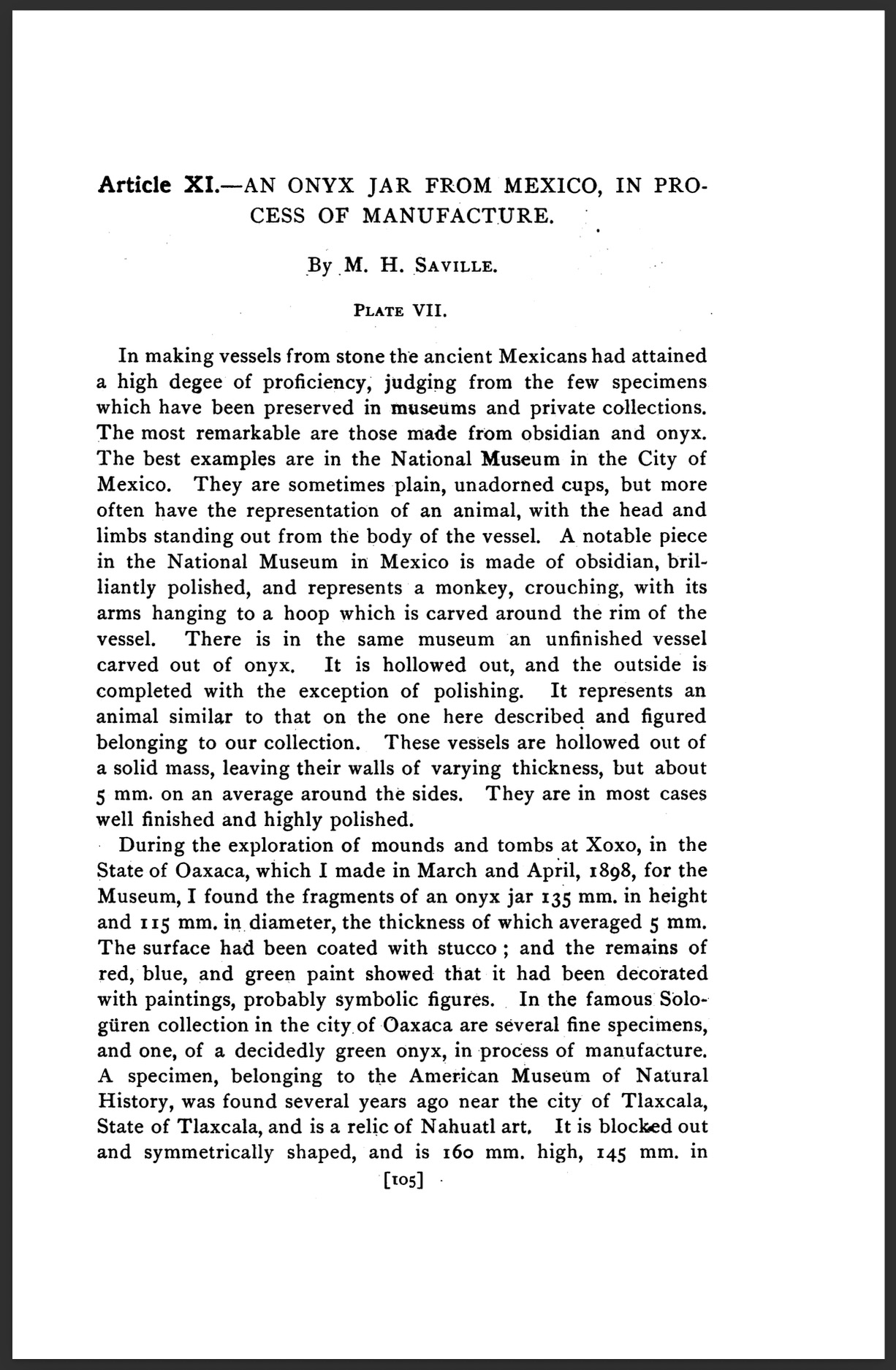
An onyx jar from Mexico, in process of manufacture
Journal Article
Saville, M.H. (1900) An onyx jar from Mexico, in process of manufacture. Bulletin of the American Museum of Natural History, Vol. 13, No. 11, pp. 105–107.
Record No. 28624  |  Sinkankas/Born No.: NIS/NIB  |  RWHL
In making vessels from stone, the ancient Mexicans attained a high degree of proficiency, judging from the few specimens that have been preserved in museums and private collections. The most remarkable are those made from obsidian and onyx. Some of the finest examples are housed in the National Museum in Mexico City. These vessels are sometimes plain, unadorned cups, but more often incorporate representations of animals, with the head and limbs projecting from the body of the vessel. One notable example in the museum is carved from brilliantly polished obsidian and depicts a crouching monkey, its arms hanging from a hoop carved around the rim. The same museum also possesses an unfinished vessel carved from onyx. Hollowed out but not yet polished, it represents an animal similar to that depicted on the example described and illustrated from the present collection. Such vessels were carved from a single solid block of stone, leaving walls of varying thickness, averaging about 5 mm around the sides. In most cases they are finely finished and highly polished.

Jade in America

Conference Paper
Wilson, T. (1900) Jade in America. Congrès International de Américanistes, Paris pp. 141–187.
Record No. 28503  |  Sinkankas/Born No.: 7274; NIB  |  RWHL
Sinkankas: One of the most valuable papers published in North America on jade and little known because of being embodied in a relatively obscure journal. Thomas Wilson commences with a review of all that was known of jade, its nomenclature, its sources, etc., from the earliest mentions that he could find in the literature, citing such authors as Pliny the Elder, Georgius Agricola, John Mandeville, Ulisse Aldrovandi and others, especially those who wrote of the jade of Mexico and the confusing terminology which was applied to green stones and therefore embracing nephrite, turquoise, and even emerald. The use of jades in Mexico is especially treated, and then, passing on to the jade of the Pacific Northwest & Alaska, we find a true bibliographical rarity indeed when Wilson states “No official report has been published [on Alaskan jade], but the following statement of the expedition, including the discovery of Jade Mountain, has been furnished me by Lieutenant-Commander George M. Stoney: … [p. 157–162].” In his account, Stoney tells of his travels in Alaska, his excursions up the Kobuk River, and his discovery of the deposits and collections of specimens, over a time span of three expeditions in 1881, 1883, and 1885–1886. For another account by Stoney, see elsewhere under his own name. Wilson then passes on to a discussion of nephrite and jadeite, then other places where nephrite occurs in Canada, citing George Mercer Dawson in this regard. From p. 171, Wilson now compares the two jades, their occurrences in Europe, the findings of Auguste Damour and Horace-Bénédict de Saussure, mineralogical composition, with a plate of thin-section photographs, and the great Jade Question or “Migration” as Wilson captions this section. An invaluable work which must be consulted by anyone researching the jades of the Western Hemisphere.

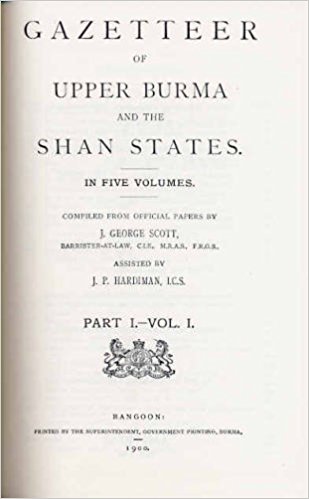
Gazetteer of Upper Burma and the Shan States
Book
Scott, J.G. and Hardiman, J.P. (1900–1901) Gazetteer of Upper Burma and the Shan States. Rangoon, Government Printing, Burma, 5 Vols., Vol. 2, Part 1, Section 7, Geology and economic mineralogy; Vol. 2, Part 2, Mogok , 560 pp.
Record No. 4671  |  Sinkankas/Born No.: NIS/NIB  |  RWHL
Scott and Hardiman’s Gazetteer of Upper Burma and the Shan States provides an extensive geographical, historical, administrative, ethnographic, and economic survey of Upper Burma and the Shan States at the beginning of the twentieth century. Of particular gemological importance are the sections on geology and economic mineralogy and the detailed account of Mogok, including information on the region’s mineral resources, ruby and other gemstone deposits, mining localities, methods of extraction, and the organization and economic significance of the gem industry. The work preserves valuable contemporary observations on the celebrated Mogok ruby-mining district and provides important historical context for the exploitation and trade of Burmese gemstones under British colonial administration.

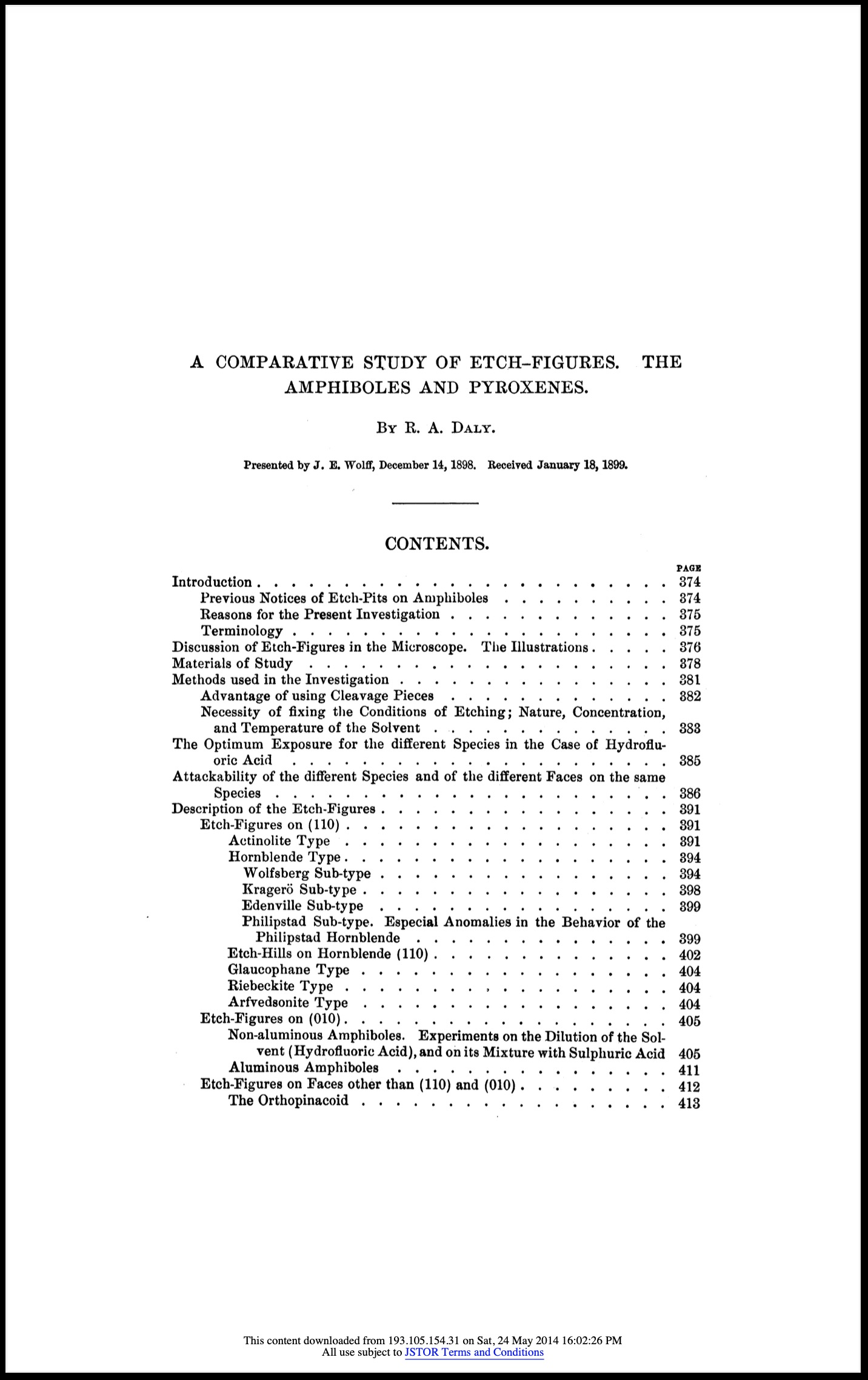
A comparative study of etch-figures: The amphiboles and pyroxenes
Journal Article
Daly, R.A. (1899) A comparative study of etch-figures: The amphiboles and pyroxenes. Proceedings of the American Academy of Arts and Sciences, Vol. 34, No. 15, March, pp. 373–430.
Record No. 6920  |  ISBN/ISSN: 1999818  |  DOI: https://dx.doi.org/10.2307/20020908  |  Sinkankas/Born No.: NIS/NIB  |  RWHL
Daly presents an experimental comparative study of etch figures produced on amphiboles and pyroxenes, using the forms developed by chemical attack on crystal surfaces to investigate the internal symmetry and structural relationships of these closely related mineral groups. He examines etched surfaces on a range of amphibole and pyroxene species, recording the orientation, shape, symmetry, and distribution of the resulting microscopic figures on different crystallographic faces. By comparing these features with the crystallographic properties of the minerals, Daly explores similarities and differences within and between the two groups and considers the significance of etch figures for determining crystal symmetry, orientation, twinning, and structural relationships. The study demonstrates the usefulness of controlled chemical etching as a supplementary method of crystallographic investigation and contributes to the contemporary discussion of the close morphological and chemical relationships between amphiboles and pyroxenes. The paper is relevant to gemology through its treatment of mineral groups that include jade constituents such as tremolite and jadeite.

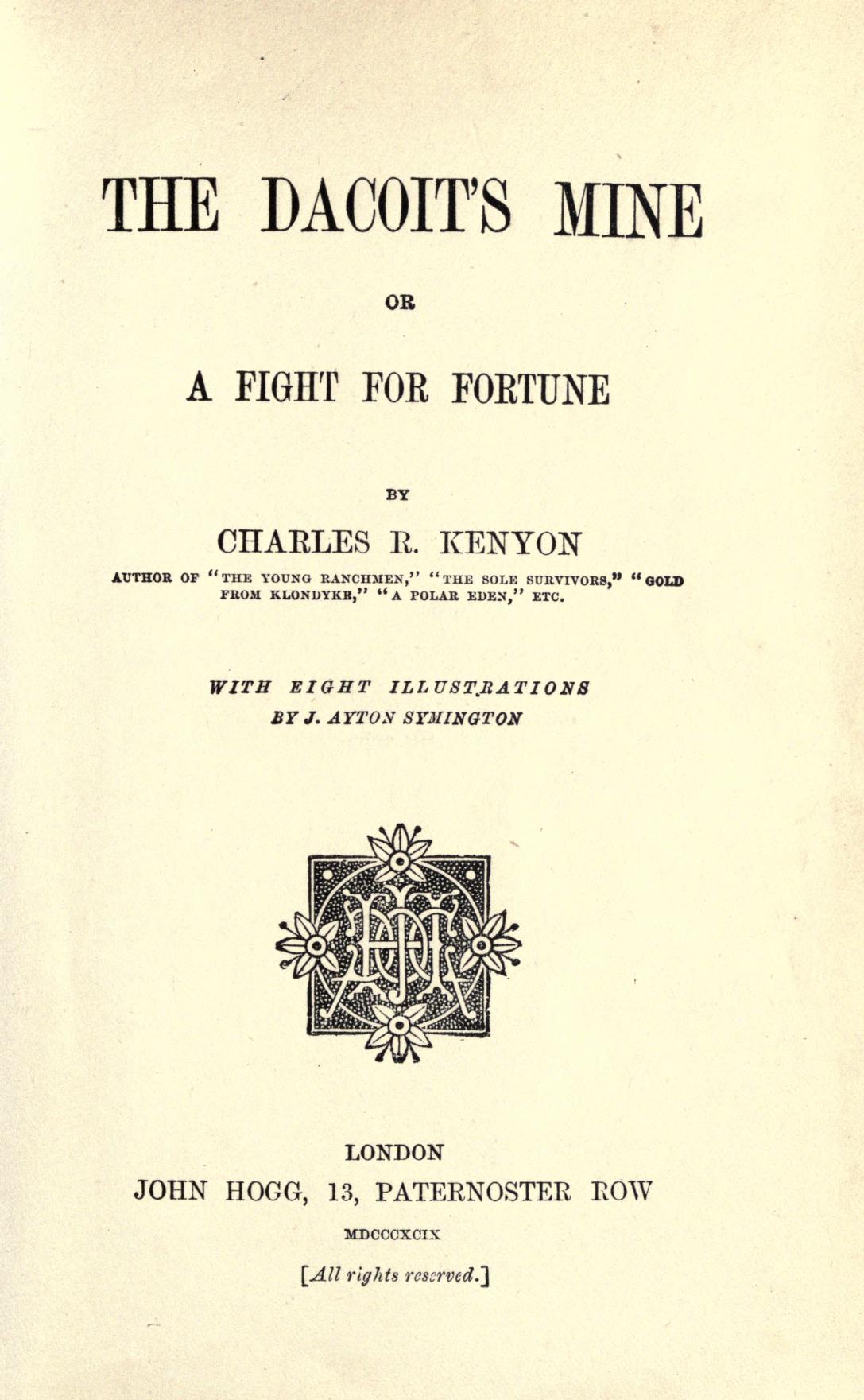
The Dacoit’s Mine

Book
Kenyon, C.R. (1899) The Dacoit’s Mine. London, John Hogg, viii + 382 pp.
Record No. 2799  |  Sinkankas/Born No.: NIS/NIB  |  RWHL
Kenyon’s The Dacoit’s Mine: A Tale of Adventure in Burma is a juvenile adventure novel set in British Burma and centered on a search for mineral wealth amid the dangers posed by dacoits, or armed bandits. The story follows its protagonists through the Burmese interior, combining exploration, travel, encounters with local peoples, and conflict with the dacoits with the discovery and exploitation of a valuable mine. The mineral deposit and the prospect of obtaining precious stones provide an important motive for the action, placing the novel within the late nineteenth-century genre of imperial adventure fiction in which remote Asian mineral wealth figures prominently. Descriptions of the Burmese landscape, mining, gems, and the hazards of travel provide contemporary popular-literary context for European perceptions of Burma as a source of extraordinary mineral riches. Although fictional rather than a scientific or historical account, the book is of gemological interest for its representation of gemstone mining and the popular fascination with the precious-stone resources of Burma at the end of the nineteenth century.

The Embassy of Sir Thomas Roe to the Court of the Great Mogul
Edited Book
Foster, W., editor (1899) The Embassy of Sir Thomas Roe to the Court of the Great Mogul.. London, Hakluyt Society, 2 Vols., Vols 1–2 , 586 pp.. Reprinted by Kraus, 1967.
Record No. 2763  |  Sinkankas/Born No.: NIS/NIB  |  RWHL
Foster’s edition of The Embassy of Sir Thomas Roe to the Court of the Great Mogul, 1615–1619 presents Roe’s journal and correspondence from his mission as ambassador of James I to the Mughal emperor Jahangir. The narrative records Roe’s travels in India, his experiences at the imperial court, negotiations concerning English commercial privileges, and his observations of Mughal government, ceremonies, society, and trade. Of particular gemological interest are his descriptions of Jahangir’s court and treasury, where precious stones, pearls, jeweled weapons, ornaments, and lavish imperial gifts figured prominently in displays of wealth and authority. Roe records exchanges of jewels and other valuables, comments on their appraisal and desirability, and provides firsthand evidence for the importance of gems within Mughal diplomatic and court culture. Foster supplements the seventeenth-century documents with an introduction and extensive notes identifying people, places, events, and historical circumstances, making the two-volume edition an important primary source for the study of Mughal India and its commerce in precious objects.

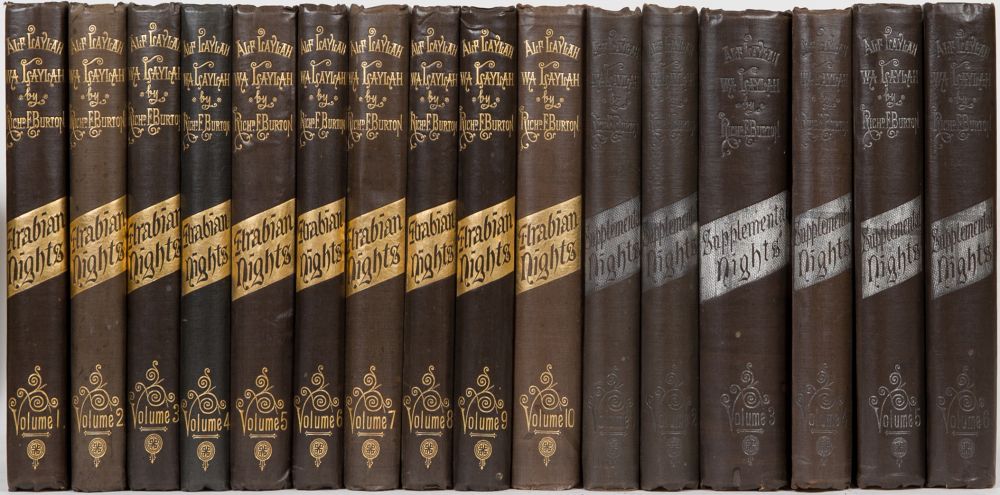
The Book of the Thousand Nights and a Night
Book
Burton, R.F. (1899) The Book of the Thousand Nights and a Night. Denver, CO, Burton Society of Denver, Vol. 5, pp. 340–343; Vol. 6, pp. 16–23, 64–69
Record No. 2724  |  Sinkankas/Born No.: NIS/NIB  |  RWHL
Burton’s The Book of the Thousand Nights and a Night, his translation of the Arabian Nights, contains numerous references to precious stones, jewelry, and fabulous treasures reflecting the luxury and gem lore of the medieval Islamic world. The cited passages in Vols. 5 and 6 include descriptions of gems and jeweled objects embedded in tales of merchants, rulers, magical adventures, and extraordinary wealth. Diamonds, rubies, emeralds, pearls, and other precious materials appear both as commodities of immense value and as components of magnificent ornaments and treasures, while some passages preserve traditional beliefs concerning the sources and properties of stones. Burton’s extensive notes supplement the tales with linguistic, historical, geographical, and ethnographic commentary, often explaining Arabic and Persian names for gems and contemporary practices connected with their trade and valuation. For gemological research, these passages are valuable primarily as literary and cultural evidence for the terminology, symbolism, commerce, and popular conceptions surrounding precious stones in the Arabic and Persian traditions transmitted through the Thousand Nights and a Night.

Ralph Fitch, England’s Pioneer to India and Burma: his Companions and Contemporaries, with his Remarkable Narrative Told in his Own Words
Book
Ryley, J.H. (1899) Ralph Fitch, England’s Pioneer to India and Burma: his Companions and Contemporaries, with his Remarkable Narrative Told in his Own Words. London, T. Fisher Unwin, 264 pp. (see pp. 172–173)
Record No. 1518  |  Sinkankas/Born No.: NIS/NIB  |  RWHL
Ryley reconstructs the life and travels of Ralph Fitch, one of the earliest English merchants to journey extensively through India and Burma, placing Fitch’s own sixteenth-century narrative within a biographical and historical account of his companions and contemporaries. Fitch left England in 1583 and travelled through the eastern Mediterranean and Persian Gulf to India, visiting Portuguese Goa, the Mughal territories, Bengal, Pegu in Burma, and other commercial centers before returning to England in 1591. His observations provide early English evidence for Asian trade, commodities, cities, courts, religious practices, and commercial routes shortly before the foundation of the English East India Company. Of particular gemological interest, [172–173] describe Pegu and its commerce, including the trade in rubies, sapphires, and spinels and the importance of precious stones among the valuable commodities associated with Burma. Ryley supplements Fitch’s narrative with explanatory notes and historical material, making the volume a useful source for the early European history of the Burmese gemstone trade.

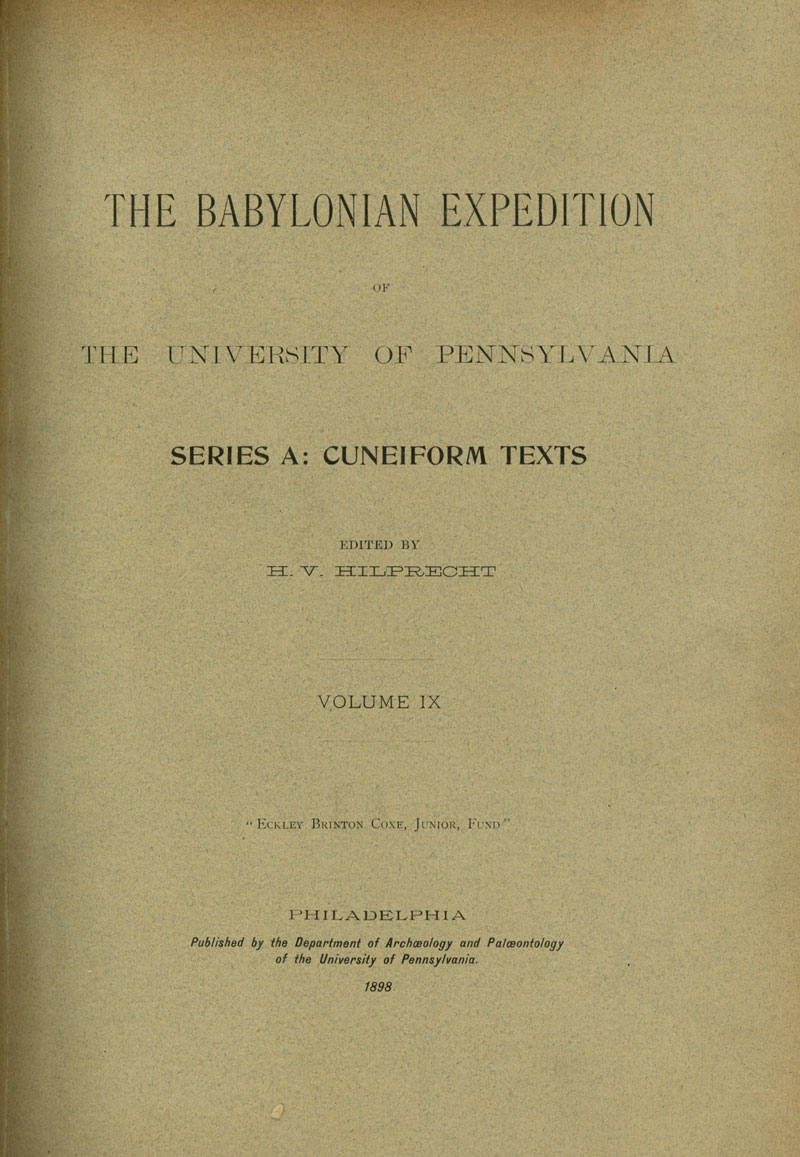
The Babylonian Expedition of the University of Pennsylvania. Series A: Cuneiform Texts
Book
Hilprecht, H.V. and Clay, A.T. (1898) The Babylonian Expedition of the University of Pennsylvania. Series A: Cuneiform Texts. Philadelphia, University of Pennsylvania
Record No. 17075  |  ISBN/ISSN: 9781510000000  |  Sinkankas/Born No.: NIS/NIB  |  RWHL
Hilprecht and Clay’s The Babylonian Expedition of the University of Pennsylvania, Series A: Cuneiform Texts forms part of the publication of tablets and inscriptions recovered principally by the University of Pennsylvania expedition to Nippur. The series presents cuneiform texts in facsimile, transcription, and, where appropriate, translation and commentary, encompassing religious, literary, lexical, mathematical, administrative, legal, and economic documents from ancient Mesopotamia. Individual volumes provide primary evidence for the Sumerian and Akkadian languages and for Babylonian religion, commerce, law, science, and everyday life. Of gemological interest are texts and lexical materials containing names for stones, minerals, metals, and manufactured objects, which contribute to the identification of ancient Mesopotamian terminology for precious and ornamental materials and to understanding their trade and use. The series is therefore an important primary source for the study of Babylonian material culture and the terminology and historical uses of stones in the ancient Near East.

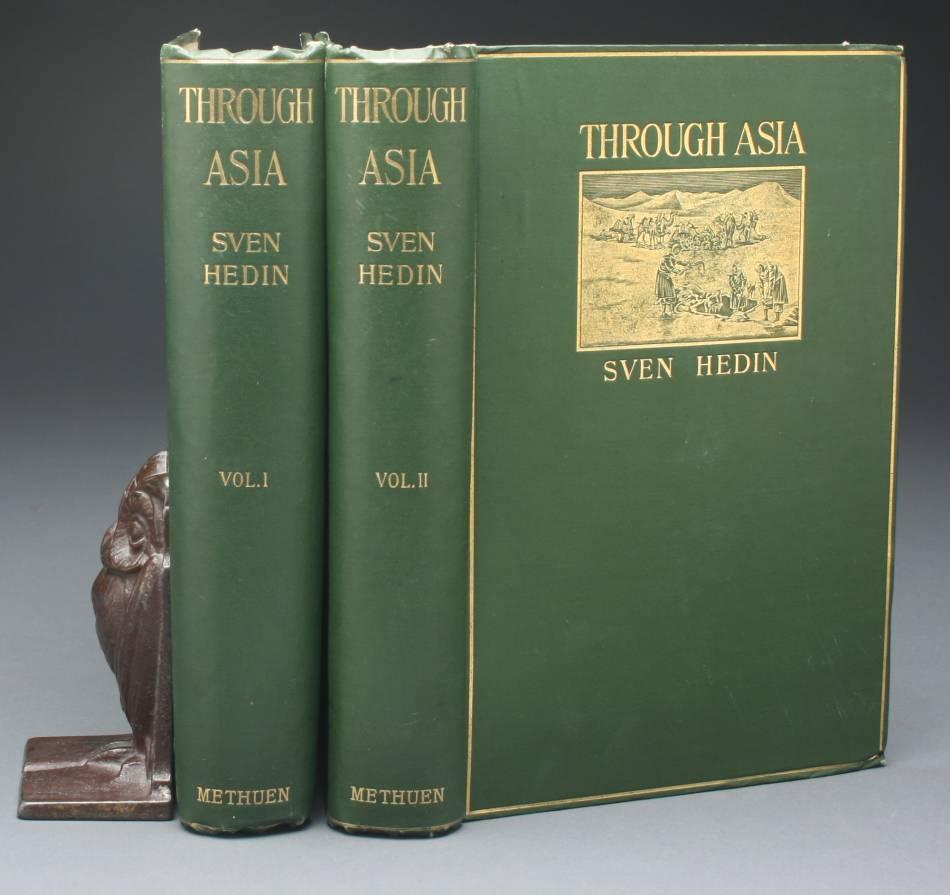
Through Asia

Book
Hedin, S. (1898) Through Asia. London, Methuen & Co., 2 Vols., 1278 pp.
Record No. 3575  |  Sinkankas/Born No.: NIS/NIB  |  RWHL
Hedin’s Through Asia recounts his extensive travels of 1893–1897 through Russian Turkestan, the Pamirs, the Tarim Basin, the Taklamakan Desert, and adjoining regions of Chinese Central Asia. Combining travel narrative with geographical and scientific observation, he describes journeys through Kashgar, Yarkand, Khotan, and other Central Asian centers, hazardous desert crossings, exploration of rivers and lakes, mountain routes, settlements, peoples, trade, and political conditions. His observations provide detailed information on the geography and ethnography of regions then imperfectly known to Europeans. Of particular gemological interest are his visits to the Khotan region and references to its celebrated jade industry, including the recovery of nephrite from rivers and mountain deposits and its importance in local commerce and trade with China. The two volumes, extensively illustrated and supplied with maps, established Hedin as one of the foremost European explorers of Central Asia and provide valuable contemporary observations on the traditional jade-producing districts of Chinese Turkestan.

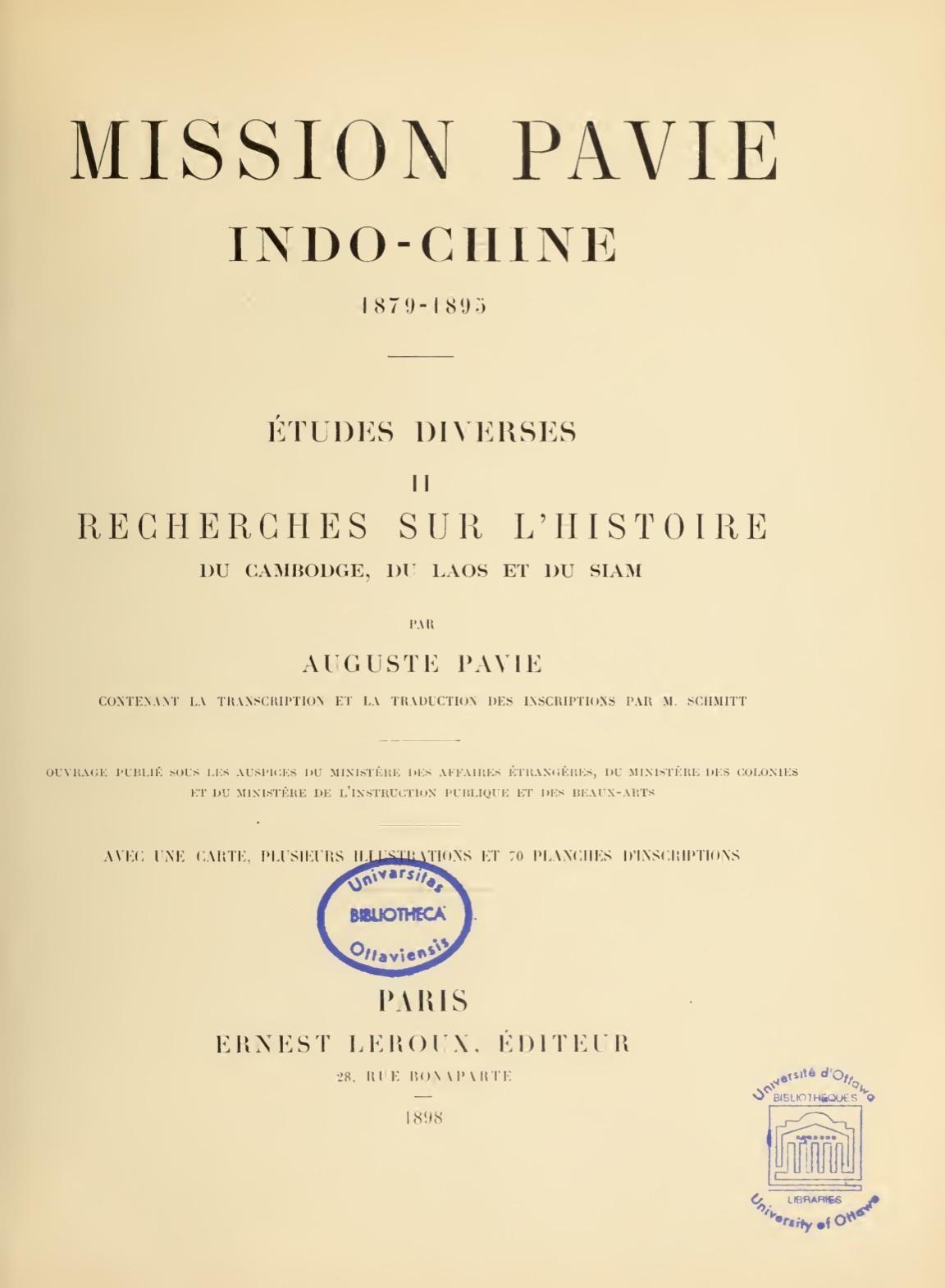
Mission Pavie Indo-Chine 1879–1895: 1. Exposé des travaux de la mission (1879-1889), par A Pavie.- 2. Exposé des travaux de la mission (1889–1895), par A. Pavie.- 3. Voyages au Laos, par Cap. Cupet.- 4. Voyages au centre de l'Annam et du Laos, par le Cap. de Malglaive et par le Cap. Rivière.- 5. Voyages dans le haut Laos, par P. Lefèvre-Pontalis.- 6. Passage du Mé-Khong au Tonkin (1887–1888) par Auguste Pavie.- Vol. 7. Journal de marche (1888-1889); Événements du Siam (1891–1893)

Pavie Mission Indo-China 1879–1895
Book
Pavie, A. (1898–1919) Mission Pavie Indo-Chine 1879–1895: 1. Exposé des travaux de la mission (1879-1889), par A Pavie.- 2. Exposé des travaux de la mission (1889–1895), par A. Pavie.- 3. Voyages au Laos, par Cap. Cupet.- 4. Voyages au centre de l'Annam et du Laos, par le Cap. de Malglaive et par le Cap. Rivière.- 5. Voyages dans le haut Laos, par P. Lefèvre-Pontalis.- 6. Passage du Mé-Khong au Tonkin (1887–1888) par Auguste Pavie.- Vol. 7. Journal de marche (1888-1889); Événements du Siam (1891–1893). [Pavie Mission Indo-China 1879–1895] Paris, Éditions Ernst Leroux, 7 Vols.
Record No. 3355  |  Sinkankas/Born No.: NIS/NIB  |  Language: in French  |  RWHL
Pavie’s monumental Mission Pavie Indo-Chine 1879–1895 records the geographical, political, ethnographic, and scientific work of the French expeditions led by Auguste Pavie through Laos, Cambodia, Siam, Annam, Tonkin, and neighboring regions. The seven volumes contain Pavie’s own narratives together with accounts by members of the mission, including Captains Cupet, de Malglaive, and Rivière and Pierre Lefèvre-Pontalis, documenting journeys through the Mekong basin, central and northern Laos, and routes connecting the Mekong with Vietnam. They describe geography, river systems, mountain routes, peoples, commerce, natural resources, communications, and political conditions, accompanied by maps and other illustrations. The later narratives also document the diplomatic and territorial conflicts between France and Siam culminating in the events of 1893. For gemological and mineralogical research, the work provides contemporary observations on the natural resources, trade, and local products of regions of mainland Southeast Asia that included important gem-producing and gem-trading areas, while preserving detailed geographical information from a period when much of the interior was still poorly documented by Europeans.

Aperçu sur les gîtes minéraux de l'Indochine centrale connus en 1897
Journal Article
Bel, J.-M. (1898) Aperçu sur les gîtes minéraux de l'Indochine centrale connus en 1897. Bulletin de la Société de l’Industrie Minerale, Third Series, Vol. 7, pp. 381–407.
Record No. 451  |  Sinkankas/Born No.: NIS/NIB  |  RWHL
Bel provides a firsthand survey of the mineral resources known in central Indochina in 1897, based largely on his scientific and industrial missions of 1893, 1895, and 1897. Of particular gemological interest is his account of the ruby and sapphire deposits of eastern Siam. In the Chantaboun massif, an English company had for several years worked the region’s precious stones, principally rubies with some sapphires; Bel states that the gems of Chantaboun were reported to be of mediocre quality, although he had not personally visited the deposits. [391–392] Near Luang Prabang, he reports additional precious-stone deposits, particularly sapphires, noting that Auguste Pavie had shown him fine specimens obtained following his mission in Upper Laos. [392] Bel concludes that the mountainous divide between the Menam and Mekong offered considerable scope for further exploration and might contain precious stones of good value. [392–393] Elsewhere he notes the possibility of gems in Cambodia, although the region remained unexplored. [394] The paper also gives extensive firsthand information on gold deposits and mining in Siam, Lower Laos, the Khas country, and Annam, together with occurrences of silver-bearing galena, copper, iron, coal, and tin, providing a valuable contemporary overview of mineral exploration in mainland Southeast Asia at the end of the nineteenth century. [384–407]

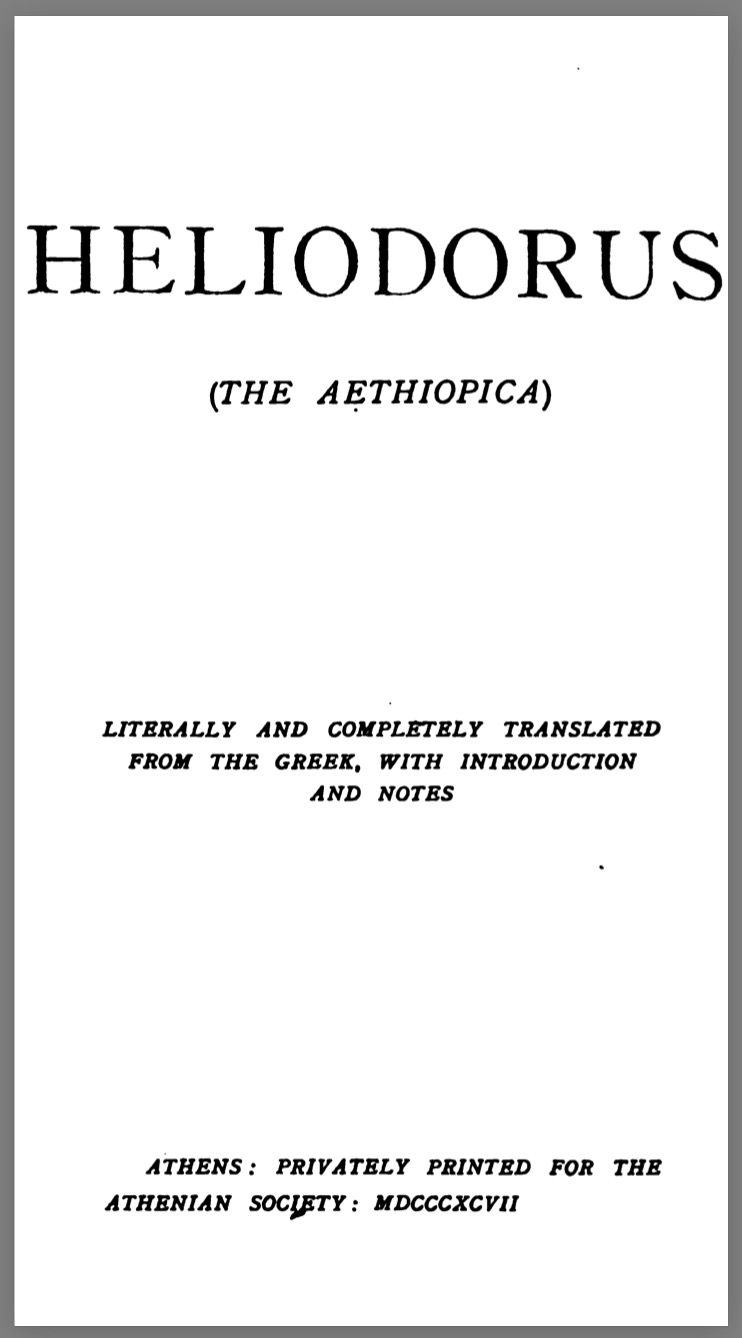
The Aethiopica

Book
Heliodorus (1897) The Aethiopica. Athens, The Athenian Society, 417 pp.
Record No. 17074  |  Sinkankas/Born No.: NIS/NIB  |  Language: in Greek and English  |  RWHL
The Aethiopica is a novel written by the Greek writer Heliodorus in the 3rd century AD. The story is set in ancient Ethiopia and follows the adventures of two young lovers, Charicleia and Theagenes, as they navigate through a series of trials and tribulations. The novel is known for its intricate plot, which involves mistaken identities, kidnappings, battles, and divine interventions. It also explores themes of love, loyalty, and the conflict between different cultures and religions. The 1897 edition of the novel, translated by Thomas Underdowne, includes an introduction that provides historical and literary context for the work. The text is presented in English, with occasional footnotes to clarify obscure references and provide additional information.

Building a Gemological Library

Gemological books range from general identification manuals and textbooks to specialized works on individual gems, mineralogy, jewelry, treatments, synthesis, history and gem-producing regions.

For a curated selection of particularly useful books, read The Gemologist's Core Library — Classic Books on Gemology, Jewelry and Mineralogy.

About Four Treasures

Four Treasures is Lotus Gemology's freely accessible gemological reference database. Use the full database to search by author, title or keyword and explore literature on gemology, mineralogy, jewelry and related fields. Where available, hyperlinks on titles may lead directly to the full publication.

Search the Complete Four Treasures Database