Gemology Books Bibliography

Gemology Books Bibliography

Explore books on gems, gemology, jewelry and mineralogy in Four Treasures, the Lotus Gemology reference database. This bibliography brings together matching book records from the collection, with publication details, abstracts and cover images where available.

Gemology Book References

The list below matches books concerning gemology and related subjects in the database's searchable fields. Some works cover several branches of gems, jewelry or mineralogy.
2,821–2,840 of 3,454 matching references

Precious stones

Book Section
Kunz, G.F. (1897) Precious stones. In: Eighteenth Annual Report of the United States Geological Survey, Washington: Govt. Printing Office, 5 Vols., Part 5.—Mineral Resources of the United States, 1896, Nonmetallic Products, Except Coal , pp. 1183–1218.
Record No. 17034  |  Sinkankas/Born No.: 3611; NIB  |  RWHL
Kunz surveys developments in precious stones during 1896, beginning with notable discoveries and events of the year and then treating diamonds in considerable detail, including American occurrences, the South African mines and their production, mining methods, trade, cutting, import duties, and the growing diamond-cutting industry in the United States. He discusses the occurrence and artificial production of ruby, with descriptions of the ruby mines of Siam and Burma, and gives particular attention to new sapphire discoveries in Montana, including the Yogo/Fergus County deposits. Other sections record American occurrences of andalusite, kyanite, tourmaline, turquoise, garnet, quartz and rock crystal, amethyst, chrysoprase, chalcedony, plasma, moss agate, and opal, together with new mineral discoveries. Kunz also discusses gem collections and exhibitions, experiments on the behavior of gems under Röntgen rays, and contemporary work on artificial production of precious stones. The report concludes with statistical tables of United States gem production, valued at $113,621 for 1896, historical production figures, and imports of diamonds and other precious stones, providing a detailed picture of both the scientific and commercial state of gemology at the end of the nineteenth century.

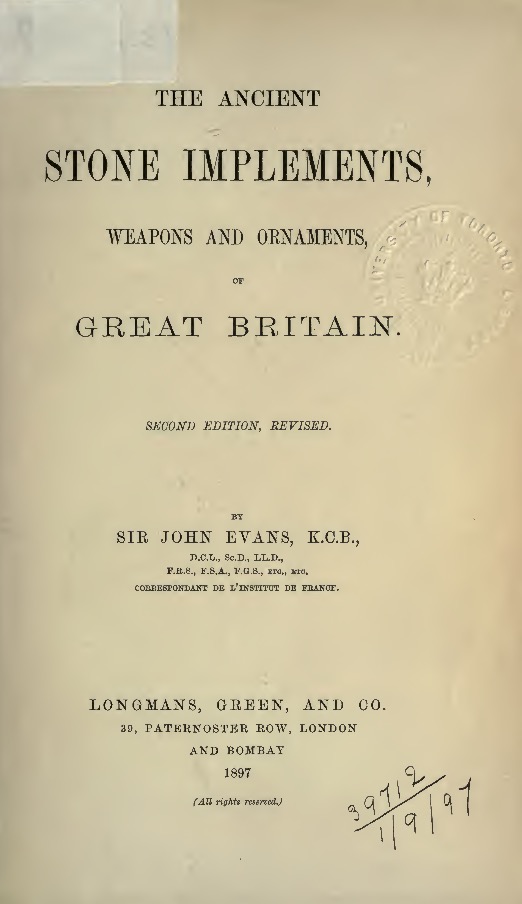
The ancient stone implements, weapons, and ornaments of Great Britain
Book
Evans, J. (1897) The ancient stone implements, weapons, and ornaments of Great Britain. London, Longmans, 747 pp.
Record No. 7954  |  Sinkankas/Born No.: NIS  |  RWHL
Evans’s substantially revised second edition of The Ancient Stone Implements, Weapons, and Ornaments of Great Britain provides a comprehensive survey of prehistoric stone artifacts found in Britain, incorporating discoveries made since the first edition of 1872. He describes and classifies chipped and polished axes and celts, adzes, chisels, hammers, mace-heads, perforated implements, flint knives, scrapers, arrow- and spear-heads, and personal ornaments, discussing their forms, manufacture, distribution, probable uses, and archaeological contexts. Particular attention is given to the lithic materials from which implements were fashioned and to techniques of flaking, grinding, polishing, boring, and sawing. Evans compares British specimens with related objects from continental Europe and other regions and considers questions of chronology, trade, and the movement of desirable stone materials. Of gemological interest are discussions of jade and other exceptionally tough green stones used for polished implements and ornaments, including the nineteenth-century debate over the provenance of European nephrite and jadeite artifacts.

The Topographia Christiana of Cosmas Indicopleustes
Book
Cosmas Indicopleustes (1897) The Topographia Christiana of Cosmas Indicopleustes. London, Hakluyt Society, First Series, No. 99
Record No. 2741  |  Sinkankas/Born No.: NIS/NIB  |  RWHL
Ravenstein’s translation of the Christian Topography of Cosmas Indicopleustes presents the sixth-century account of a merchant and traveler who had extensive knowledge of the Red Sea, northeastern Africa, Arabia, India, and the Indian Ocean trade. Although primarily a Christian cosmographical and theological work, it contains valuable geographical and commercial information derived from Cosmas’s travels and mercantile experience. Of particular gemological interest are his references to precious stones and their sources and trade, including sapphires associated with Ceylon (Taprobane), which he describes as an important entrepôt receiving merchandise from India, Persia, Ethiopia, and other regions and redistributing it through the Indian Ocean trading network. Cosmas also records products such as pearls, spices, silk, and other valuable commodities and provides evidence for the extensive maritime commerce connecting the Mediterranean and Red Sea worlds with India and Ceylon in late antiquity. Ravenstein’s edition includes an introduction, notes, and geographical commentary that place Cosmas’s observations within the historical geography of early Indian Ocean trade.

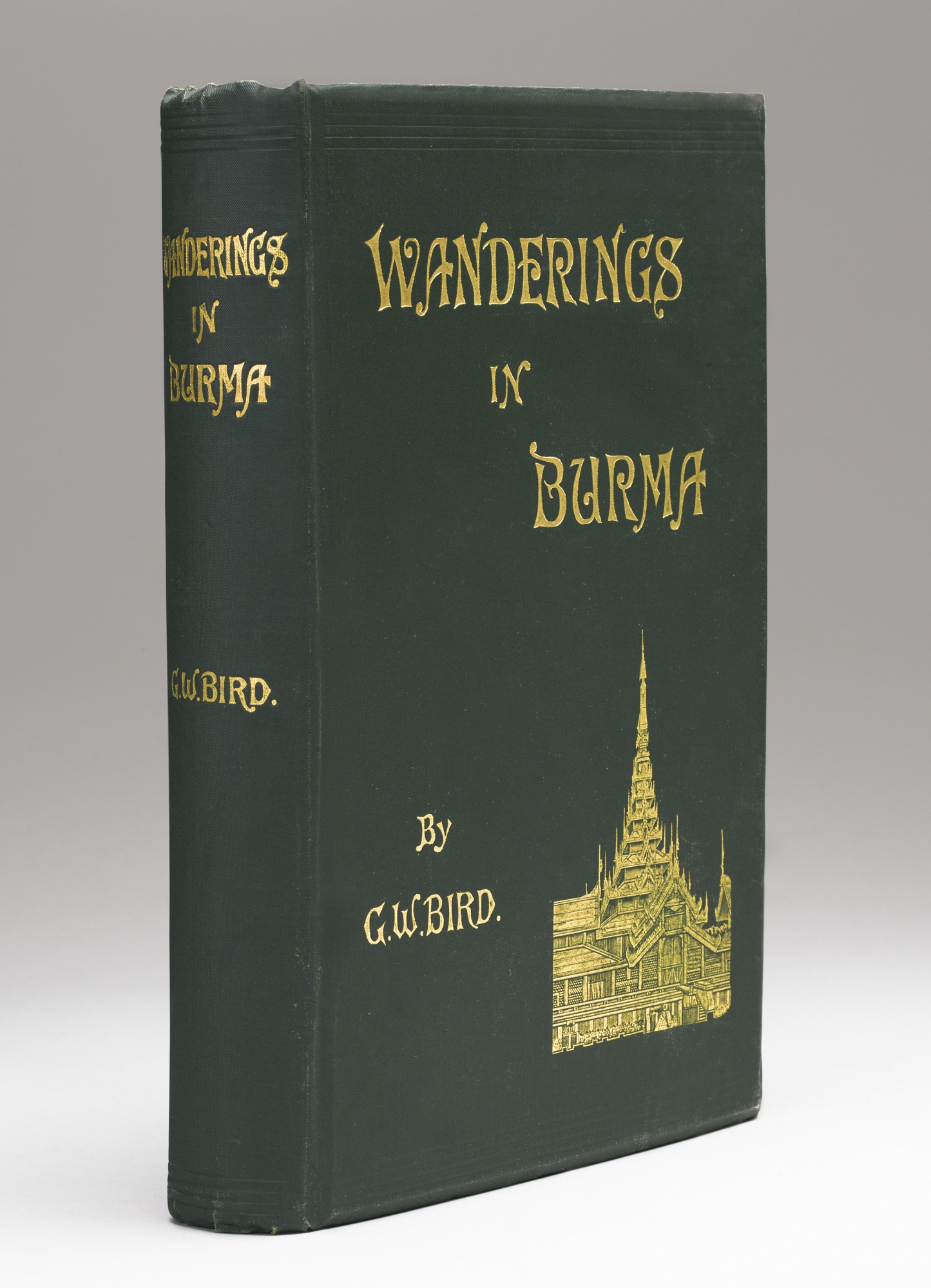
Wanderings in Burma

Book
Bird, G.W. (1897) Wanderings in Burma. Bournemouth, F.J. Bright & Son, 410 pp.; see pp. 365–368
Record No. 2713  |  Sinkankas/Born No.: NIS/NIB  |  RWHL
Bird’s Wanderings in Burma is a travel account describing journeys through Burma, with observations on the country’s scenery, peoples, customs, towns, monuments, natural resources, and economic life. Of particular gemological interest are pp. 365–368, where Bird discusses the ruby mines of Upper Burma and the celebrated Mogok mining district. She describes the search for rubies in the gem-bearing ground, the washing and sorting of the material, and the conditions under which the mines were worked, together with the importance and value of the stones recovered. The account places ruby mining within the broader landscape and society of Upper Burma and reflects contemporary European interest in the mines following the British annexation of the region. Although written as a travel narrative rather than a geological study, Bird’s firsthand descriptions provide a useful late nineteenth-century view of the Burmese ruby industry and the methods by which the famous Mogok gems were obtained.

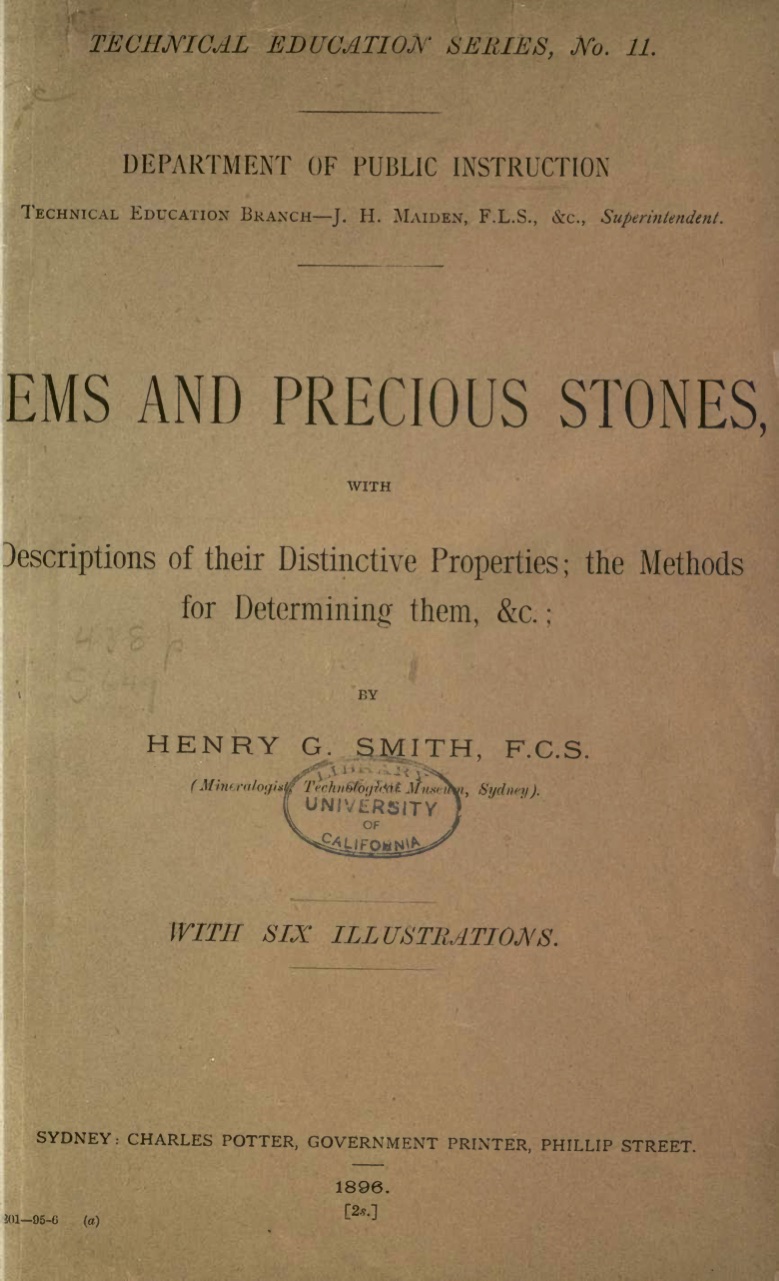
Gems and Precious Stones

Book
Smith, H.G. (1896) Gems and Precious Stones. Sydney, Charles Potter, 87 pp.
Record No. 3143  |  Sinkankas/Born No.: 6174; NIB  |  RWHL
Smith’s Gems and Precious Stones, published as No. 11 of the Technical Education Series of the New South Wales Department of Public Instruction, is a practical introductory handbook devoted to the identification and properties of gemstones. Its full title, Gems and Precious Stones: With Descriptions of Their Distinctive Properties, the Methods for Determining Them, &c., reflects its emphasis on distinguishing gem materials by observable and measurable characteristics. Smith treats the principal precious and ornamental stones and explains the properties used in their determination, providing a concise guide intended for students, collectors, jewelers, and others requiring a practical introduction to gem identification. Published in Sydney by Charles Potter, Government Printer, the work is significant as an early Australian gemological manual and as part of the colony’s program of technical education.

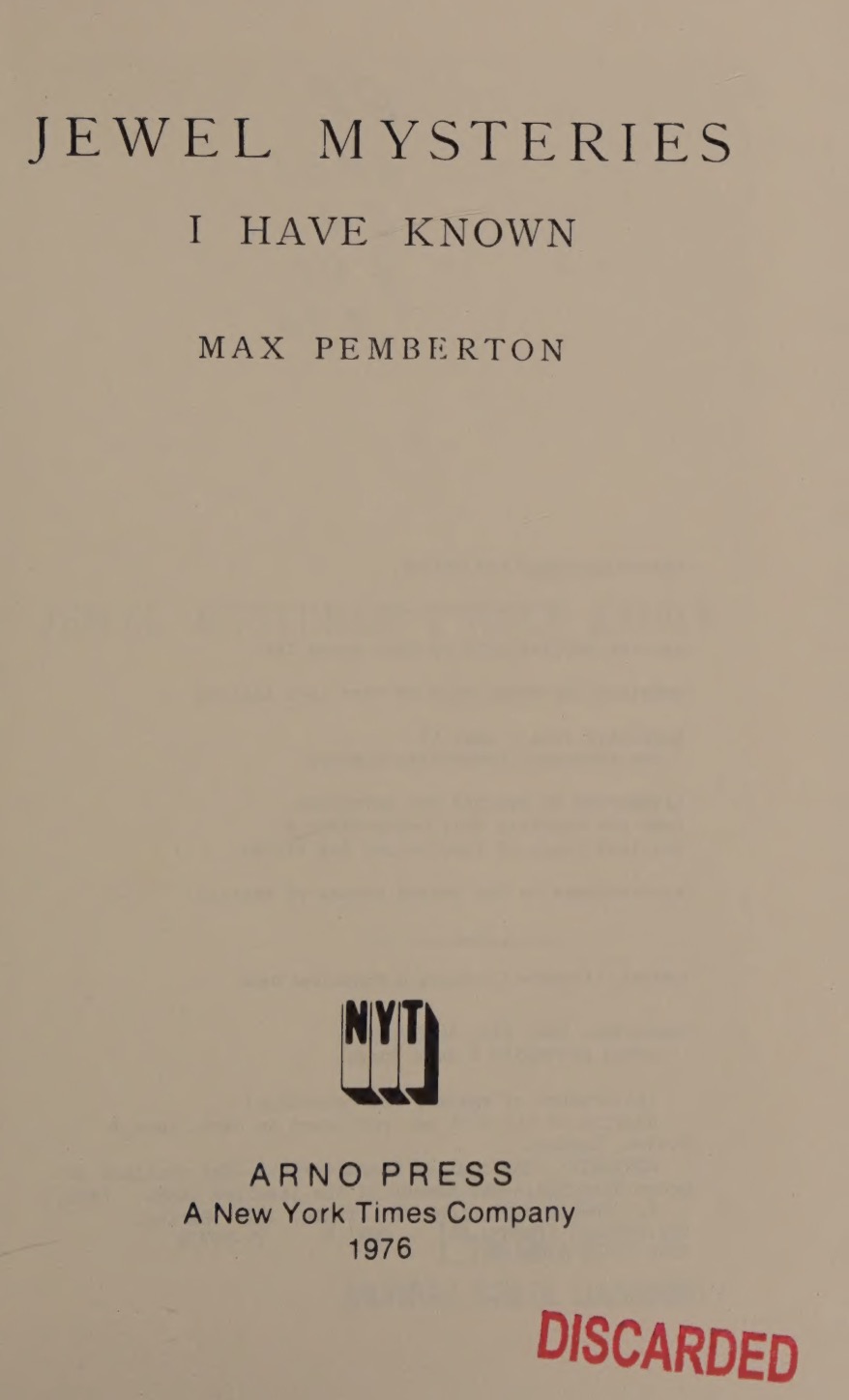
Jewel Mysteries I Have Known — From a Dealer's Notebook
Book
Pemberton, M. (1894) Jewel Mysteries I Have Known — From a Dealer's Notebook. London, Ward, Lock & Bowden, 269 pp.
Record No. 29977  |  Sinkankas/Born No.: 5061; NIB  |  RWHL
Sinkankas: The author assumes the name of “Sutton,” a London jeweler, for the purpose of recounting a series of fictitious but highly interesting stories involving gems, jewels, and the gem trade. The gemological information is accurate and carries the ring of authority. A popular work in its day, at least one identical reprint was issued. A later issue, in maroon cloth, gold lettering on cover with blind logo in a box, and gold spine title, beveled boards, plain endpapers, measured 22.6 × 14.6 cm (8 7/8 × 5 3/4 in.). Uncut. The front illustration fitted with tissue; the advertisements are different and the pages for same are numbered. Price 5s.

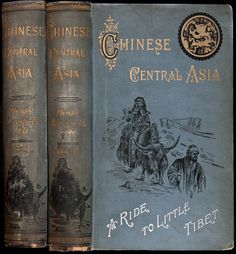
Chinese Central Asia: A Ride to Little Tibet
Book
Lansdell, H. (1894) Chinese Central Asia: A Ride to Little Tibet. New York, Charles Scribner’s Sons, 2 Vols., 456, 512 pp.
Record No. 3384  |  RWHL
Lansdell recounts an extensive journey through Russian and Chinese Central Asia to the western approaches of Tibet, combining personal travel narrative with geographical, ethnographic, historical, and commercial observations. His route takes him through the Russian Turkestan region and across Chinese Turkestan, including Kashgar, Yarkand, and Khotan, before reaching the high country toward Ladakh and “Little Tibet.” He describes local peoples, religions, agriculture, markets, communications, political conditions, and natural resources, drawing upon both firsthand observations and contemporary geographical literature. Of particular gemological interest is his account of Khotan and its celebrated jade industry, including the collection of nephrite from the rivers and the extraction of material from the surrounding mountains, its preparation and trade, and its importance as a commodity exported eastward to China. The work provides a valuable late nineteenth-century description of the traditional Khotan jade-producing region and the Central Asian trade routes through which its nephrite circulated.

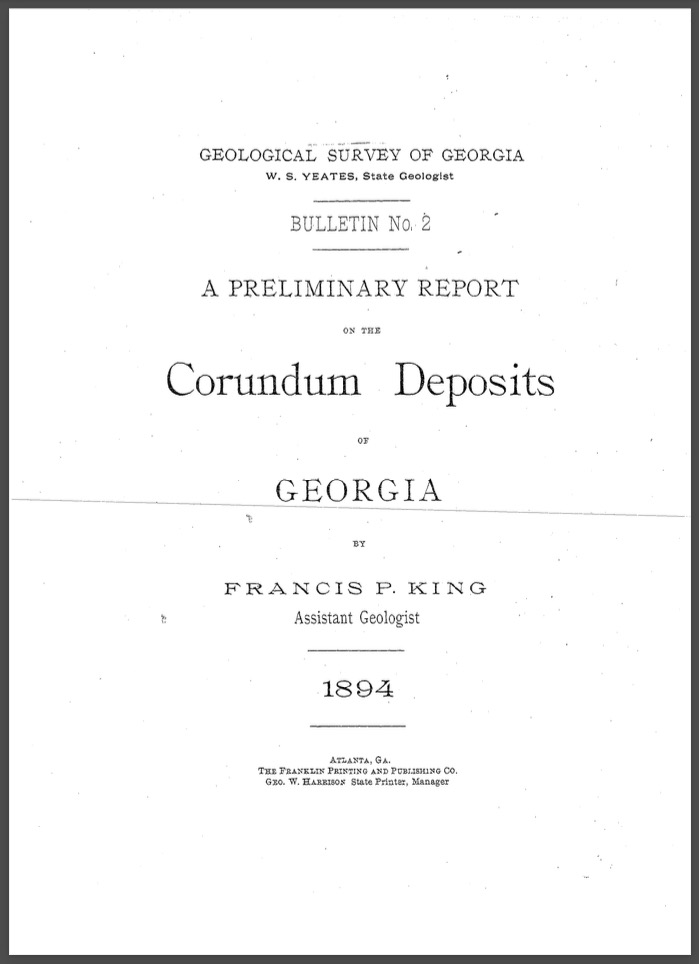
A preliminary report on the corundum deposits of Georgia
Book
King, F.P. (1894) A preliminary report on the corundum deposits of Georgia. Atlanta, Ga.,, The Franklin Printing and Publishing Co., 133, 4 p.
Record No. 2804  |  Sinkankas/Born No.: NIS/NIB  |  RWHL
King presents a detailed preliminary survey of the corundum deposits of Georgia, describing their geographical distribution, geological occurrence, mineral associations, methods of mining, and economic importance. He examines the principal deposits of northern Georgia, where corundum occurs chiefly in association with peridotite and its altered products, and provides descriptions of individual mines and prospects, the character and quantity of their corundum, and the rocks and minerals accompanying it. Particular attention is given to the origin and geological relationships of the deposits, prospecting and extraction methods, preparation of corundum for market, production, and its principal use as an abrasive. The report also records variations in the color and quality of Georgia corundum and occurrences of material of potential gemological interest. Illustrated with geological and locality information, the bulletin provides an important late nineteenth-century account of Georgia’s corundum industry and the geology upon which its commercial exploitation depended.

Corundum deposits of Georgia

Journal Article
King, F.P. (1894) Corundum deposits of Georgia. Bulletin, Geological Survey of Georgia, No. 2, 133 pp..
Record No. 1096  |  RWHL
King presents a detailed study of the corundum deposits of Georgia, describing their geographic distribution, geological occurrence, mineral associations, mining, and economic prospects. He examines the principal corundum localities along the crystalline belt of northern Georgia and describes deposits associated particularly with peridotite and related altered rocks, recording the character, size, color, and quality of the corundum found at individual workings. The report discusses prospecting and mining methods, preparation of corundum for abrasive use, production and markets, and the factors affecting the commercial value of deposits. King also records accessory minerals and varieties of corundum encountered in the field, including material of potential gemological interest, although the industry was directed principally toward supplying corundum as an abrasive. The bulletin provides an important late nineteenth-century account of the geology and exploitation of one of the principal corundum-producing regions of the United States. Contains a good history of corundum.

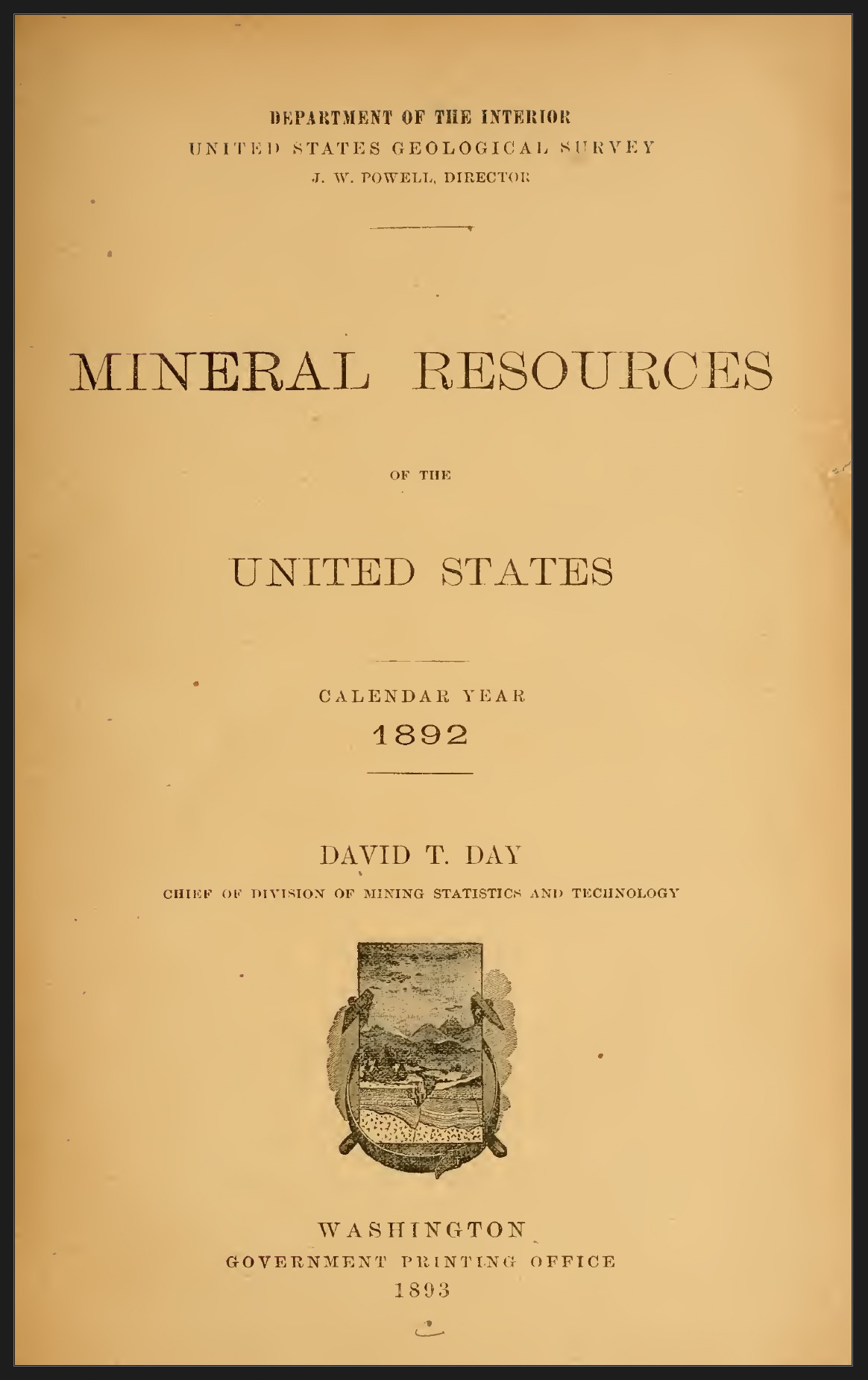
Precious stones

Book Section
Kunz, G.F. (1893) Precious stones. In: Mineral Resources of the United States | Calendar Year 1892, Washington: Govt. Printing Office, pp. 756–781.
Record No. 17003  |  Sinkankas/Born No.: 3607; NIB  |  RWHL
Kunz reviews the production, occurrence, mining, and trade of precious stones during 1892, with particular attention to developments in the United States. He records American gem production and discusses diamonds and a wide range of colored and ornamental stones, including sapphire, turquoise, tourmaline, garnet, beryl, quartz, opal, and other materials. The turquoise deposits of the southwestern United States receive specific attention [763–764], while the report also describes contemporary American sapphire occurrences and other newly developed or investigated gem localities. A substantial section is devoted to diamonds, including American occurrences and developments in the South African industry, with discussion of diamond-bearing rocks, mining, production, and contemporary ideas concerning diamond genesis. As in Kunz’s earlier annual reports, economic information is combined with mineralogical and gemological observations, making the paper an important contemporary record of the rapidly developing American gem industry and of the international precious-stone trade at the end of the nineteenth century.

Les cachets d’oculistes et les lapidaires de l’Antiquité et du haut Moyen Âge
The Lapidaries of Antiquity and Oculists’ Stamps
Journal Article
Mély, F.d.S., de (1892) Les cachets d’oculistes et les lapidaires de l’Antiquité et du haut Moyen Âge. [The Lapidaries of Antiquity and Oculists’ Stamps] Revue de Philologie, Series 2, Vol. 16, pp. 81–95.
Record No. 29439  |  Sinkankas/Born No.: NIS/NIB  |  Language: in French  |  RWHL
Mély examines ancient lapidary literature in relation to the inscribed stone stamps used by Greco-Roman oculists for marking medicinal preparations. By comparing the names and supposed properties of mineral substances recorded in medical and lapidary texts with the inscriptions preserved on these oculists’ stamps, he attempts to clarify obscure terminology and trace the transmission of mineral-based medical recipes from Antiquity into the early Middle Ages. The study is particularly relevant to the history of gemstones and mineralogy because it treats ancient stone names not simply as literary curiosities but as part of practical pharmacological traditions, illustrating the close historical relationship between lapidaries, medicine, and materia medica.

Histoire Physique, Naturelle et Politique de Madagascar
Physical, Natural and Political History of Madagascar
Book
Grandidier, A. (1892) Histoire Physique, Naturelle et Politique de Madagascar. [Physical, Natural and Political History of Madagascar] Paris, Librairie Hachette, 40 Vols., Vol. 1
Record No. 16922  |  Sinkankas/Born No.: NIS/NIB  |  Language: in French  |  RWHL
Grandidier’s monumental Histoire physique, naturelle et politique de Madagascar presents an extensive survey of Madagascar, bringing together its physical geography, geology, natural history, anthropology, ethnography, history, and political development. Based on Grandidier’s travels and research and subsequently expanded with contributions by other specialists, the series documents the island’s distinctive fauna and flora, its peoples and languages, natural resources, and European exploration and colonization. The work is particularly valuable for its detailed compilation of nineteenth-century knowledge of Madagascar and for the numerous maps, plates, scientific descriptions, and historical sources incorporated throughout its many volumes. For gemological and mineralogical research, the geological and physical sections provide information on Madagascar’s rocks, minerals, and natural resources during the period immediately preceding the major development of the island’s gemstone deposits at the end of the nineteenth century. The mineral grandidierite" was named after Grandidier."

Der ägyptische Smaragd nebst einer vergleichenden mineralogischen Untersuchung der Smaragde von Alexandrien, vom Gebel Sabara und vom Ural
The Egyptian emerald together with a comparative mineralogical study of the emeralds of Alexandria, the Gebel Sabara and the Urals
Journal Article
Schneider, O. and Arzruni, A. (1892) Der ägyptische Smaragd nebst einer vergleichenden mineralogischen Untersuchung der Smaragde von Alexandrien, vom Gebel Sabara und vom Ural. [The Egyptian emerald together with a comparative mineralogical study of the emeralds of Alexandria, the Gebel Sabara and the Urals] Zeitschrift für Ethnologie, Vol. 24, pp. 41–100.
Record No. 8132  |  Sinkankas/Born No.: 5850; NIB  |  Language: in German  |  RWHL
Sinkankas: The discovery of the Alexandrian hoard of gemstones and other materials, including glasses, enamels, partly-worked, and finished gemstones during 1867–9, inspired the present study of Egyptian emeralds in a monograph of great historical and archaeological value, not to mention the numerous gleanings of pertinent information from ancient writers who mentioned Egyptian emerald. As a result of the discovery of the hoard, a controversy arose concerning the origin of the emeralds—were they from Egypt or were they from the Urals? Andreas Arzruni, the eminent European mineralogist, was called in to examine the specimens and compare them to emeralds from Gebel Sabara in Egypt and from the Urals. From his examinations, especially of inclusions, he concluded that the Alexandrian stones were from Gebel Sabara. In the course of his study, Schneider examined works by K.R. Lepsius (1810–1884), a German Egyptologist, Leo Africanus, Diodorus Siculus, Ptolemy Philadelphus, Solinus Polyhistor, Aelian, Lucian, Strabo, Olympiodorus, and other ancient writers, and took much from a treatise on gemstones by Masudi (Abu-al-Hasan Ali al-Masudi, d. 956 AD) and Achmed Teifaschi (13th c. Cairo gem dealer), not to mention much later accounts of travelers, explorers, and visitors to the Gebel Sabara emerald mines. Among the latter may be mentioned Frederic Cailliaud (1787–1869), whose account is referenced elsewhere in the present bibliography, and who rediscovered the emerald mines in 1816. [919] The present account by Schneider is of great importance but is rarely mentioned in the ordinary gemological bibliographies; it deserves translation into English and other languages. USGS Kunz Coll, GS 34-1005.

The Naulahka: A Story of West and East
Book
Kipling, R. and Balestier, C.W. (1892) The Naulahka: A Story of West and East. New York, MacMillan and Co.
Record No. 5237  |  RWHL
Kipling and Balestier’s novel follows Nicholas Tarvin, an ambitious American from the fictional town of Topaz, Colorado, who travels to the Indian state of Rhatore in pursuit both of his fiancée, Kate Sheriff, and of a fabulous jeweled necklace known as the Naulahka. Kate has gone to India to work as a nurse, while Tarvin hopes to obtain the necklace and use it to advance his commercial schemes at home. The story contrasts American enterprise and optimism with the authors’ portrayal of princely India, combining romance, adventure, political intrigue, and descriptions of court life. Of particular gemological interest is the Naulahka itself, a legendary state necklace composed of extraordinarily valuable diamonds, rubies, emeralds, and other gems, whose history, appearance, and attempted theft form a central element of the plot. The novel provides a late nineteenth-century literary portrayal of Indian royal jewels and the fascination they exercised upon Western observers.

Palms & Pearls or Scenes in Ceylon

Book
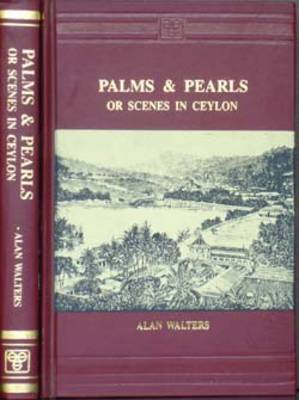
Walters, A. (1892) Palms & Pearls or Scenes in Ceylon. London, Richard Bentley & Son, 317 pp.
Record No. 2654  |  Sinkankas/Born No.: NIS/NIB  |  RWHL
Walters’s Palms & Pearls is an illustrated account of a prolonged stay in Ceylon, written from opportunities the author believed gave him greater familiarity with the island than that of an ordinary traveler. He describes its scenery, towns, vegetation and wildlife, together with the everyday life, customs, religions, occupations, and social conditions of its inhabitants. The narrative combines personal travel experiences with observations on Colombo, Kandy and the hill country, Buddhist temples and ceremonies, agriculture and plantation life, indigenous animals, and other features of late nineteenth-century Ceylon. Of particular gemological interest are his descriptions of pearls and the celebrated pearl fisheries, including the methods and conditions under which pearl oysters were obtained and the people associated with the industry. The work provides a contemporary British traveler’s view of Ceylon shortly before the end of the nineteenth century.

Les pierres chaldéennes d'aprèsle Lapidaire d'Alphonse Xle Sage
The Chaldean Stones According to the Lapidary of Alfonso X the Wise
Journal Article
Mély, F.d.S., de (1891) Les pierres chaldéennes d'aprèsle Lapidaire d'Alphonse Xle Sage. [The Chaldean Stones According to the Lapidary of Alfonso X the Wise] Comptes rendus des séances de l'Académie des Inscriptions et Belles-Lettres, Vol. 35, No. 3, pp. 196–201.
Record No. 29430  |  DOI: https://doi.org/10.3406/crai.1891.69967  |  Sinkankas/Born No.: NIS/NIB  |  Language: in French  |  RWHL
The Academy will kindly permit me to submit to it, as a simple contribution to the study of stones, a few remarks that I have just made in the famous Lapidary of Alfonso X, at the Escorial. The work, according to the translator, was translated from Chaldean into Arabic, and from Arabic into Spanish; the translation dates from the thirteenth century. This Lapidary, which is not, like all similar works, simply a medical, astronomical, and mineralogical compilation claiming to go back to the most remote times, contains a quantity of philological and geographical information that I had at first neglected. But the precision that a more thorough examination has enabled me to discover in it, from the philological point of view, seemed to me to merit attention, which I have the honor of bringing to the notice of the Academy.

Les Méthodes de Synthèse en Minéralogie
Methods of Synthesis in Mineralogy
Book
Meunier, S. (1891) Les Méthodes de Synthèse en Minéralogie. [Methods of Synthesis in Mineralogy] Paris, Librairie Polythechnique, 359 pp.
Record No. 4623  |  Sinkankas/Born No.: NIS/NIB  |  Language: in French  |  RWHL
Meunier surveys the experimental methods by which minerals could be reproduced artificially, presenting mineral synthesis as a means of investigating the conditions under which natural minerals and rocks formed. He describes techniques involving fusion, sublimation, reactions at high temperatures, the action of gases and vapors, hydrothermal processes, and crystallization from molten or dissolved substances, reviewing experiments by numerous nineteenth-century investigators. The work treats the artificial production of a wide range of mineral species and discusses the significance of successful syntheses for mineralogy and geology. Of particular gemological interest are experiments involving the synthesis of corundum and ruby, including the work of Gaudin, Ebelmen, Sainte-Claire Deville, Caron, Frémy, and Feil, in which alumina was crystallized under various high-temperature conditions and chromium compounds were used to produce ruby coloration. The volume provides a useful contemporary synthesis of experimental mineralogy immediately before Verneuil’s development of a commercially practical method for producing synthetic ruby.

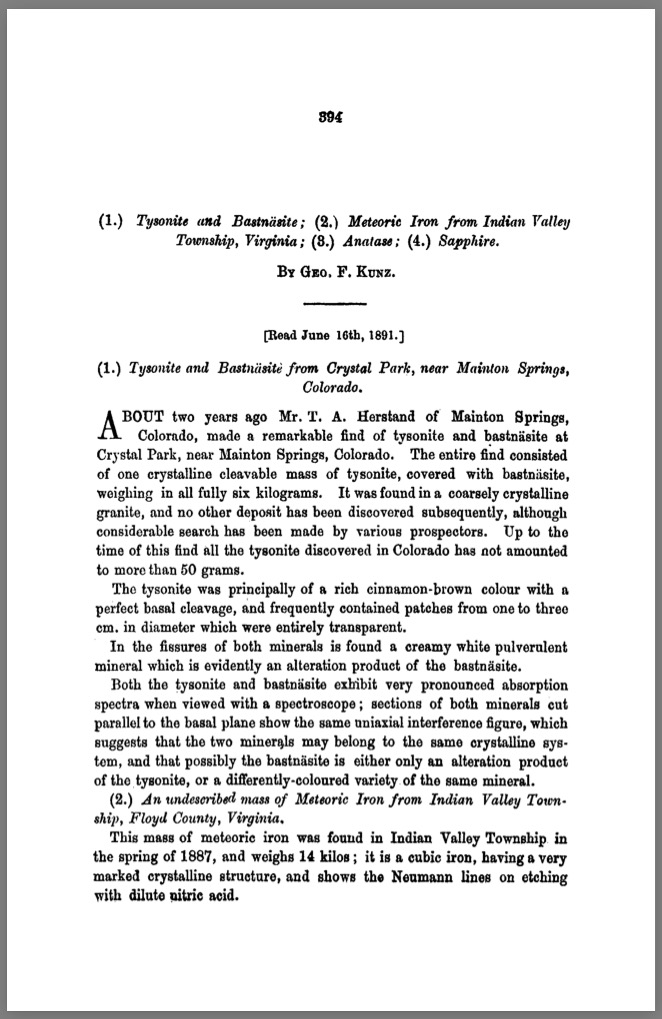
(1.) Tysonite and Bastniisite ; (2.) Meteoric Iron from Indian lndian Valley Township, Virginia; (3.) Anatase; (4.) Sapphire
Journal Article
Kunz, G.F. (1891) (1.) Tysonite and Bastniisite ; (2.) Meteoric Iron from Indian lndian Valley Township, Virginia; (3.) Anatase; (4.) Sapphire. Mineralogical Magazine, Vol. 9, No. 44, December, pp. 394–396.
Record No. 1142  |  Sinkankas/Born No.: NIS/NIB  |  RWHL
Kunz presents four brief mineralogical notes on recently examined specimens. The first concerns tysonite and bastnäsite, rare fluorine-bearing minerals from the well-known Colorado locality, with observations on their occurrence and identification. The second describes a mass of meteoric iron discovered in Indian Valley Township, Floyd County, Virginia, recording its physical characters and circumstances of discovery. The third treats anatase, noting noteworthy crystals and their mineralogical characteristics. The final section concerns sapphire and describes occurrences of corundum of gem quality, with attention to the color, form, and character of the specimens and their potential value as gemstones. Collectively, the paper is characteristic of Kunz’s short mineralogical communications, documenting unusual or newly recognized American mineral specimens and emphasizing those possessing gemological or commercial interest.

Marbode, évêque de Rennes. Sa vie et ses œuvres (1035–1123)
Marbode, Bishop of Rennes. His life and works (1035–1123).
Book
Marbode de Rennes and Ernault, L. (1890) Marbode, évêque de Rennes. Sa vie et ses œuvres (1035–1123). [Marbode, Bishop of Rennes. His life and works (1035–1123).] Rennes, H. Caillière, 261 pp.
Record No. 4153  |  Sinkankas/Born No.: NIS/NIB  |  Language: in French  |  RWHL
Ernault presents a biographical and literary study of Marbode (Marbodus), Bishop of Rennes (1035–1123), examining his life, ecclesiastical career, intellectual milieu, and surviving writings. Particular attention is devoted to Marbode’s Latin poetry and didactic works, including the celebrated Liber lapidum or De lapidibus, a verse lapidary describing stones and the medicinal, magical, and symbolic virtues traditionally attributed to them. Ernault considers the sources, manuscripts, editions, and literary character of Marbode’s writings and places them within the scholarly and religious culture of the eleventh and early twelfth centuries. For the history of gemology, the study is especially useful for establishing the authorship, textual history, and context of the Liber lapidum, one of the most influential medieval European lapidaries and an important conduit through which Classical and late-antique traditions concerning precious stones were transmitted into medieval literature.

A Thousand Miles on an Elephant in the Shan States

Book
Hallet, H.S. (1890) A Thousand Miles on an Elephant in the Shan States. Edinburgh, William Blackwood and Sons, xxxvi + 484 pp.
Record No. 2784  |  Sinkankas/Born No.: NIS/NIB  |  RWHL
Hallett recounts his extensive travels through Burma, the Shan States, northern Siam, and adjoining regions, undertaken principally to investigate routes for a proposed railway connecting Burma and Siam with southwestern China. The work combines a detailed travel narrative with observations on geography, rivers, communications, agriculture, trade, natural resources, ethnic groups, political conditions, and local customs, and includes maps and illustrations. Of particular gemological interest is his description of entering the ruby-mining district near Muang Haut (present-day Hot, northern Thailand), where the ground was covered with broken fragments of quartz, sandstone, and granite resulting from searches for gems. He states that valuable stones were said to have been found there, that workings were confined largely to the surface and stream banks, and that more systematic mining might prove valuable.

Building a Gemological Library

Gemological books range from general identification manuals and textbooks to specialized works on individual gems, mineralogy, jewelry, treatments, synthesis, history and gem-producing regions.

For a curated selection of particularly useful books, read The Gemologist's Core Library — Classic Books on Gemology, Jewelry and Mineralogy.

About Four Treasures

Four Treasures is Lotus Gemology's freely accessible gemological reference database. Use the full database to search by author, title or keyword and explore literature on gemology, mineralogy, jewelry and related fields. Where available, hyperlinks on titles may lead directly to the full publication.

Search the Complete Four Treasures Database