Burmese Ruby Inclusions
Explore Burmese ruby inclusions in Hyperion, the Lotus Gemology inclusion database. Hyperion contains photomicrographs of inclusions and internal features in natural rubies from Myanmar (Burma), documented with information on treatment, lighting conditions, field of view, photographer and published references.
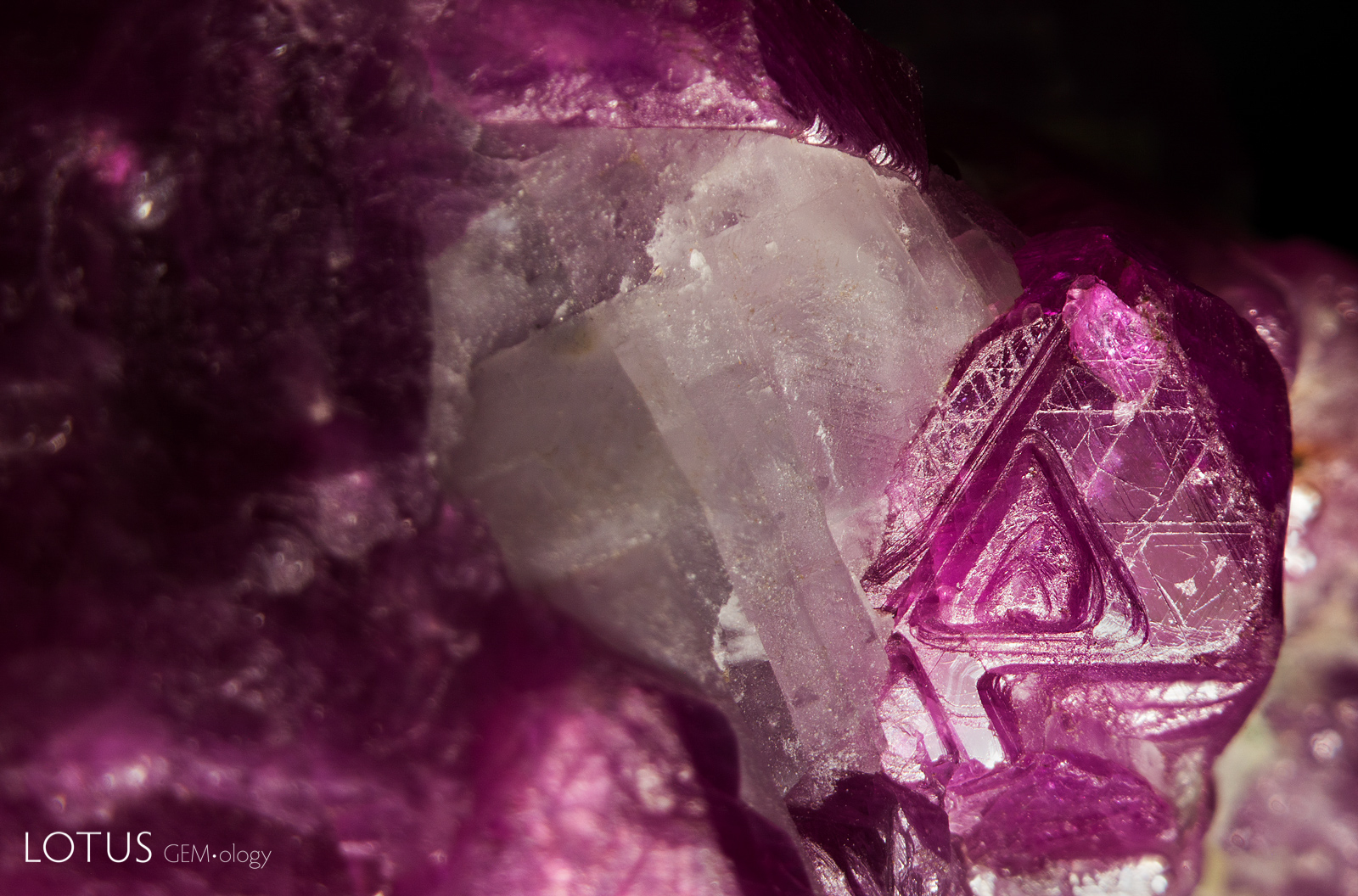
Triangular growth markings decorate the exterior of this rough ruby crystal.
Natural Ruby •
Myanmar (Burma); Mogok/Namya •
Enhancements:
None Detected (None) •
Lighting Conditions:
Fiber Optic: Diffuse Oblique
Photographer:
E. Billie Hughes •
Image Number:
A-003-5528-1
• Field of View = 23mm
This small rounded crystal caught our attention when examining a ruby from Mong Hsu, Burma. Micro Raman analysis revealed that it is an apatite inclusion.
Natural Ruby •
Myanmar (Burma); Mong Hsu •
Enhancements:
Fissure Filling with colorless Oil/resin (FF-O1); No indications of heating (No indications of heating) •
Lighting Conditions:
Dark Field
Photographer:
E. Billie Hughes •
Image Number:
A-003-4341-1
• Field of View = 2mm
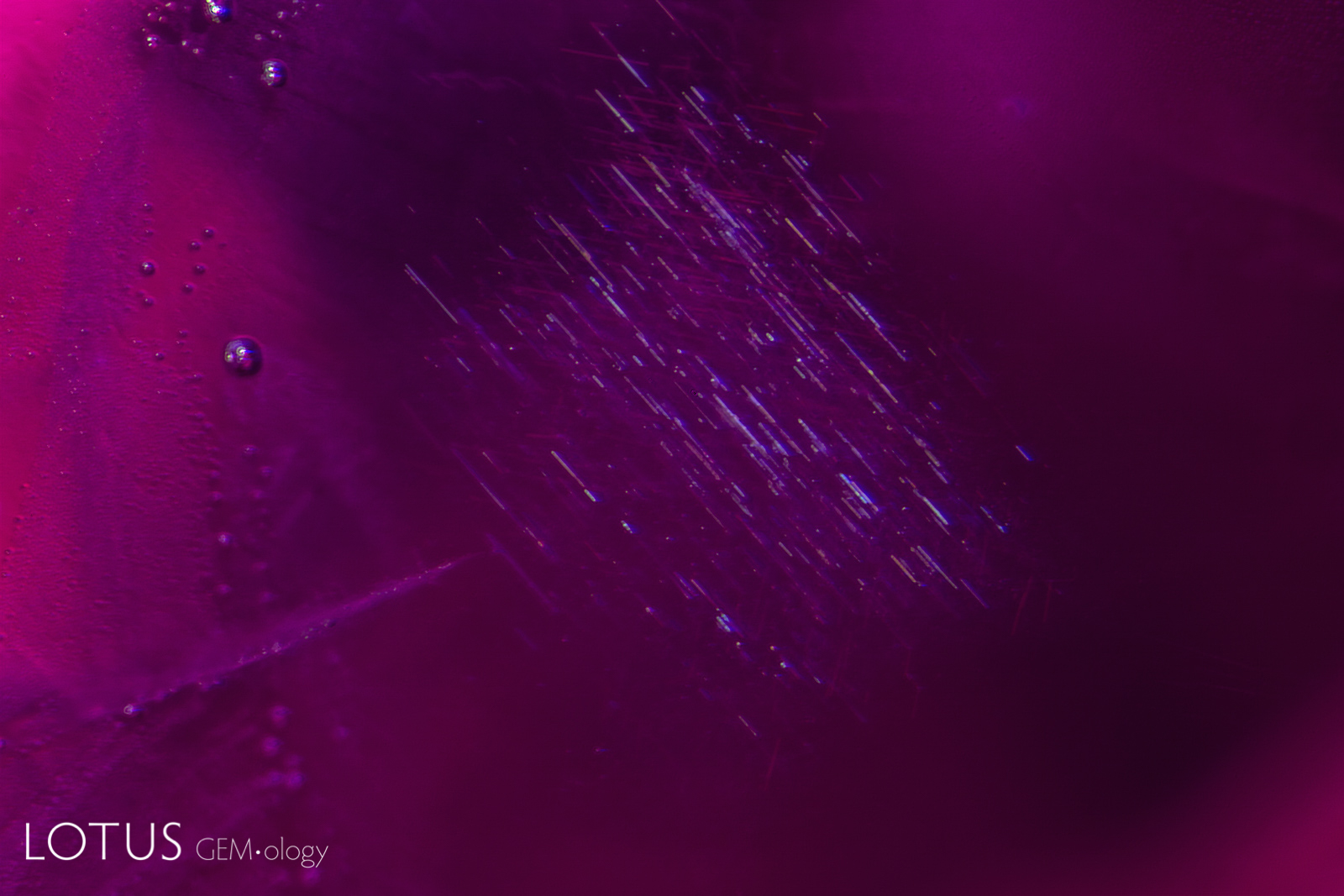
Mong Hsu rubies generally contain fluffy clouds of exsolved diaspore silk. While rutile silk is not common, it is seen on occasion, as evidenced by a cloud of rutile silk in a Mong Hsu ruby.
Natural Ruby •
Myanmar (Burma); Mong Hsu •
Enhancements:
Heat + Fissure Healing (H-FH) •
Lighting Conditions:
Dark Field + Oblique Fiber Optic
Photographer:
Richard W. Hughes •
Image Number:
A-003-4251-4
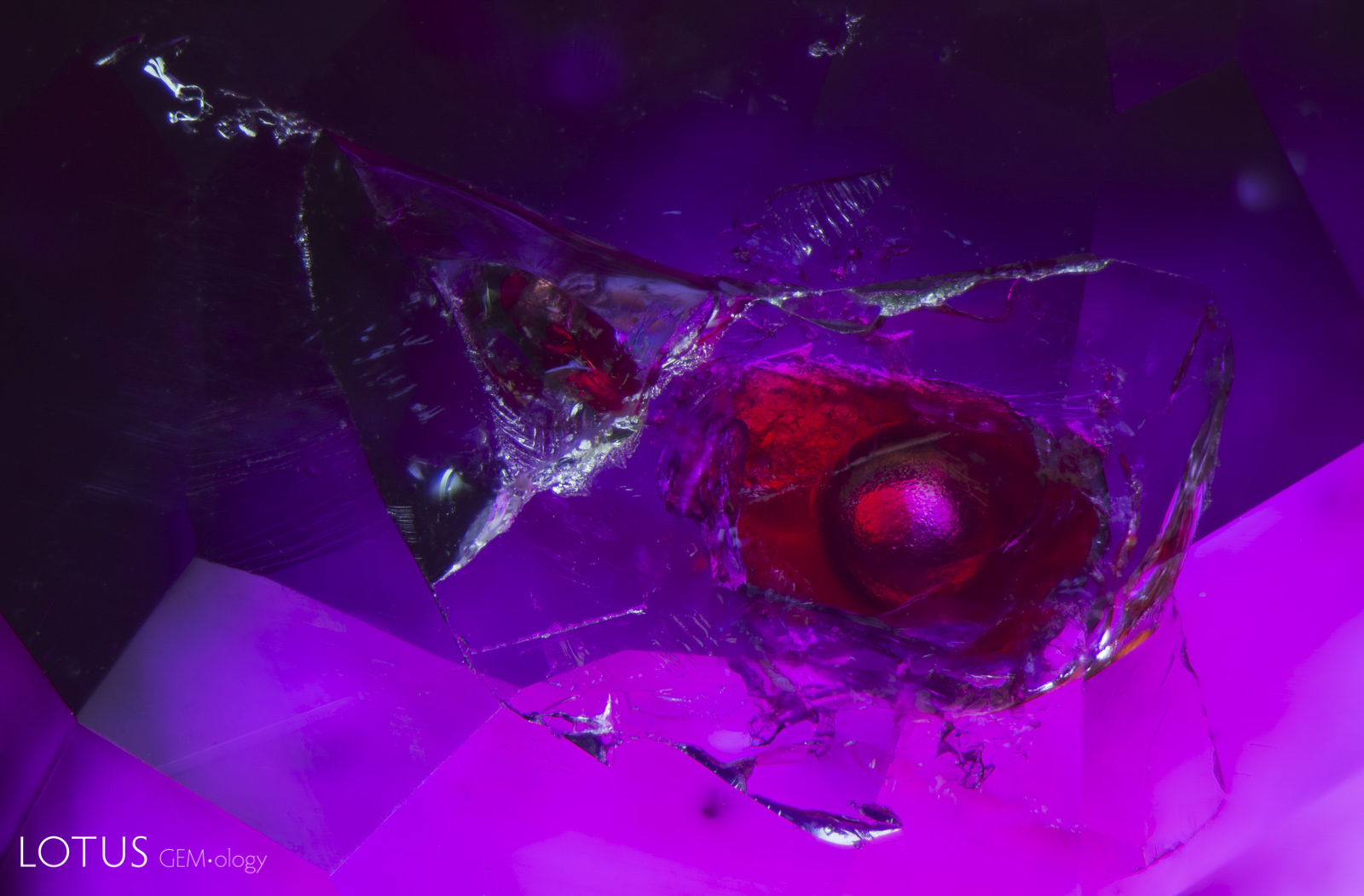
During flux healing, as the process continues, contraction bubbles form and then become larger as the void becomes more spherical. The degree of healing in flux-healed Mong Hsu rubies is so great that the flux remnants are often quite rounded, complete with contraction bubbles. Imagine a synthetic corundum crystal that has a long, thin hot-dog shaped gas bubble in it. If we heat that crystal to a high temperature, the hot dog will break up into a row of spherical bubbles, a process known as “necking down.” This image vividly illustrates the necking down of a void in a flux-healed Mong Hsu ruby.
Natural Ruby •
Myanmar (Burma); Mong Hsu •
Enhancements:
Heat + Fissure Healing (H-FH) •
Lighting Conditions:
Dark Field + Shadowing
Photographer:
Richard W. Hughes •
Image Number:
A-003-4251-1
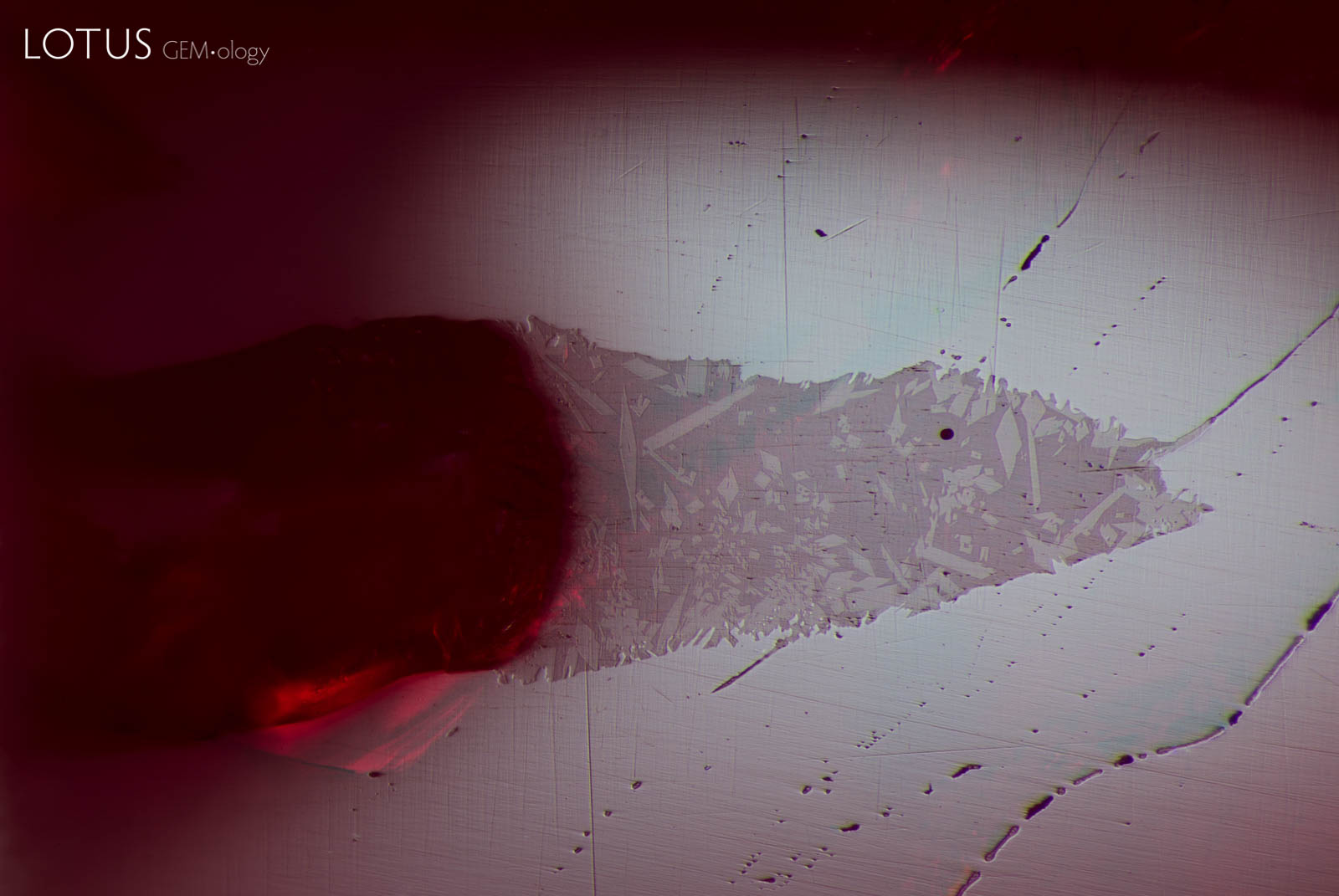
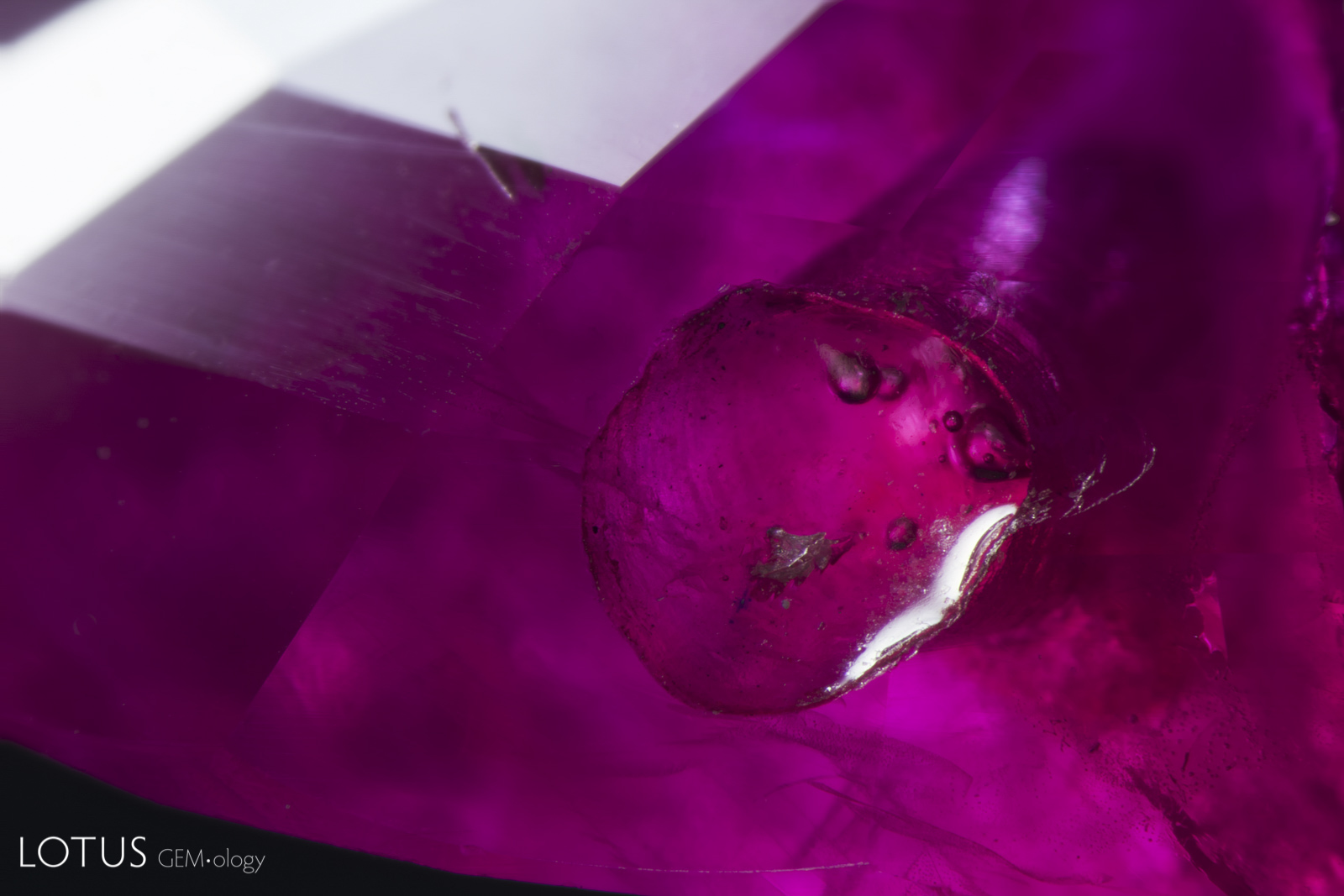
The lower luster of glass on the surface of this heated, fissure healed ruby, helps to separate the glass from the surrounding corundum, which has a higher luster.
Natural Ruby •
Myanmar (Burma); Mogok/Namya •
Enhancements:
Heat + Fissure Healing (H-FH); Heat + Glass Cavity/Fissure Filling (H-GF1) •
Lighting Conditions:
Dark Field + Diffuse Fiber Optic
Photographer:
E. Billie Hughes •
Image Number:
A-003-3635-1
Cottony diaspore silk in a rare, untreated ruby from Mong Hsu, Myanmar.
Natural Ruby •
Myanmar (Burma); Mong Hsu •
Enhancements:
None Detected (None) •
Lighting Conditions:
Light Field + Oblique Fiber Optic
Photographer:
Wimon Manorotkul •
Image Number:
R-003-3644-2
In this heated and fissure-healed ruby from Myanmar, a surface cavity is filled with glass. The glass can be identified by the large gas bubble at the lower part of the cavity.
Natural Ruby •
Myanmar (Burma); Mogok/Namya •
Enhancements:
Heat + Fissure Healing (H-FH); Heat + Glass Cavity/Fissure Filling (H-GF1) •
Lighting Conditions:
Dark Field
Photographer:
Richard W. Hughes •
Image Number:
A-003-3551-1
In this heated and fissure-healed ruby from Myanmar, a surface cavity is filled with glass. The glass can be identified by its lower luster.
Natural Ruby •
Myanmar (Burma); Mogok/Namya •
Enhancements:
Heat + Fissure Healing (H-FH); Heat + Glass Cavity/Fissure Filling (H-GF1) •
Lighting Conditions:
Fiber Optic: Diffuse Overhead
Photographer:
Richard W. Hughes •
Image Number:
A-003-3551-2
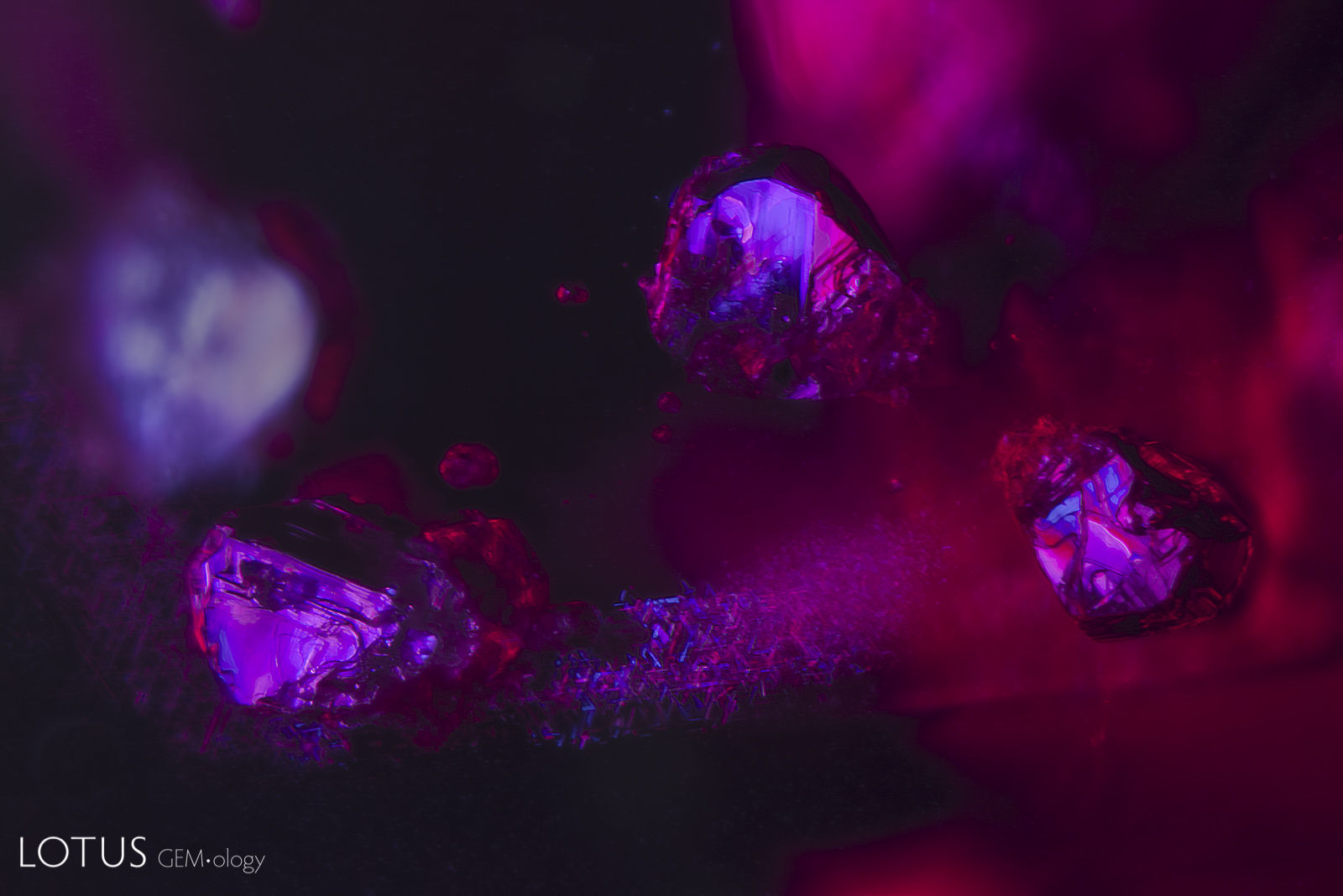
Intact, undamaged crystals and fine nests of rutile silk are often seen in untreated Burmese rubies like this one.
Natural Ruby •
Myanmar (Burma); Mogok/Namya •
Enhancements:
None Detected (None) •
Lighting Conditions:
Dark Field + Diffuse Fiber Optic
Photographer:
E. Billie Hughes •
Image Number:
A-002-4777-1
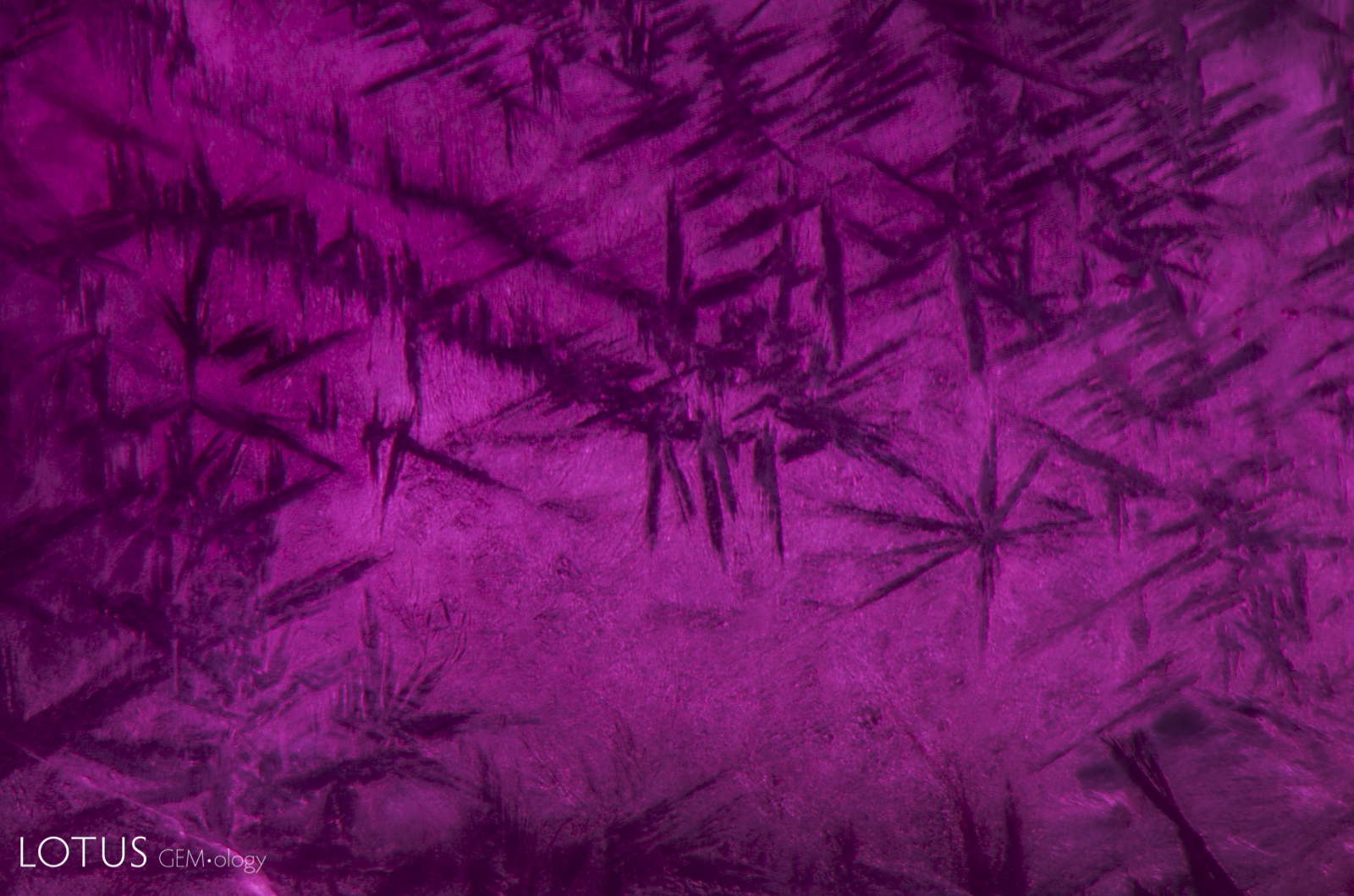
A dendritic healing pattern creates leaf-like imagery inside this untreated Mogok ruby.
Natural Ruby •
Myanmar (Burma); Mogok/Namya •
Enhancements:
None Detected (None) •
Lighting Conditions:
Dark Field
Photographer:
E. Billie Hughes •
Image Number:
A-002-4261-1
This ruby had a cavity that was filled with glass where small rounded gas bubbles can be seen.
Natural Ruby •
Myanmar (Burma); Mogok/Namya •
Enhancements:
(); Heat + Fissure Healing (H-FH) •
Lighting Conditions:
Fiber Optic: Diffuse Oblique
Photographer:
E. Billie Hughes •
Image Number:
A-002-4332-1
This ruby has been treated with red oil to disguise the appearance of fissures. Here it has been trapped in a cavity with a large gas bubble.
Natural Ruby •
Myanmar (Burma); Mogok/Namya •
Enhancements:
Fissure Filling with Dyed Filler (FF-DF1); No indications of heating (No indications of heating) •
Lighting Conditions:
Fiber Optic: Diffuse Oblique
Photographer:
E. Billie Hughes •
Image Number:
A-002-2909-1
Lotus Gemology (2015) Lotus Gemology Lab Alert for Oiled Gems. Bangkok, LotusGemology.com, RWHL*.
Burmese ruby inclusions may include mineral crystals, rutile silk, healed fissures, fluid inclusions, negative crystals, growth features and other internal features formed during or after crystal growth. Such features are important to gemologists because they can provide evidence useful in identifying ruby and evaluating a possible Burmese origin.
Burmese Ruby Inclusion Photomicrographs
The Hyperion Burmese ruby gallery includes microscopic features documented in rubies from Myanmar (Burma). Each entry is accompanied by descriptive information and, where available, references to the gemological literature.
What Inclusions Can Reveal About Burmese Ruby
Inclusions are an important part of geographic origin determination in ruby. Their form, composition, orientation and associations can provide evidence that, when considered together with other gemological properties, may support or contradict a Burmese origin.
Hyperion combines inclusion photomicrography with supporting gemological information so that individual features can be compared with documented examples from Burmese rubies.
About Hyperion
Hyperion is the Lotus Gemology searchable inclusion database. It allows users to browse gemstone inclusions by gem type, geographic origin, treatment and keyword.