Burmese Ruby Inclusions
Explore Burmese ruby inclusions in Hyperion, the Lotus Gemology inclusion database. Hyperion contains photomicrographs of inclusions and internal features in natural rubies from Myanmar (Burma), documented with information on treatment, lighting conditions, field of view, photographer and published references.
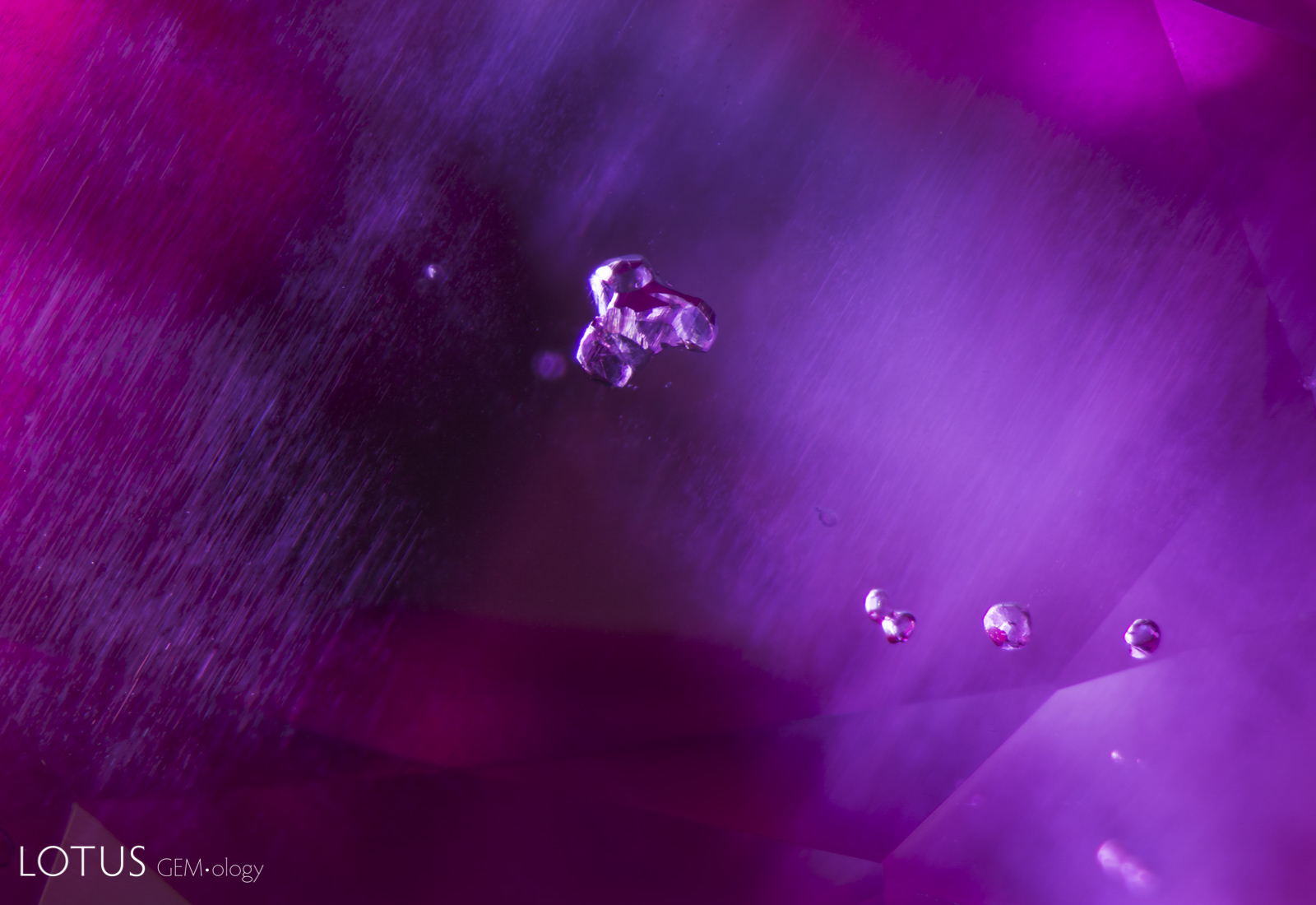
A flux-healed fingerprint in a heated ruby from Myanmar (Burma).
Natural Ruby •
Myanmar (Burma); Mogok/Namya •
Enhancements:
Heat + Fissure Healing (H-FH) •
Lighting Conditions:
Diffuse Light Field (Transmitted Light)
Photographer:
E. Billie Hughes •
Image Number:
A-001-7346-4
Hughes, R.W., Manorotkul, W. et al. (2017) Ruby & Sapphire: A Gemologist's Guide. Bangkok, Lotus Publishing, 816 pp.; RWHL*.
Emmett, J.L. (1999) Fluxes and the heat treatment of ruby and sapphire. Gems & Gemology, Vol. 35, No. 3, Fall, pp. 90–92; RWHL*.
Hughes, R.W. and Emmett, J.L. (2004) Fluxed up: The fracture healing of ruby. The Guide, Vol. 23, Issue 5, Part 1, Sept.–Oct., pp. 1, 4–9; RWHL*.
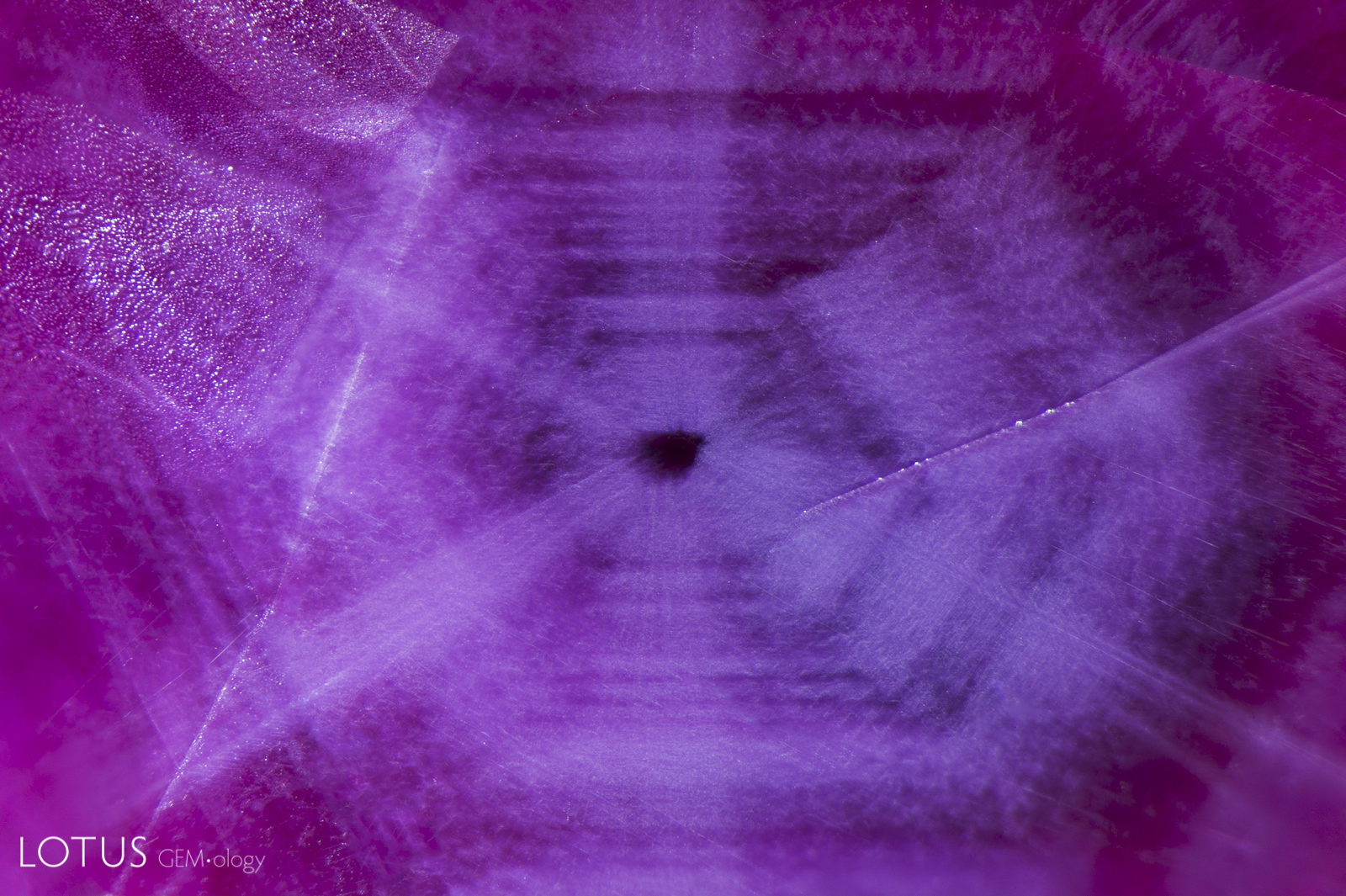
Sharp growth zoning in this ruby evokes a fiery sunset blazing through a mountain range.
Natural Ruby •
Myanmar (Burma); Mong Hsu •
Enhancements:
Heat + Fissure Healing (H-FH) •
Lighting Conditions:
Dark Field
Photographer:
E. Billie Hughes •
Image Number:
A-001-8658-1
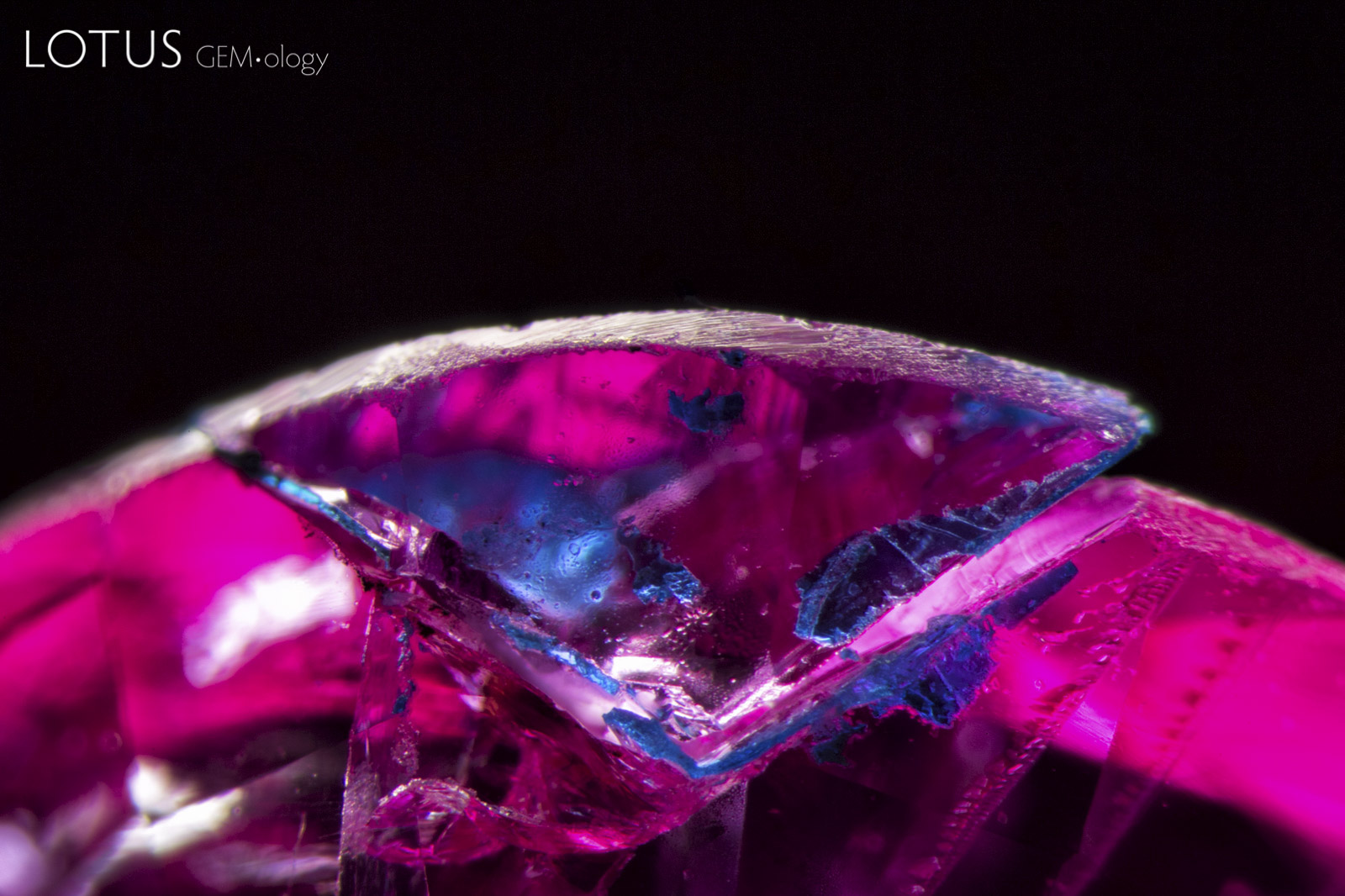
In this Burmese ruby, the stone was broken after polishing (probably during the setting process). To cover up the mistake, blue cement was used to glue the chip back in place. The cement quickly liquified when the hot point was touched to it, revealing the fraud.
Natural Ruby •
Myanmar (Burma); Mogok/Namya •
Enhancements:
None Detected (None) •
Lighting Conditions:
Dark Field
Photographer:
Richard W. Hughes •
Image Number:
A-001-4851-1
Hughes, R.W. (1997) Ruby & Sapphire. Boulder, CO, RWH Publishing, 512 pp.; RWHL*.
When Burmese rubies, such as this stone from Mong Hsu, are heat treated, they often develop a zoned chalky fluorescence in shortwave UV. In this position, the stone’s original blue core has been removed by the heat treatment, but that zone does not display the chalky fluorescence, just fluorescing red.
Natural Ruby •
Myanmar (Burma); Mong Hsu •
Enhancements:
Heat + Fissure Healing (H-FH) •
Lighting Conditions:
Ultraviolet: Shortwave
Photographer:
Patharaphum Sudprasert •
Image Number:
A-001-4392-2
Hughes, R.W. and Emmett, J.L. (2005) Heat Seeker: UV fluorescence as a gemological tool. The Guide, Vol. 24, No. 5, Part 1, Sept.–Oct., pp. 1, 4–7; RWHL*.
When Burmese rubies, such as this stone from Mong Hsu, are heat treated, they often develop a zoned chalky fluorescence in shortwave UV.
Natural Ruby •
Myanmar (Burma); Mong Hsu •
Enhancements:
Heat + Fissure Healing (H-FH) •
Lighting Conditions:
Ultraviolet: Shortwave
Photographer:
Patharaphum Sudprasert •
Image Number:
A-001-4392-1
Hughes, R.W. and Emmett, J.L. (2005) Heat Seeker: UV fluorescence as a gemological tool. The Guide, Vol. 24, No. 5, Part 1, Sept.–Oct., pp. 1, 4–7; RWHL*.
When a ruby is heat-treated at a high enough temperature, the angular channels of fingerprints begin a “necking down” process where they become more rounded, as seen here. This is particularly true if fluxes are used during the treatment.
Natural Ruby •
Myanmar (Burma); Mong Hsu •
Enhancements:
Heat + Fissure Healing (H-FH) •
Lighting Conditions:
Dark Field
Photographer:
Richard W. Hughes •
Image Number:
A-001-4393-1
Hughes, R.W. and Emmett, J.L. (2004) Fluxed up: The fracture healing of ruby. The Guide, Vol. 23, Issue 5, Part 1, Sept.–Oct., pp. 1, 4–9; RWHL*.
The vast majority of Mong Hsu rubies are heated with fluxes to heal their fissures. This is a rare example of a fingerprint in an Mong Hsu ruby that has not been heated. Note the angular nature of the negative crystals. Overhead lighting was used to reveal the interference colors on the surface of the liquid-filled channels.
Natural Ruby •
Myanmar (Burma); Mong Hsu •
Enhancements:
None Detected (None) •
Lighting Conditions:
Dark Field + Overhead Fiber Optic
Photographer:
Richard W. Hughes •
Image Number:
A-001-4334-2
Peretti, A., Schmetzer, K. et al. (1995) Rubies from Mong Hsu. Gems & Gemology, Vol. 31, No. 1, Spring, pp. 2–26; RWHL*.
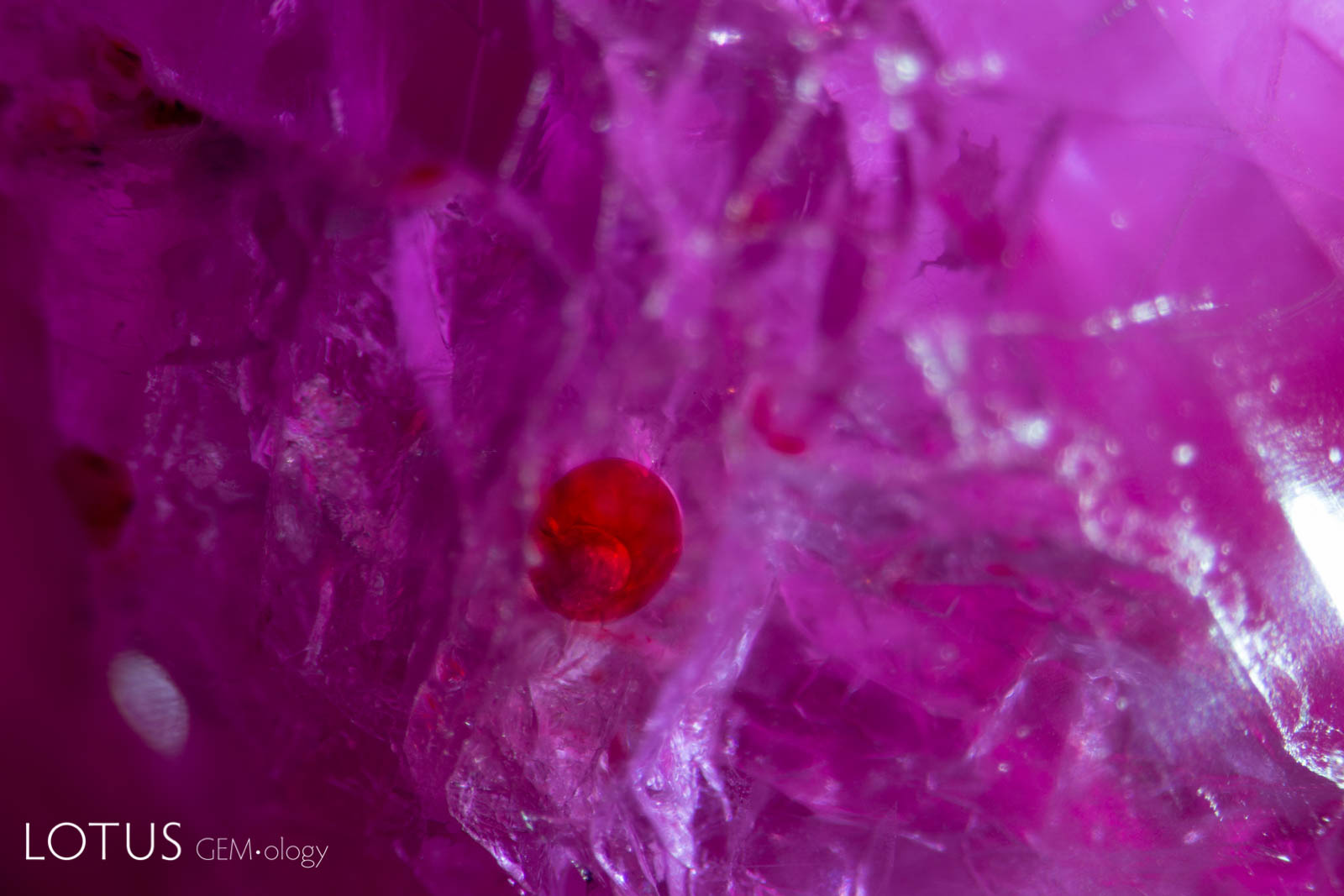
This high-temperature ruby bead necklace was impregnated with red wax. Here the wax has filled a small cavity in one of the ruby beads. One can clearly see a gas bubble in the red wax.
Natural Ruby •
Myanmar (Burma); Mogok/Namya •
Enhancements:
Heat + Fissure Healing (H-FH); Fissure Filling with Dyed Filler (FF-DF1) •
Lighting Conditions:
Fiber Optic: Oblique
Photographer:
Richard W. Hughes •
Image Number:
A-001-2997-2
108 Total Images
Results: 73 – 84 | Page 7 of 9 Pages
Burmese ruby inclusions may include mineral crystals, rutile silk, healed fissures, fluid inclusions, negative crystals, growth features and other internal features formed during or after crystal growth. Such features are important to gemologists because they can provide evidence useful in identifying ruby and evaluating a possible Burmese origin.
Burmese Ruby Inclusion Photomicrographs
The Hyperion Burmese ruby gallery includes microscopic features documented in rubies from Myanmar (Burma). Each entry is accompanied by descriptive information and, where available, references to the gemological literature.
What Inclusions Can Reveal About Burmese Ruby
Inclusions are an important part of geographic origin determination in ruby. Their form, composition, orientation and associations can provide evidence that, when considered together with other gemological properties, may support or contradict a Burmese origin.
Hyperion combines inclusion photomicrography with supporting gemological information so that individual features can be compared with documented examples from Burmese rubies.
About Hyperion
Hyperion is the Lotus Gemology searchable inclusion database. It allows users to browse gemstone inclusions by gem type, geographic origin, treatment and keyword.
Search the Complete Hyperion Database