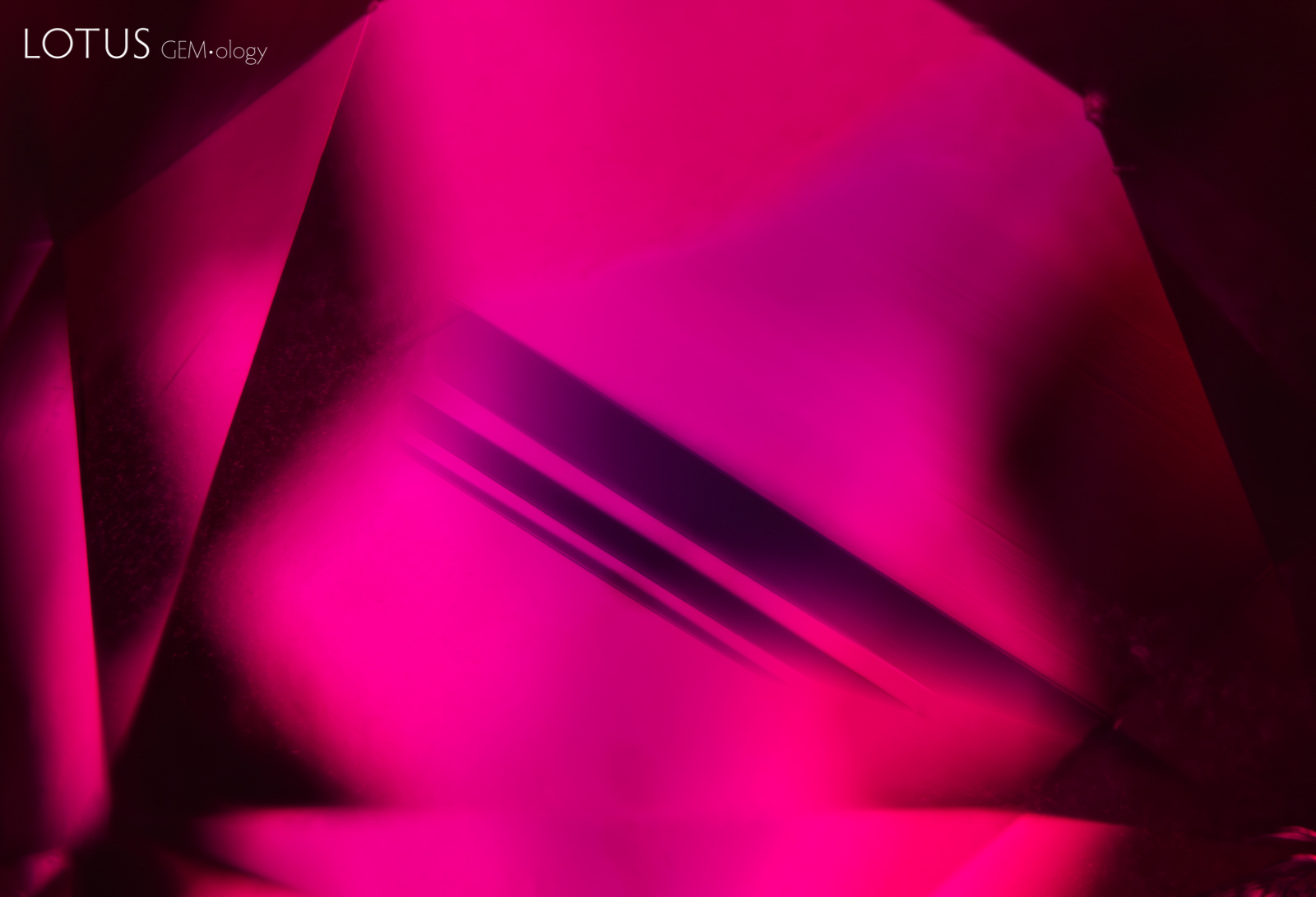
Burmese Ruby Inclusions
Explore Burmese ruby inclusions in Hyperion, the Lotus Gemology inclusion database. Hyperion contains photomicrographs of inclusions and internal features in natural rubies from Myanmar (Burma), documented with information on treatment, lighting conditions, field of view, photographer and published references.
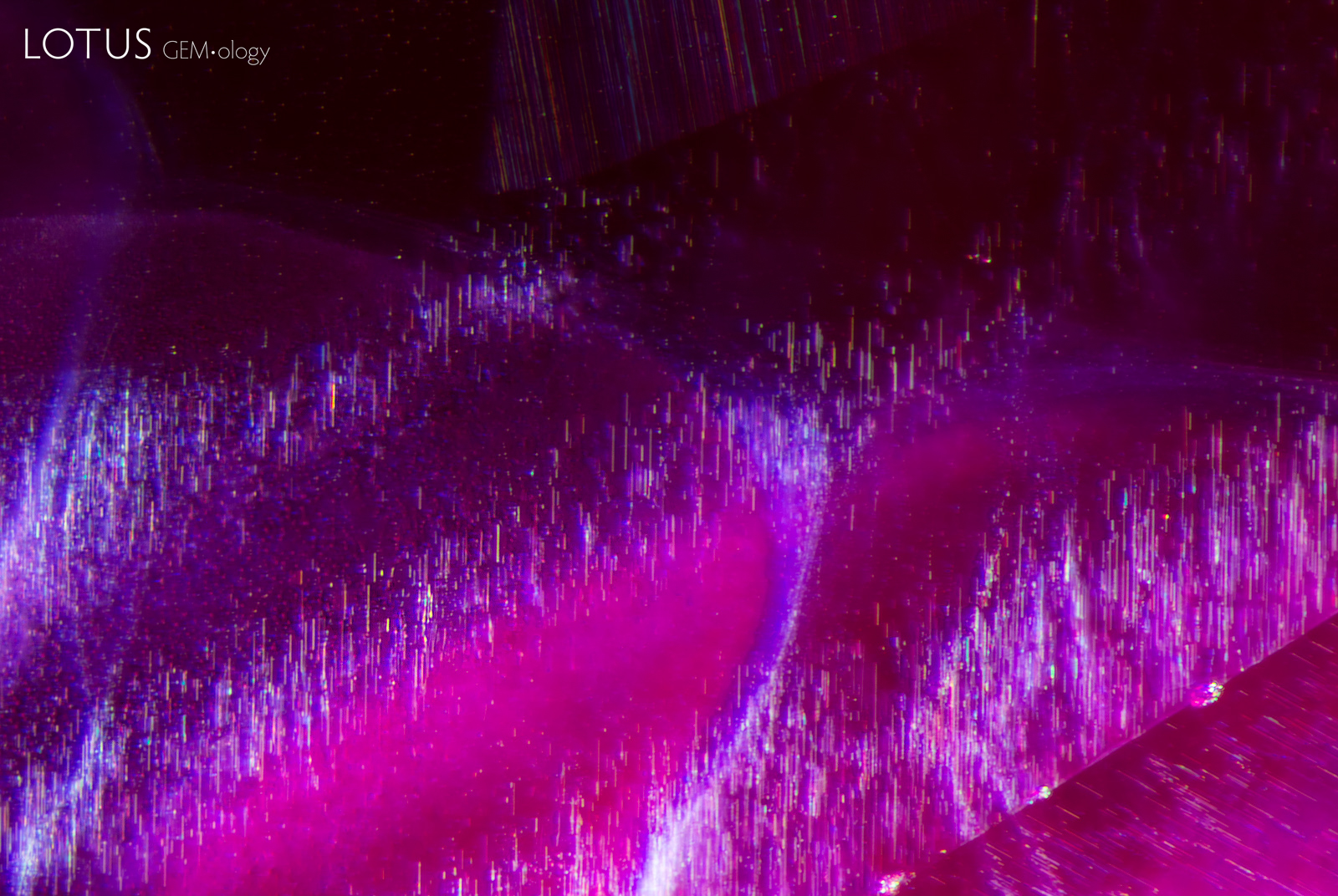
While superficially the rutile silk in this ruby may look intact, closer observation reveals that some of the needles have started to break down and develop gaps. Other evidence in the stone confirmed that this ruby was heated.
Natural Ruby •
Myanmar (Burma); Mogok/Namya •
Enhancements:
Heat (H) •
Lighting Conditions:
Fiber Optic: Diffuse Oblique
Photographer:
E. Billie Hughes •
Image Number:
A-005-8034-6
• Field of View = 3mm
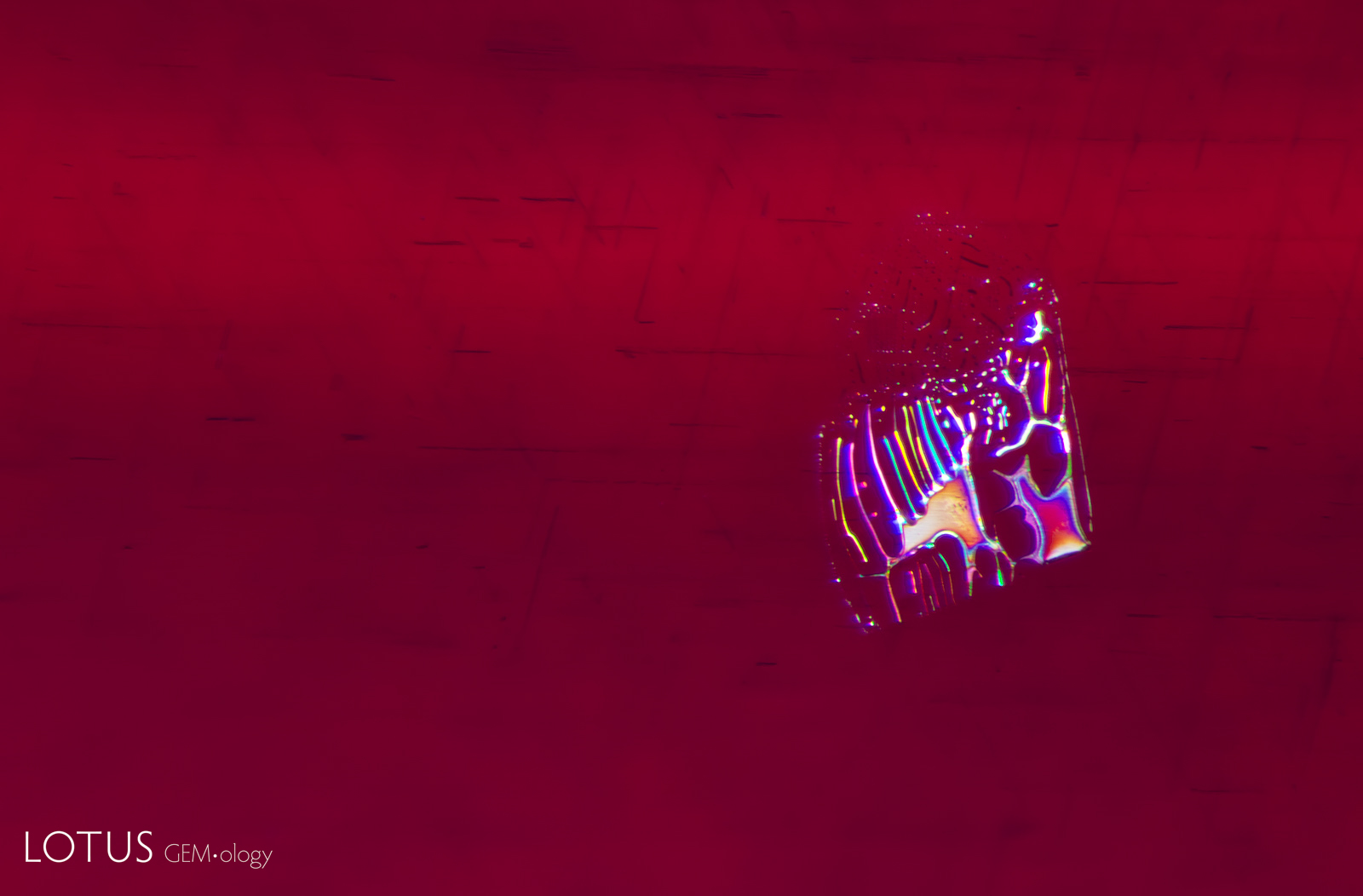
A melted fingerprint with drippy edges provides evidence that this ruby was heated.
Natural Ruby •
Myanmar (Burma); Mogok/Namya •
Enhancements:
Heat (H) •
Lighting Conditions:
Dark Field + Diffuse Fiber Optic
Photographer:
E. Billie Hughes •
Image Number:
A-005-8034-5
• Field of View = 1.8mm
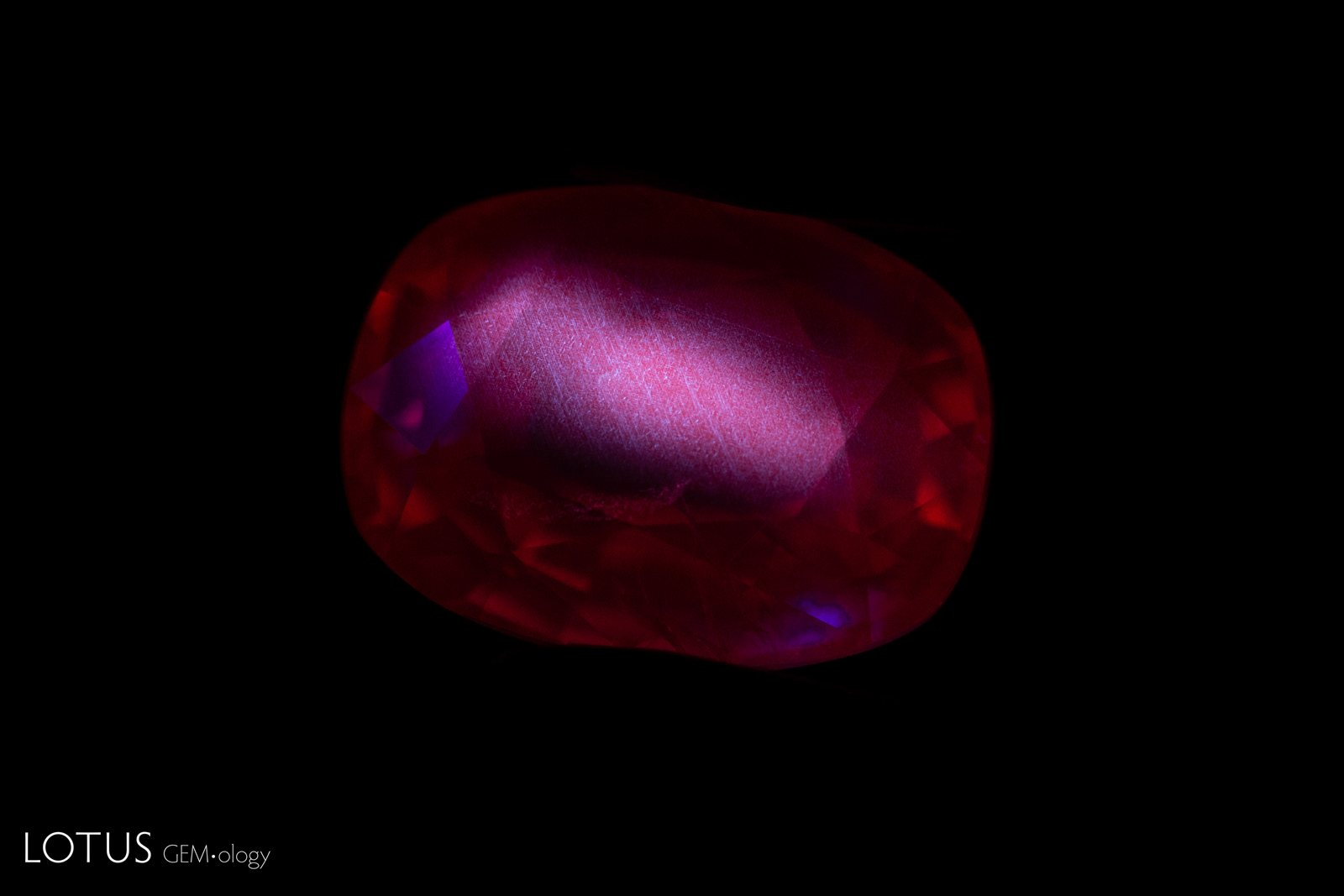
A chalky appearance can be observed in this heated ruby. Note that the chalky areas follow the pattern of silk.
Natural Ruby •
Myanmar (Burma); Mogok/Namya •
Enhancements:
Heat (H) •
Lighting Conditions:
Ultraviolet: Shortwave
Photographer:
E. Billie Hughes •
Image Number:
A-005-8034-1
This Mong Hsu ruby contained very fine “silk” needles, likely rutile. These kinds of needles are seem extremely rarely in stones from Mong Hsu. Note that while the needles here are intact, the stone was heated at “low temperature.”
Natural Ruby •
Myanmar (Burma); Mong Hsu •
Enhancements:
Heat + Fissure Healing (H-FH) •
Lighting Conditions:
Fiber Optic: Oblique
Photographer:
E. Billie Hughes •
Image Number:
A-005-6609-4
• Field of View = 1.5mm
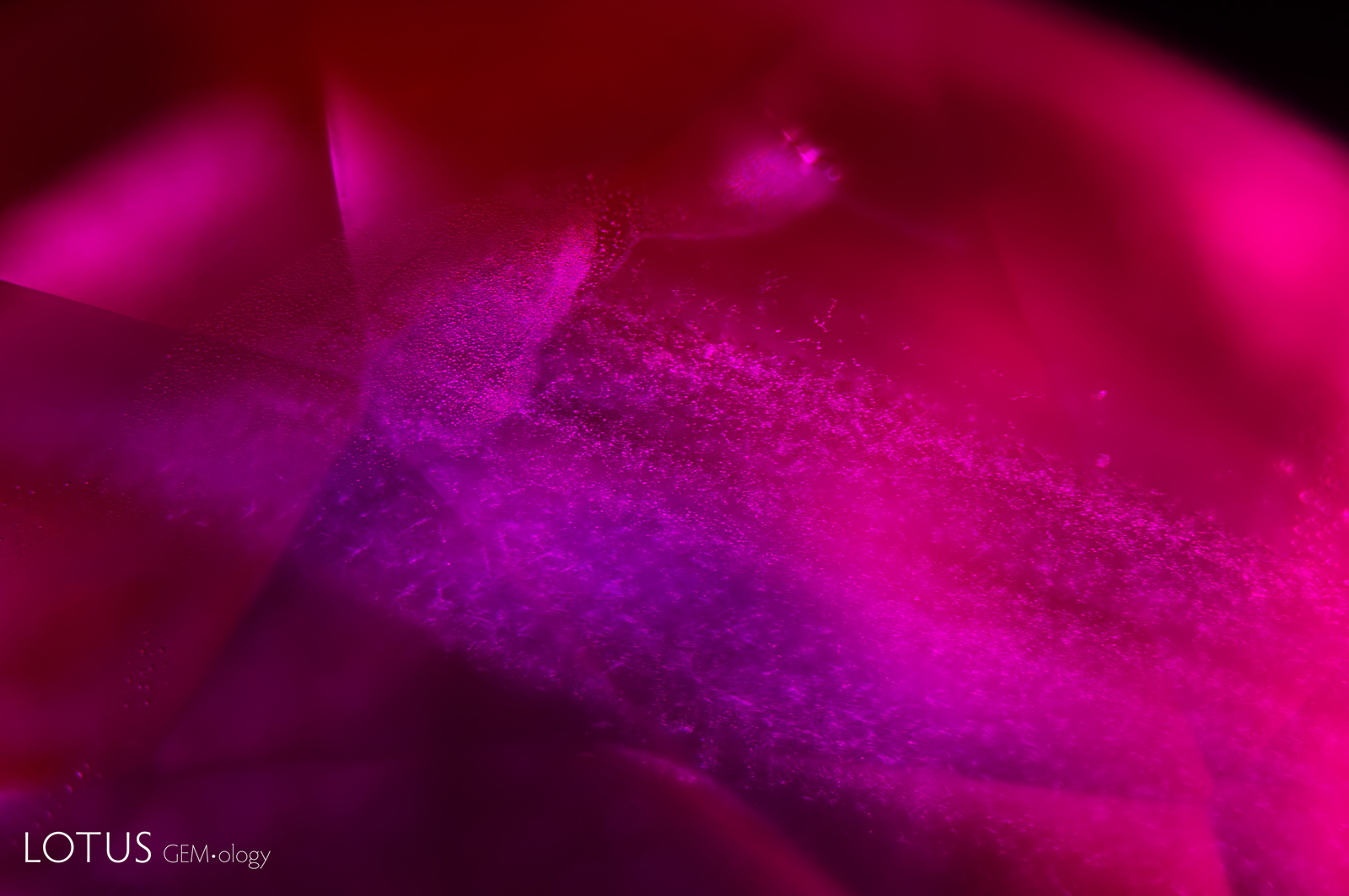
Wispy, cottony diaspore silk, as depicted here, is a common inclusion in rubies from Myanmar’s Mong Hsu mines.
Natural Ruby •
Myanmar (Burma); Mong Hsu •
Enhancements:
Heat + Fissure Healing (H-FH) •
Lighting Conditions:
Fiber Optic: Oblique
Photographer:
E. Billie Hughes •
Image Number:
A-005-6609-1
• Field of View = 2.8mm
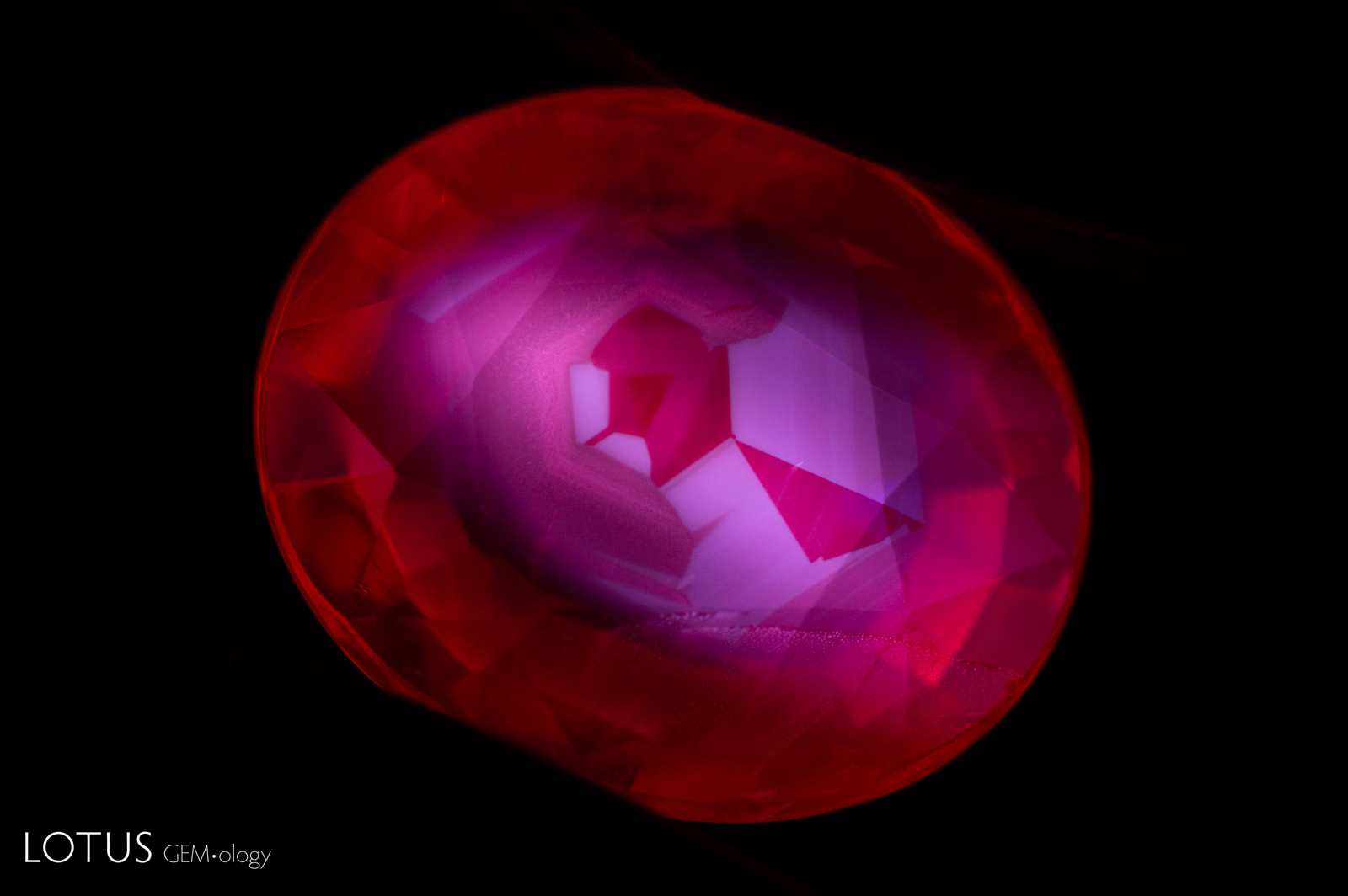
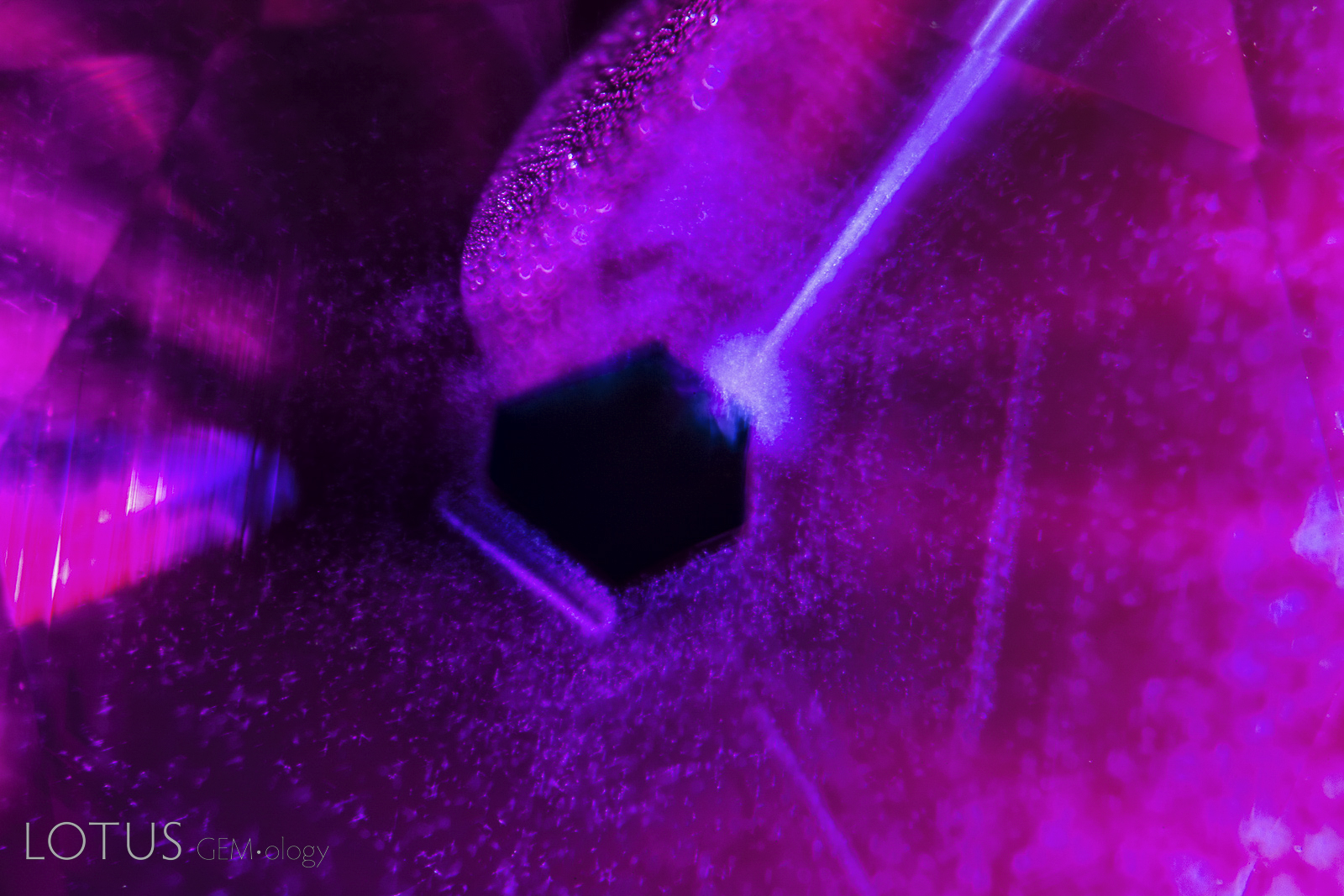
The hexagonal zones in this ruby display a characteristic chalky fluorescence in short wave UV. This is typical in heated Mong Hsu rubies. Prior to heat treatment, the hexagonal core of the crystal is typically blue. Heat treatment removes the blue cores, but also alters the exsolved diaspore particles, and changes the infrared spectrum, assisting detection.
Natural Ruby •
Myanmar (Burma); Mong Hsu •
Enhancements:
Heat + Fissure Healing (H-FH) •
Lighting Conditions:
Ultraviolet: Shortwave
Photographer:
E. Billie Hughes •
Image Number:
A-005-5296-1
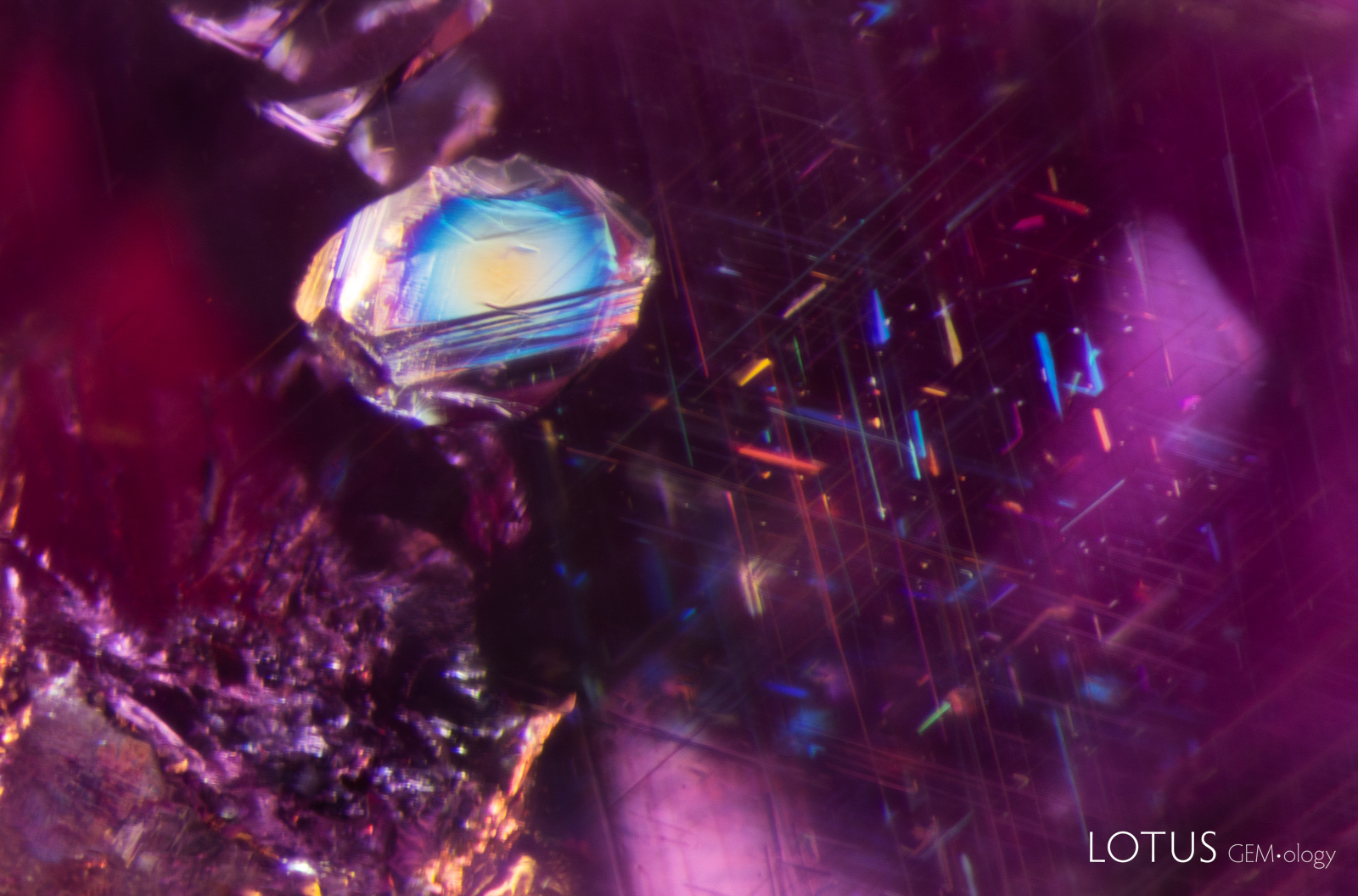
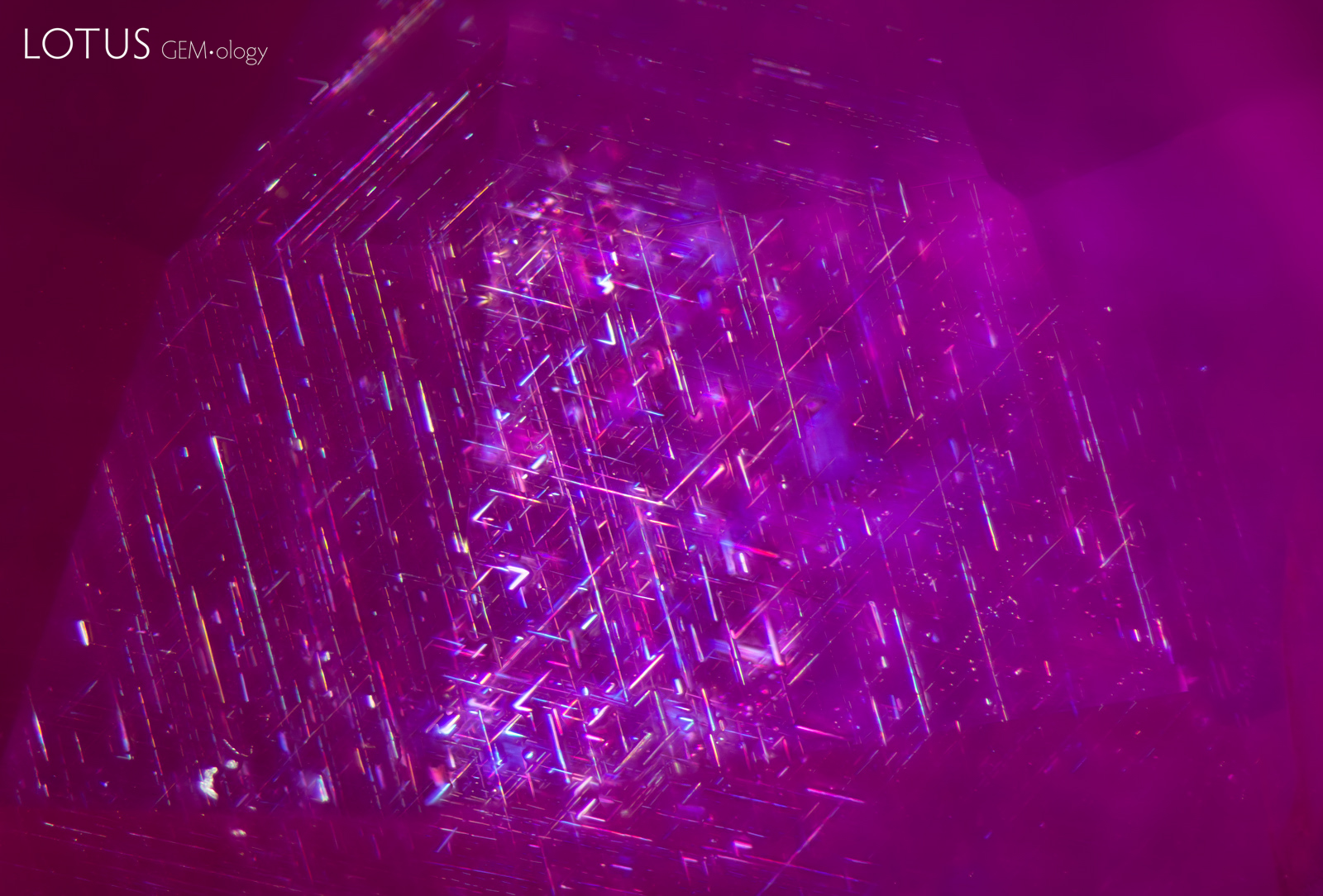
A fluorite crystal (identified with micro Raman) displays beautiful interference colors on its surface. In the background, a cloud of rutile silk needles can be seen. Specimen courtesy Vincent Pardieu.
Natural Ruby •
Myanmar (Burma); Mogok/Namya •
Enhancements:
None Detected (None) •
Lighting Conditions:
Fiber Optic: Diffuse Oblique
Photographer:
E. Billie Hughes •
Image Number:
R-004-8582-1
• Field of View = 1.5mm
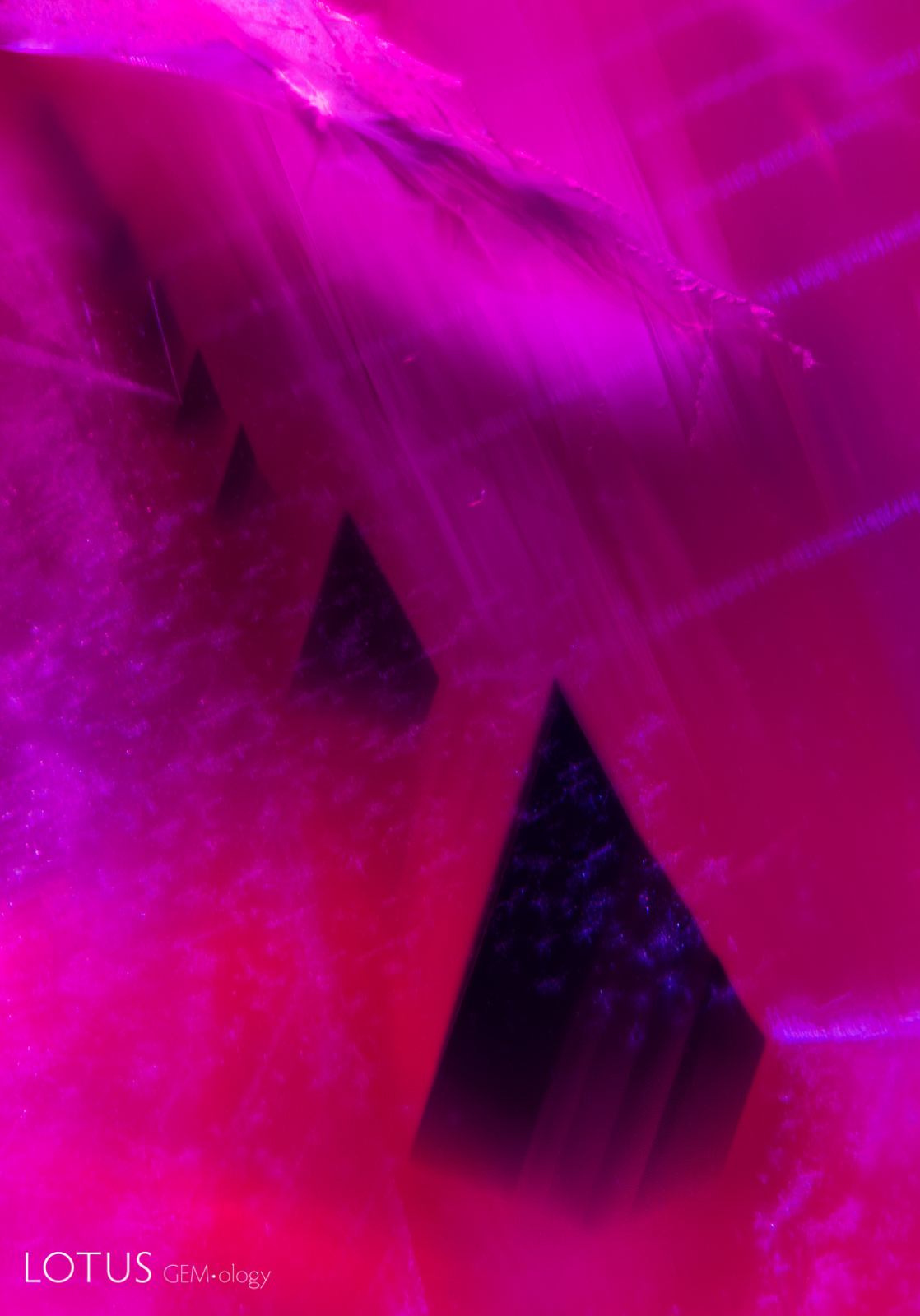
Angular blue color zoning is a hallmark of rubies like this one, which comes from Myanmar’s Mong Hsu region.
Natural Ruby •
Myanmar (Burma); Mong Hsu •
Enhancements:
None Detected (None) •
Lighting Conditions:
Fiber Optic: Oblique
Photographer:
E. Billie Hughes •
Image Number:
A-004-7703-1
• Field of View = 2.5mm
Prior to heat treatment, most Mong Hsu ruby crystals will feature a deep blue core surrounded by zoned clouds of fine exsolved diaspore particles; heat treatment will remove the blue core and other blue zoning.
Natural Ruby •
Myanmar (Burma); Mong Hsu •
Enhancements:
None Detected (None) •
Lighting Conditions:
Fiber Optic: Oblique
Photographer:
Richard W. Hughes •
Image Number:
A-004-2950-1
• Field of View = 4mm
A dusting of rutile silk needles appears to glide inside this ruby from Mogok, Myanmar (Burma).
Natural Ruby •
Myanmar (Burma); Mogok/Namya •
Enhancements:
None Detected (None) •
Lighting Conditions:
Fiber Optic: Oblique
Photographer:
Wimon Manorotkul •
Image Number:
A-004-1095-2
• Field of View = 3mm
Two small transparent crystals are nestled in a dense cloud of rutile silk. Micro Raman identified the crystal on the left as apatite and the one on the right as titanite (sphene).
Natural Ruby •
Myanmar (Burma); Mogok/Namya •
Enhancements:
None Detected (None) •
Lighting Conditions:
Dark Field + Diffuse Fiber Optic
Photographer:
E. Billie Hughes •
Image Number:
A-004-1095-1
• Field of View = 1.5mm
Like Mother Nature’s brush strokes, blue color zones are visible in this ruby from Mong Hsu, Myanmar (Burma).
Natural Ruby •
Myanmar (Burma); Mong Hsu •
Enhancements:
None Detected (None) •
Lighting Conditions:
Light Field (Transmitted Light)
Photographer:
E. Billie Hughes •
Image Number:
A-004-1096-1
• Field of View = 3.5mm
Burmese ruby inclusions may include mineral crystals, rutile silk, healed fissures, fluid inclusions, negative crystals, growth features and other internal features formed during or after crystal growth. Such features are important to gemologists because they can provide evidence useful in identifying ruby and evaluating a possible Burmese origin.
Burmese Ruby Inclusion Photomicrographs
The Hyperion Burmese ruby gallery includes microscopic features documented in rubies from Myanmar (Burma). Each entry is accompanied by descriptive information and, where available, references to the gemological literature.
What Inclusions Can Reveal About Burmese Ruby
Inclusions are an important part of geographic origin determination in ruby. Their form, composition, orientation and associations can provide evidence that, when considered together with other gemological properties, may support or contradict a Burmese origin.
Hyperion combines inclusion photomicrography with supporting gemological information so that individual features can be compared with documented examples from Burmese rubies.
About Hyperion
Hyperion is the Lotus Gemology searchable inclusion database. It allows users to browse gemstone inclusions by gem type, geographic origin, treatment and keyword.