Natural Ruby Inclusions
Explore ruby inclusions in Hyperion, the Lotus Gemology inclusion database. Hyperion contains photomicrographs of inclusions and internal features in natural ruby, documented with information on geographic origin, treatment, lighting conditions, field of view, photographer and published references.
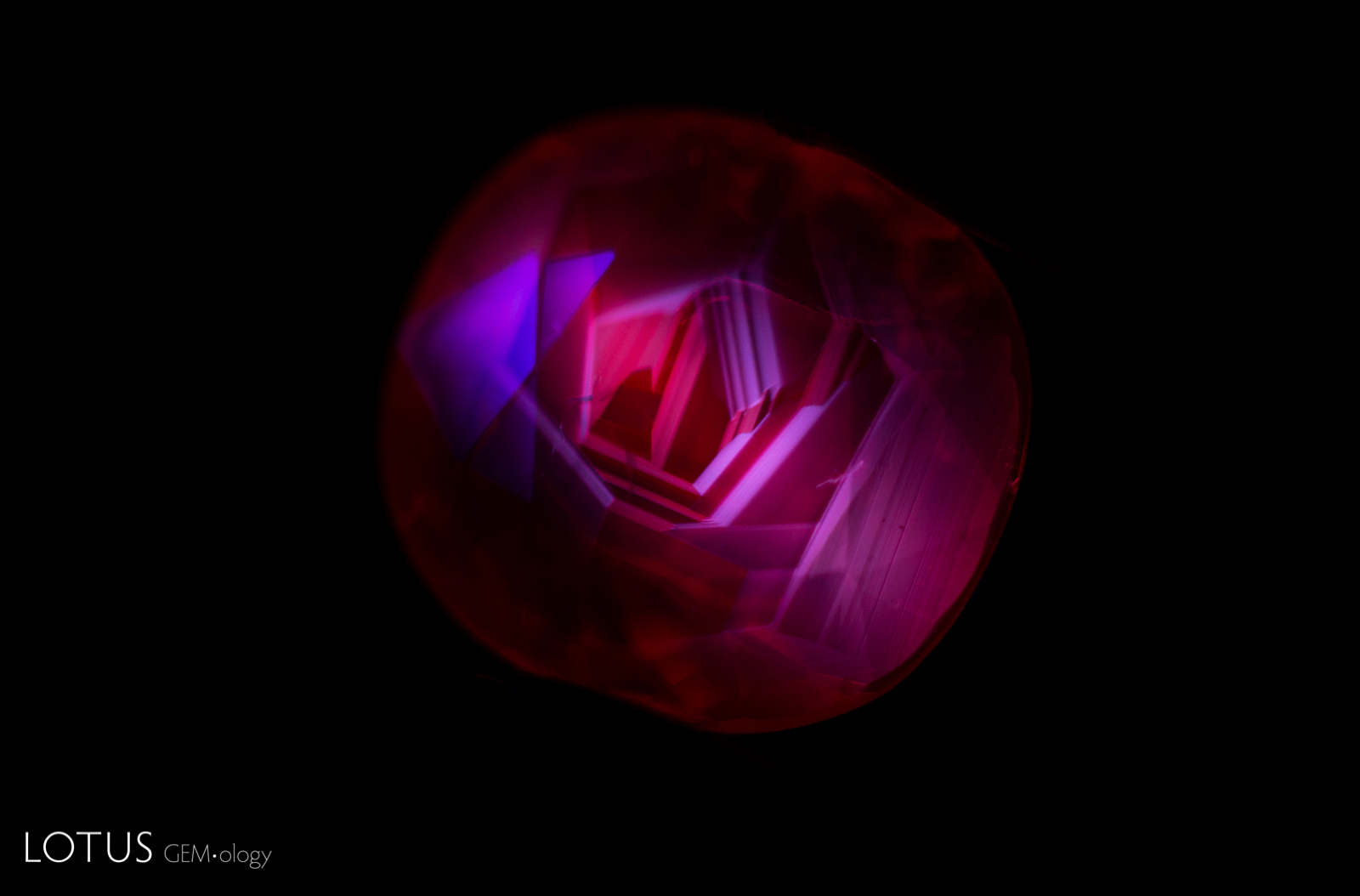
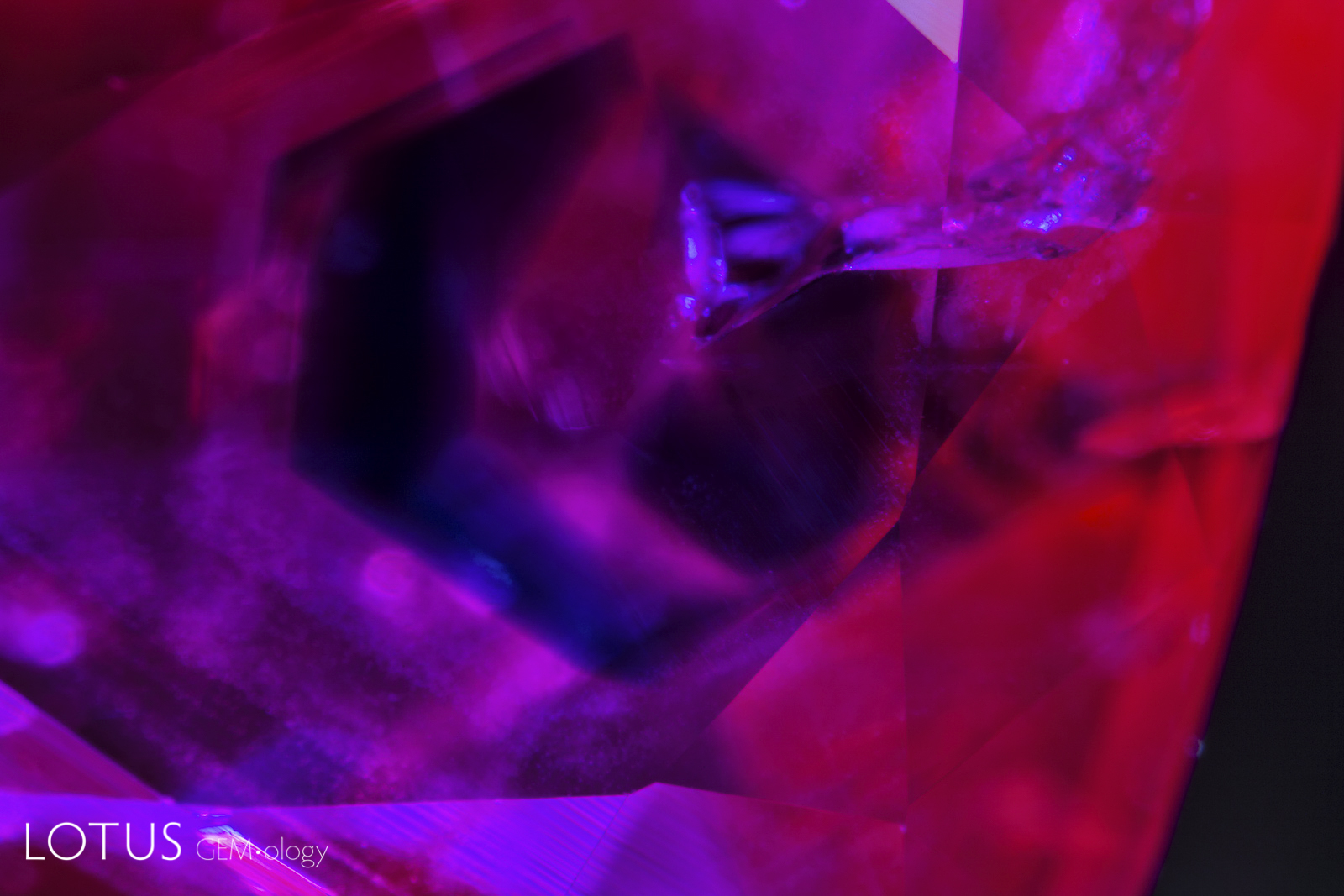
A chalky angular pattern, viewed here in shortwave UV illumination, is a strong sign of heat treatment. Many rubies from Mong Hsu, Myanmar, are heated to remove the blue zones that are often present in the natural material.
Natural Ruby •
Myanmar (Burma); Mong Hsu •
Enhancements:
Heat (H) •
Lighting Conditions:
Ultraviolet: Shortwave
Photographer:
E. Billie Hughes •
Image Number:
A-003-8110-1
Hughes, R.W. and Emmett, J.L. (2005) Heat Seeker: UV fluorescence as a gemological tool. The Guide, Vol. 24, No. 5, Part 1, Sept.–Oct., pp. 1, 4–7; RWHL*.
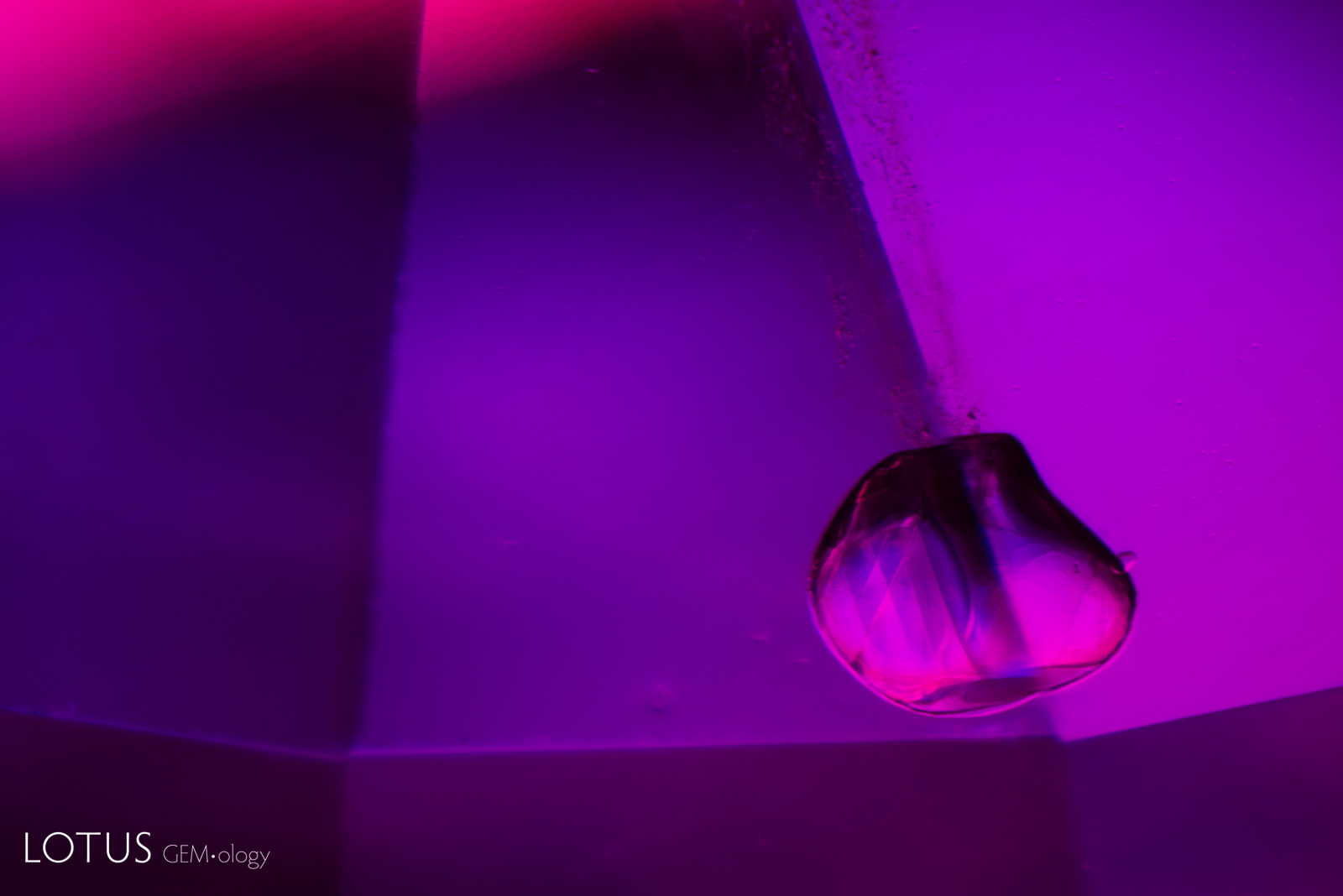
When viewed in transmitted light, this crystal in a Mozambique ruby displays a slightly greenish color. This hints that it might be an amphibole crystal. We confirmed this hypothesis with micro Raman.
Natural Ruby •
Mozambique •
Enhancements:
None Detected (None) •
Lighting Conditions:
Light Field (Transmitted Light)
Photographer:
E. Billie Hughes •
Image Number:
A-003-7933-1
• Field of View = 3mm
Pardieu, V., Sangsawong, S. et al. (2013) Rubies from the Montepuez area (Mozambique). Gemological Institute of America, October 5, 84 pp.; RWHL*.
Hughes, R.W., Manorotkul, W. and Hughes, E.B. (2017) Ruby & Sapphire: A Gemologist's Guide. Bangkok, Lotus Publishing, 816 pp.; RWHL*.
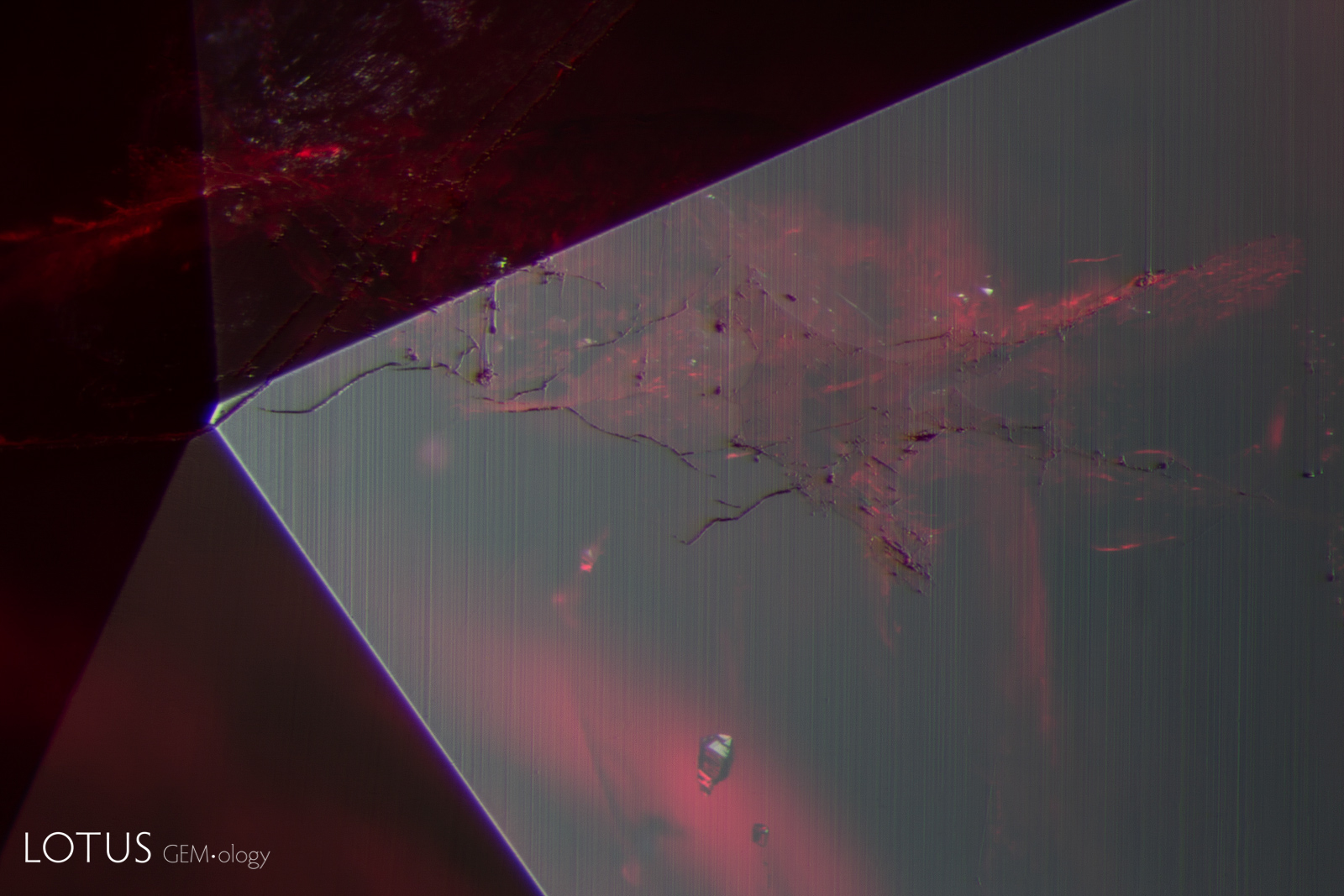
The oiling of gems to improve their appearance is a treatment we see with increasing frequency, particularly with gems originating in Myanmar. Here is a Mogok ruby that shows oil leaking from the fissures following a few minutes contact with the hot point.
Natural Ruby •
Myanmar (Burma); Mogok/Namya •
Enhancements:
Fissure Filling with colorless Oil/resin (FF-O2); No indications of heating (No indications of heating) •
Lighting Conditions:
Fiber Optic: Diffuse Overhead + Dark Field
Photographer:
Richard W. Hughes •
Image Number:
A-003-8626-1
• Field of View = 10mm
Lotus Gemology (2015) Lotus Gemology Lab Alert for Oiled Gems. Bangkok, LotusGemology.com, RWHL*.
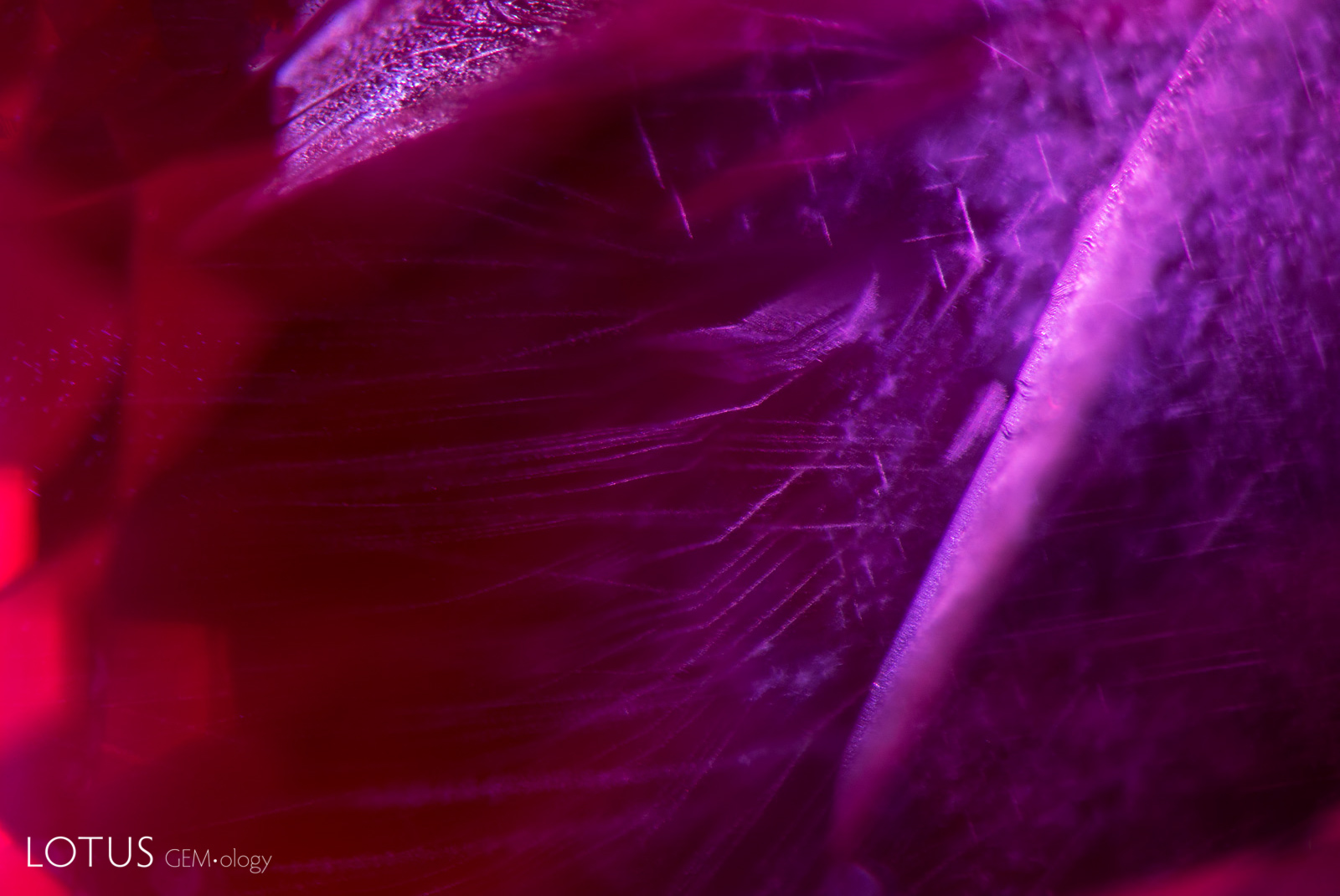
Virtually all Burmese rubies from Mong Hsu feature deep blue cores surrounded by cottony diaspore silk, as shown here. In previous times, most of this material was heated with flux to remove the blue areas and heal the fissures. However with the high price difference between natural and heated rubies, we now see many Mong Hsu rubies that have not been treated.
Natural Ruby •
Myanmar (Burma); Mong Hsu •
Enhancements:
None Detected (None) •
Lighting Conditions:
Fiber Optic: Diffuse Oblique
Photographer:
Richard W. Hughes •
Image Number:
A-003-8076-1
• Field of View = 4mm
Peretti, A., Schmetzer, K. et al. (1995) Rubies from Mong Hsu. Gems & Gemology, Vol. 31, No. 1, Spring, pp. 2–26; RWHL*.
Hughes, R.W., Manorotkul, W. and Hughes, E.B. (2017) Ruby & Sapphire: A Gemologist's Guide. Bangkok, Lotus Publishing, 816 pp.; RWHL*.
A large negative crystal was cut through on the pavilion of this ruby and filled with debris. Its appearance makes for an imposing figure in this ruby from Madagascar.
Natural Ruby •
Madagascar •
Enhancements:
None Detected (None) •
Lighting Conditions:
Dark Field + Diffuse Fiber Optic
Photographer:
E. Billie Hughes •
Image Number:
A-003-7817-1
• Field of View = 3mm
Hughes, R.W., Manorotkul, W. and Hughes, E.B. (2017) Ruby & Sapphire: A Gemologist's Guide. Bangkok, Lotus Publishing, 816 pp.; RWHL*.
Hughes, R.W., Manorotkul, W. et al. (2015) Let it bleed: New rubies from Madagascar. Bangkok, Lotus Gemology Co. Ltd., RWHL*.
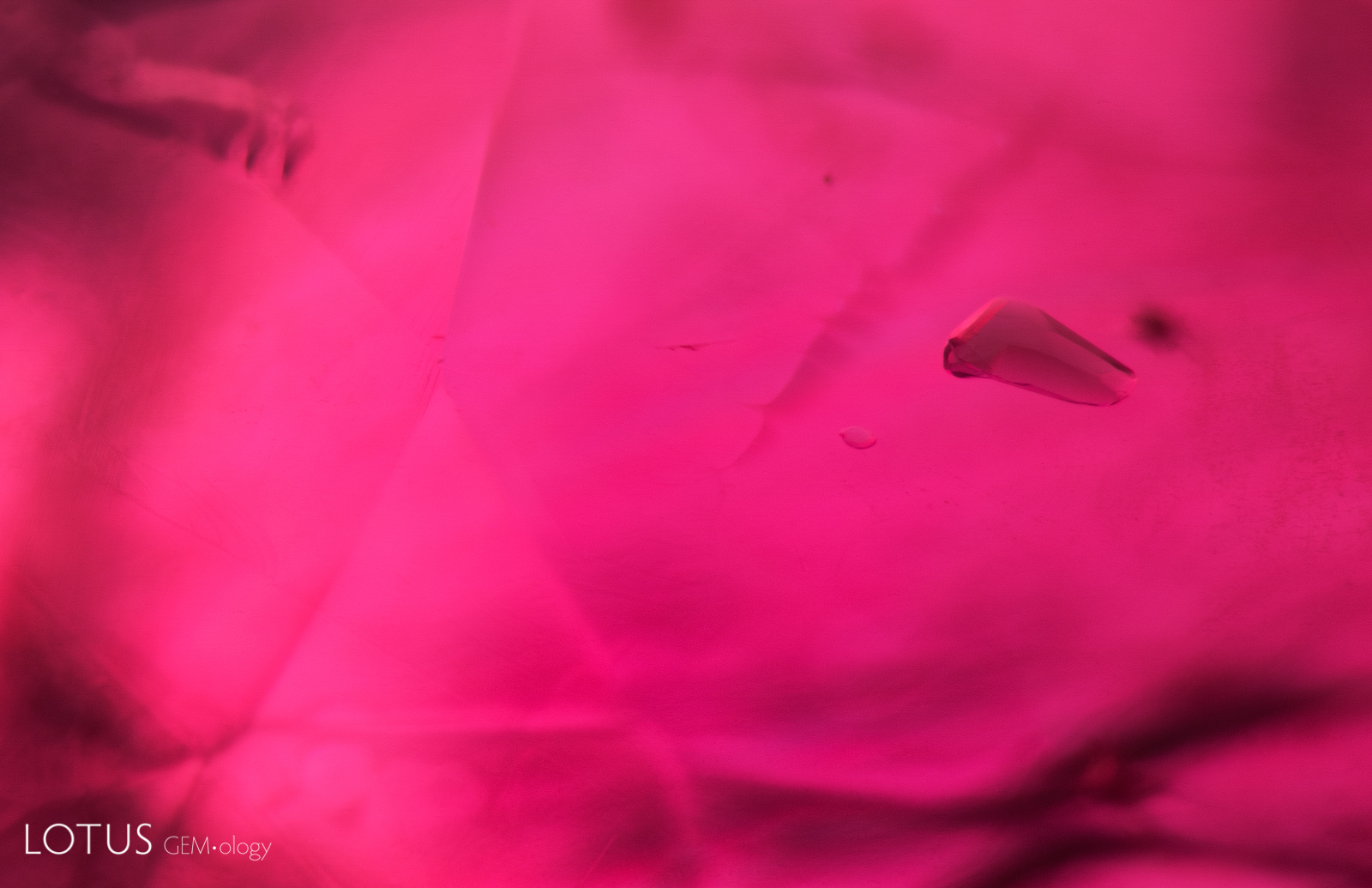
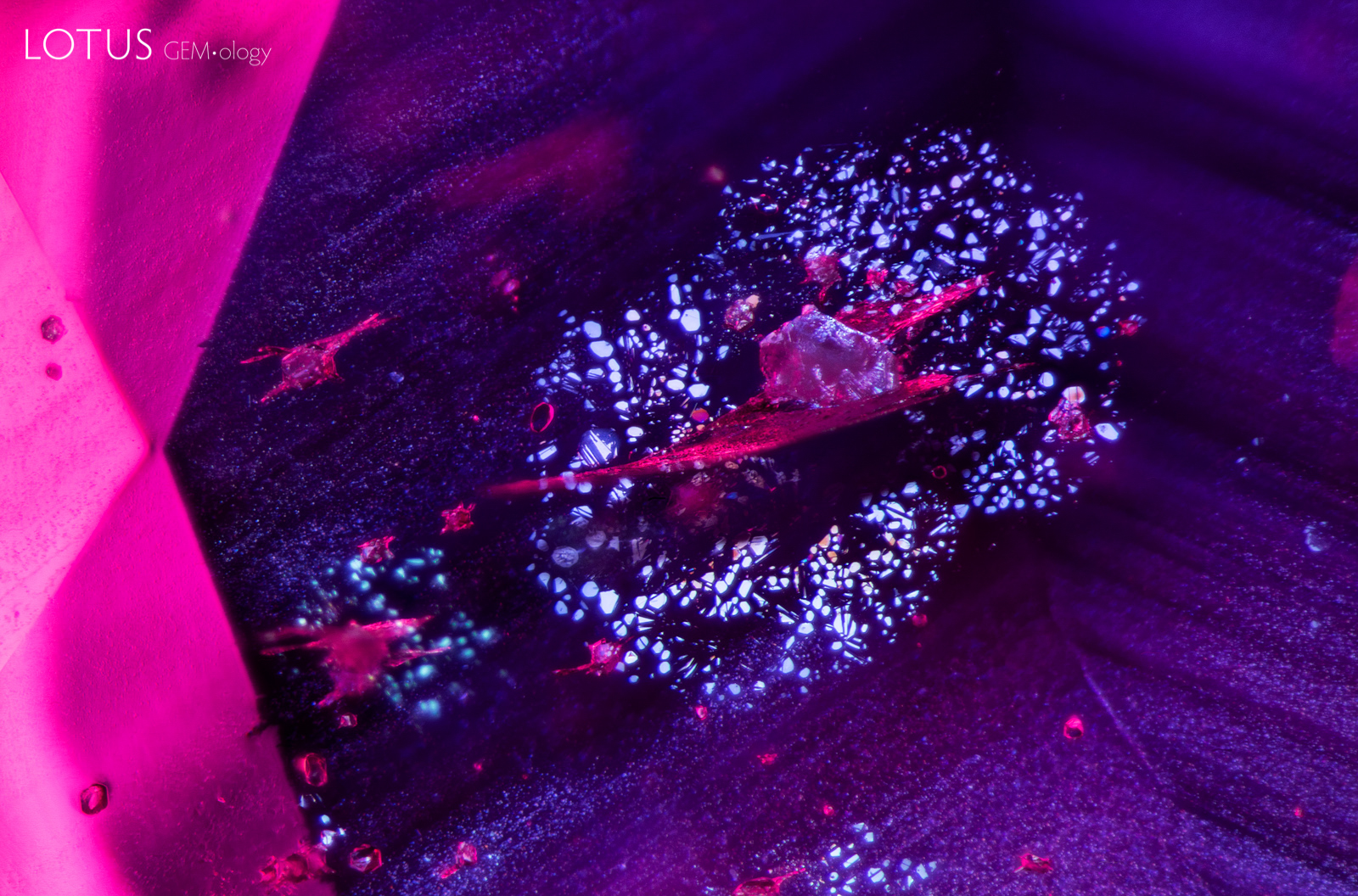
Mica crystals, identified here with micro Raman, are common feature in Mozambique ruby. They often have “rosettes” of thin films surrounding them as depicted in this photomicrograph.
Natural Ruby •
Mozambique •
Enhancements:
None Detected (None) •
Lighting Conditions:
Dark Field + Diffuse Fiber Optic
Photographer:
E. Billie Hughes •
Image Number:
A-003-7806-2
• Field of View = 3mm
Pardieu, V., Sangsawong, S. et al. (2013) Rubies from the Montepuez area (Mozambique). Gemological Institute of America, October 5, 84 pp.; RWHL*.
Hughes, R.W., Manorotkul, W. and Hughes, E.B. (2017) Ruby & Sapphire: A Gemologist's Guide. Bangkok, Lotus Publishing, 816 pp.; RWHL*.
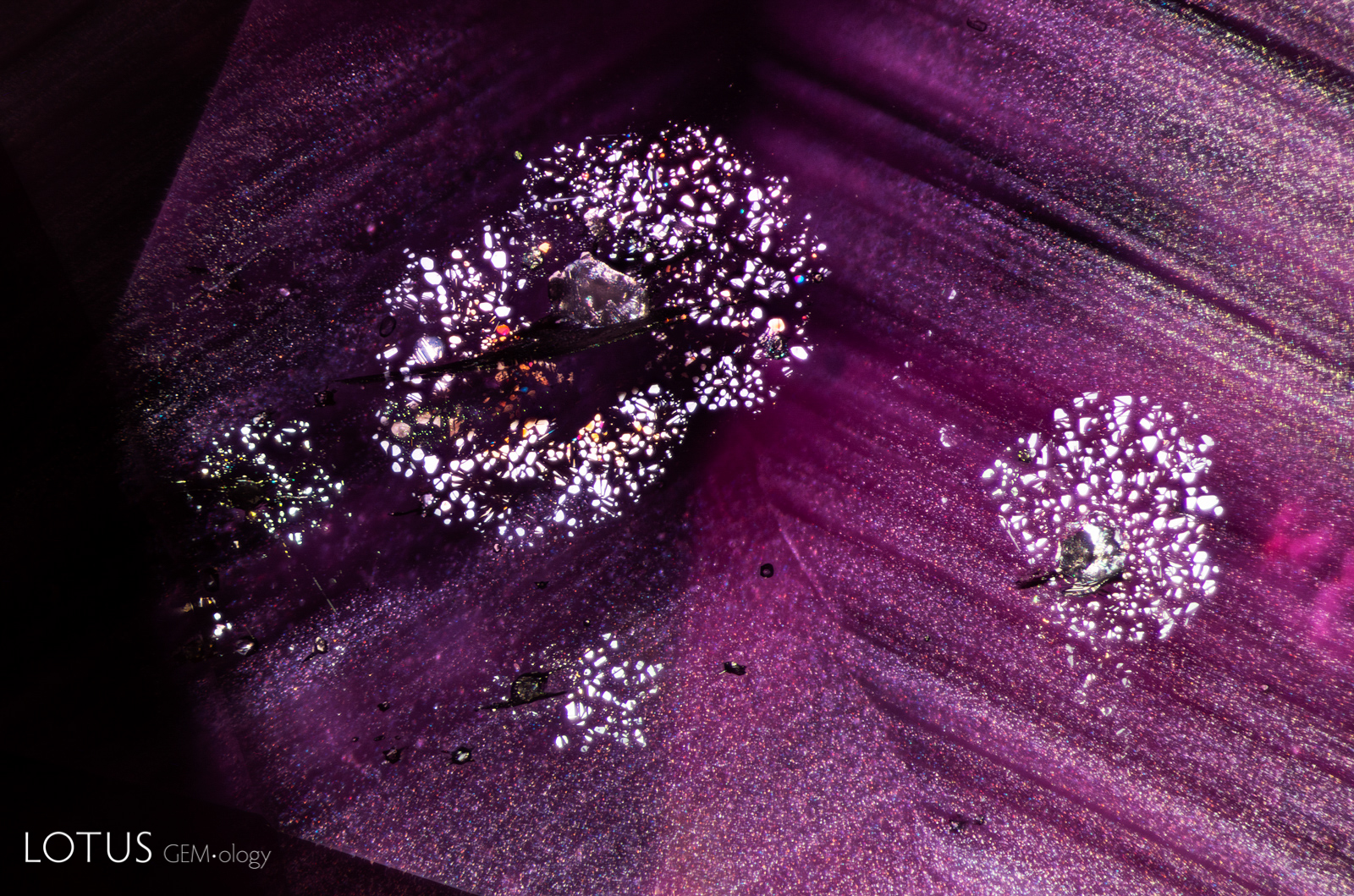
Mica crystals, identified here with micro Raman, are common feature in Mozambique ruby. They often have “rosettes” of thin films surrounding them as depicted in this photomicrograph.
Natural Ruby •
Mozambique •
Enhancements:
None Detected (None) •
Lighting Conditions:
Fiber Optic: Diffuse Oblique
Photographer:
E. Billie Hughes •
Image Number:
A-003-7806-1
• Field of View = 4mm
Pardieu, V., Sangsawong, S. et al. (2013) Rubies from the Montepuez area (Mozambique). Gemological Institute of America, October 5, 84 pp.; RWHL*.
Hughes, R.W., Manorotkul, W. and Hughes, E.B. (2017) Ruby & Sapphire: A Gemologist's Guide. Bangkok, Lotus Publishing, 816 pp.; RWHL*.
458 Total Images
Results: 109 – 120 | Page 10 of 39 Pages
Natural ruby inclusions may include mineral crystals, rutile silk, healed fissures, fluid inclusions, negative crystals, color zoning and other features formed during or after crystal growth. Such features are important to gemologists because they can provide evidence useful in identifying ruby, understanding its geological history, recognizing treatment and, in some cases, determining geographic origin.
Natural Ruby Inclusion Photomicrographs
The Hyperion natural ruby gallery includes microscopic features found in rubies from major deposits around the world. Each entry is accompanied by descriptive information and, where available, references to the gemological literature.
What Inclusions Can Reveal About Natural Ruby
Inclusions are an important part of ruby identification. Their form, composition, orientation and alteration can help gemologists distinguish natural ruby from synthetic material, recognize evidence of heat treatment, and study the geological environment in which the ruby formed.
Hyperion combines inclusion photomicrography with supporting gemological information so that individual features can be compared with documented examples from known ruby deposits.
About Hyperion
Hyperion is the Lotus Gemology searchable inclusion database. It allows users to browse gemstone inclusions by gem type, geographic origin, treatment and keyword.
Search the Complete Hyperion Database