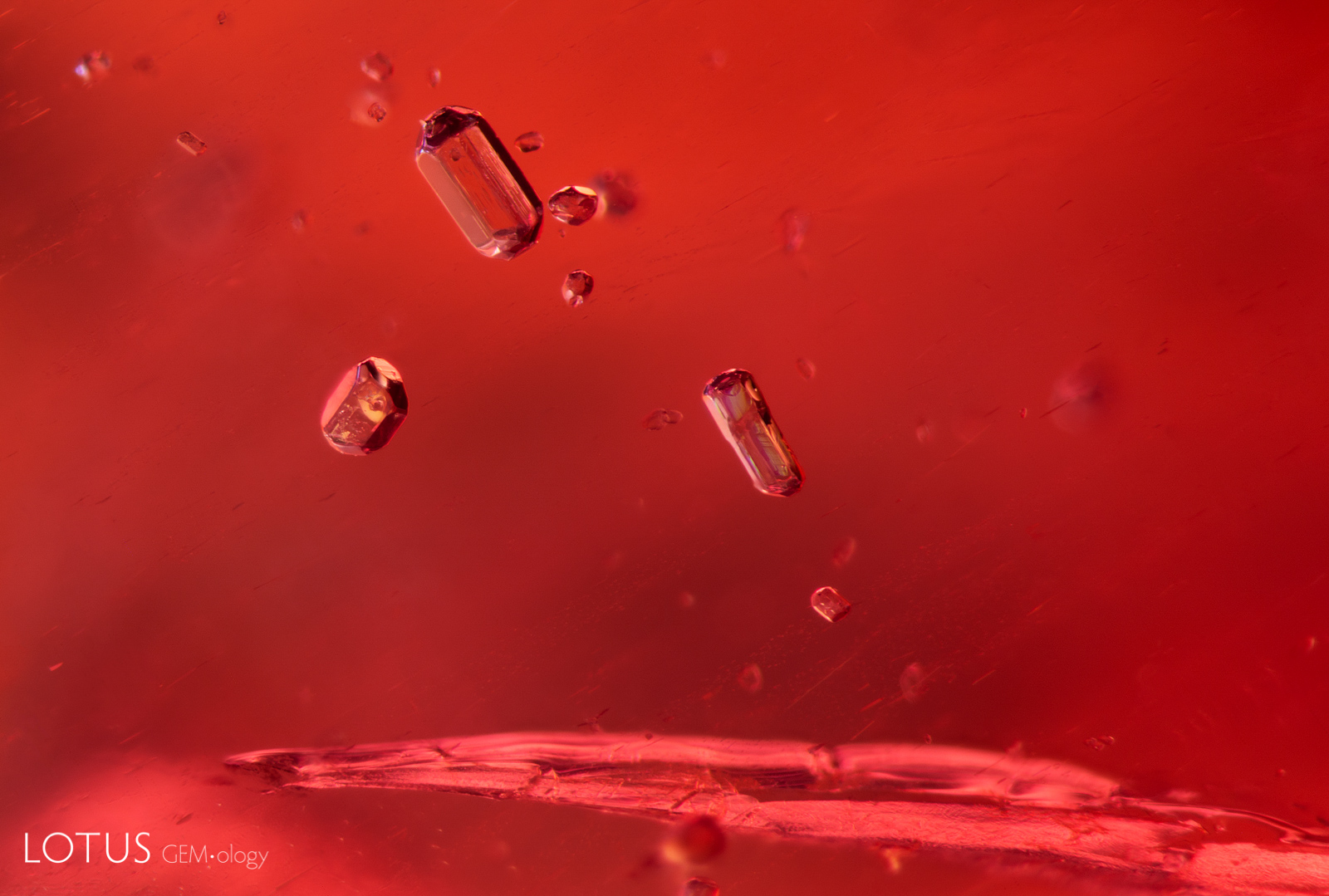
Natural Ruby Inclusions
Explore ruby inclusions in Hyperion, the Lotus Gemology inclusion database. Hyperion contains photomicrographs of inclusions and internal features in natural ruby, documented with information on geographic origin, treatment, lighting conditions, field of view, photographer and published references.
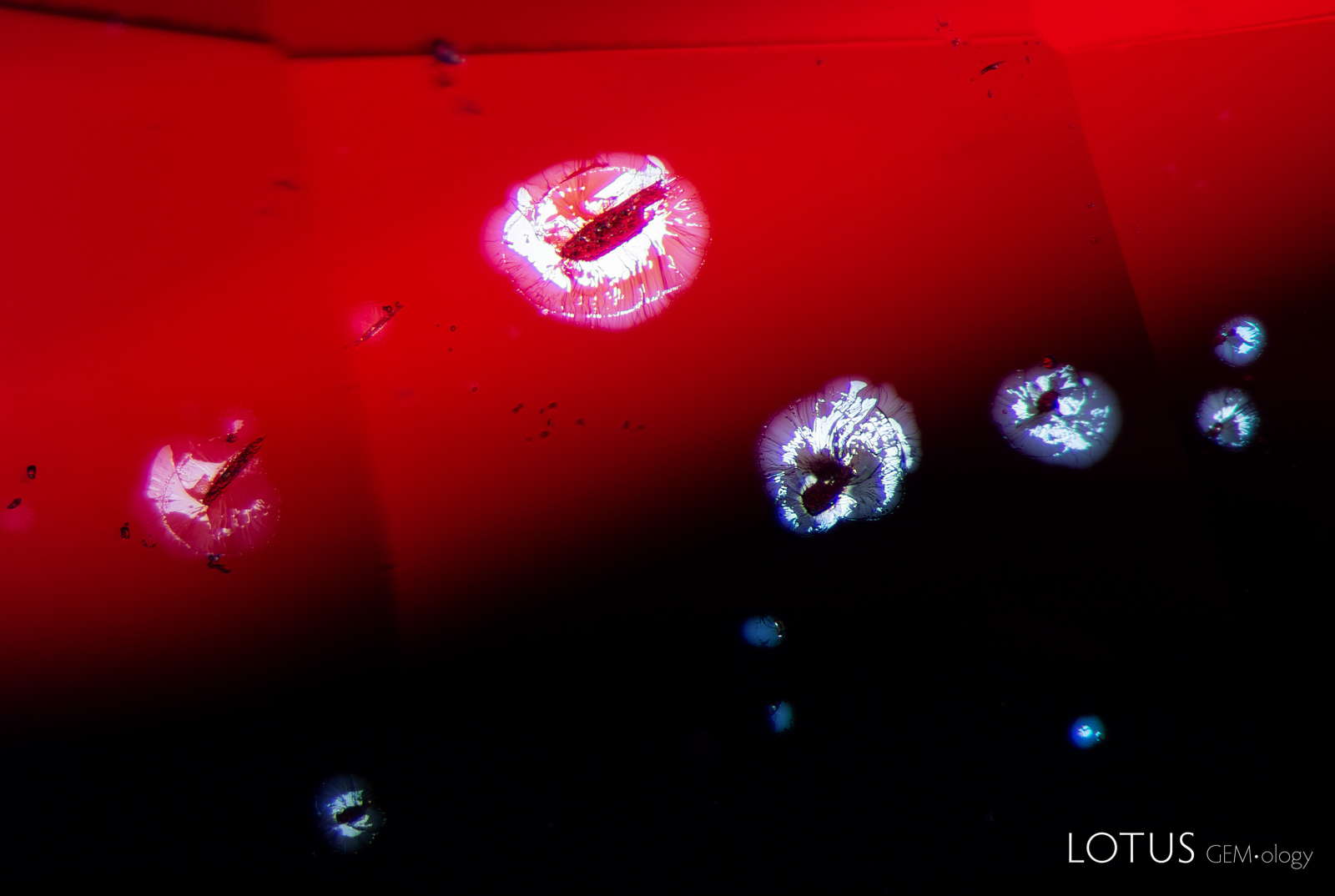
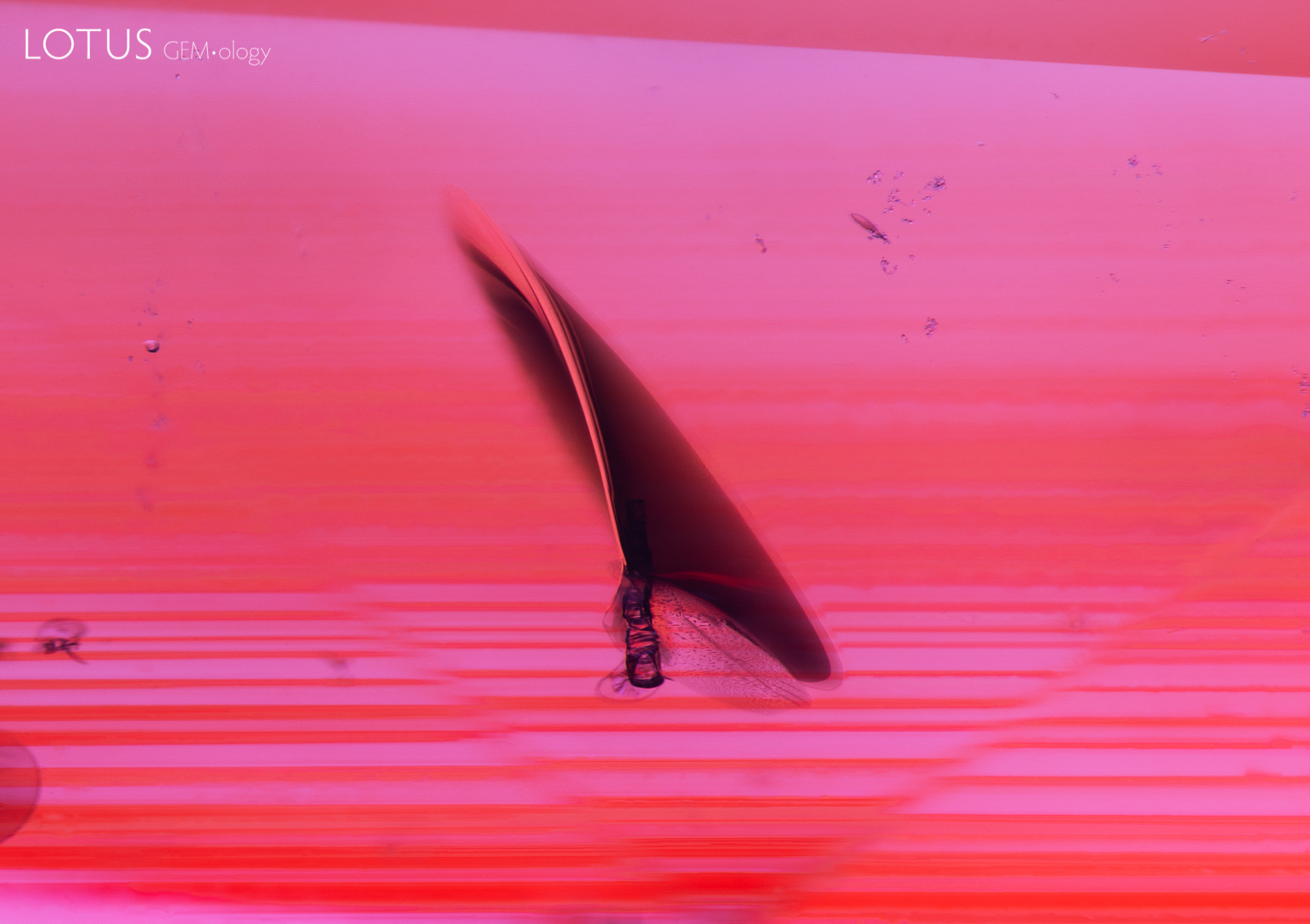
Several crystals in this ruby from Madagascar are surrounded by small reflective fissures.
Natural Ruby •
Madagascar •
Enhancements:
Heat (H) •
Lighting Conditions:
Dark Field + Diffuse Fiber Optic
Photographer:
E. Billie Hughes •
Image Number:
A-004-3304-2
• Field of View = 6mm
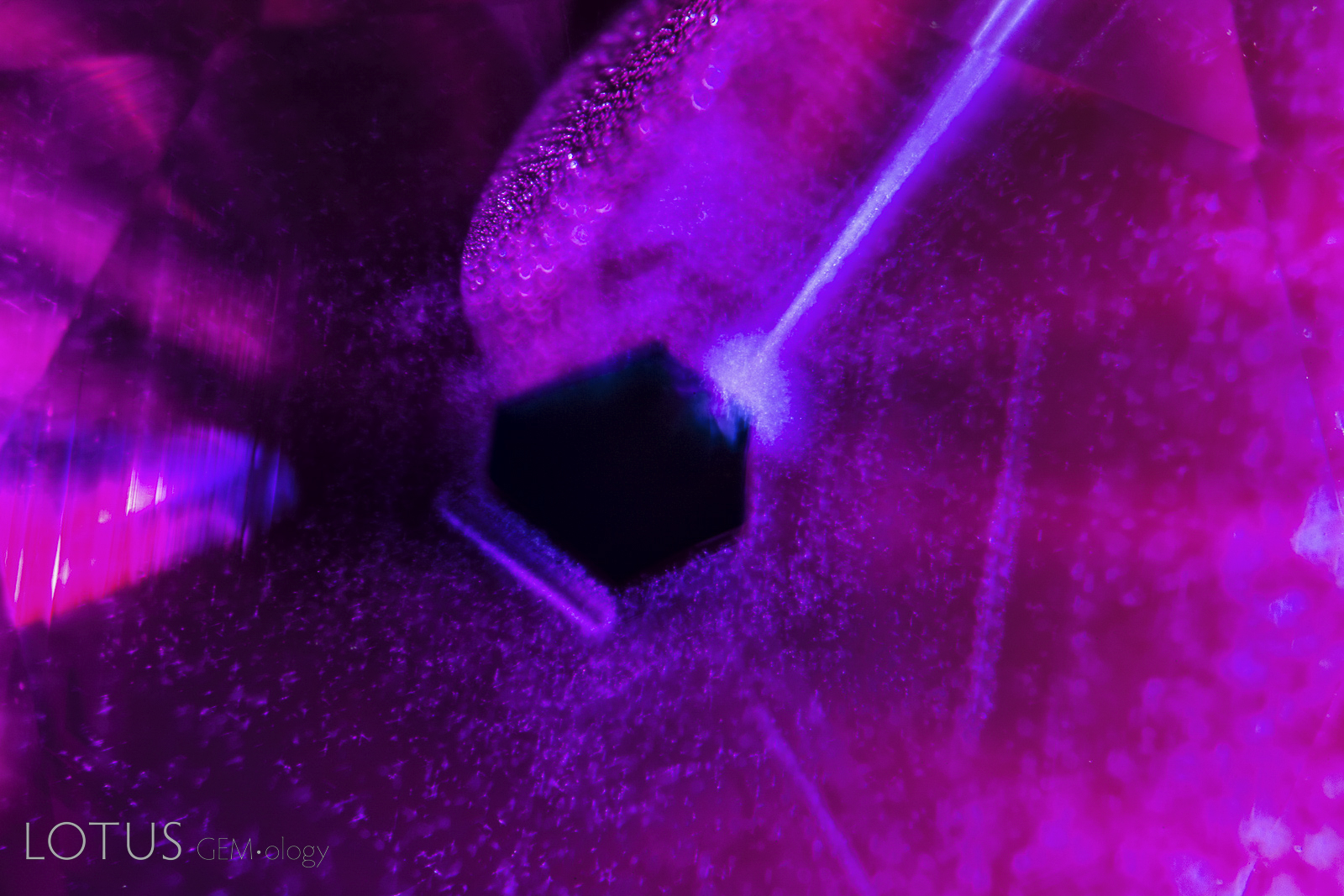
A small crystal with a shiny discoid attached can be seen clearly against a backdrop of orange color zoning in this ruby from Madagascar.
Natural Ruby •
Madagascar •
Enhancements:
Heat (H) •
Lighting Conditions:
Diffuse Light Field + Blue Filter
Photographer:
E. Billie Hughes •
Image Number:
A-004-3304-1
• Field of View = 5mm
Prior to heat treatment, most Mong Hsu ruby crystals will feature a deep blue core surrounded by zoned clouds of fine exsolved diaspore particles; heat treatment will remove the blue core and other blue zoning.
Natural Ruby •
Myanmar (Burma); Mong Hsu •
Enhancements:
None Detected (None) •
Lighting Conditions:
Fiber Optic: Oblique
Photographer:
Richard W. Hughes •
Image Number:
A-004-2950-1
• Field of View = 4mm
“Saturn inclusion” type crystals, as seen here, are a hallmark of Thai/Cambodian ruby. Although we were unable to identify the composition of the whole crystal, the black spots on the surface were identified as magnetite with micro Raman.
Natural Ruby •
Thailand/Cambodia •
Enhancements:
Heat (H) •
Lighting Conditions:
Dark Field + Oblique Fiber Optic
Photographer:
Wimon Manorotkul •
Image Number:
A-004-1969-3
• Field of View = 5mm
Thin films, as seen here, are a classic inclusion in Thai/Cambodian ruby.
Natural Ruby •
Thailand/Cambodia •
Enhancements:
Heat (H) •
Lighting Conditions:
Fiber Optic: Oblique
Photographer:
Wimon Manorotkul •
Image Number:
A-004-1969-1
• Field of View = 3.5mm
Mozambique rubies often contain silk with an appearance like what is seen here.
Natural Ruby •
Mozambique •
Enhancements:
None Detected (None) •
Lighting Conditions:
Fiber Optic: Oblique
Photographer:
Wimon Manorotkul •
Image Number:
A-004-1533-1
• Field of View = 3mm
The silk pictured here has an appearance typically found in Mozambique ruby.
Natural Ruby •
Mozambique •
Enhancements:
None Detected (None) •
Lighting Conditions:
Fiber Optic: Oblique
Photographer:
Wimon Manorotkul •
Image Number:
A-004-1537-3
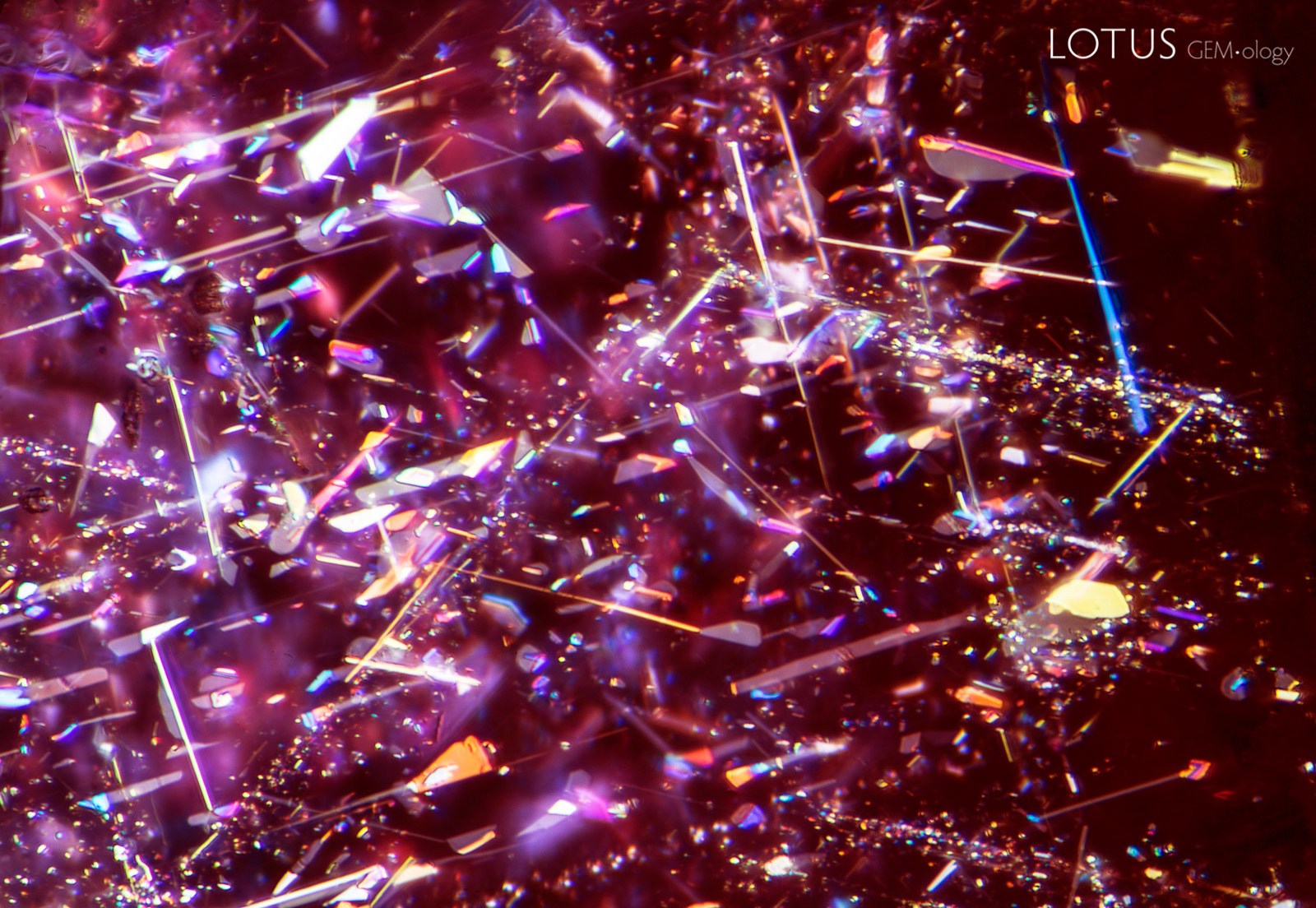
Further evidence is found by carefully examining the mixed crystal exsolved rutile silk. Such inclusions typically unmix into two different solid phases, one highly reflective and the other of lower relief. When such crystals are heated, the lower relief crystals may begin to break down, developing irregular white patches, as one can see here, particularly in the crystal at the center left of the field of view.
Natural Ruby •
Mozambique •
Enhancements:
Heat (H) •
Lighting Conditions:
Fiber Optic: Oblique
Photographer:
Richard W. Hughes •
Image Number:
A-004-1219-3
• Field of View = 1mm
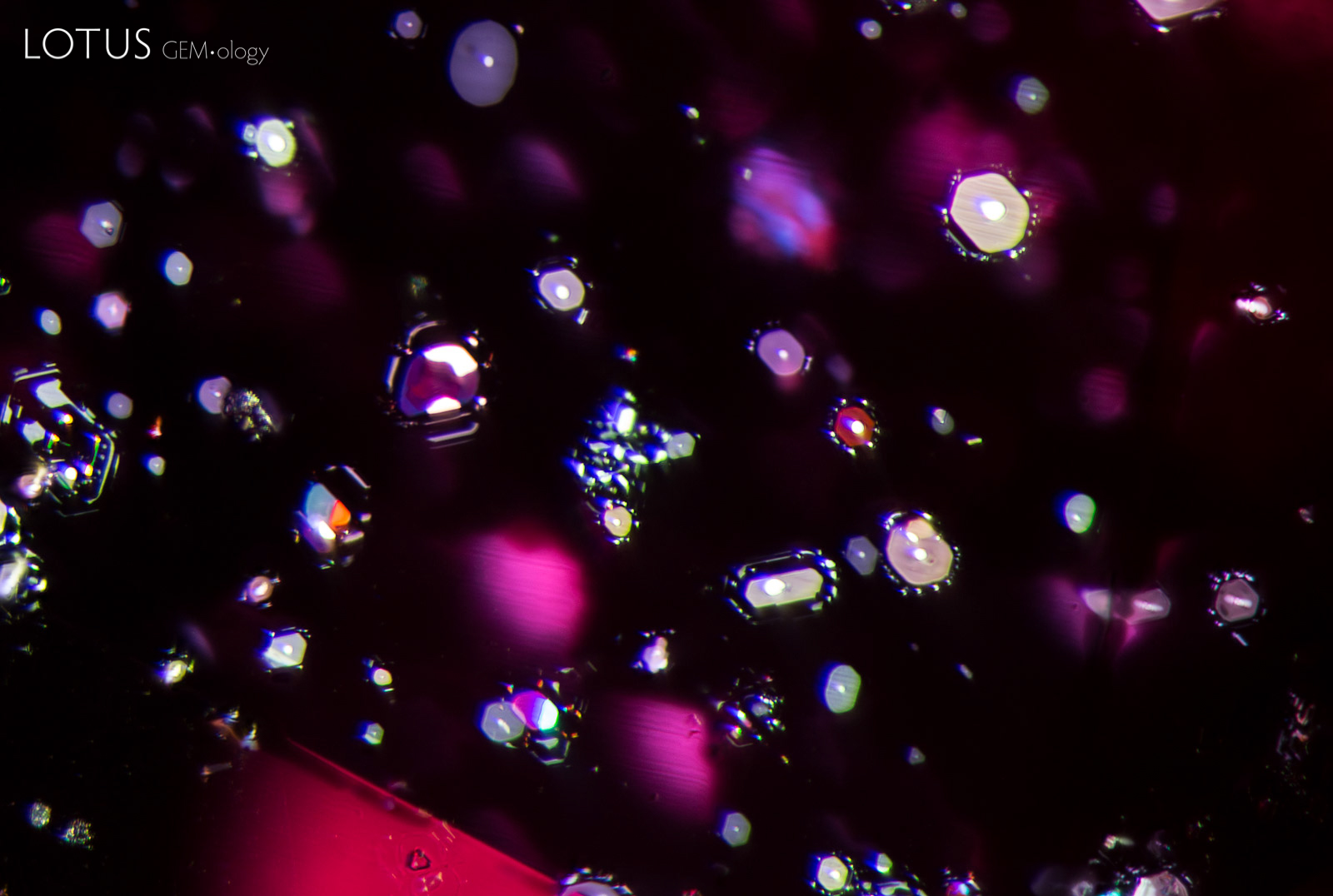
Spall marks on the surface of this Mozambique ruby prove that it was heat-treated after cutting and polishing.
Natural Ruby •
Mozambique •
Enhancements:
Heat (H) •
Lighting Conditions:
Dark Field + Overhead Fiber Optic
Photographer:
Richard W. Hughes •
Image Number:
A-004-1219-2
• Field of View = 2mm
Spall marks on the surface of this Mozambique ruby prove that it was heat-treated after cutting and polishing. Note that some of the spall marks have dark halos around them.
Natural Ruby •
Mozambique •
Enhancements:
Heat (H) •
Lighting Conditions:
Dark Field + Overhead Fiber Optic
Photographer:
Richard W. Hughes •
Image Number:
A-004-1219-1
• Field of View = 2.5mm
A number of blocky apatite crystals can be observed in this ruby from East Africa. Interspersed with the crystals we can also see polysynthetic twin planes and particles of silk.
Natural Ruby •
East Africa •
Enhancements:
None Detected (None) •
Lighting Conditions:
Dark Field + Diffuse Fiber Optic
Photographer:
E. Billie Hughes •
Image Number:
A-004-1161-2
• Field of View = 3.5mm
This East African ruby contains several prismatic apatite crystals.
Natural Ruby •
East Africa •
Enhancements:
None Detected (None) •
Lighting Conditions:
Dark Field + Diffuse Fiber Optic
Photographer:
E. Billie Hughes •
Image Number:
A-004-1161-1
• Field of View = 3mm
Natural ruby inclusions may include mineral crystals, rutile silk, healed fissures, fluid inclusions, negative crystals, color zoning and other features formed during or after crystal growth. Such features are important to gemologists because they can provide evidence useful in identifying ruby, understanding its geological history, recognizing treatment and, in some cases, determining geographic origin.
Natural Ruby Inclusion Photomicrographs
The Hyperion natural ruby gallery includes microscopic features found in rubies from major deposits around the world. Each entry is accompanied by descriptive information and, where available, references to the gemological literature.
What Inclusions Can Reveal About Natural Ruby
Inclusions are an important part of ruby identification. Their form, composition, orientation and alteration can help gemologists distinguish natural ruby from synthetic material, recognize evidence of heat treatment, and study the geological environment in which the ruby formed.
Hyperion combines inclusion photomicrography with supporting gemological information so that individual features can be compared with documented examples from known ruby deposits.
About Hyperion
Hyperion is the Lotus Gemology searchable inclusion database. It allows users to browse gemstone inclusions by gem type, geographic origin, treatment and keyword.