Natural Ruby Inclusions
Explore ruby inclusions in Hyperion, the Lotus Gemology inclusion database. Hyperion contains photomicrographs of inclusions and internal features in natural ruby, documented with information on geographic origin, treatment, lighting conditions, field of view, photographer and published references.
This type of inclusion scene is typical for untreated Mozambique ruby. A blocky crystal can be observed, suspended in between layers of “silk” needles and platelets.
Natural Ruby •
Mozambique •
Enhancements:
None Detected (None) •
Lighting Conditions:
Dark Field + Diffuse Fiber Optic
Photographer:
E. Billie Hughes •
Image Number:
A-004-8840-1
• Field of View = 1.5mm
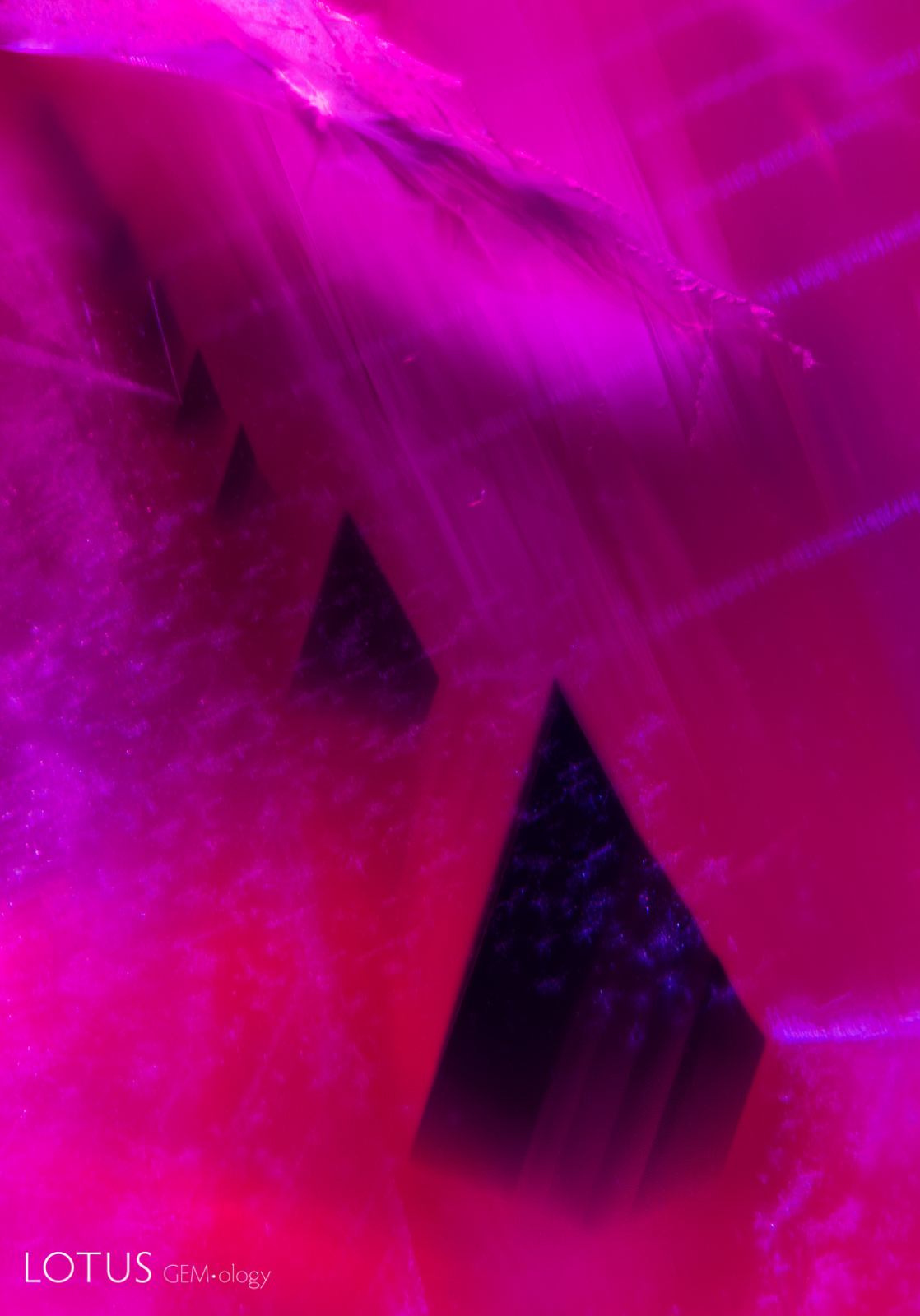
Angular blue color zoning is a hallmark of rubies like this one, which comes from Myanmar’s Mong Hsu region.
Natural Ruby •
Myanmar (Burma); Mong Hsu •
Enhancements:
None Detected (None) •
Lighting Conditions:
Fiber Optic: Oblique
Photographer:
E. Billie Hughes •
Image Number:
A-004-7703-1
• Field of View = 2.5mm
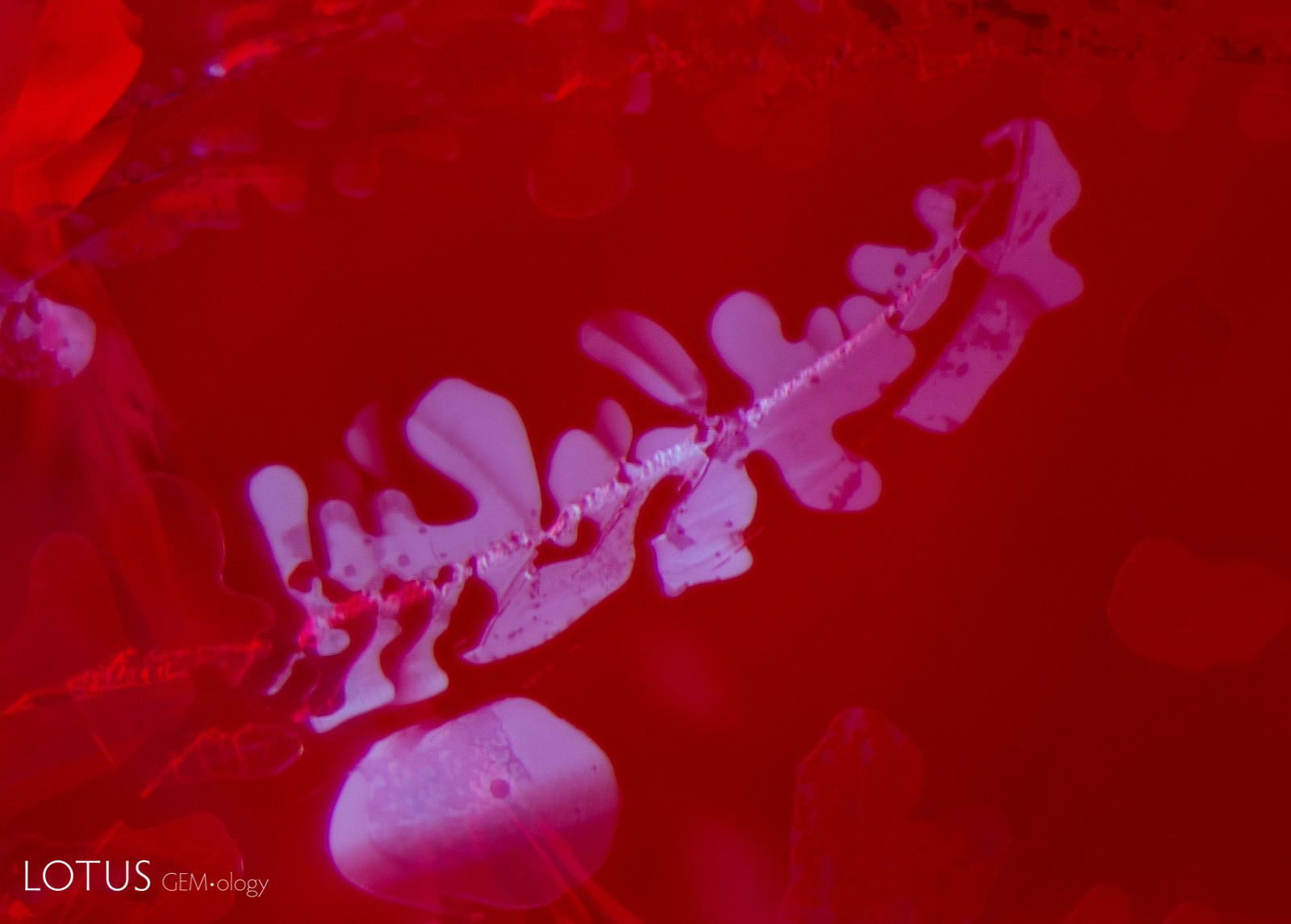
When the fissure in this ruby is illuminated with a longwave UV torch, a dendritic pattern where filler is present can be easily seen.
Natural Ruby •
East Africa •
Enhancements:
Heat + Glass Cavity/Fissure Filling (H-GF1) •
Lighting Conditions:
Ultraviolet: Longwave
Photographer:
E. Billie Hughes •
Image Number:
A-004-7334-1
• Field of View = 2.5mm
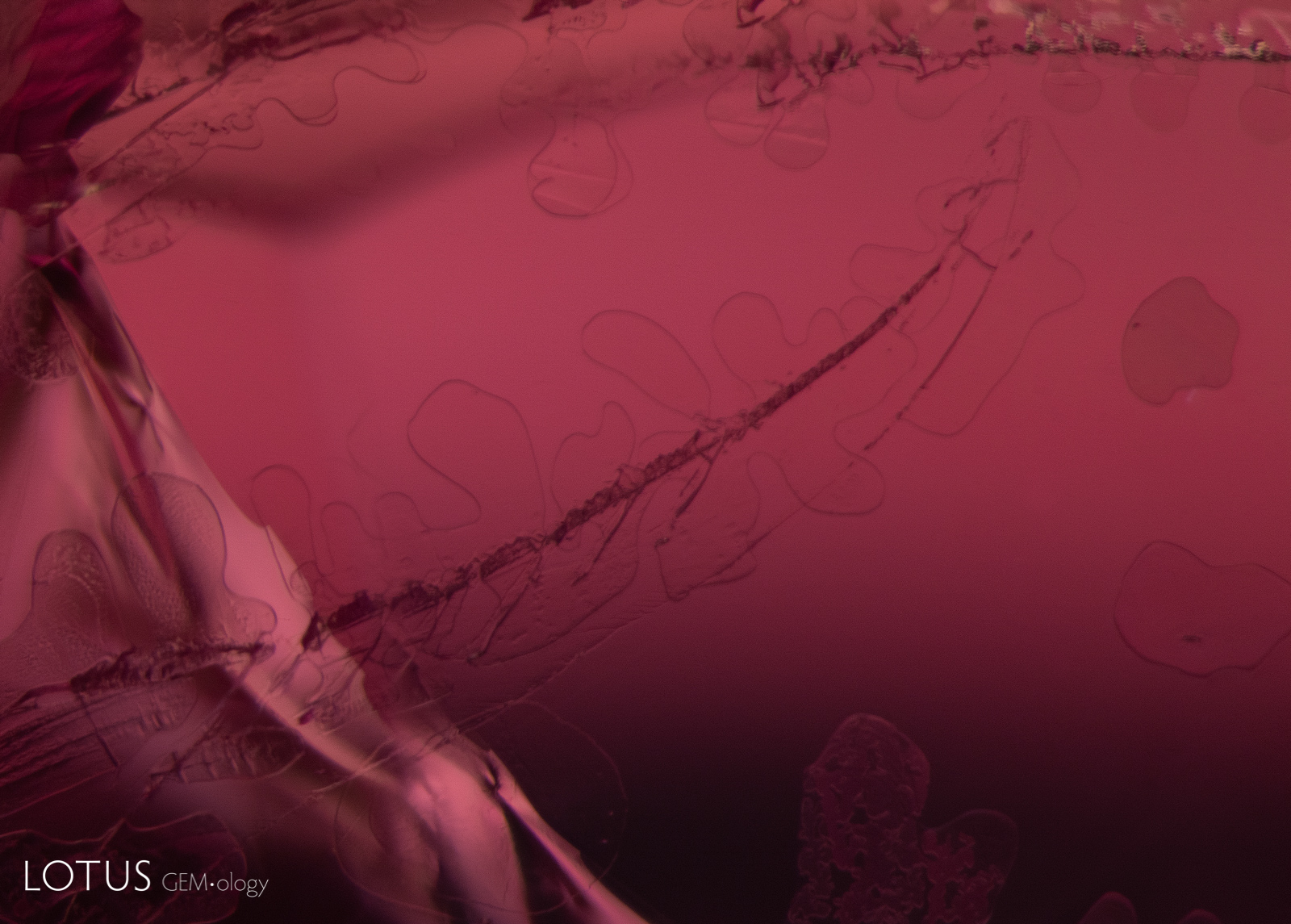
Viewed in transmitted light, the fissure in this ruby displays a subtle dendritic pattern.
Natural Ruby •
East Africa •
Enhancements:
Heat + Glass Cavity/Fissure Filling (H-GF1) •
Lighting Conditions:
Diffuse Light Field (Transmitted Light)
Photographer:
E. Billie Hughes •
Image Number:
A-004-7334-3
• Field of View = 2.5mm
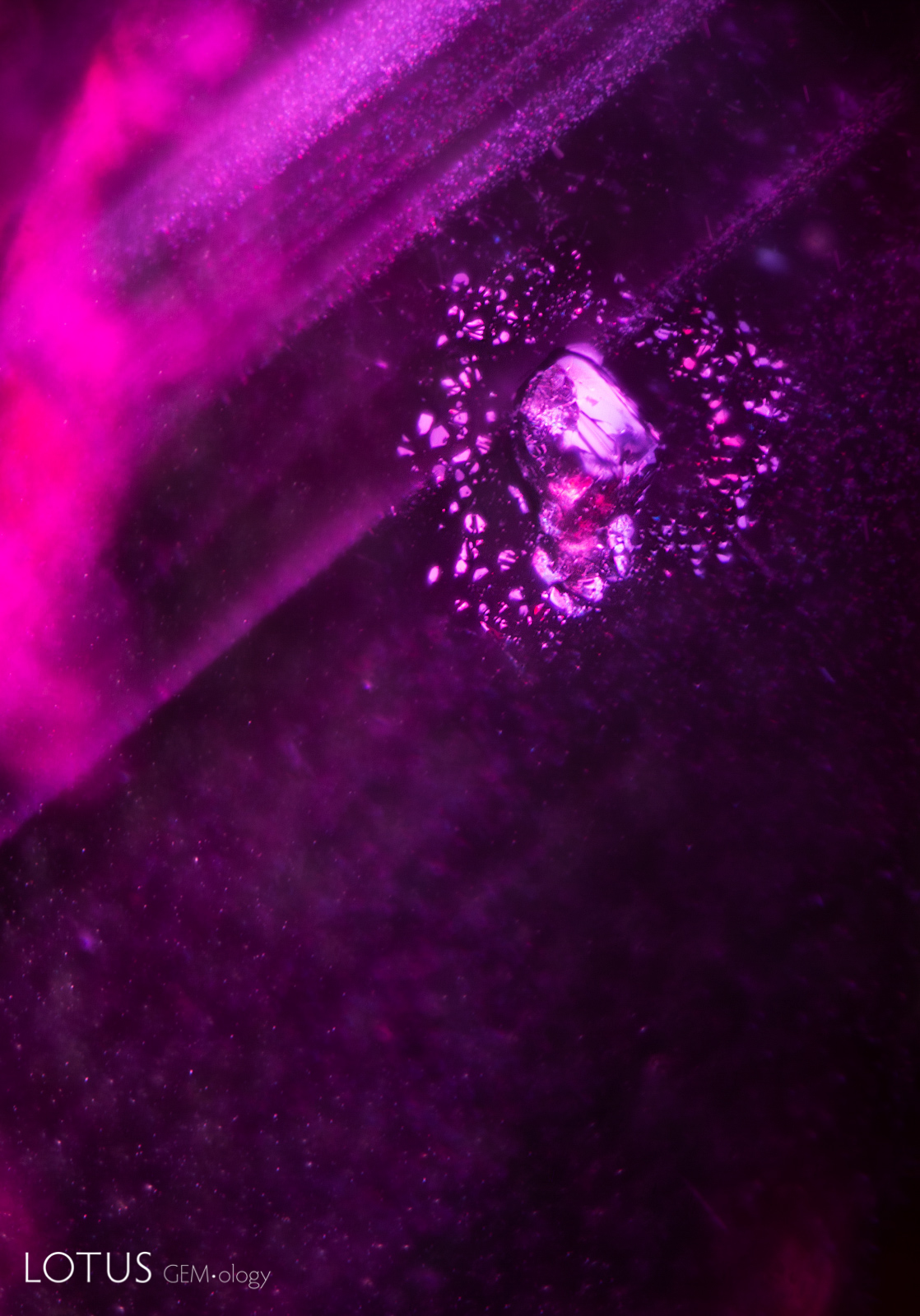
A striking crystal (likely mica) is framed by a beautiful rosette in this ruby from Mozambique.
Natural Ruby •
Mozambique •
Enhancements:
None Detected (None) •
Lighting Conditions:
Fiber Optic: Diffuse Oblique
Photographer:
E. Billie Hughes •
Image Number:
A-004-7338-1
• Field of View = 3mm
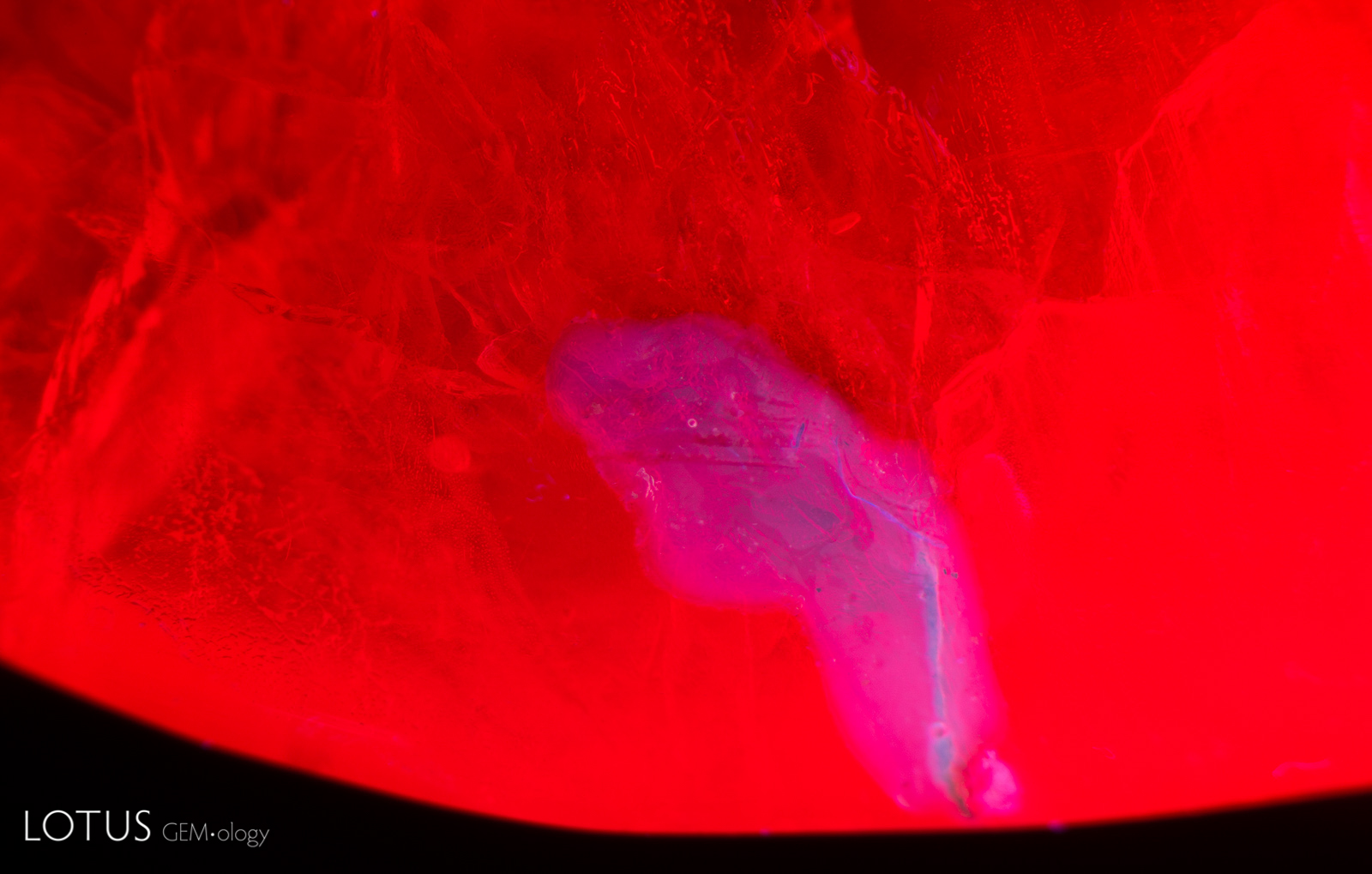
When illuminated with a long wave UV torch, the filler in this ruby becomes easy to spot with a chalky appearance.
Natural Ruby •
Thailand/Cambodia •
Enhancements:
Heat (H); Fissure Filling with colorless Oil/resin (FF-O1) •
Lighting Conditions:
Ultraviolet: Longwave
Photographer:
E. Billie Hughes •
Image Number:
A-004-6354-2
• Field of View = 7mm
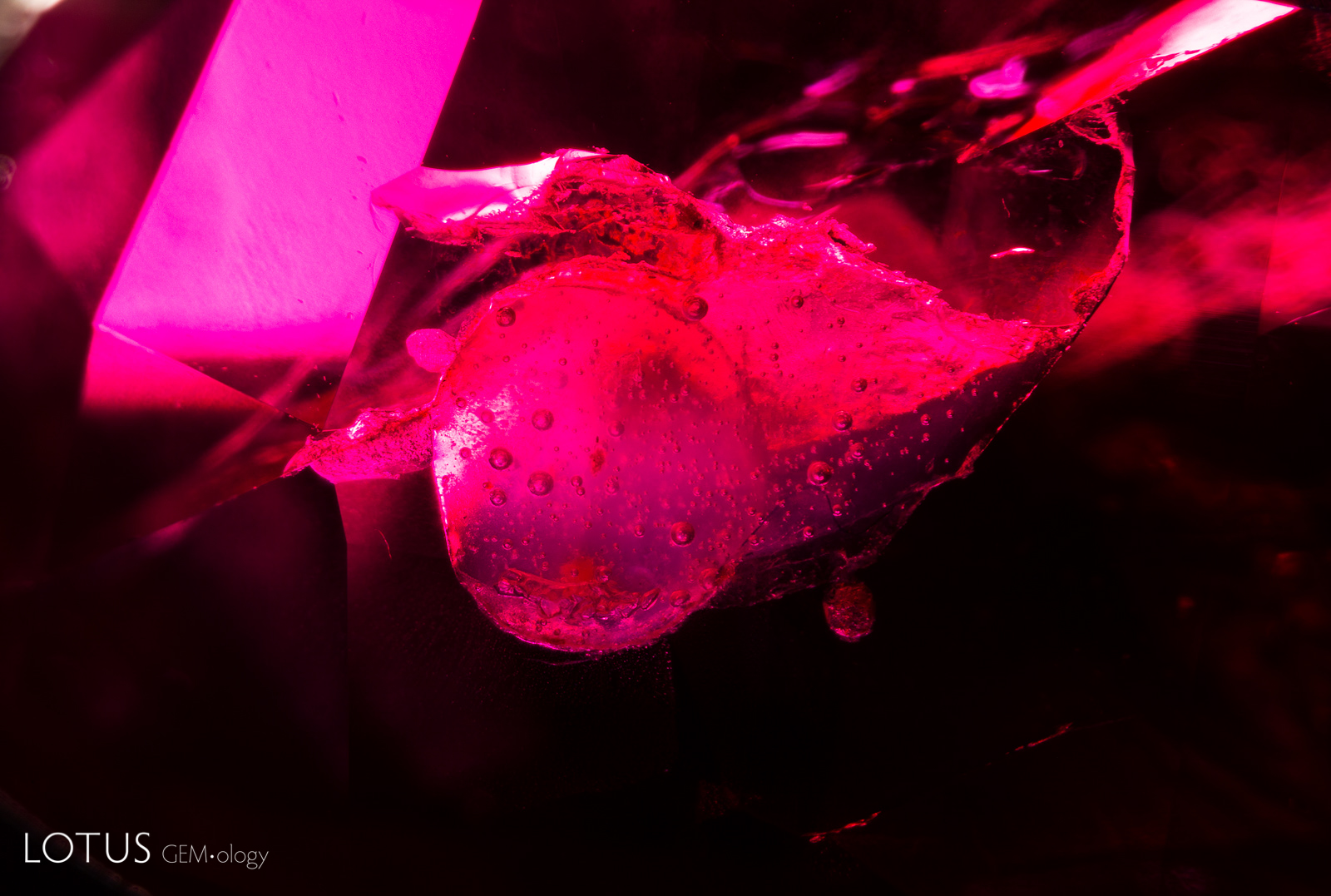
Bubbles can be observed in the filler that is present in the cavity in this ruby.
Natural Ruby •
Thailand/Cambodia •
Enhancements:
Heat (H); Fissure Filling with colorless Oil/resin (FF-O1) •
Lighting Conditions:
Dark Field
Photographer:
E. Billie Hughes •
Image Number:
A-004-6354-1
• Field of View = 7mm
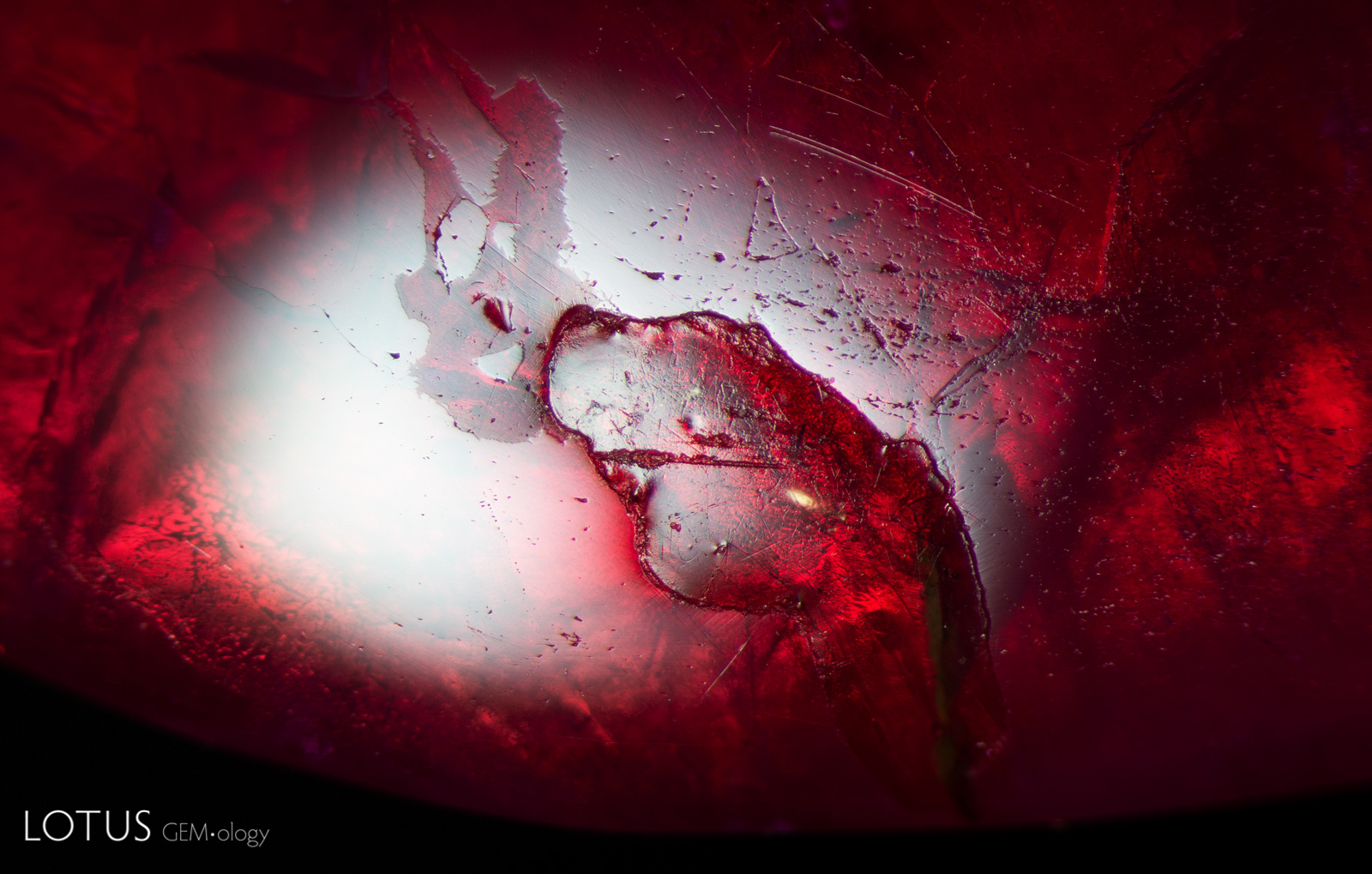
This cavity in a ruby was filled with a yellowish, waxy substance, probably dopping varnish. In transmitted light, we can observe a slight difference in color between the filler and the surrounding ruby.
Natural Ruby •
Not Determinable •
Enhancements:
Heat + Fissure Healing (H-FH); Heat + Glass Cavity/Fissure Filling (H-GF1); Fissure Filling with Dyed Filler (FF-DF1) •
Lighting Conditions:
Diffuse Light Field (Transmitted Light)
Photographer:
E. Billie Hughes •
Image Number:
A-004-5267-3
• Field of View = 6mm
When illuminated with a longwave ultraviolet torch, an area filled with waxy varnish displayed a chalky appearance on this ruby.
Natural Ruby •
Not Determinable •
Enhancements:
Heat + Fissure Healing (H-FH); Heat + Glass Cavity/Fissure Filling (H-GF1); Fissure Filling with Dyed Filler (FF-DF1) •
Lighting Conditions:
Ultraviolet: Longwave
Photographer:
E. Billie Hughes •
Image Number:
A-004-5267-2
• Field of View = 6mm
A combination of fillers of different lusters can be observed on the surface of this ruby. On the top left, the lower luster area is glass filling. On the bottom right, the area displayed could be easily scratched, and was likely dopping varnish or a similar substance.
Natural Ruby •
Not Determinable •
Enhancements:
Heat + Fissure Healing (H-FH); Heat + Glass Cavity/Fissure Filling (H-GF1); Fissure Filling with Dyed Filler (FF-DF1) •
Lighting Conditions:
Dark Field + Diffuse Fiber Optic
Photographer:
E. Billie Hughes •
Image Number:
A-004-5267-1
• Field of View = 6mm
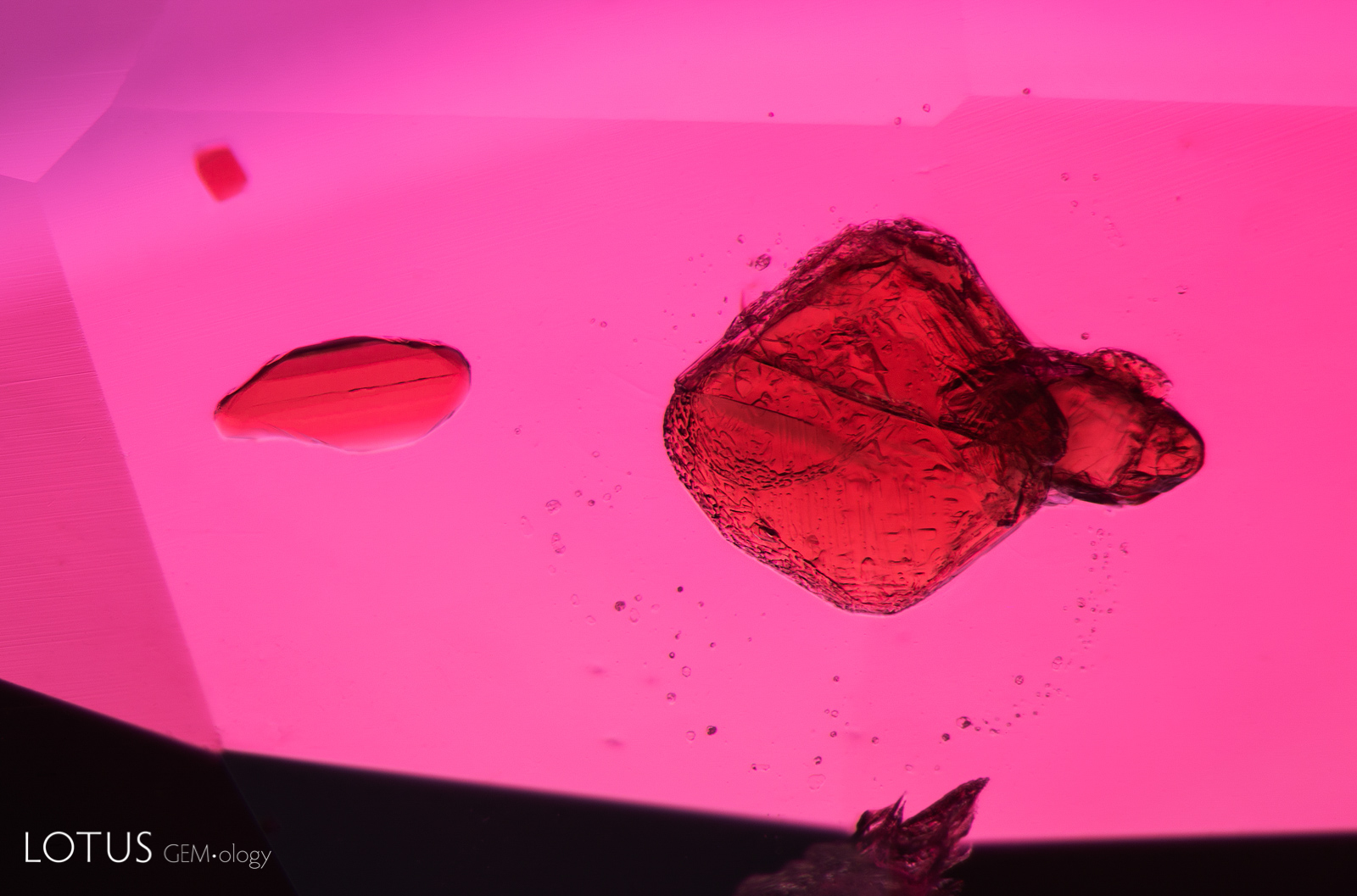
These bright red crystals stood out against their ruby backdrop. Analysis with micro Raman identified them as staurolite. Staurolite has been previously reported in other rubies from East Africa.
Natural Ruby •
Tanzania •
Enhancements:
None Detected (None) •
Lighting Conditions:
Diffuse Light Field (Transmitted Light)
Photographer:
E. Billie Hughes •
Image Number:
A-004-3672-1
• Field of View = 3mm
We received for testing a chess set where the pieces were carved from ruby and sapphire. Microscopic examination showed wax residues from the polishing process. Wax is frequently used as part of the final processing of some carvings. While it was somewhat difficult to detect the wax under normal white light, application of light from a long wave (365 nm) torch easily revealed the extent of the wax which fluoresced with a light blue to white color, dramatically offset against the ruby’s red fluorescence.
Natural Ruby •
Not Determinable •
Enhancements:
None Detected (None) •
Lighting Conditions:
Ultraviolet: Longwave
Photographer:
Richard W. Hughes •
Image Number:
A-004-4331-1
• Field of View = 5mm
Natural ruby inclusions may include mineral crystals, rutile silk, healed fissures, fluid inclusions, negative crystals, color zoning and other features formed during or after crystal growth. Such features are important to gemologists because they can provide evidence useful in identifying ruby, understanding its geological history, recognizing treatment and, in some cases, determining geographic origin.
Natural Ruby Inclusion Photomicrographs
The Hyperion natural ruby gallery includes microscopic features found in rubies from major deposits around the world. Each entry is accompanied by descriptive information and, where available, references to the gemological literature.
What Inclusions Can Reveal About Natural Ruby
Inclusions are an important part of ruby identification. Their form, composition, orientation and alteration can help gemologists distinguish natural ruby from synthetic material, recognize evidence of heat treatment, and study the geological environment in which the ruby formed.
Hyperion combines inclusion photomicrography with supporting gemological information so that individual features can be compared with documented examples from known ruby deposits.
About Hyperion
Hyperion is the Lotus Gemology searchable inclusion database. It allows users to browse gemstone inclusions by gem type, geographic origin, treatment and keyword.