Emerald Bibliography

Emerald Bibliography

Explore books, articles and historical sources on emerald in Four Treasures, the Lotus Gemology reference database. This bibliography brings together matching records from the collection, with publication details, abstracts and cover images where available.

Emerald References

The list below matches the terms emerald or emeralds in the database's searchable fields. Some references discuss emeralds as part of a broader subject.
301–320 of 851 matching references

Precious stones

Book Section
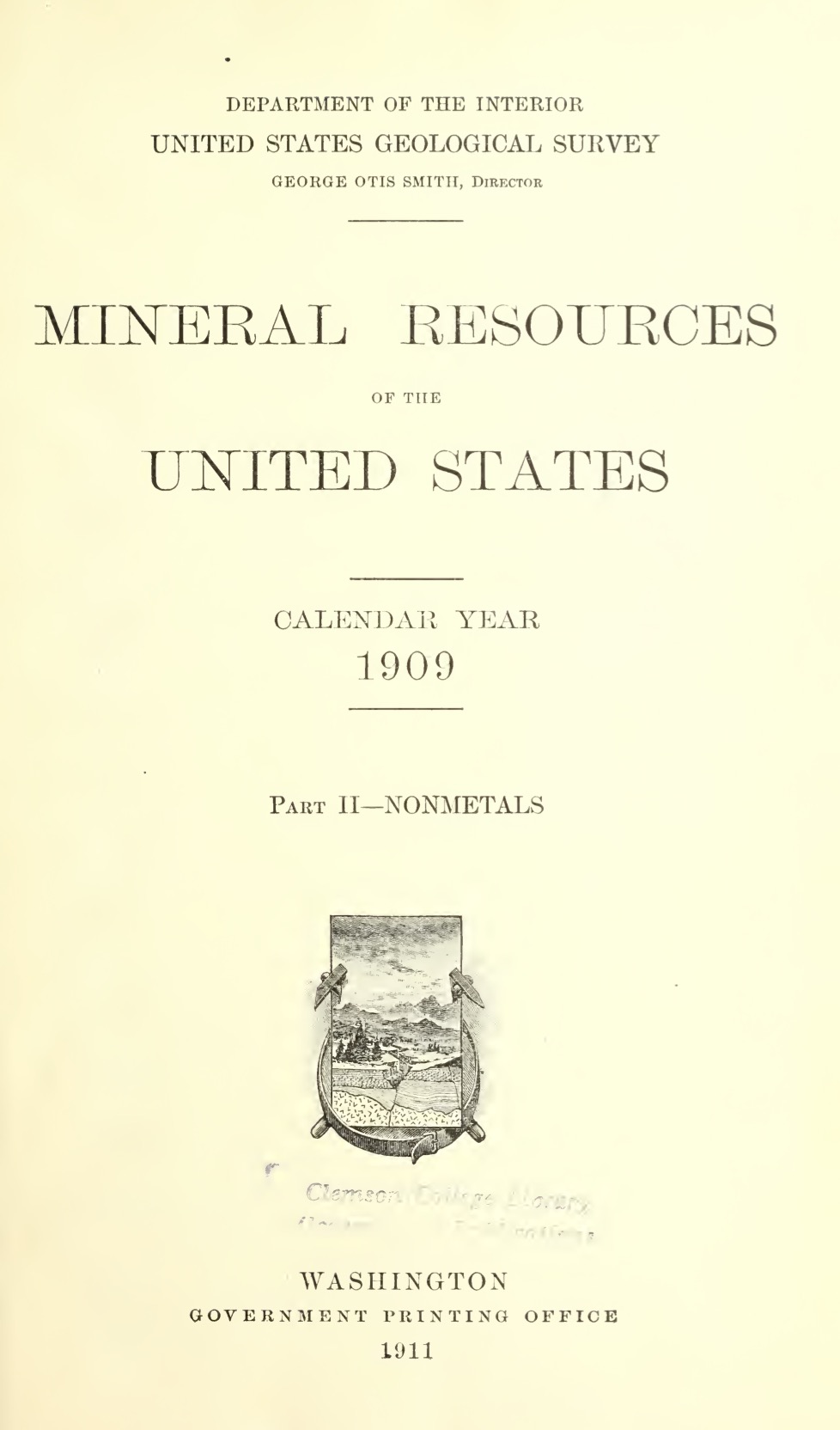
Sterrett, D.B. (1911) Precious stones. In: Mineral Resources of the United States | Calendar Year 1909, pp. 739–808.
Record No. 17026  |  RWHL*
A comprehensive review of precious-stone production, mining, discoveries, and trade during 1909. Sterrett records a marked increase in U.S. gem production, especially turquoise, variscite, tourmaline, and chrysoprase, reflecting the growing popularity of blue and green matrix stones; more than 17 tons of rough turquoise and 3½ tons of variscite were mined during the year. A major portion of the report is devoted to detailed descriptions of American deposits, including turquoise and variscite in Nevada and Utah, a new emerald occurrence near Shelby, North Carolina, Montana sapphires, California tourmaline and californite, and numerous agate, amethyst, beryl, opal, garnet, and ornamental-stone localities. Particularly important is an extensive account of the newly discovered benitoite deposit in San Benito County, California, covering its geology, paragenesis with natrolite and neptunite, crystallography, optical properties, cutting, and gem qualities. The report also describes the newly named rose-colored beryl morganite from Madagascar. Diamond sections survey Arkansas, California, South Africa, German Southwest Africa, British Guiana, and Australia, while Burmese ruby mining at Mogok and sapphire production in Queensland and Ceylon are also discussed. The report concludes with U.S. production statistics and notes a strong recovery in precious-stone imports, especially rough and cut diamonds, indicating a return of the diamond trade toward pre-1908 conditions.

Precious stones

Book Section
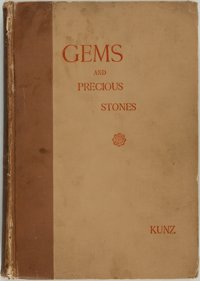
Kunz, G.F. (1909) Precious stones. In: The Mineral Industry… During 1907, New York: Hill Publishing Co., Vol. 16 , pp. 790–812.
Record No. 17056  |  Sinkankas/Born No.: 3626; NIB  |  RWHL*
A wide-ranging review of precious-stone developments during 1907, with particular attention to American gem discoveries, diamond mining, and changing fashions in the jewelry trade. Kunz discusses tourmaline from Maine, kunzite from California, turquoise and variscite from the Southwest, amethyst from Virginia, hiddenite and emerald from North Carolina, copper-colored chalcedony from Arizona, californite, rose quartz, petrified wood, and the newly discovered blue gem benitoite from California, giving detailed mineralogical data on the latter. The major event of the year was the discovery of diamonds in kimberlitic peridotite near Murfreesboro, Arkansas; Kunz describes the geology, weathering products, extent of the pipe, recovered diamonds, mining conditions, and prospects for commercial development, while warning against speculative claims. Extensive sections also cover the De Beers and Premier mines of South Africa, the Cullinan diamond, debates over the origin of diamonds in eclogite and Vaal River gravels, and expanding Brazilian diamond and carbonado production. Other noteworthy subjects include Queensland sapphires, Burmese rubellite mining, Australian topaz and opal, huge New Zealand nephrite boulders, jade-like ornamental stones such as “jadeolite” and verdite, and contemporary preferences for green and blue gems. The report closes with observations on jewelry styles and the sharp decline in U.S. gem imports following the financial panic of 1907.

La Synthèse des Pierres Précieuses

The Synthesis of Precious Stones
Book
Boyer, J.-M.-J. (1909) La Synthèse des Pierres Précieuses. [The Synthesis of Precious Stones] Paris, Gauthier-Villars, Imprimeur-Libraire, 30 pp.
Record No. 2985  |  Sinkankas/Born No.: 854; NIB  |  Language: in French  |  RWHL*
Boyer’s original publication on gem materials synthesis precedes Michel’s Die künstlichen Edelsteine, 1914, which see, although the latter is far more thorough. The first German edition rewrote Boyer’s work into more easily understandable prose, included more historical data, gave fuller accounts of contemporary work in Germany, and otherwise substantially enlarged and improved Boyer’s edition. The present edition further enlarges the work. In general, major remarks are confined to the synthesis of corundum but also include comments on synthetic quartz, opal, emerald, and diamond, the German editors believing that diamond was actually made by Moissan. Amplifying remarks in part four discuss color in natural gemstones, distinctions between synthetic and natural gemstones, properties of synthetic diamond (!) and including their combustion, and prices of synthetic stones. Other parts treat impact of synthetics in industry and controversy over nomenclature and possible deceptive sales practices, and rather out of place, the cultured pearl.

Precious stones

Book Section
Sterrett, D.B. (1908) Precious stones. In: Mineral Resources of the United States | Calendar Year 1907, Part 2—Nonmetallic Products , pp. 795–842.
Record No. 17037  |  Sinkankas/Born No.: 6342; NIB  |  RWHL*
An extensive annual review of the precious-stone industry of the United States for 1907, describing production, mining developments, new discoveries, localities, cutting, marketing, and imports. Sterrett treats a wide range of gem materials, including diamond, ruby, sapphire, emerald, hiddenite, beryl and aquamarine, tourmaline, turquoise, garnet, quartz varieties, amethyst, amazonite, opal, agate, amber, and others. Particular attention is given to important developments in Arkansas diamonds, the ruby and gem deposits of North Carolina, tourmaline and other pegmatite gems, and the newly recognized mineral benitoite from San Benito County, California. The report also discusses gem cutting and sales, summarizes gem minerals of North Carolina and Canada, includes information on Madagascar gems and experiments involving radium and corundum, and concludes with statistical tables of U.S. production and imports and a section on pearls. It provides a valuable contemporary snapshot of American gemstone exploration and commerce at the beginning of the twentieth century.

Gems and Precious Stones of Mexico

Book
Kunz, G.F. (1907) Gems and Precious Stones of Mexico. Mexico City, Secretariat of Development, Callejón de Betlemitas, 54 pp.
Record No. 28494  |  Sinkankas/Born No.: 3688; NIB  |  RWHL*
Kunz presents a broad survey of the gem and ornamental-stone resources of Mexico, combining contemporary mineralogical information with extensive discussion of pre-Columbian lapidary materials and their possible sources. He notes that opal was then the only gemstone systematically mined in Mexico and tecali, the so-called Mexican onyx but actually a form of banded aragonite, the principal ornamental stone. Other materials discussed include garnet, topaz, amethyst, rock crystal, chalcedony, agate, jasper, turquoise, obsidian, and reported but generally unsubstantiated occurrences of diamond, ruby, sapphire, and emerald. Particular attention is devoted to Mexican opal, including deposits in Querétaro, Hidalgo, Guerrero, Michoacán, Jalisco, and San Luis Potosí, their geology and mining, varieties and colors, cutting and commerce, and the tendency of some material to crack or lose its play-of-color as it dries. Kunz also describes the recently discovered turquoise occurrence near Bonanza, Zacatecas, and reviews the extensive use of turquoise mosaic in Aztec objects. A substantial portion of the work concerns chalchihuitl, which he recognizes as a general indigenous designation embracing several valued green materials rather than a single mineral. He distinguishes turquoise from what he terms the “precious chalchihuitl,” identified as jadeite, and discusses jadeite artifacts, archaeological discoveries, historical tribute records, and attempts to reconstruct the geographic sources of the material. Kunz states that jadeite, rather than nephrite, characterizes the Mexican and Central American jades known to him and argues from Aztec tribute records that its sources lay south of Mexico City, particularly toward the Oaxaca–Veracruz border, Chiapas, and Central America. He nevertheless acknowledges that the primary deposits remained unknown and that much of the ancient material appears to have been obtained as stream-worn pebbles and boulders. The work is therefore both an early mineralogical survey of Mexican gemstones and an important historical treatment of the identification, use, archaeological distribution, and unresolved provenance of Mesoamerican jade and other greenstones.

Precious stones

Book Section
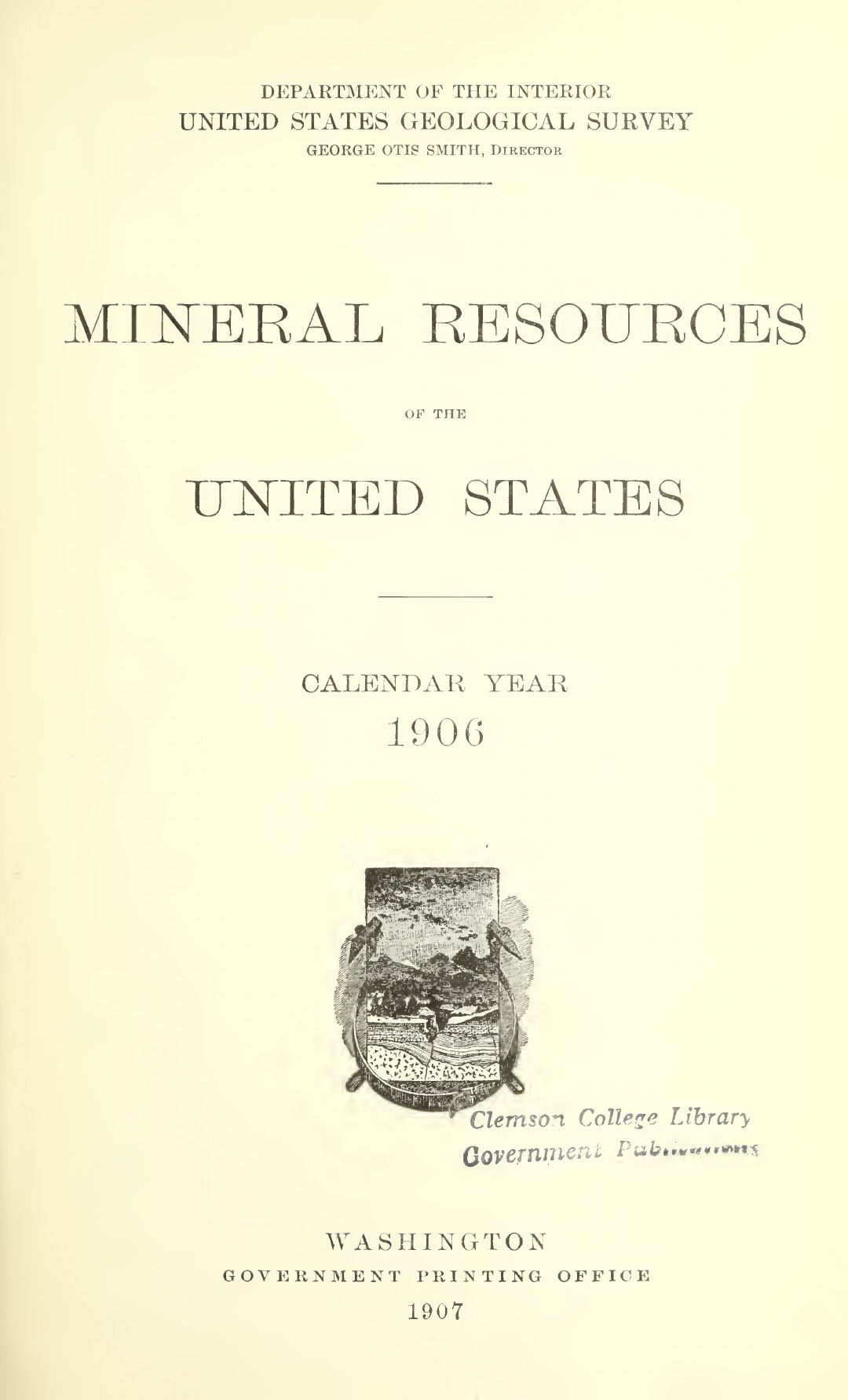
Sterrett, D.B. (1907) Precious stones. In: Mineral Resources of the United States | Calendar Year 1906, pp. 1213–1252.
Record No. 17013  |  Sinkankas/Born No.: 6341; NIB  |  RWHL*
Sterrett reviews the precious-stone industry for 1906, with particular emphasis on new and developing American gem deposits, production, mining conditions, and trade. He describes tourmaline, beryl, kunzite, topaz, hessonite and other gems from southern California; Maine pegmatite gems; Colorado tourmaline and beryl; abundant California chrysoprase; declining turquoise production in the Southwest; and the discovery of blue and other sapphires in the gold placers of Washington County, Idaho. A major portion is devoted to diamonds. Sterrett discusses prospecting in California and Kentucky, attempts to identify diamond-bearing matrices, Canadian theories for the source of Great Lakes glacial diamonds, and the rapidly expanding South African industry. Of special importance is his detailed account of the newly confirmed diamond occurrence near Murfreesboro, Arkansas, where 130 stones had been recovered, the largest about 6½ carats; he regards their occurrence in peridotite as unquestionable and compares the host rock with the diamond-bearing rocks of Kimberley. International coverage includes De Beers and Transvaal production, Brazilian diamond and carbonado mining, Indian diamonds, Australian discoveries, Borneo cutting, Burmese amber, Austrian and Colombian emeralds, and other gem materials. The report also covers freshwater pearls, noting strong American demand and substantial production from the Mississippi Valley. Sterrett substantially reorganizes the U.S. production statistics from Kunz’s earlier reports, attempting to value material in the rough and distinguishing genuine production changes from changes in estimation; particularly large differences are recorded for sapphire, turquoise, chrysoprase, tourmaline, and kunzite. The report concludes with import statistics showing U.S. precious-stone imports rising to about $43.6 million in 1906, chiefly through increases in cut and rough diamonds, illustrating the continued rapid expansion of the American gem and jewelry market.

Precious Stones for Curative Wear

Journal Article
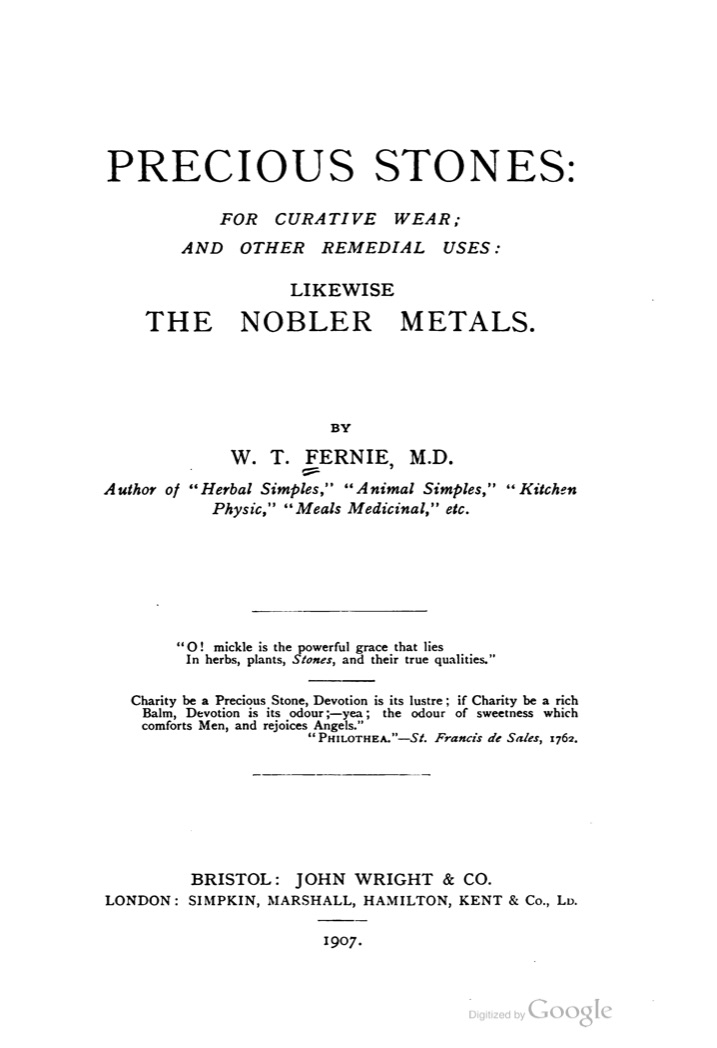
Fernie, W.T. (1907) Precious Stones for Curative Wear. xviii, 486 pp..
Record No. 2756  |  ISBN/ISSN: 60623608  |  Sinkankas/Born No.: 2025–2027; NIB  |  RWHL*
A wide-ranging compilation of historical, folkloric, medical and occult beliefs concerning the curative powers of gemstones and the nobler metals. Fernie gathers material from classical authors, medieval lapidaries, early medical writers, folklore, literature and contemporary sources, discussing the supposed therapeutic virtues of individual stones and the diseases they were believed to prevent or cure when worn, carried, powdered or otherwise administered. Separate treatments include diamond, ruby, sapphire, emerald, amethyst, agate, bloodstone, coral, pearl, turquoise, opal, lapis lazuli and many other materials, together with gold, silver and related substances. The work is less a scientific mineralogical study than an extensive survey of traditional gem medicine, amuletic practice and popular belief, frequently juxtaposing ancient claims with modern medical commentary. Its chief value to gemology lies in the extraordinary breadth of historical lore assembled on the medicinal and supernatural uses of gems and in documenting the persistence of such beliefs into the early twentieth century.

Precious stones

Book Section
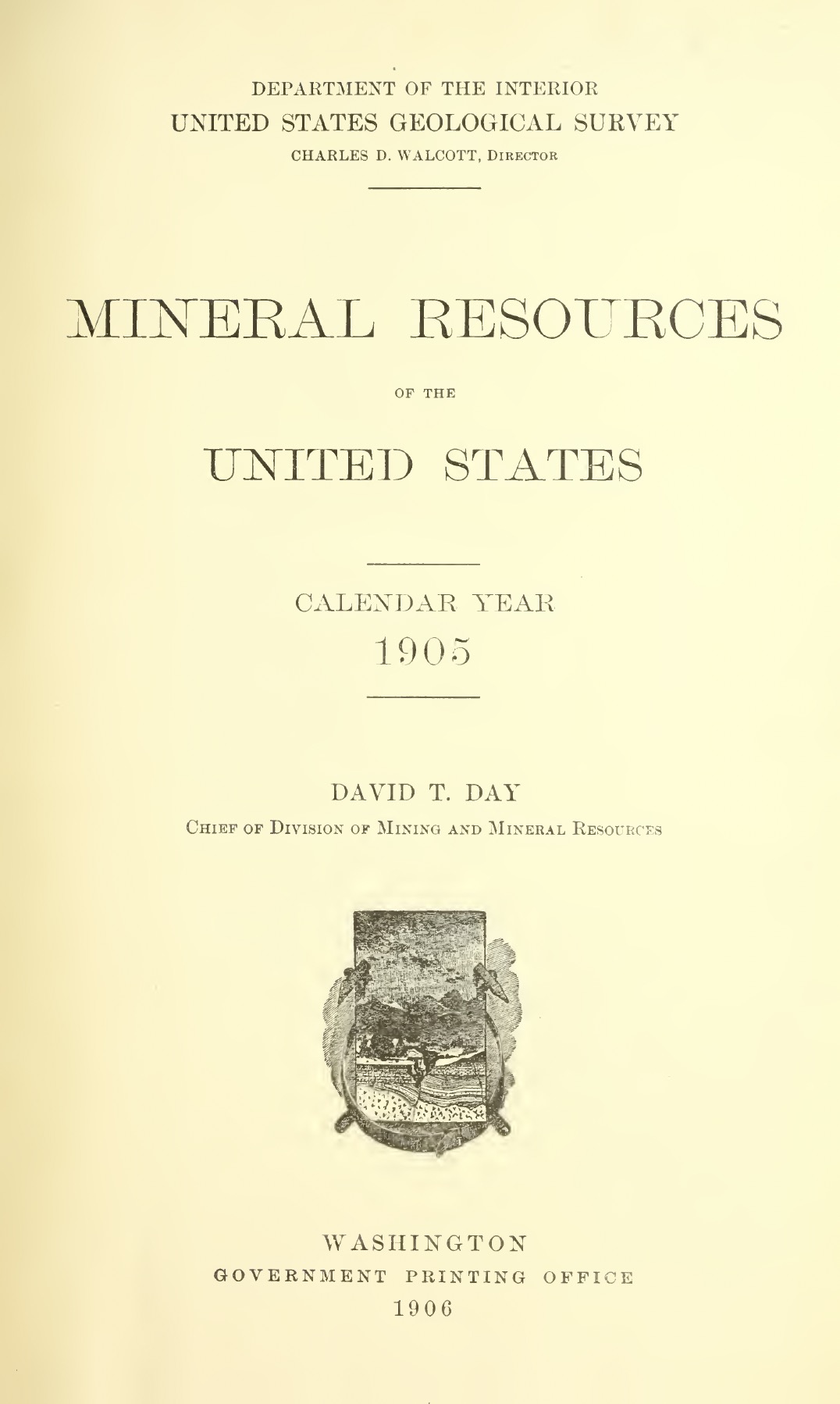
Kunz, G.F. (1906) Precious stones. In: Mineral Resources of the United States | Calendar Year 1905, pp. 1323–1358.
Record No. 17004  |  Sinkankas/Born No.: NIS/NIB  |  RWHL*
Kunz surveys the American and international precious-stone industry for 1905, a year he describes as a record for U.S. gem imports and one of exceptional prosperity in the jewelry trade. He notes strong demand for brightly colored stones, especially emerald, pearl, tourmaline, peridot, amethyst, aquamarine, and topaz, together with improved American lapidary work and rapidly expanding domestic diamond cutting. Particular attention is given to U.S. gem localities, including California tourmaline, beryl and kunzite deposits, Maine tourmaline, southwestern turquoise, Utah variscite (“utahlite”), and rose quartz and other ornamental stones. Kunz-1906-Precious Stones.pdf The extensive diamond section discusses reported U.S. occurrences and attempts to trace diamonds from the glacial drift of the Great Lakes region to a Canadian source, as well as production in South Africa, Brazil, and Australia. South African developments include De Beers production, declining grades but rising diamond prices, and the Premier mine’s extraordinary large stones, including the Cullinan diamond. Kunz-1906-Precious Stones.pdf Other sections treat corundum gems, including Burma ruby production; Colombian emeralds, particularly Muzo; amber, garnet, quartz varieties, and other gem materials. Kunz records Burma ruby output and describes a 77-carat ruby reportedly sold for four lakhs of rupees, while noting the large but incompletely explored emerald-bearing area at Muzo. Kunz-1906-Precious Stones.pdf The report concludes with trade statistics showing U.S. imports of diamonds and other precious stones reaching nearly $35 million in 1905, a striking rise from the preceding years and evidence of the rapid growth of the American gem and jewelry market.

Chap. V. Gasparo Balbi his voyage to Pegu, and observations there, gathered out of his owne Italian relation
Book Section
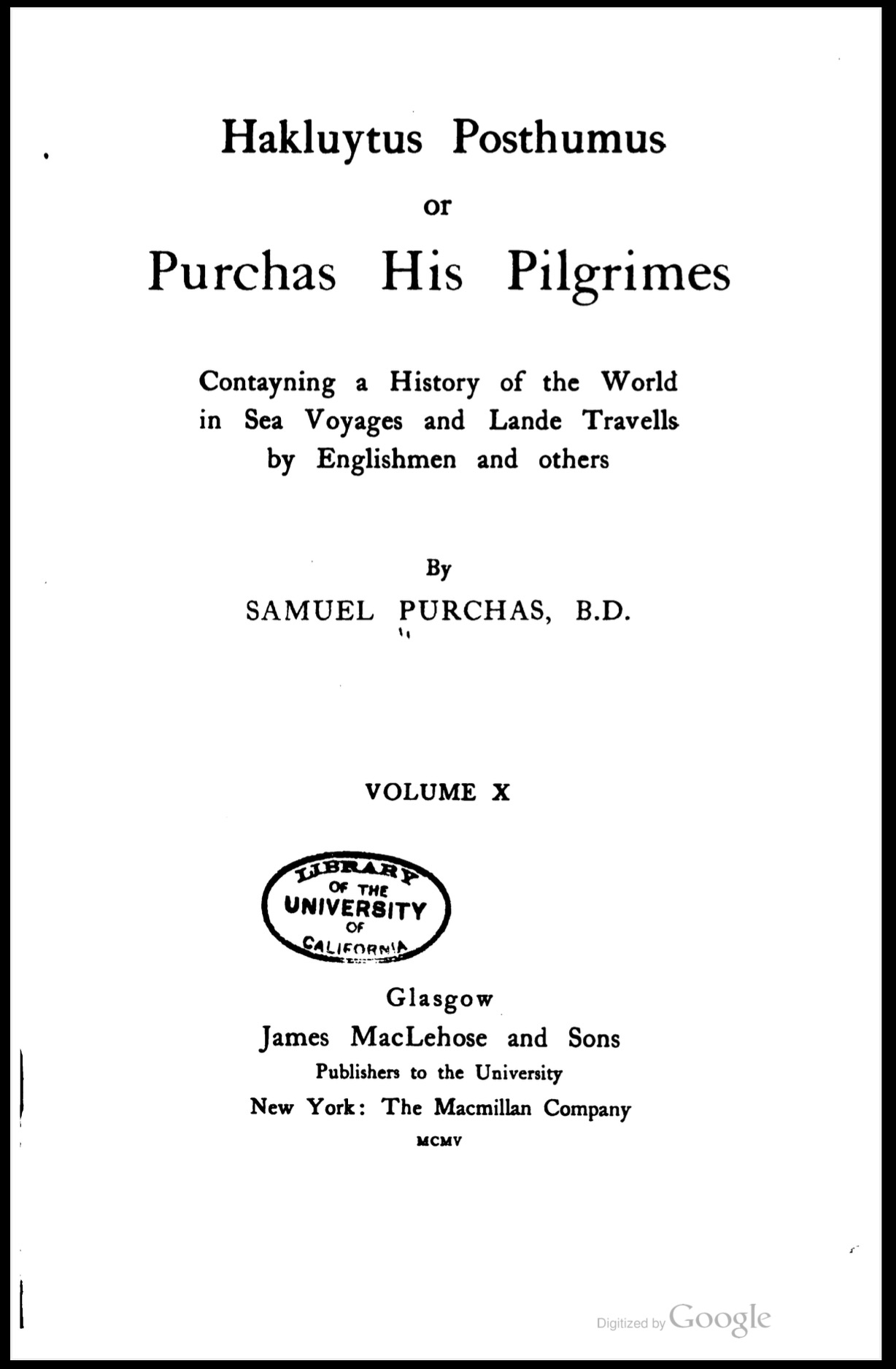
Balbi, G. (1905) Chap. V. Gasparo Balbi his voyage to Pegu, and observations there, gathered out of his owne Italian relation. In: Hakluytus Posthumas or Purchas His Pilgrimes, Glasgow: James MacLehose and Sons, 20 Vols., Vol. 10 , pp. 143–164.
Record No. 16809  |  Sinkankas/Born No.: NIS/NIB  |  RWHL*
An important early account of Burma by the Venetian jeweller Gasparo Balbi, who travelled east from Aleppo beginning in 1579 and reached Pegu in 1583. Balbi describes his route through the eastern Mediterranean, Persian Gulf, India and Southeast Asia, but the greatest value of the narrative lies in his observations on Pegu and the Burmese court. As a jeweller, he is of particular gemological interest: he carried emeralds from Venice and presented them to the King of Pegu during a formal audience, describing the elaborate court ceremonial surrounding the gift. He also records the extraordinary royal wealth of Pegu in gold, silver and jewels, together with its temples, gilded monuments, commerce, customs and political life. Purchas elsewhere summarizes Balbi as regarding the king of Pegu as among the richest rulers in the world in gold, silver and jewels. Although Balbi gives less direct information on Burmese ruby mining than some near-contemporary travellers, his account is especially valuable as the observations of a professional jeweller visiting the region at the height of the sixteenth-century Pegu trade, and as one of the earliest European firsthand descriptions of the Burmese court and its use of precious stones. He brought emeralds from Venice to trade for rubies, but also mentioned a good trade was bringing enamel bracelets in Saint Thomas for sale in Pegu.

Smaragdgruben von Muzo

The emerald mines of Muzo
Journal Article
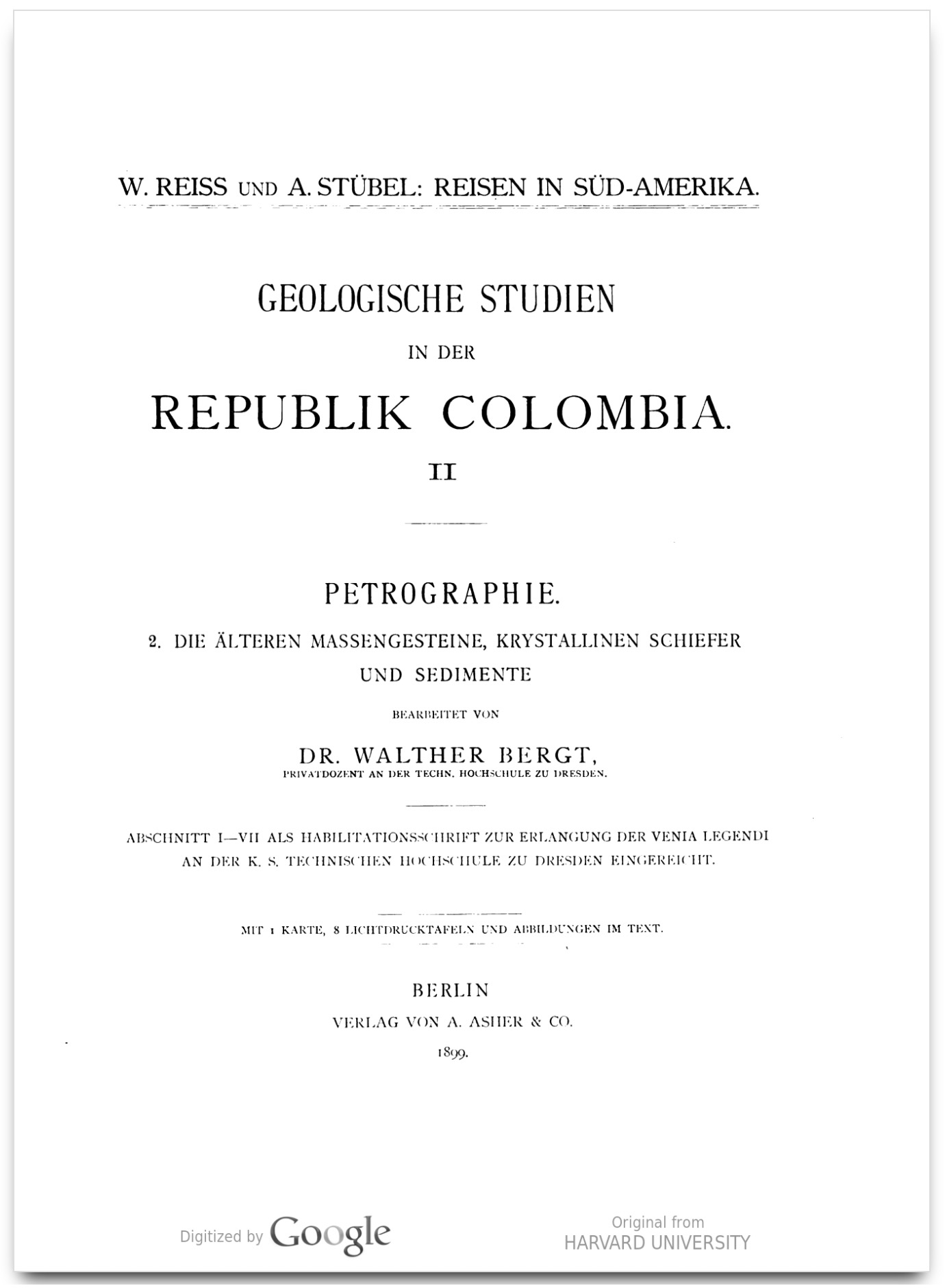
Bergt, W. (1899) Smaragdgruben von Muzo. [The emerald mines of Muzo] Geologische Studien in der Republik Colombia, Vol. 2, pp. 43–48.
Record No. 29401  |  Sinkankas/Born No.: NIS/NIB  |  Language: in German  |  RWHL*
Bergt describes the celebrated emerald mines of Muzo in Colombia, with particular attention to their geological setting and the mode of occurrence of the emeralds. He discusses the sedimentary rocks of the district and the veins and fissures in which emerald occurs, together with calcite and other associated minerals, and considers the geological processes responsible for the mineralization. The character of the emerald-bearing zones and their relationship to the surrounding rocks are described, as are the mining operations by which the deposits were exposed and worked. Bergt also comments on the occurrence and quality of the emerald crystals and on Muzo’s importance as a source of gem material. The paper forms part of his broader Geologische Studien in der Republik Colombia and provides a concise late nineteenth-century geological account of one of the world’s most historically important emerald deposits, emphasizing the geological relationships between the emerald mineralization, its associated minerals, and the enclosing sedimentary formations.

Precious stones

Book Section
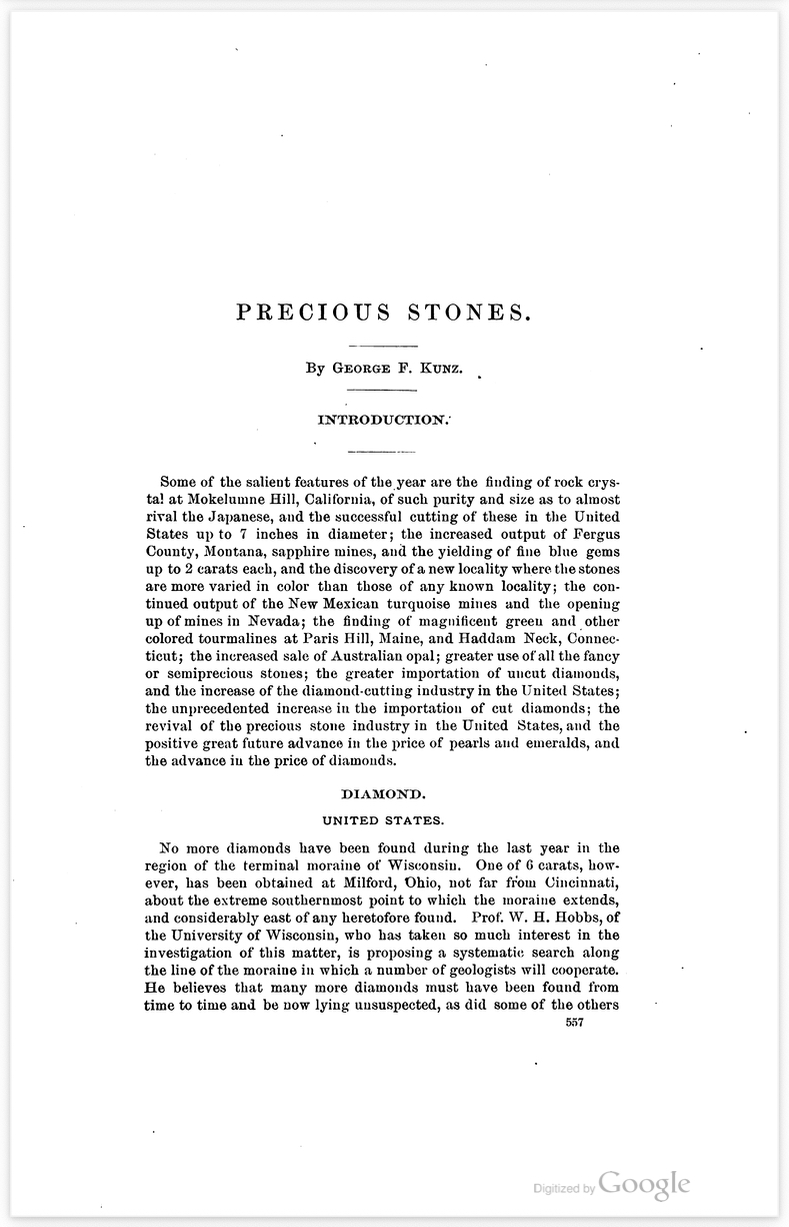
Kunz, G.F. (1899) Precious stones. In: Twentieth Annual Report of the United States Geological Survey, Washington: Govt. Printing Office, 6 Vols., Part 6.—Continued , pp. 557–602, + 1 color plate.
Record No. 17035  |  Sinkankas/Born No.: 3613; NIB  |  RWHL*
Some of the salient features of the year are the finding of rock crystal at Mokelumne Hill, California, of such purity and size as to almost rival the Japanese, and the successful cutting of these in the United States up to 7 inches in diameter; the increased output of Fergus County, Montana, sapphire mines, and the yielding of fine blue gems up to 2 carats each, and the discovery of a new locality where the stones are more varied in color than those of any known locality; the continued output of the New Mexican turquoise mines and the opening up of mines in Nevada; the finding of magnificent green and other colored tourmalines at Paris Hill, Maine, and Haddam Neck, Connecticut; the increased sale of Australian opal; greater use of all the fancy or semiprecious stones; the greater importation of uncut diamonds, and the increase of the diamond-cutting industry in the United States; the unprecedented increase in the importation of cut diamonds; the revival of the precious stone industry in the United States, and the positive great future advance in the price of pearls and emeralds, and the advance in the price of diamonds.

Glimpses of India

Book
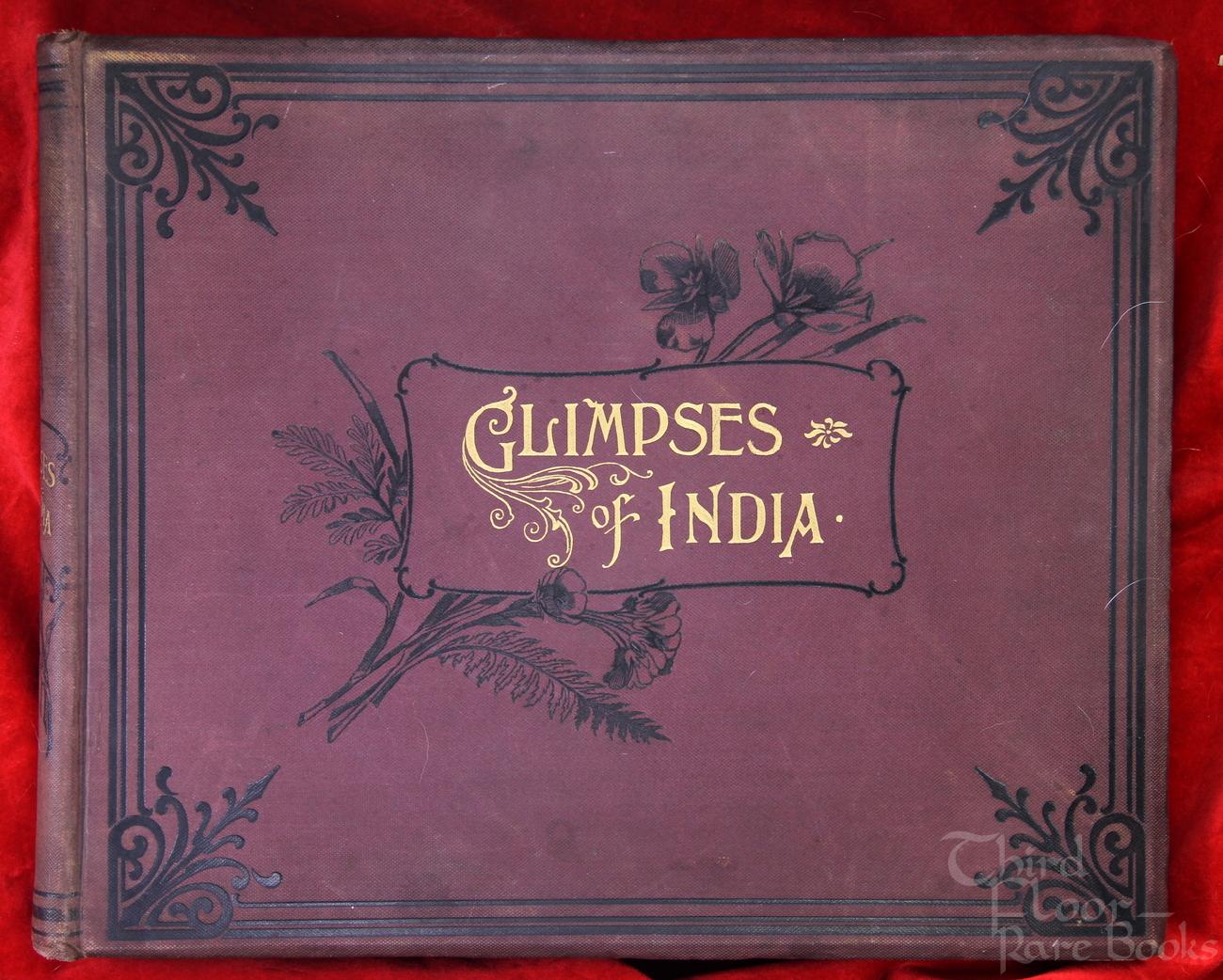
Furneaux, J.H. (1895) Glimpses of India. C.B. Burrows, Bombay, 544 pp.
Record No. 2769  |  Sinkankas/Born No.: NIS/NIB  |  RWHL*
A profusely illustrated survey of British India at the close of the nineteenth century, combining descriptions of its principal cities, monuments, peoples, religions, industries, institutions, and historical sites. Of gemological interest are numerous incidental references to jewelry, precious stones, and objects of royal and religious treasure. Bombay mill women are described wearing extensive ornaments of gold, silver, or gilded base metal, while Parsee women are said increasingly to favor European-style diamond and pearl ornaments. The great temple at Madura possessed a rich treasury with magnificent jewels, including an ancient gold crown, turban, and pendant studded with precious stones. At Futtehpur-Sikri, merchants from Bengal, the Deccan, and Kabul are described bringing jewels, precious stones, gold and silver embroidery, and other luxury goods to the Mughal court. The Peacock Throne at Delhi is noted for its sapphires, rubies, diamonds, emeralds, and other jewels, while Mysore receives attention for its state jewels. The work also mentions the ancient pearl and conch-shell fisheries of Tuticorin and provides extensive visual documentation of Indian dress, ornament, architecture, courtly culture, and everyday life, making it a useful contemporary source for the social and cultural setting of gems and jewelry in late nineteenth-century India.

The mines of the northern Etbai or of northern Æthiopia. With a map, water-colour drawings and photographs by the scientific expedition to the northern Etbai
Journal Article
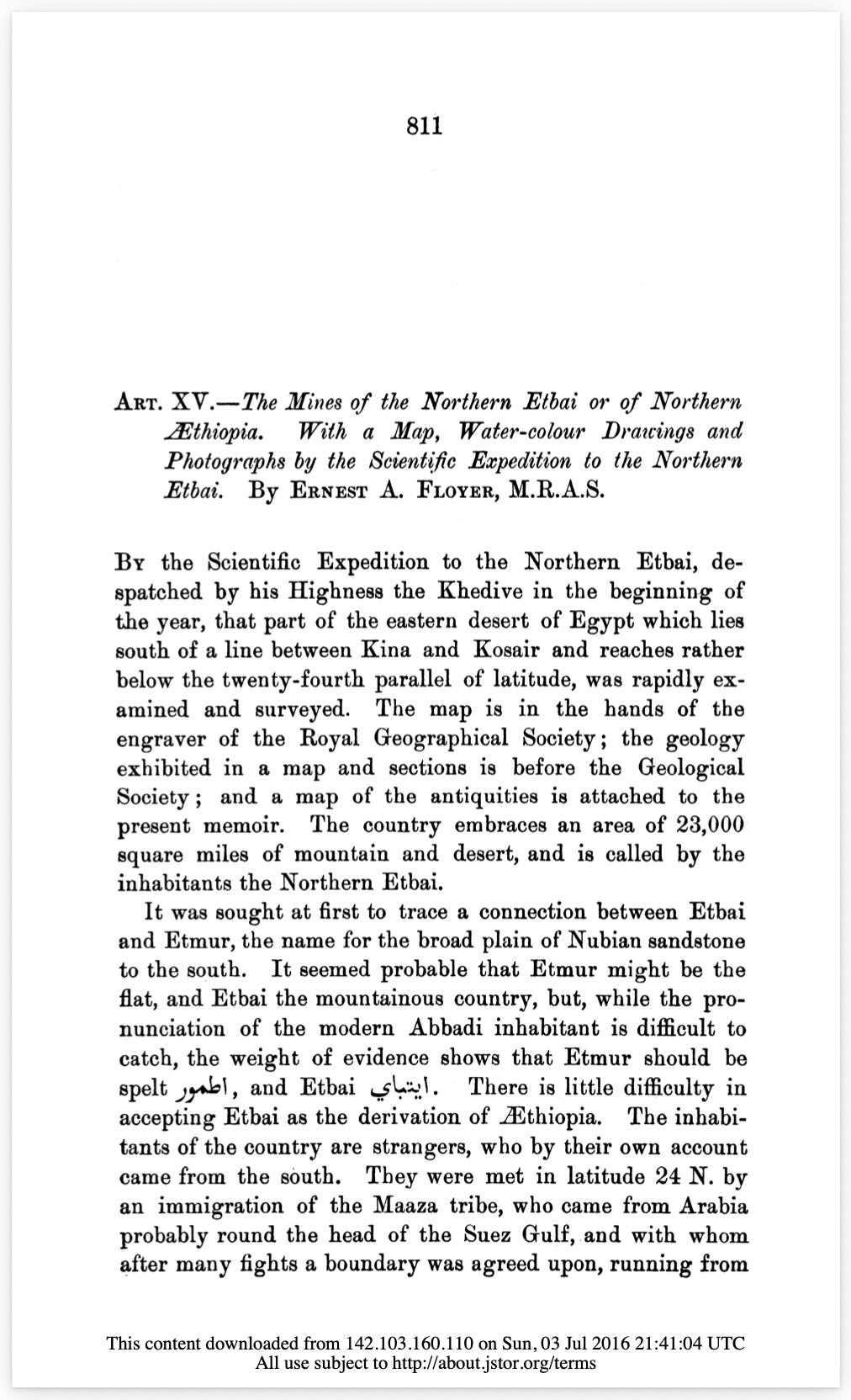
Floyer, E.A. (1892) The mines of the northern Etbai or of northern Æthiopia. With a map, water-colour drawings and photographs by the scientific expedition to the northern Etbai. Journal of the Royal Asiatic Society of Great Britain and Ireland, October, pp. 811–833, maps.
Record No. 29120  |  ISBN/ISSN: 0035869X  |  Sinkankas/Born No.: NIS/NIB  |  RWHL*
Floyer reports the results of the scientific expedition dispatched by the Khedive to examine the Northern Etbai, some 23,000 square miles of mountainous Eastern Desert between the Nile and Red Sea. The paper describes the geography, geology, antiquities, ancient mining remains, routes, water sources, and mineral resources encountered by the expedition, with particular attention to the celebrated ancient Egyptian emerald workings. Floyer describes emerald occurring in mica schist and identifies the most important workings around Wadi Sikait, where extensive ancient excavations and settlements testified to mining on a considerable scale; the emerald district was estimated to extend over some 40 square miles of valleys and mountains. The expedition was important in bringing renewed attention to the long-abandoned Sikait–Zabara emerald region, the classical Mons Smaragdus, and Floyer’s observations provide a significant late nineteenth-century record of the geology and physical condition of the ancient workings before modern investigation. The paper is illustrated with a map and was originally accompanied by water-colour drawings and photographs made during the expedition; an abridged geological account appeared the same year in the Quarterly Journal of the Geological Society.

Precious Stones and Gems

Book
Streeter, E.W. (1892) Precious Stones and Gems. London, Bell, 355 pp.
Record No. 1660  |  Sinkankas/Born No.: 6396; NIB  |  RWHL*
Sinkankas: Entirely re-written & enlarged in the format established by the previous edition; new material appears in virtually every part of the text and much is now included on the ruby mines of Burma, whose systematic exploitation by modern mining methods was financed in part by Streeter’s company. Also to be found are remarks on the Montana sapphire mines and the Egyptian emerald mines. An interesting photograph of the famous Kashmir sapphire locality is now included among the illustrations, also a color plate of rough sapphire crystals from Montana, but for the most part, the color plates remain as poorly prepared as before. Many regard this as the best edition.

The geology of Safed Koh

Journal Article
Griesbach, C.L. (1892) The geology of Safed Koh. Records, Geological Survey of India, Vol. 25, Part 2, pp. 59–109.
Record No. 851  |  Sinkankas/Born No.: NIS/NIB  |  RWHL*
Griesbach gives a brief geological account of the Safed Koh (Spin Ghar) range on the northwestern frontier of British India, describing the principal rock formations observed in the region and their structural relationships. The note records the geological character of this mountainous belt and places its formations within the broader stratigraphy of the adjoining Afghan frontier, drawing on observations made during Griesbach’s geological work in Afghanistan and neighboring territories. Although extremely brief, the notice contributes to the early Geological Survey of India documentation of the geology of the Safed Koh and the poorly known country between Afghanistan and the Indian frontier. Reports on occurrence of ruby and spinel at Jagdallak [Jegdalek]; he also mentions emerald.

Gems and Precious Stones of North America
Book
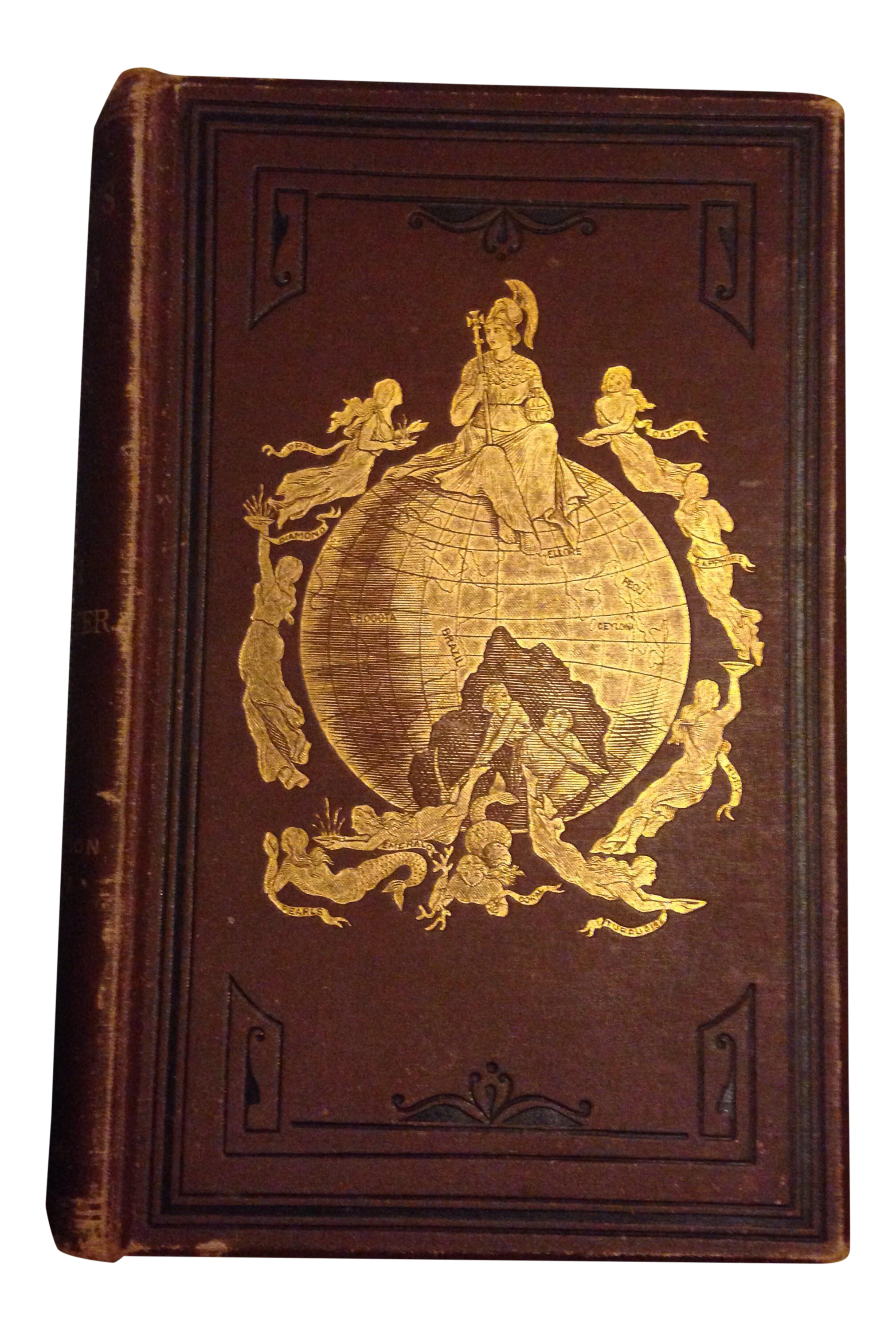
Kunz, G.F. (1890) Gems and Precious Stones of North America. New York, The Scientific Publishing Co., 336 pp.
Record No. 2811  |  Sinkankas/Born No.: NIS/NIB  |  RWHL*
Kunz presents a comprehensive survey of the precious and ornamental stones of North America, describing their mineralogical properties, geographic occurrence, mining and production, cutting, uses, values, and notable specimens. Drawing extensively on American deposits and discoveries, he treats diamonds, corundum varieties including ruby and sapphire, beryl and emerald, turquoise, tourmaline, garnet, quartz and its varieties, feldspars, spodumene, topaz, zircon, opal, jade and related ornamental materials, as well as pearls and other gem substances. Particular attention is given to localities in the United States and Canada, with accounts of individual mines and discoveries and historical production data. The work combines mineralogical description with practical gemology, mining history, commerce, and lapidary information, and is especially valuable as a record of the state of the North American gem industry and known gem deposits in the late nineteenth century.

Aperçu sur la province de Battambang

Overview of the Battambang Province
Journal Article
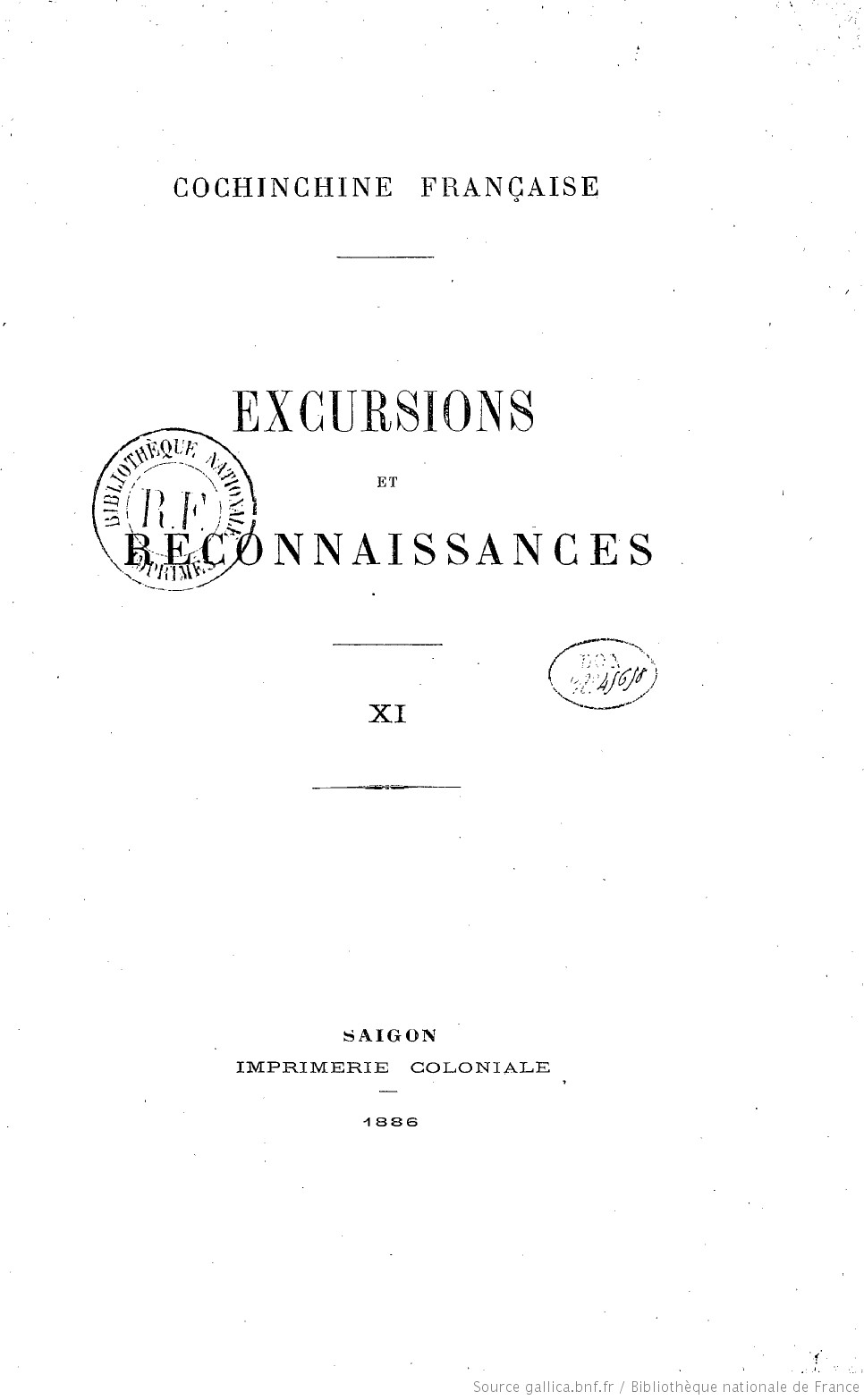
Brien, M. (1886) Aperçu sur la province de Battambang. [Overview of the Battambang Province] Cochinchine Française, Excursions et Reconnaissances, Vol. 11, No. 25, pp. 5–44 (see pp. 10–12).
Record No. 517  |  Sinkankas/Born No.: NIS/NIB  |  Language: in French  |  RWHL*
Regional account containing a detailed description of the gem industry at Payrinh (Pailin), pp. 10–12. Brien estimates 3,000–4,000 miners, predominantly Burmese and Peguans known as Koulahs, and describes abundant but often pale sapphires and rarer, finer rubies, alongside stones identified as white topaz and emerald. He records trade through Chantaboun, Battambang, Phnom Penh, Bangkok and India; local cutting with sapphire powder; and final polishing with rice-husk ash on copper. Particularly significant is his description of red or dark-blue wax placed beneath pale stones in their settings to improve their apparent colour. He also discusses cabochon rings, the concealment of valuable gems beneath the skin during transport, abandoned gold workings at Ba Méas, and regional rock crystal occurrences.

A Manual of the Geology of India, Part 3: Economic Geology
Book
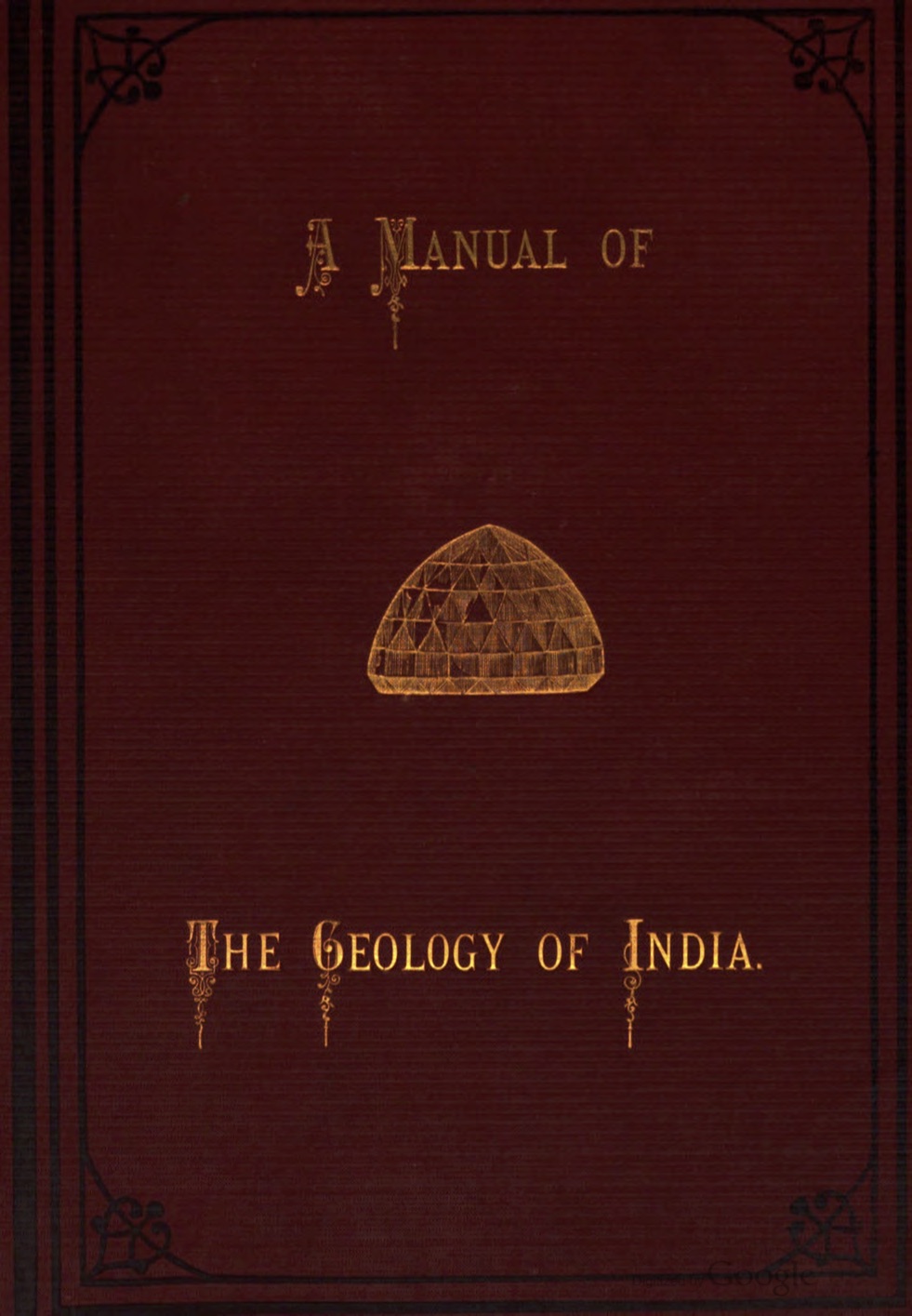
Ball, V. (1881) A Manual of the Geology of India, Part 3: Economic Geology. Calcutta, Geological Survey of India, 4 Vols., Vol. 3 , 663 pp.
Record No. 2704  |  Sinkankas/Born No.: 336; NIB  |  RWHL*
A Manual of the Geology of India, Part 3: Economic Geology is a foundational geological text authored by Irish geologist Valentine Ball and published by the Geological Survey of India in 1881. It serves as a comprehensive encyclopedic survey of the subcontinent's mineral wealth, detailing deposits of coal, metallic minerals, salts, building stones, and precious gems. The manual was later revised in parts during the second edition, with notable contributions from T.H. Holland. Sinkankas: While including all earth and rock products, minerals, etc., much is also provided on gemstones, making this book a valuable reference even today. Special interest: Ch. 1, pp. 1–50, on diamond in India, with historical remarks, mining methods, localities, etc., and with colored geological maps of the Karnaul, Kistna, and Panna districts. Burmese amber: pp. 57–58. Ch. IX briefly describes and furnishes localities for ruby, sapphire, spinel, turquoise. Ch. XIII on quartz and its varieties, pp. 502–514, is especially informative. Ch. XIV includes nephrite and jadeite, also beryl and emerald, garnet, zircon, lapis lazuli, and topaz. Highlights include the large chapter on diamonds in India, and also a richly detailed section on the mining, sorting, heat treatment, sale, and lapidary treatment of quartz gemstones, taken from an article first published by Ball in the Bombay Journal; this article describes what may be the first use of tumbling to round and polish gemstones in leather bags. Appendix F, pp. 636–639, lists native terms for minerals and gemstones and is the only one that I know of for India. Appendix E, pp. 596–635, bibliography, with many entries for gemstones.

History and Mystery of Precious Stones

Book
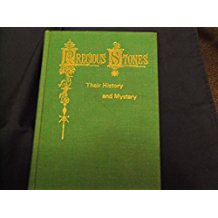
Jones, W. (1880) History and Mystery of Precious Stones. London, Richard Bentley and Son, 384 pp.
Record No. 2796  |  Sinkankas/Born No.: 3269; NIB  |  RWHL*
A wide-ranging historical and literary survey of precious stones by William Jones, concerned principally with their folklore, symbolism and cultural associations rather than their mineralogy. Jones examines ancient and medieval beliefs concerning the supernatural and medicinal virtues of gems, biblical and rabbinical traditions, planetary and birth stones, talismans, famous jewels, literary references, royal and ecclesiastical treasures, and the use of precious stones in crowns, regalia, jewelry and costume. Drawing extensively on classical, medieval and early modern authors, inventories, chronicles and poetry, the work assembles numerous accounts of diamonds, rubies, sapphires, emeralds, pearls and other gems and traces the legends and historical events associated with them. Jones explicitly states that he does not attempt to cover the mineralogical composition or structure of gemstones. The book is particularly valuable as a nineteenth-century compilation of gem folklore, historical jewelry references and literary traditions surrounding precious stones.

Compte-rendu de la séance du 13 Février 1879 [Curious Emerald Crystals]

Report of the Meeting of 13 February 1879
Journal Article
Bertrand, E. (1879) Compte-rendu de la séance du 13 Février 1879 [Curious Emerald Crystals]. [Report of the Meeting of 13 February 1879] Bulletin de la Société Minéralogique de France, Vol. 2, No. 2, pp. 29–31.
Record No. 29400  |  Sinkankas/Born No.: NIS/NIB  |  Language: in French  |  RWHL*
Mr E. Bertrand then presented some rather curious emerald crystals; these specimens come from Muzo, New Granada. They consist, at the centre, of an almost colourless hexagonal portion; this central part is surrounded by another, green portion, striated parallel to the sides of the hexagon and showing modifications tangent to the edges of the prism. The central part shows to the naked eye a six-rayed asterism and the parhelic circle; under the polarising microscope, in convergent light, the cross and rings can be seen, with a slight dislocation in the three directions normal to the sides of the hexagon. The striated green portions surrounding the central core show to the naked eye a single luminous line perpendicular to the striations. In convergent polarised light, the cross and rings are consistently deformed and show a phenomenon similar to that which would be produced by a crystal with two closely spaced optic axes, the plane of the axes being perpendicular to the striations. These crystals, numbering about forty, all show the same phenomenon. First mention of trapiche emeralds at Muzo.

Exploring the Literature of Emerald

Emerald literature spans gemology, mineralogy, deposits, identification, treatments, synthesis, history and the gem trade, with important sources covering deposits around the world.

For a curated guide to this subject, read Green Fire — Lotus Gemology's Guide to the Literature of Emerald.

About Four Treasures

Four Treasures is Lotus Gemology's freely accessible gemological reference database. Use the full database to search by author, title or keyword and explore literature on gemology, mineralogy, jewelry and related fields. Where available, hyperlinks on titles may lead directly to the full publication.

Search the Complete Four Treasures Database