Emerald Bibliography

Emerald Bibliography

Explore books, articles and historical sources on emerald in Four Treasures, the Lotus Gemology reference database. This bibliography brings together matching records from the collection, with publication details, abstracts and cover images where available.

Emerald References

The list below matches the terms emerald or emeralds in the database's searchable fields. Some references discuss emeralds as part of a broader subject.
321–340 of 851 matching references

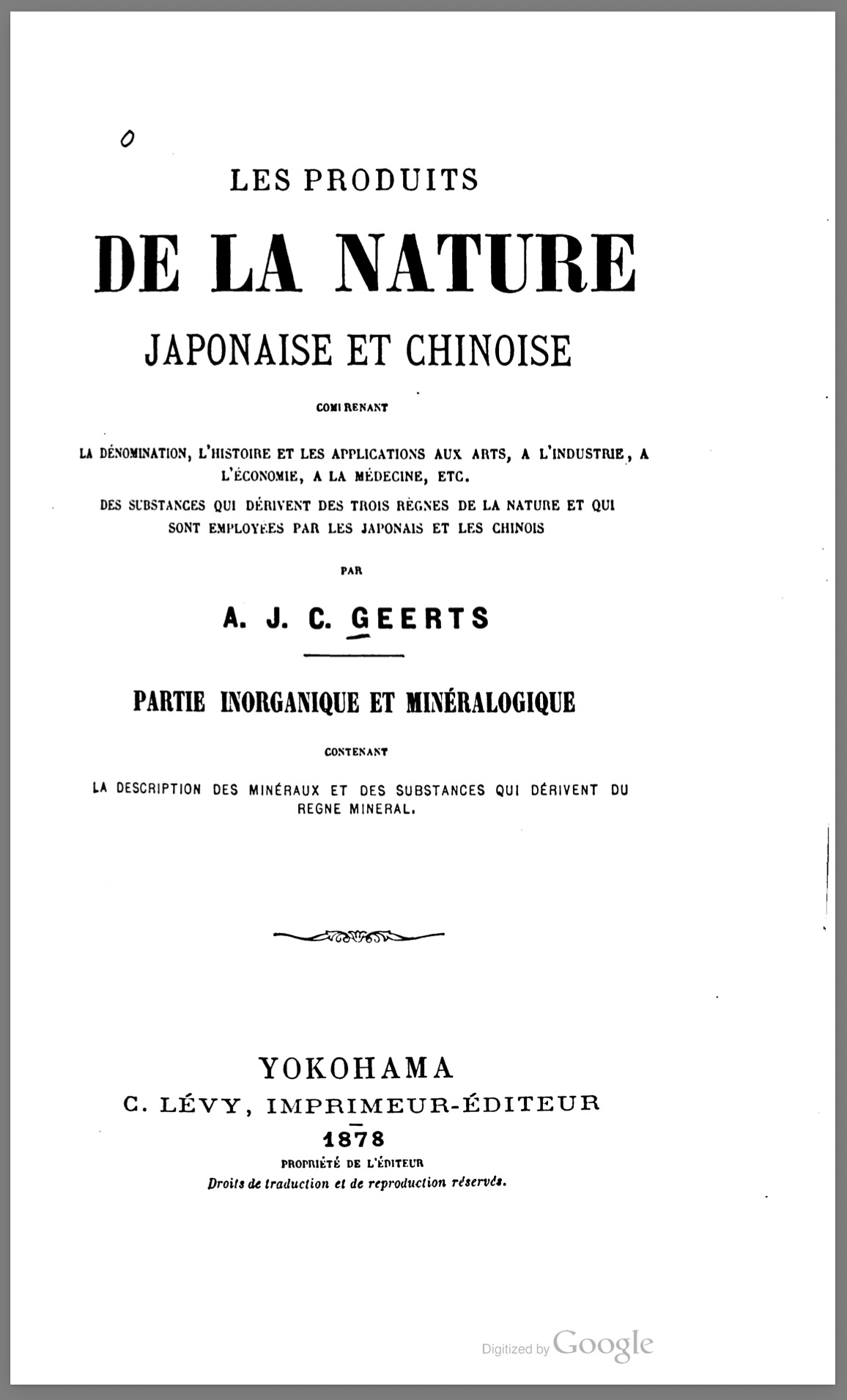
Les Produits de la Nature Japonaise et Chinese Comprenant la Dénomination, l'Histoire et les Applications aux Arts, a l'Industrie, a l'Economie, a la Médecine, etc.
Book
Geerts, A.J.C. (1878, 1883) Les Produits de la Nature Japonaise et Chinese Comprenant la Dénomination, l'Histoire et les Applications aux Arts, a l'Industrie, a l'Economie, a la Médecine, etc. Yokohama, C. Lévy, 2 Vols.
Record No. 28763  |  Sinkankas/Born No.: 2327; NIB  |  RWHL*
The first of two separately published parts dealing with the mineral products employed by the Japanese and Chinese in older, traditional arts and industries; they are considered highly important sources of authentic information and were much referenced in later publications. In the large section on carbon, diamond finds a place on pages 201–203, and here Geerts gives its names in phonetic equivalents as well as in the native ideographs, then cites authorities for the same and gives a discussion of its uses by the Japanese and the Chinese. In similar manner, under the heading of “Silicium,” he gives crystalline and cryptocrystalline varieties of quartz, pp. 241–247, including rock crystal, sagenite, smoky quartz, amethyst, rose quartz, citrine, cat’s-eye quartz, aventurine, and others, as well as numerous varieties of chalcedony, and at the end includes opal. An appendix to this section, pp. 272–294, describes prehistoric stone implements and weapon points, including objects meant for personal adornment or as talismans. The plates depict recovery of arsenic, charcoal-burning, making soot, weapon points, implements, tools, and other stone objects. The last plate is a part-colored folding map of Japan showing the major mining districts, with colored spots indicating the minerals obtained. This part contains alabaster-gypsum, p. 329; marbles, pp. 332–335; ruby, pp. 358–362; obsidian, pp. 413–414; garnets, pp. 421–424; tourmaline, pp. 424–425; serpentines and steatites, pp. 434–440, including agalmatolite; meerschaum, p. 441; and ophitic serpentines, pp. 441–445. In the section entitled “Pierres précieuses,” pp. 452–482, appear discussions of jade varieties, including properties, use in medicines, etc., also red coral, several uncertainly identified stones, topaz, emerald, aquamarine, zircon, and sapphire. This work is cited and commented upon by Laufer in his Sino-Iranica (1919) and his treatises on turquoise and diamond; see also F. de Mély and M. H. Courcel, Les Lapidaires de l’Antiquité et du Moyen Âge, I, Lapidaires Chinois, especially in connection with a Chinese-Japanese encyclopedia containing a lapidary, reproduced in its original form in that volume along with translation and commentaries. Gemstones are discussed on pp. 178–188.

Über die columbischen Smaragden

On the colombian emeralds
Journal Article
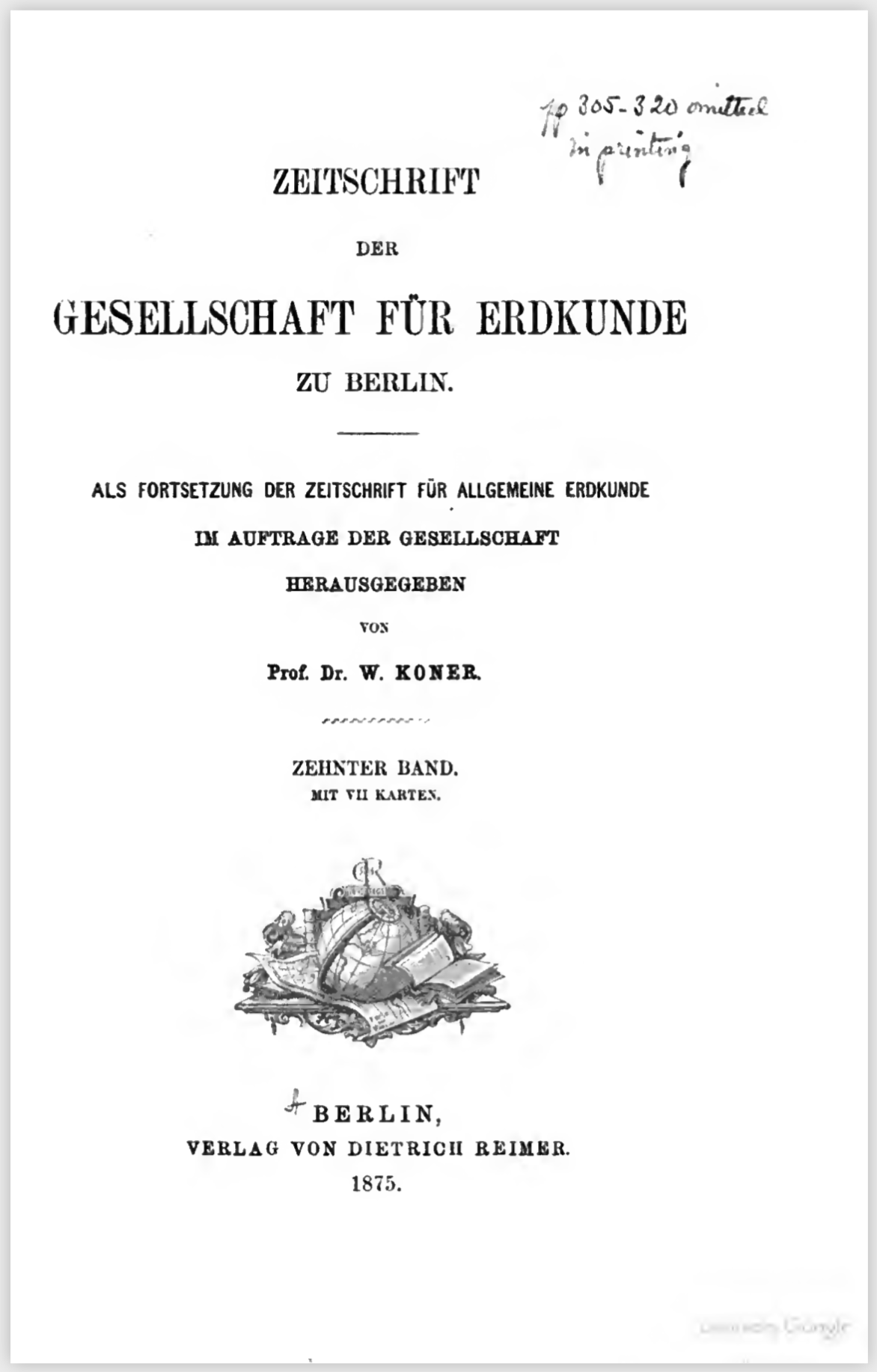
Schumacher, H.A. (1875) Über die columbischen Smaragden. [On the colombian emeralds] Zeitschrift der Gesellschaft für Erdkunde zu Berlin, Vol. 10, pp. 38–62.
Record No. 4255  |  Sinkankas/Born No.: 5897  |  Language: in German  |  RWHL*
Carefully researched, detailed article on the Colombian emerald deposits, covering the entire span of exploitation from the earliest records of Spanish colonial times to the present. With comments on knowledge of emerald in antiquity, emerald elsewhere in the world, properties of emerald, but by far most of the text is a systematic chronology of mining with citations from pertinent literature and archival material, with much in passing on inhabitants, local geography, working conditions, laws & decrees, mining methods, leases, pacts, etc. Despite the valuable material in this article it is rarely mentioned in later works dealing with the emerald and emerald deposits, possibly because it appeared in a geographical rather than a geological journal. From the historical viewpoint, it far exceeds in value any other article that purports to be authoritative in regard to the history ofthe Colombian deposits. JE Pogue, The emerald deposits of Muzo, Colombia, 1916, which see, a detailed and valuable historical description of the Muzo mines based on original sources.” Sinkankas"

The emerald

Journal Article
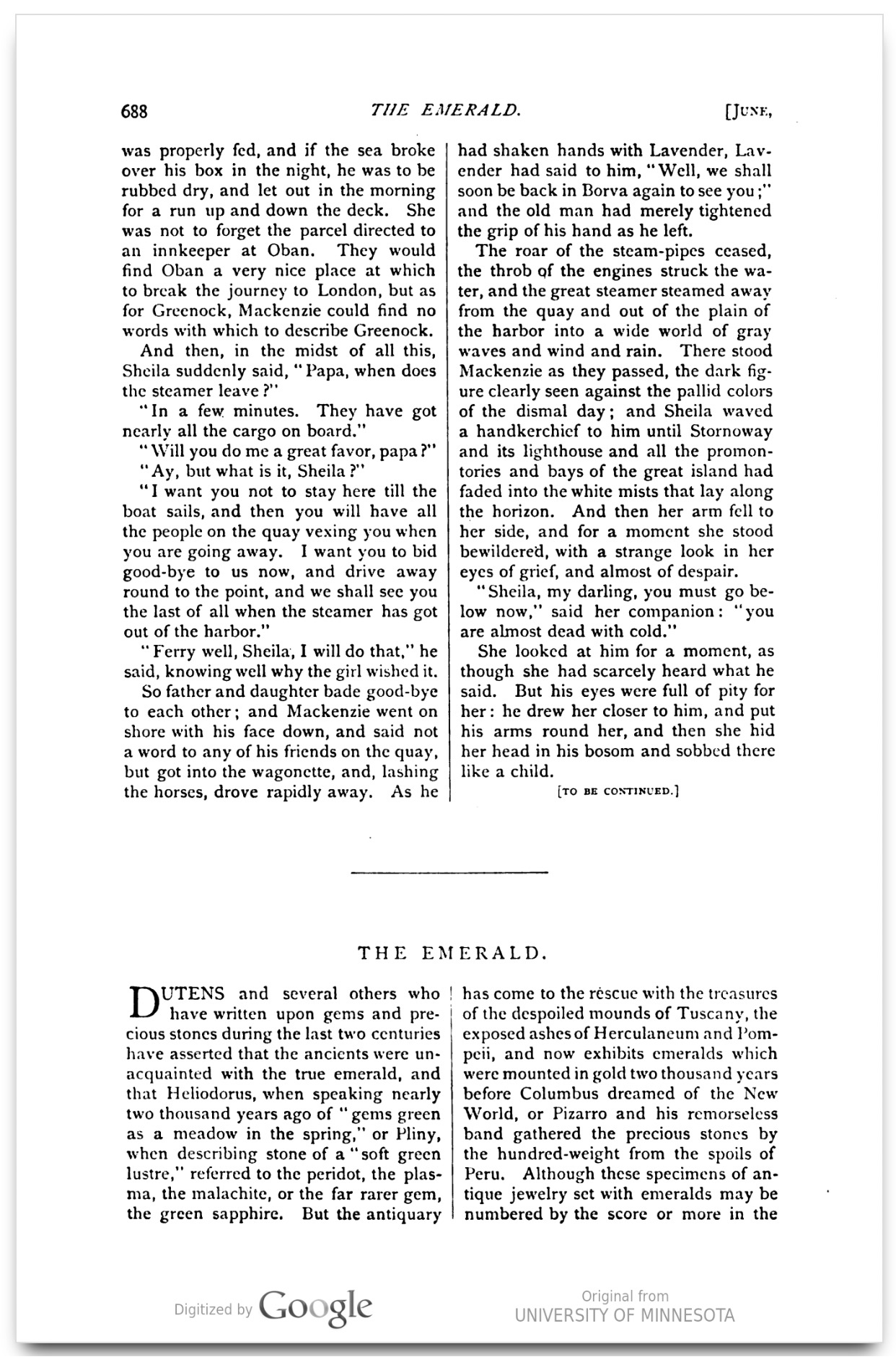
Hamlin, A.C. (1873) The emerald. Lippincott’s Magazine, Vol. 11, June, pp. 688–696.
Record No. 29399  |  Sinkankas/Born No.: NIS/NIB  |  RWHL*
Dutens and several others who have written upon gems and precious stones during the last two centuries have asserted that the ancients were unacquainted with the true emerald, and that Heliodorus, when speaking nearly two thousand years ago of gems green as a meadow in the spring, or Pliny, when describing stone of a soft green lustre, referred to the peridot, the plasma, the malachite, or the far rarer gem, the green sapphire. But the antiquary has come to the rescue with the treasures of the despoiled mounds of Tuscany, the exposed ashes of Herculaneum and Pompeii, and now exhibits emeralds which were mounted in gold two thousand years before Columbus dreamed of the New World, or Pizarro and his remorseless band gathered the precious stones by the hundred-weight from the spoils of Peru. Although these specimens of antique jewelry set with emeralds may be numbered by the score or more in the museums and reliquaries of Europe, but very few engraved emeralds have descended to us from ancient times. This rarity is not due to the hardness of the stone, for the ancient lapidaries cut the difficult and still harder sapphire: therefore we must believe the statement of the early gem-writers that the emerald was exempted from the glyptic art by common consent on account of its beauty and costliness.

The Treasures of the Earth

Book
Jones, W. (1872?) The Treasures of the Earth. London, Frederick Warne and Co., xii, 404 pp.
Record No. 2795  |  Sinkankas/Born No.: Sinkankas #3261–3264; NIB  |  RWHL*
Jones presents a popular survey of valuable mineral products obtained from the earth, combining mineralogical information with accounts of their discovery, extraction, working, commerce, and historical use. Particular attention is given to precious metals and gemstones, including diamonds, rubies, sapphires, emeralds, opals, turquoise, and other ornamental stones, with descriptions of their physical properties, principal sources, celebrated specimens, and methods of cutting and polishing. The work also discusses mining and mineral resources more broadly, placing gemstones within the economic and technological exploitation of the mineral kingdom. Written for a general readership, it provides a useful nineteenth-century overview of contemporary popular knowledge concerning precious stones, their sources, and their commercial and ornamental importance.

Observations on a collection of the Chalchihuitls from Central America
Journal Article
Squirer, E.G. (1869) Observations on a collection of the Chalchihuitls from Central America. Annals of the Lyceum of Natural History of New York, Vol. 9, pp. 246–265.
Record No. 4493  |  Sinkankas/Born No.: 6306; NIB  |  RWHL*
Sinkankas: An important early paper on the jades and jade-like green stones employed in ornaments and small carvings by the Indians of Mexico and Central America. He discusses the term “chalchihuitl” as used by early writers, possible synonymy, notes that the term “quetzalitztli” was applied to emerald, and referred to the brilliant green plumage of the quetzal bird, Trogon resplendens, and further noted the high esteem in which such green stones were held. Some early Spanish accounts are given, including one from Hernán Cortés. Suggests uses of the carved objects, the various minerals and rocks employed in their manufacture, and lapidary techniques. The types of objects include plaques, personal ornaments, lip plugs, hatchet blades, and small animal sculptures. The importance of this work is recognized by Heinrich Fischer, who comments at length upon it in Der Nephrit und der Jadeit, 1880, 263–271, which see.

Essai sur la minéralogie Arabe

Essay on Arabic Mineralogy
Journal Article
Clément-Mullet, J.-J. (1868) Essai sur la minéralogie Arabe. [Essay on Arabic Mineralogy] Journal Asiatique, Sixth Series, Vol. 5, January, pp. 1–81; February–March, pp. 109–253; June, pp. 502–522.
Record No. 5226  |  Sinkankas/Born No.: 1385; NIB  |  Language: in French  |  RWHL*
Clément-Mullet presents an extensive study of Arabic mineralogy based on medieval Arabic texts, examining the names, descriptions, properties, sources, and uses assigned to minerals and precious stones by Islamic authors. He compares Arabic terminology with Greek and later European mineralogical nomenclature and discusses substances including diamond, ruby, sapphire, emerald, turquoise, pearls, corundum, quartz, and various ornamental and medicinal stones. Particular attention is given to descriptions of gemstone localities, physical properties, methods of testing and distinguishing stones, commercial values, and beliefs concerning their medicinal or supernatural virtues. By translating and comparing passages from Arabic authorities and relating them to contemporary mineralogical knowledge, Clément-Mullet provides an important nineteenth-century synthesis of the medieval Arabic lapidary tradition and a valuable source for the history of gemology and mineralogy in the Islamic world. Contains translation and commentary on Teifaschi’s treatise on gems written about 1242 AD.

The Natural History, Ancient and Modern, of Precious Stones and Gems, and of the Precious Metals
Book
King, C.W. (1865) The Natural History, Ancient and Modern, of Precious Stones and Gems, and of the Precious Metals. London, Bell and Daldy, 442 pp.
Record No. 2801  |  Sinkankas/Born No.: 3401; NIB  |  RWHL*
Sinkankas: Remarkable and encyclopedic, this work presents several dozen essays on gemstones, including those mentioned by ancient writers and still imperfectly identified. Each essay offers insights into the properties, sources, ancient uses, and modern commercial significance of various gems, with major textual revisions and new material substantial enough to treat them as independent works. King was unfortunate in his choice of publisher, Bell and Daldy, who used exceedingly poor binding materials, causing most copies to disintegrate quickly with use. The book was reviewed in detail in Edinburgh Review (July 1866, pp. 228–260). The introductory essay explores ancient mineralogical knowledge and its development through modern times, drawing from numerous literary sources. The main text arranges gemstones alphabetically, followed by essays on pastes, the Orphic poem (pp. 375–398) with commentary, ancient jewelry, chemical analysis of gemstones, sales prices of notable precious stones, weights, designs of famous gems, and colored diamonds. Additional notes discuss engraved gems used by King to ornament his book. The plates are of special interest, depicting mineral crystal forms, outline drawings of famous diamonds, the Devonshire emerald crystal, and notable jewels. Despite its age and sometimes controversial opinions, the book is a delight to explore, offering much for those interested in unusual aspects of gemology. It is also worth noting that, like his work on Gnostics, this book exemplifies the fractionation and expansion process described by Adolf Furtwängler, leading to offshoots with related titles, sometimes mistakenly referred to as second editions."

Sur l’absorption dans Ies milieux colorés birefringents
On absorption in colored birefringent media
Journal Article
Babinet, M. (1838) Sur l’absorption dans Ies milieux colorés birefringents. [On absorption in colored birefringent media] Comptes Rendus Hebdomadaires des Séances de l’Académie des Sciences, Vol. 7, July–December, pp. 832–833.
Record No. 28068  |  Sinkankas/Born No.: NIS/NIB  |  Language: in French  |  RWHL*
Absorption in colored birefringent media differs essentially from the ordinary phenomenon to which the inherent colors of bodies relate. Here, as in many other parts of modern optics, the first observations, those constituting the discovery, are due to M. Arago. He showed that in colored birefringent media, and notably in yellowish baryte sulfate, polarized light developed varying tints depending on the direction in which it passed through the crystal. M. Biot and M. Brewster, but especially M. Biot, then studied the phenomenon, though without formulating the definitive law. In a note formerly communicated to the Academy, I had stated that colored birefringent crystals, called negative or repulsive, such as Iceland spar, tourmaline, and sapphire, absorb the ordinary ray more strongly, whereas positive or attractive crystals, such as quartz, zircon, and common apophyllite, extinguish the extraordinary ray to a greater extent, and consequently allow the ordinary ray to pass as partially polarized light. However, there are some exceptions, such as beryl, though not emerald. Finally, in the memoir on the optical properties of minerals, dichroism had not led to the statement of the law of the phenomenon to whose demonstration the experiments of the present memoir refer.

Pluto Brasiliensis

The Mineral Wealth of Brazil
Book
Eschwege, W.L., von (1833) Pluto Brasiliensis. [The Mineral Wealth of Brazil] Berlin, G. Reimer, 623 pp.
Record No. 29371  |  Sinkankas/Born No.: 1947  |  Language: in German  |  RWHL*
Sinkankas: An outstanding and carefully researched work reflecting the author’s many years of practical experience in Brazil and involvement in the country’s mining industry. Although primarily concerned with gold, it contains an important section on gemstones (Part IV, pp. 345–446), covering diamonds, tourmaline, topaz, beryl, chrysoberyl, amethyst, euclase and other stones. It is among the earliest major works to provide a history of diamond and gemstone discoveries in Brazil, including the expeditions prompted by reports of emeralds, the subsequent discovery of diamonds, and the identification of supposed emeralds—reported from 1573 or earlier—as green tourmaline. It also describes Portuguese Crown regulations governing diamond mining and trade, reviews the diamond industry from 1749 to 1822 with production statistics, and discusses mining districts, administration, mining methods, diamond occurrences and crystal forms, specimens from the Serro do Frio in the Royal Cabinet, and the smuggling of gold and diamonds. A fundamental source for the history of Brazilian gold, diamond and gemstone mining.

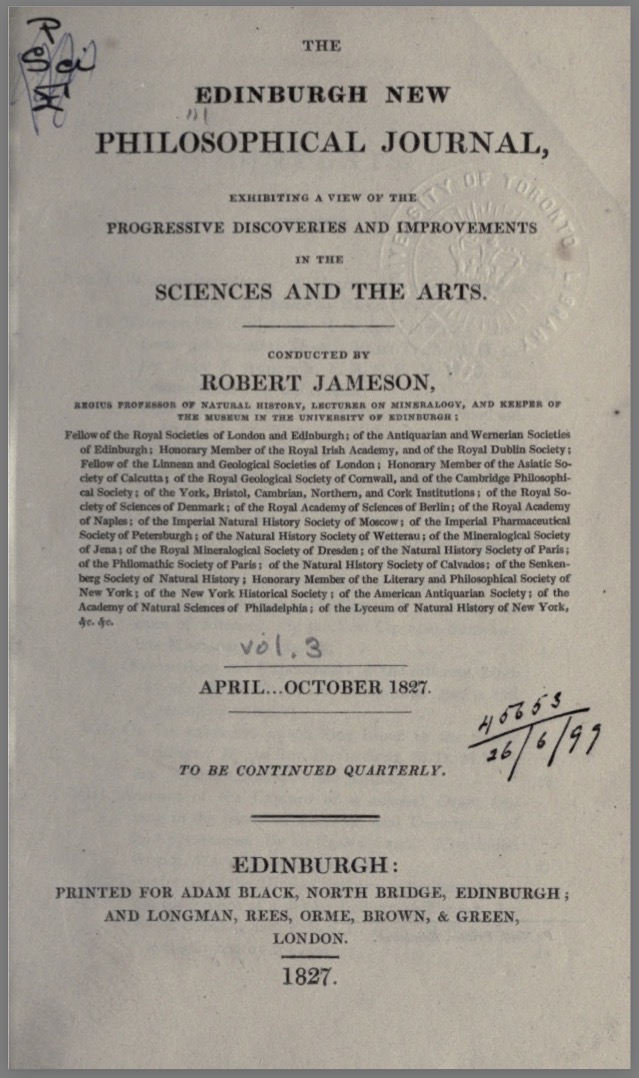
Account of Mr. Crawford’s Mission to Ava
Journal Article
Calcutta Government Gazette (1827) Account of Mr. Crawford’s Mission to Ava. Edinburgh New Philosophical Journal, Vol. 3, July–September, pp. 359–370.
Record No. 16845  |  Sinkankas/Born No.: NIS/NIB  |  RWHL*
A brief description of the ruby and sapphire gem mines near Mo-gaot (Mogok) and Kyat-pyan that were five days journey from Ava (near present-day Mandalay). The information was taken from a report by a British diplomat on a mission to the Kingdom of Ava (in central Burma) in 1826–1827. The account was originally published in the Calcutta Government Gazette of 1st March.

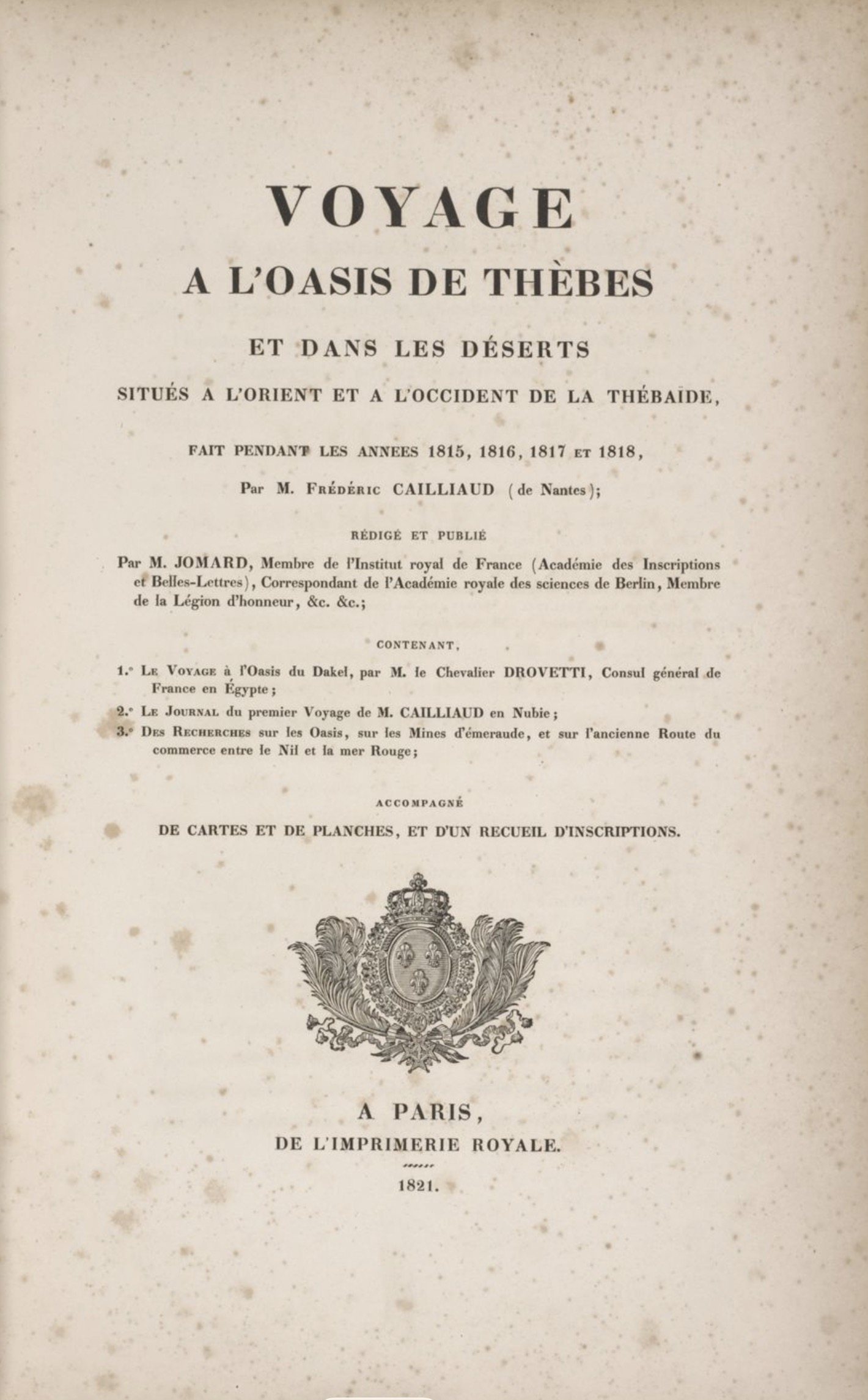
Voyage à l’Oasis de Thèbes et dans les déserts situés à l’orient et à l’occident de la Thébaïde, fait pendant les années 1815, 1816, 1817 et 1818
Journey to the Oasis of Thebes and into the deserts situated east and west of the Thebaid, made during the years 1815, 1816, 1817 and 1818
Book
Cailliaud, F. (1822) Voyage à l’Oasis de Thèbes et dans les déserts situés à l’orient et à l’occident de la Thébaïde, fait pendant les années 1815, 1816, 1817 et 1818. [Journey to the Oasis of Thebes and into the deserts situated east and west of the Thebaid, made during the years 1815, 1816, 1817 and 1818] Paris, Imprimerie Royale, xvii, 120 pp., 24 plates
Record No. 29946  |  Sinkankas/Born No.: 1105 (not seen); NIB  |  Language: in French  |  RWHL*
Sinkankas: Jomard, the editor of the main work above, summarizes the importance of Cailliaud’s exploration in his introduction: “M. Cailliaud, favoured by a chance prize which fortune allotted him, discovered at Mount Zabarah the famous Emerald Mines, hitherto only known by passages in ancient authors, and from the recitals of the Arabs. Forgotten, as it were, during a lapse of centuries, the French voyager has retraced them, nearly in the same condition wherein the engineers of the Ptolomies left them. He has not only penetrated into subterranean cavities of a vast depth, but he has arrived at causeways, has collected tools, instruments, utensils of various kinds … [also] … he commenced the labours of the mines, and by dint of application and exertion, he is enabled to present to Mohammed Aly Pacha ten pounds of Emeralds.” The plates include a plan of the mining town of Sekket (Sikait) showing mines & buildings, a view of the town, a map of the desert region between the Nile River and the Red Sea, and several views of temples at Sikait. In addition to his descriptions of mines, ruins, etc., Cailliaud also gives an excellent mineralogy of the emerald deposits and the mode of occurrence of emerald crystals in the schistose rocks. Landmark in the history of Egyptian emerald.

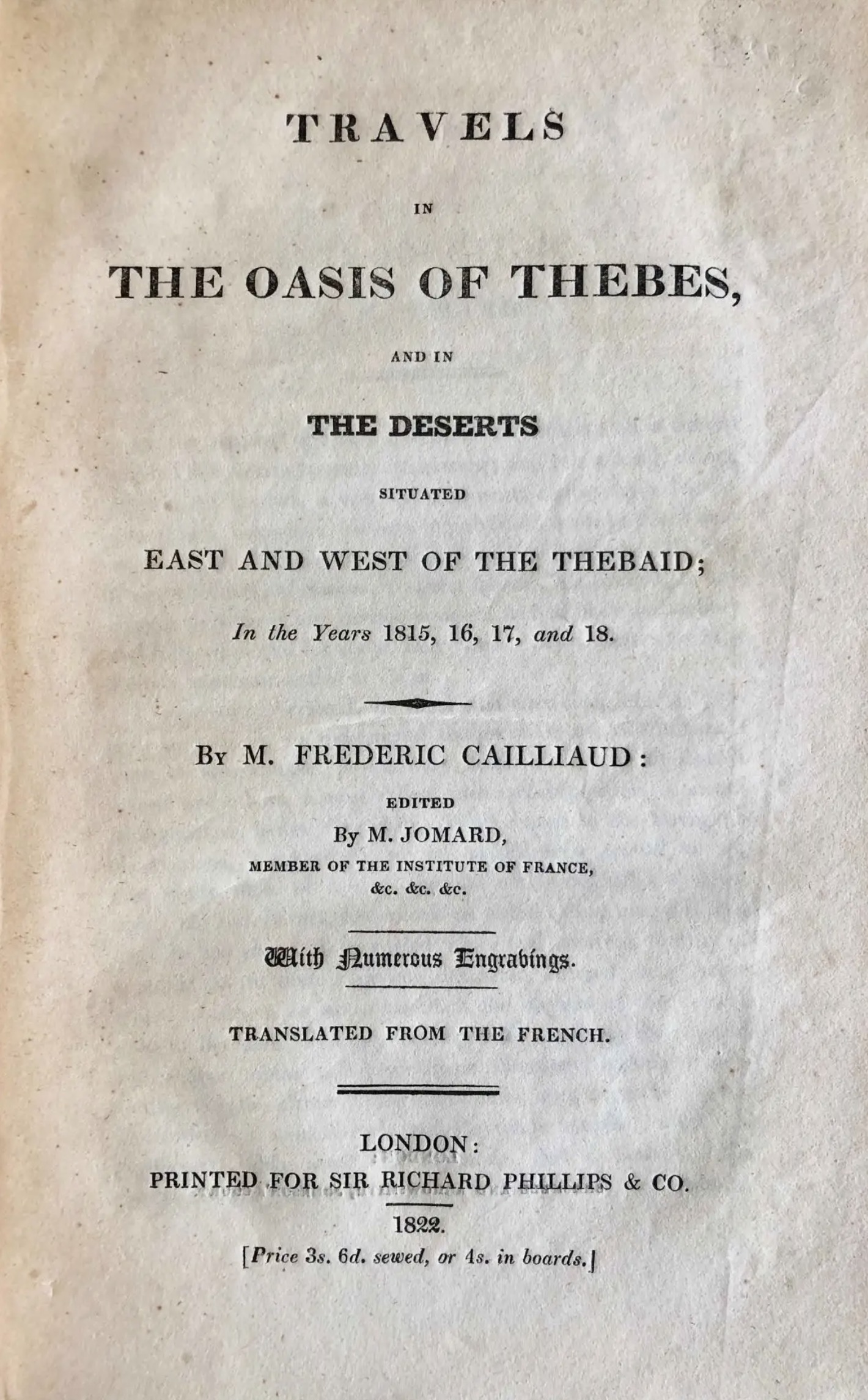
Travels in the Oasis of Thebes, and in the Deserts Situated East and West of the Thebaid in the Years 1815, 1816, 1817 and 1818
Book
Cailliaud, F. (1822) Travels in the Oasis of Thebes, and in the Deserts Situated East and West of the Thebaid in the Years 1815, 1816, 1817 and 1818. London, Richard Phillips & Co., xii, 66 pp.
Record No. 29945  |  Sinkankas/Born No.: 1105–1106  |  RWHL*
Sinkankas: Jomard, the editor of the main work above, summarizes the importance of Cailliaud’s exploration in his introduction: “M. Cailliaud, favoured by a chance prize which fortune allotted him, discovered at Mount Zabarah the famous Emerald Mines, hitherto only known by passages in ancient authors, and from the recitals of the Arabs. Forgotten, as it were, during a lapse of centuries, the French voyager has retraced them, nearly in the same condition wherein the engineers of the Ptolomies left them. He has not only penetrated into subterranean cavities of a vast depth, but he has arrived at causeways, has collected tools, instruments, utensils of various kinds … [also] … he commenced the labours of the mines, and by dint of application and exertion, he is enabled to present to Mohammed Aly Pacha ten pounds of Emeralds.” The plates include a plan of the mining town of Sekket (Sikait) showing mines & buildings, a view of the town, a map of the desert region between the Nile River and the Red Sea, and several views of temples at Sikait. In addition to his descriptions of mines, ruins, etc., Cailliaud also gives an excellent mineralogy of the emerald deposits and the mode of occurrence of emerald crystals in the schistose rocks. Landmark in the history of Egyptian emerald.

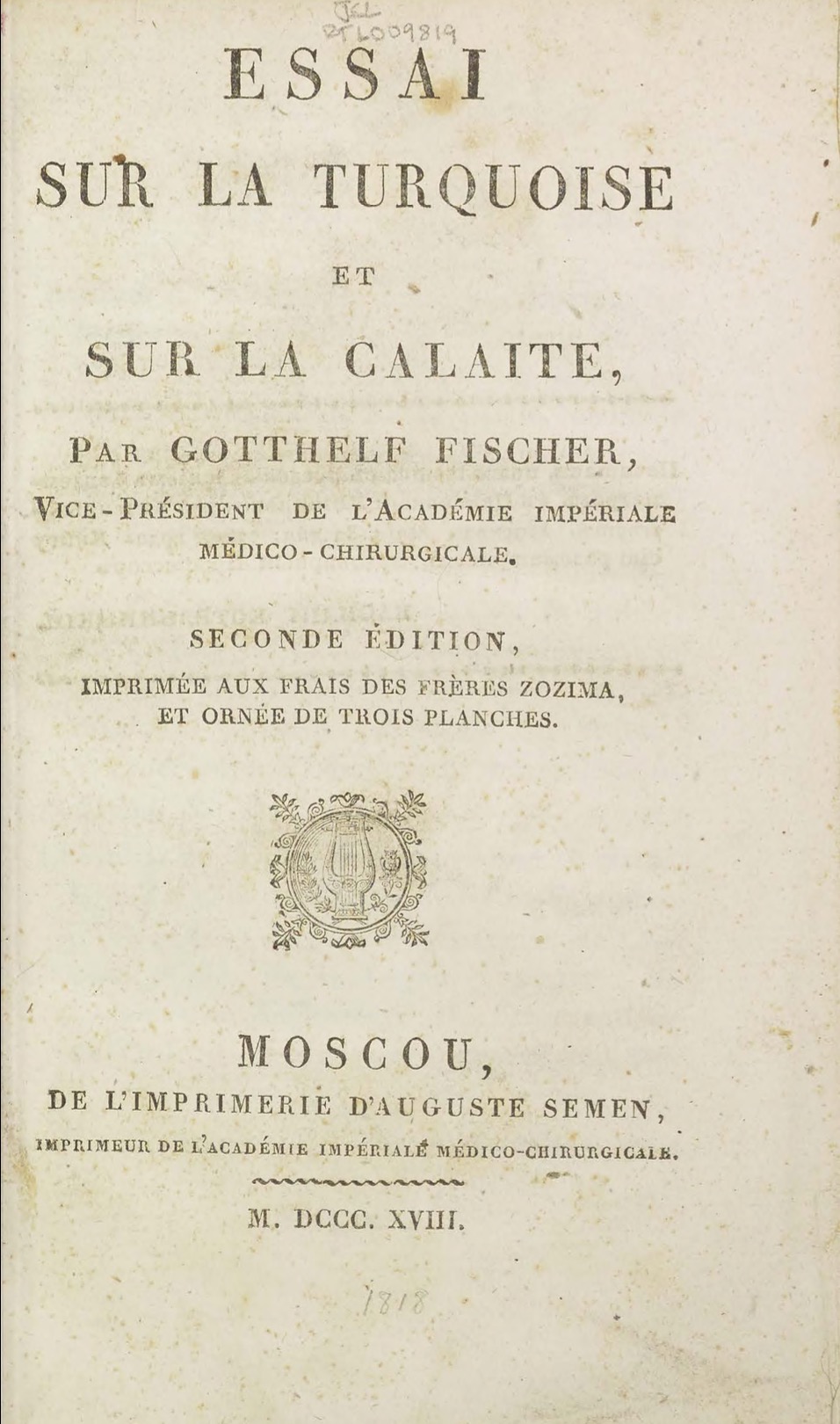
Essai sur la Turquoise et sur la Calaite
Essay on the turquoise and on the calaite
Book
Fischer, G. (1818) Essai sur la Turquoise et sur la Calaite. [Essay on the turquoise and on the calaite] Moscow, Imprimerie d’Auguste Semen, 47 pp.
Record No. 4622  |  Sinkankas/Born No.: NIS/NIB  |  Language: in French  |  RWHL*
An early mineralogical study by Gotthelf Fischer of two very different substances historically called turquoise. Fischer distinguishes “oriental turquoise,” which he regards as a true mineral, from “occidental turquoise” or turquoise odontolite, which he identifies as fossil tooth or bone colored by a copper compound. He proposes the name calaite for the mineral turquoise and discusses its occurrence, physical character and historical nomenclature, comparing it with Pliny’s descriptions of callais. Fischer notes that calaite occurs as rounded pieces in alluvial deposits rather than in a rocky matrix and discusses its resemblance to emerald and sapphire in ancient descriptions. The work is important in the history of gemology for its attempt to separate true mineral turquoise from odontolite and to reconcile contemporary mineralogical observations with the terminology of classical lapidary sources.

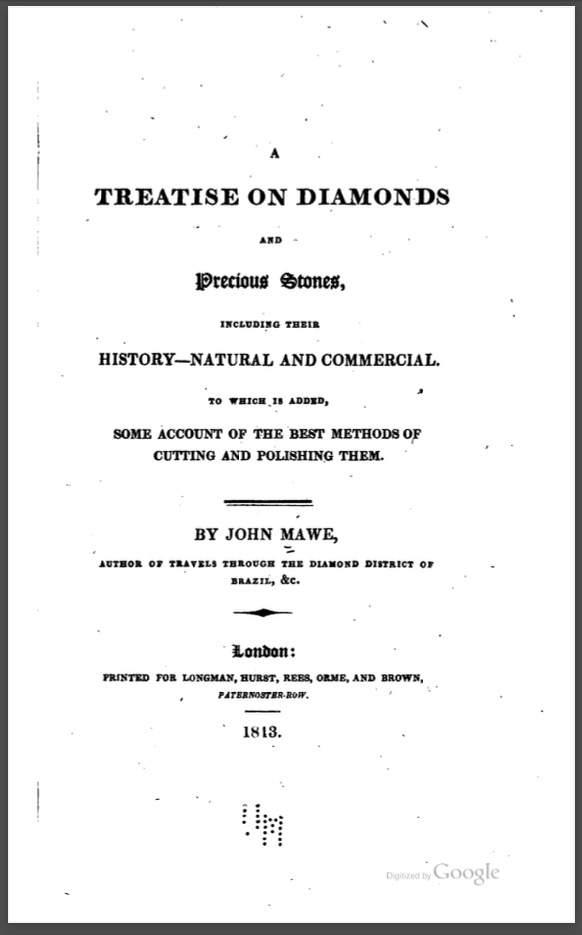
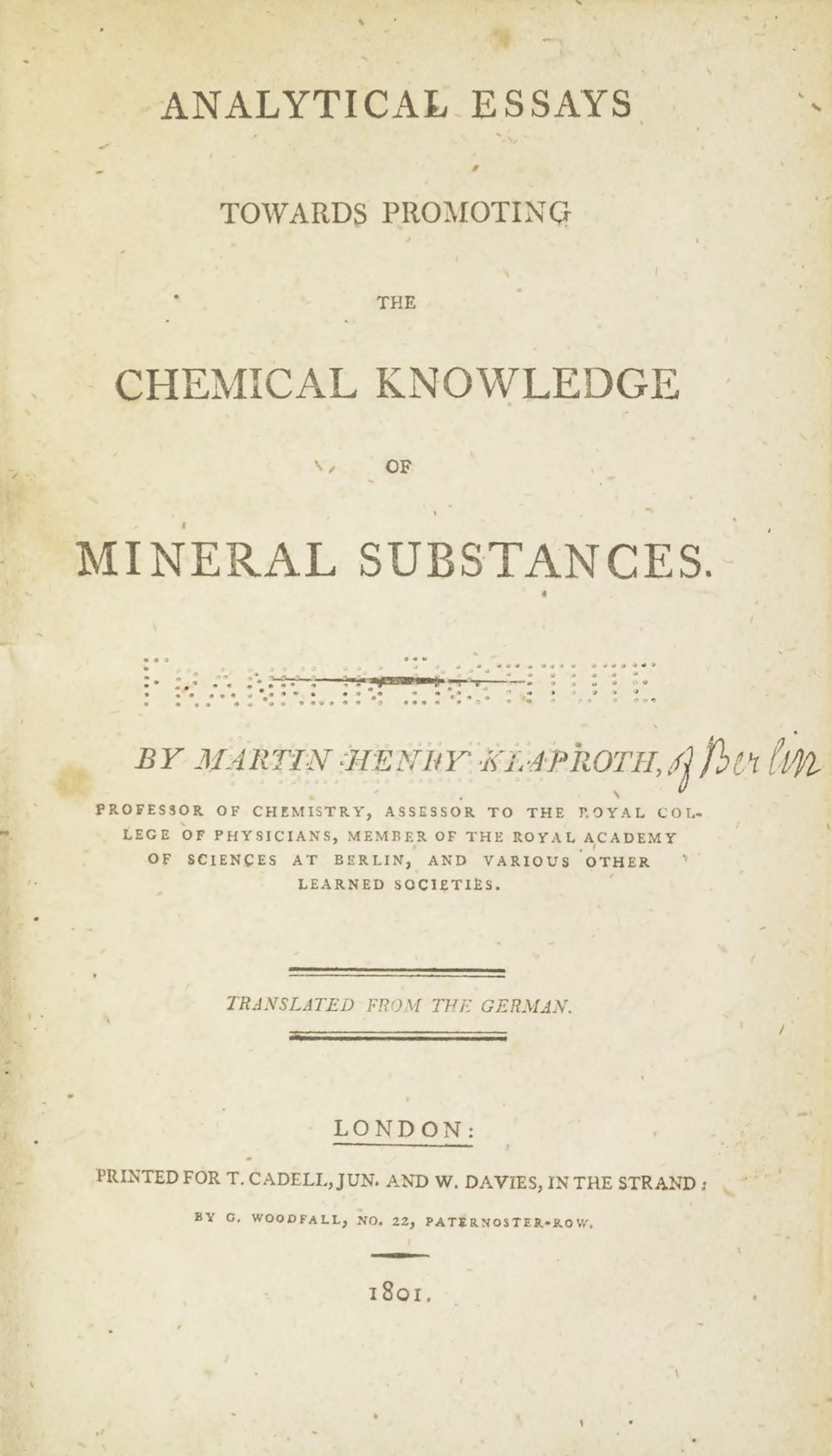
A Treatise on Diamonds and Precious Stones
Book
Mawe, J. (1813) A Treatise on Diamonds and Precious Stones. London, Longman, Hurst, Rees, Orme, and Brown, 168 pp.
Record No. 8066  |  Sinkankas/Born No.: 4283–4284  |  RWHL*
One of the first general treatises on gemstones in the English language that is refreshingly free of fantasy and superstition; it is, instead, a factual, easy to read, and surprisingly complete work on the subject. Much of its outstanding character is due to the author’s experience in collecting & studying minerals and gemstones, and later becoming a well-known and respected dealer in same. The first chapter treats the diamond at length, discussing its value, esteem, ancient knowledge, physical & chemical properties, occurrences, notable large diamonds, the diamond trade, and how it is cut. Other chapters, less detailed, treat corundum gems, amethyst, topaz, and other gemstones of lesser value, such as the feldspars and quartzes. The work is greatly enhanced by its two color plates, which depict cut gems, cutting styles, and, on Plate 2, crystals of diamond. The third plate consists of colored rectangles representing the gamut of hues observable in gemstones from diamond to malachite. The final leaf advertises Mawe’s business and briefly describes the series of gemstones that he then offered for sale. The present work quickly achieved popularity and brought about a second edition. Copies are now very scarce.

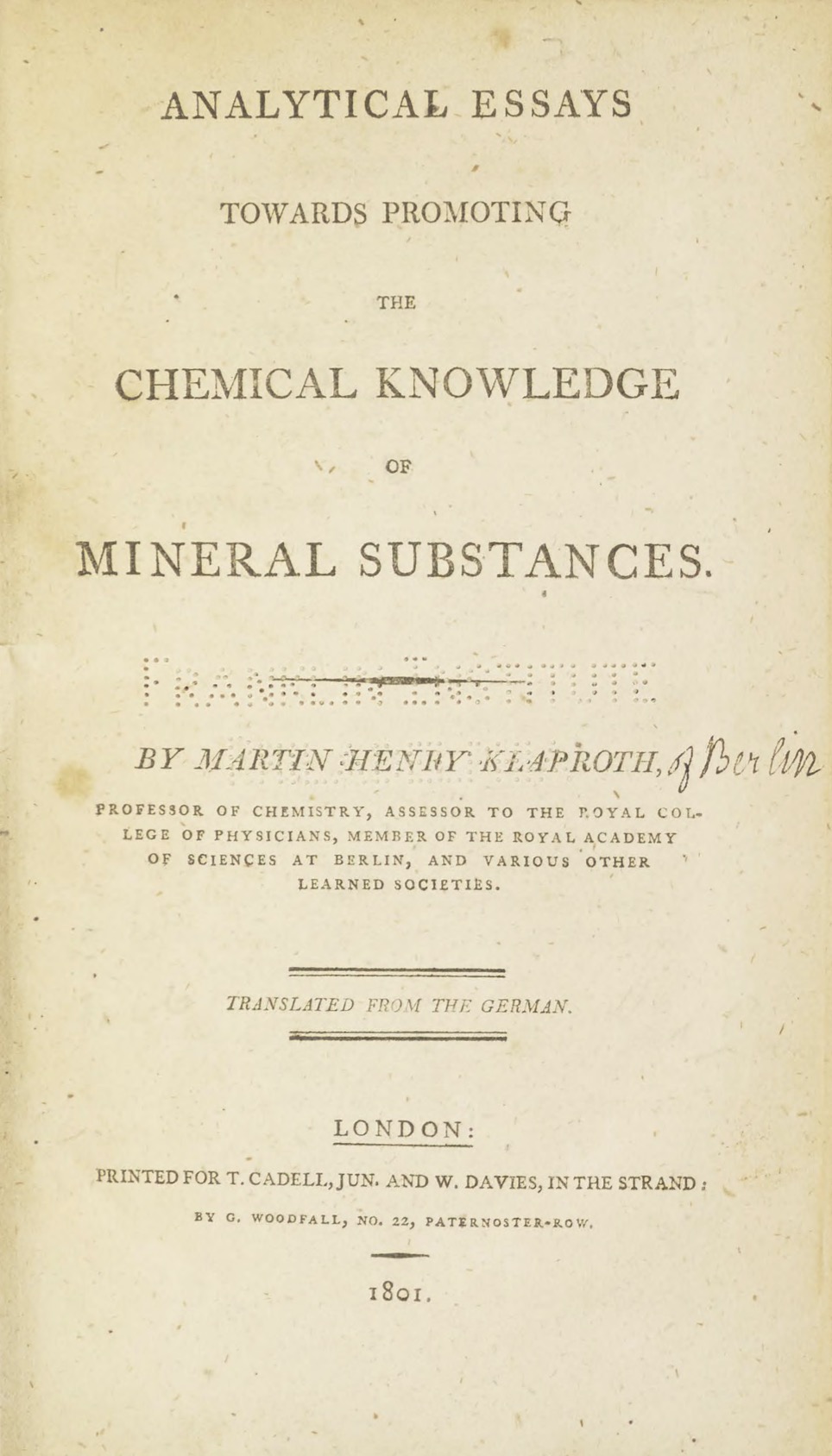
Analytical Essays Towards Promoting the Chemical Knowledge of Mineral Substances
Book
Klaproth, M.H. (1801) Analytical Essays Towards Promoting the Chemical Knowledge of Mineral Substances. London, T. Cadell, Jun. and W. Davies, 592 pp.
Record No. 28777  |  Sinkankas/Born No.: 3437  |  RWHL*
Sinkankas: Corresponds to the first 2 vols of the German edition [of the Beiträge], and containing essays I-LXXII. In the first essay, Klaproth describes the results of subjecting numerous mineral substances to the intense heat of a porcelain fire," among them, feldspars, alabaster, marble, beryl (& emerald), tourmaline, quartzes, chrysoberyls, olivines, kyanite, opals, garnets, zircons, corundums, spinels, topazes, etc. Specific experiments and analyses on gemstones as follows: oriental sapphire, cat's-eye, chrysoberyl, chrysolite, olivine, lapis lazuli, zircon, spinel, Colombian emerald, oriental garnet, vesuvianite, leucite, staurolite, chrysoprase, Hungarian opal, hydrophane, common opals, meerschaum, Chinese agalmatolite, spessartine."

Examination of the oriental sapphire

Book Section
Klaproth, M.H. (1801) Examination of the oriental sapphire. In: Analytical Essays Towards Promoting the Chemical Knowledge of Mineral Substances, London: T. Cadell, Jun. and W. Davies, pp. 71–77.
Record No. 1102  |  Sinkankas/Born No.: 3437  |  RWHL*
Sinkankas: Corresponds to the first 2 vols of the German edition [of the Beiträge], and containing essays I-LXXII. In the first essay, Klaproth describes the results of subjecting numerous mineral substances to the intense heat of a porcelain fire," among them, feldspars, alabaster, marble, beryl (& emerald), tourmaline, quartzes, chrysoberyls, olivines, kyanite, opals, garnets, zircons, corundums, spinels, topazes, etc. Specific experiments and analyses on gemstones as follows: oriental sapphire, cat's-eye, chrysoberyl, chrysolite, olivine, lapis lazuli, zircon, spinel, Colombian emerald, oriental garnet, vesuvianite, leucite, staurolite, chrysoprase, Hungarian opal, hydrophane, common opals, meerschaum, Chinese agalmatolite, spessartine."

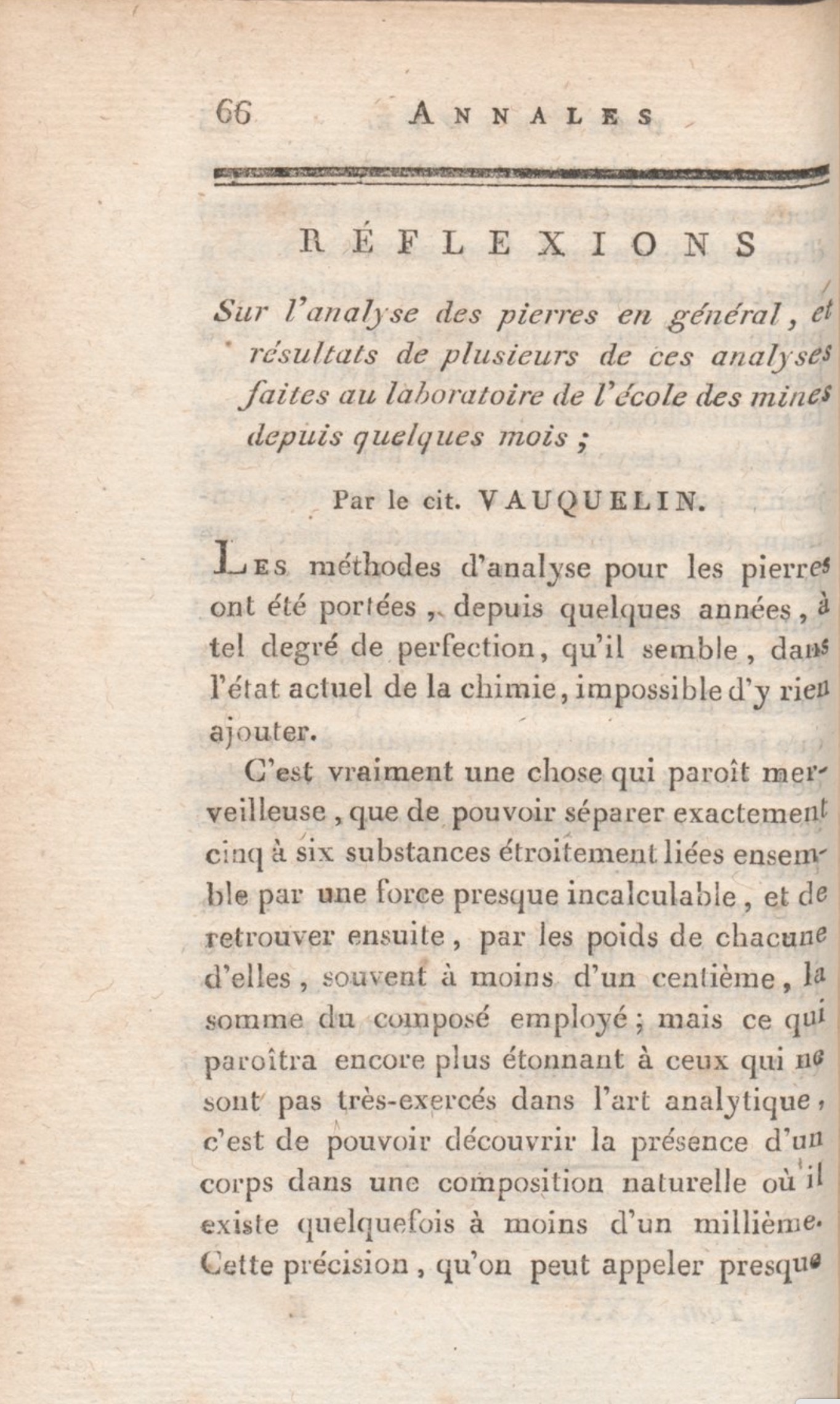
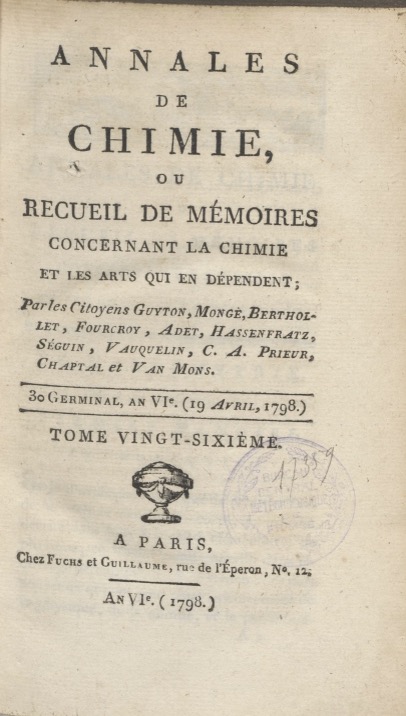
Réflexions sur l'analyse des pierres, et résultats de plusieurs de ces analyses
Reflections on the analysis of stones, and results of several of these analyses
Journal Article
Vauquelin, N.-L. (1799) Réflexions sur l'analyse des pierres, et résultats de plusieurs de ces analyses. [Reflections on the analysis of stones, and results of several of these analyses] Annales de chimie, Vol. 30, pp. 66–106.
Record No. 28378  |  Sinkankas/Born No.: NIS/NIB  |  Language: in French  |  RWHL*
An important methodological paper by Nicolas-Louis Vauquelin on the chemical analysis of stones and minerals, combining discussion of analytical procedures with results obtained from several mineral substances. Vauquelin considers the difficulties involved in decomposing minerals, separating their constituent earths and interpreting analytical results, illustrating the increasing reliance on chemistry for mineral identification at the end of the eighteenth century. The paper is significant to gemology because it reflects the emerging practice of distinguishing gemstones and related minerals by composition rather than by color, appearance or traditional names alone, and forms part of Vauquelin’s broader work on beryl, emerald, tourmaline, chrysolite and other gem materials.

Analyse de l’aigue marine, ou béril; et découverte d’une terre nouvelle dans cette pierre
Analysis of aquamarine, or beryl; and discovery of a new earth in this stone
Journal Article
Vauquelin, N.-L. (1798) Analyse de l’aigue marine, ou béril; et découverte d’une terre nouvelle dans cette pierre. [Analysis of aquamarine, or beryl; and discovery of a new earth in this stone] Annales de Chimie et de Physique, Vol. 26, No. 2, pp. 155–170.
Record No. 26364  |  Sinkankas/Born No.: 6830  |  Language: in French  |  RWHL*
An important chemical investigation of aquamarine (beryl) by Nicolas-Louis Vauquelin, in which he announced the discovery of a previously unknown earth in the mineral. Through chemical analysis, Vauquelin distinguished this substance from alumina and identified what became known as glucina (beryllia), beryllium oxide, thereby establishing beryl as chemically distinct from minerals with which it had previously been associated. The discovery ultimately led to recognition of the element beryllium. The paper is particularly important to gemology because it demonstrated that emerald and aquamarine are varieties of the same mineral species, beryl, despite their markedly different colors, and illustrates the growing importance of chemical composition in the scientific classification of gemstones.

Émeraude at béril

Emerald and beryl
Journal Article
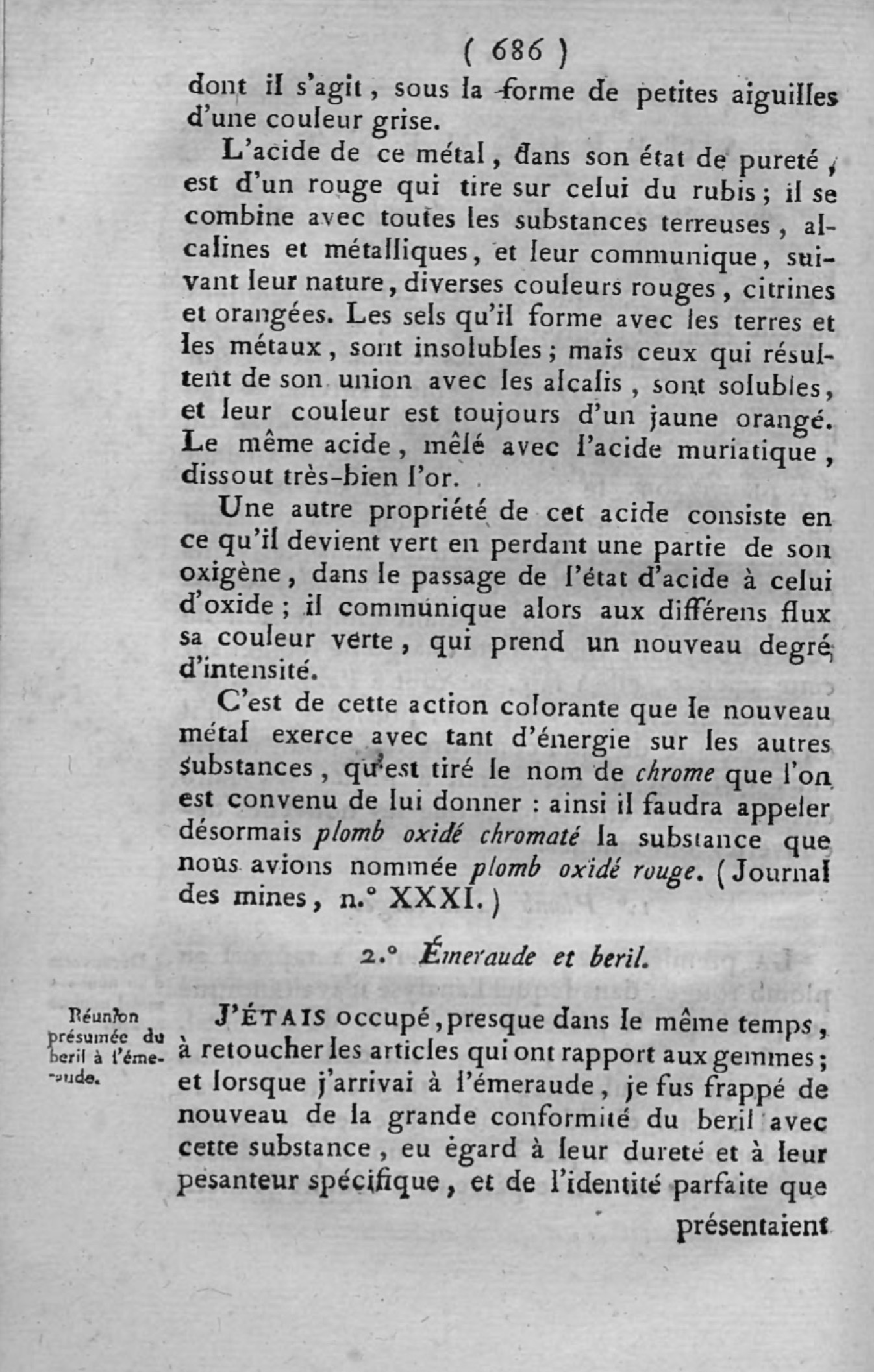
Haüy, R.J. (1797) Émeraude at béril. [Emerald and beryl] Journal des Mines, Vol. 6, No. 33, pp. 686–688.
Record No. 28353  |  Sinkankas/Born No.: NIS/NIB  |  Language: in French  |  RWHL*
Emerald and beryl. I was occupied, at nearly the same time, in revising the articles relating to gemstones; and when I came to the emerald, I was struck anew by the great conformity of beryl with this substance, with regard to their hardness and specific gravity, and by the perfect identity presented by the figure and dimensions of their constituent molecules, and even by their secondary forms.¹ In truth, they had appeared to differ from one another only by refraction, which is double in the emerald, and which I had found to be simple in beryl. A very limpid prism of the latter substance had never given me more than a single image of objects, even when I viewed light placed at a distance of more than fifty toises. But recent investigations on double refraction in general led me to suspect that in every crystal possessing double refraction there exists one direction in which the image is sensibly simple, as Giovanni Battista Beccaria had already remarked concerning rock crystal. I first attempted to verify this suspicion by means of carbonate of lime, determining beforehand the manner in which one of the rhomboids known under the name Iceland spar should be cut so that, in a certain position of the eye, the two images would coincide into one. In this investigation I was guided by the knowledge acquired concerning the laws governing the double refraction of carbonate of lime, as I had explained elsewhere;² and experiment confirmed the result predicted by theory. Since analogous effects, obtained with other doubly refracting minerals, raised no doubts in my mind concerning those presented by the prism of beryl, I had a second prism cut in a different direction, and I observed that it doubled images, though only to a moderate degree; yet even in this it still approached the emerald. Thus, all the physical and geometrical characters concur in calling for the union of these two substances,³ and all that is now lacking is an analysis of beryl which, by its exactness, would deserve comparison with that which Martin Heinrich Klaproth gave for emerald, so that we may know what conclusion should be drawn from a rapprochement which mineralogy must not permit itself to make until it has obtained the consent of chemistry. The result that I have just announced will require precautions on the part of those who wish to determine whether the refraction of a mineral is simple or double. But since it seems to me that we now possess a rule for determining the direction in which only a single image is seen, it will be easy to avoid error. Theory will thereby have gained, and observation will be made more certain. ⸻ ¹ At that time beryl was known only in the form of the regular hexagonal prism, when observations made on several crystals of this gem which I had found in commerce, or had myself detached from a fragment of rock brought from Siberia, offered me a very marked rapprochement between the modifying facets on the summits of these crystals and those existing on varieties of emerald. See Journal des mines, no. XIX, p. 72. ² Mémoires de l’Académie des sciences, 1788, p. 34 ff.; Journal des Mines, Prairial, Year V. ³ Besides, the molecules here possess characters of regularity which might place them among the forms common to different substances. See Journal des mines, no. XIX, p. 72.

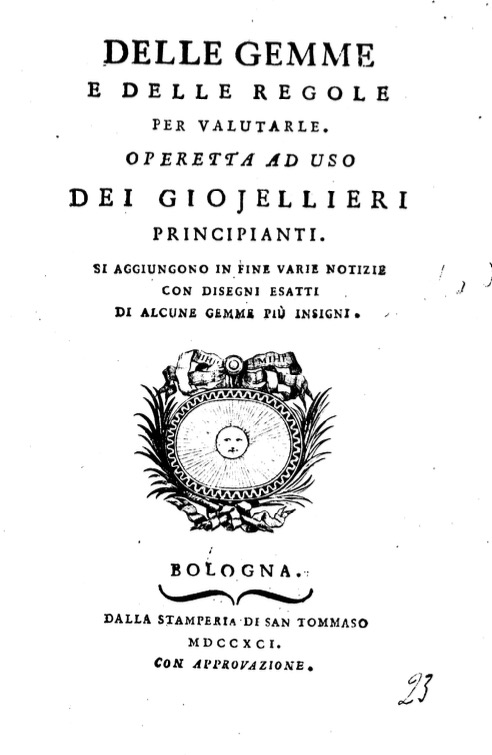
Delle Gemme e Delle Regole per Valutarle

Gems and Rules to Evaluate Them
Book
Naldi, P. (1791) Delle Gemme e Delle Regole per Valutarle. [Gems and Rules to Evaluate Them] Bologna, San Tommaso, 361 pp.
Record No. 8064  |  Sinkankas/Born No.: 4689  |  Language: in Italian  |  RWHL*
Sinkankas: This interesting and worthy text is divided into two distinct and actually unrelated parts, the first being a course of instruction for apprentice jewelers and the second descriptions of large and famous gems. Each part is paged separately, the first written as a dialogue between a certain Litofilo, who asks the questions, and the expert, Didattucolo, who answers them. During the dialogue much is elucidated on the reasons why gems are held in high esteem, with examples of diamond prices (taken from Tavernier, De Boodt, Mosquera, Dutens, etc.), together with comments on the principal gem-producing regions, weight systems for gems, commerce in rough and cut gemstones, forms of rough, cutting, hardness, and the absence of flaws as vital to final value. Following sections describe the gemstones, beginning with a large treatise on diamond, then passing on to ruby, spinel, opal, sapphire, topaz, zircon, emerald, and others, including the crystalline and chalcedonic varieties of quartz, jades, petrified wood, various ornamental materials, stones useful for engraved gems, lapis lazuli, aventurine, coral, and pearl, the latter treated in considerable detail and subdivided according to types and shapes. All of it is non-technical, though references are made in places to the formal mineralogies of Wallerius, Romé de l’Isle, and others. The second part of the book describes 26 large or famous gems, each illustrated by an engraving in which shading is imparted as well as the usual sharp lines of the burin. Most of the illustrations are copied from Tavernier and include the Grand Mogol and Grand Duke of Tuscany diamonds, among others, together with several examples of large pearls. All gems are identified in the text, their weights given, and shown at natural size in the engravings. A rare work.

Exploring the Literature of Emerald

Emerald literature spans gemology, mineralogy, deposits, identification, treatments, synthesis, history and the gem trade, with important sources covering deposits around the world.

For a curated guide to this subject, read Green Fire — Lotus Gemology's Guide to the Literature of Emerald.

About Four Treasures

Four Treasures is Lotus Gemology's freely accessible gemological reference database. Use the full database to search by author, title or keyword and explore literature on gemology, mineralogy, jewelry and related fields. Where available, hyperlinks on titles may lead directly to the full publication.

Search the Complete Four Treasures Database