Explore books on gems, gemology, jewelry and mineralogy in Four Treasures, the Lotus Gemology reference database. This bibliography brings together matching book records from the collection, with publication details, abstracts and cover images where available.
Gemology Book References
The list below matches books concerning gemology and related subjects in the database's searchable fields. Some works cover several branches of gems, jewelry or mineralogy.
2,441–2,460 of 3,464 matching references
Unstable colour in a yellow sapphire from Sri Lanka
Journal Article
Schiffmann, C.A. (1981) Unstable colour in a yellow sapphire from Sri Lanka.Journal of Gemmology, Vol. 17, No. 8, October, pp. 615–618.
Record No. 1545 | ISBN/ISSN: 221252 | RWHL
Reference copied to clipboard!
corundum, Sri Lanka.12, treatments.6, gems
Sapphires
Journal Article
O’Donoghue, M. (1981) Sapphires.Gemmological Newsletter, Vol. 10, No. 13, p. 1; No. 14, p. 1.
Record No. 1373 | RWHL
Reference copied to clipboard!
corundum, treatments.6, gems
Geuda sapphires: Their colouring elements and their reaction to heat
Journal Article
Gunaratne, H.S. (1981) Geuda sapphires: Their colouring elements and their reaction to heat.Journal of Gemmology, Vol. 17, No. 5, Jan., pp. 292–300.
Record No. 863 | ISBN/ISSN: 221252 | RWHL
Reference copied to clipboard!
corundum, sapphire, Sri Lanka.12, treatments.6, gems
Röllig, W., Herrmann, G. and Moorey, P.R.S. (1980–1983) Lapislazuli. [Lapis lazuli] In: Reallexikon der Assyriologie und Vorderasiatischen Archäologie [Encyclopedia of Assyriology and Near Eastern Archaeology], Berlin: Walter de Gruyter, Vol. 6, pp. 488–492.
Record No. 26839 | Sinkankas/Born No.: NIS/NIB | Language: in German | RWHL
Reference copied to clipboard!
gems, lapis lazuli, Afghanistan, history of gemology, gem trade, Central Asia
The entry surveys lapis lazuli in the ancient Near East, beginning with the Sumerian ZA.GÌN and Akkadian uqnû, and considers its identification, terminology, sources, trade, archaeological occurrence, and uses. Lapis lazuli was an imported and highly valued material in Mesopotamia, occurring from very early periods and employed for beads, seals, inlays, amulets, vessels, and other prestigious objects; it also acquired important religious, magical, and literary associations. The discussion considers the problem of determining the geographical sources of ancient Near Eastern lapis lazuli, with Badakhshan in Afghanistan regarded as the principal probable source, and places the stone within the extensive long-distance exchange networks connecting Mesopotamia with Iran and regions farther east.
Der diamant und seine imitationen
The diamond and its imitations
Journal Article
Gübelin, E.J. (1980) Der diamant und seine imitationen. [The diamond and its imitations]Schweizerische Uhrmacher- und Goldschmiede-Zeitung (SUZ), December, unpaginated offprint.
Record No. 16948 | Sinkankas/Born No.: NIS/NIB | Language: in German | RWHL
Reference copied to clipboard!
gems, diamond, imitation diamond, gemology
Gübelin surveys diamond and the principal materials used to imitate it, emphasizing the gemological properties by which natural diamond can be distinguished from simulants. He discusses diagnostic characteristics such as refractive index, dispersion, hardness, specific gravity, luster, thermal behavior, and optical appearance, showing how combinations of relatively simple gemological tests permit reliable separation. The article reflects the increasing variety and quality of diamond imitations available around 1980 and stresses systematic identification rather than reliance on visual appearance alone.
Observations made on some scapolites from central Tanzania
Journal Article
Gübelin, E.J. and Graziani, G. (1980) Observations faites sur quelques scapolites de Tanzanie centrale. [Observations made on some scapolites from central Tanzania]Revue de Gemmologie A.F.G., No. 65, December,
Record No. 7711 | Sinkankas/Born No.: NIS/NIB | Language: in French | RWHL
Reference copied to clipboard!
scapolite, Tanzania, gems
Gübelin and Graziani investigate gem-quality scapolites from central Tanzania, examining their gemological, optical, and mineralogical properties and the variations among specimens. The study is particularly concerned with characterizing the Tanzanian material and relating its properties to scapolite composition; it subsequently appeared in an expanded English version as “Observations on some scapolites of central Tanzania,” Journal of Gemmology, Vol. 17, No. 6 (1981), pp. 395–405, with further investigations published in 1983.
Chrome-diopside jade from Chisaka, Hidaka Province, Hokkaido
Journal Article
Bamba, T. (1980) Chrome-diopside jade from Chisaka, Hidaka Province, Hokkaido.Journal of The Gemmological Society of Japan [宝石学会誌], Vol. 7, No. 1, pp. 9–13.
Record No. 3912 | DOI: 10.14915/gsjapan.7.1_9 | Sinkankas/Born No.: NIS/NIB | Language: in Japanese with English abstract | RWHL
Reference copied to clipboard!
jade, jadeite, fei cui, Japan, gems
Peculiar stone characterized by interlaced structure, tenacious feeling and beautiful grass green color, similar to nephrite jade was found in 1966 in Chisaka area, Hidaka Province, central Hokkaido. This stone has been called Hidaka Jade" after the locality name. The stone consists mainly of chrome-diopside, associated with small amount of uvarovite, chromite and pectolite. The stone is formed as network veins cutting through the boundary between serpentinite and rodingite, both of which intruded into the Jurassic formations in the Kamuikotan structural belt, central axial zone of Hokkaido. In some parts of rodingite, fine veins consisting of grossularite and kammererite are found. It is observed sometimes that kammererite is replaced by chrome-diopside retaining the original fibrous structure. For these observations the author led the following conclusions on the genesis of this chrome-diopside jade. In the shear zone along the boundary between the serpentinite and rodingite, ascending hydrothermal solution that passed through the serpentinite including chromite ores dissolved chromium on a way and repeatedly formed some chromian minerals. Chrome-diopside after kammererite retained the original fabric 0L interlaced structure, then became a jade-like precious stone. Therefore, the author proposes to call this precious stone "Chrome-diopside jade" or "Hidaka jade" as a new variety of jade It is noteworthy that the chrome-diopside in question is bigger in cell volume compared with chrome-diopside from Horoman peridotite which is considered to be an Upper Mantle material. Above-stated features and facts may support author's view that "Hidaka jade" might have been formed in situ."
Gem minerals from Taiwan
Journal Article
Huang, C.K. (1980) Gem minerals from Taiwan.Journal of The Gemmological Society of Japan [宝石学会誌], Vol. 7, No. 2, pp. 35–44.
Record No. 3911 | Sinkankas/Born No.: NIS/NIB | Language: in Japanese with English abstract | RWHL
Mineralogy of semi-precious gems, such as nephrite, tremolite cat's-eye, blue chalcedony and veined stones, from Taiwan are reviewed, supplemented with some data (Fig.1). Nephrite and cat's-eye tremolite occur at the contacts of graphite-sericite schist and serpentinite sills in association with asbestus, talc and diopside-dominant skarn near Hualien (Fig.2). Cat's-eye tremolite was formed evidently later than nephrite. Nephrite jade is spinach-green to yellowish green in color; translucent to opaque. H. : 6.5; G. : 3.007-3.014. It is composed of sub-parallel tufts of fibrous tremolite in interfelted base with nephritic texture, accompanied by minor chromite, magnetite, picotite, garnet and chlorite which give rise to black spots or streaks (Fig.3). α : 1.609-1.612, β : 1.620-1.621, γ : 1.631-1.633; γ-α : 0.021-0.022. Noteworthy is that the Taiwan jade is similar in mineralogy to the New Zealand jade. Tremolite cat's-eye varies in color, from greenish yellow to black; translucent to opaque. H : 6-7, G. : 3.000-3.045. It consists solely of fine, Ionger sub-parallel fibers of tremolite without nephritic texture. α : 1.612-1.613. β : 1.620-1.626, γ : 1.637=1.639; γ-α : 0.024-0.027. Both nephrite and cat's-eye are similar in X-ray data to tremolite from St. Gotthard, Switzerland (Table 1). Chemical analyses also revealed that no marked differences in cornposition exislt between nephrite jade and cat's-eye and between cat's-eyes of various colors, all showing about 10 % of the ferro-actinolite molecule (Tables 2 & 3). Minor uvarovite with 10% Cr_2O_3 and vesuvianite were first found in Taiwan (Tables 5 & 6). Blue chalcedony occurs as irregular small veins in andesitic agglomerate north of Taitung. It is deep sky-blue to greenish blue in color; opaque to translucent. H. : 7; G. : 2.581; n : 1.539. Traversed by veinlets of chalcedony-quartz and quartz-pyrite, it consists mainly of radial-fibrous aggregates of chalcedony, with minor chlorite, opal and iron hydroxides (Fig. 5). Veined stones are produced on the Penghu Islands as globular concentric aggregates chiefly of calcite, aragonite and siderite in the amygdaloidal cavities of olivine-augite basalt (Figs.5 & 6). H : 3-4; G. : 2.83-3.30. Some gemological features of these gem materials are also given (Fig.4).
Seberged: Die Peridot-Insel im Roten Meer
Seberged: The peridot island in the Red Sea
Journal Article
Gübelin, E.J. (1980) Seberged: Die Peridot-Insel im Roten Meer. [Seberged: The peridot island in the Red Sea]Lapis, Vol. 5, No. 11, November, pp. 19–26.
Record No. 2152 | Sinkankas/Born No.: NIS | Language: in German | RWHL
Reference copied to clipboard!
peridot, Zebergad, St. John’s Island, Egypt, gems
Gübelin describes Zabargad (Seberged, St. John’s Island) in the Red Sea, the celebrated ancient source of gem-quality peridot. He discusses the island’s geography and history, including the exploitation of its olivine deposits since antiquity and the long-standing confusion between peridot and emerald in early accounts, together with the geology and mineralogy of the deposit, the occurrence and recovery of peridot crystals, and the gemological characteristics of the material. The article provides both a historical and mineralogical account of one of the world’s classic gemstone localities and the source of many important historic peridots.
Gemological Notes: Brief notes on Chatham flux sapphires
Journal Article
Koivula, J.I. (1980) Gemological Notes: Brief notes on Chatham flux sapphires.Gems & Gemology, Vol. 16, No. 12, Winter, pp. 410–411.
Record No. 1110 | ISBN/ISSN: 0016626X | RWHL
Reference copied to clipboard!
synthetic corundum.7, flux, inclusions.5, gems
Physical and chemical analyses of soft stone vessels from Southwest Asia
Journal Article
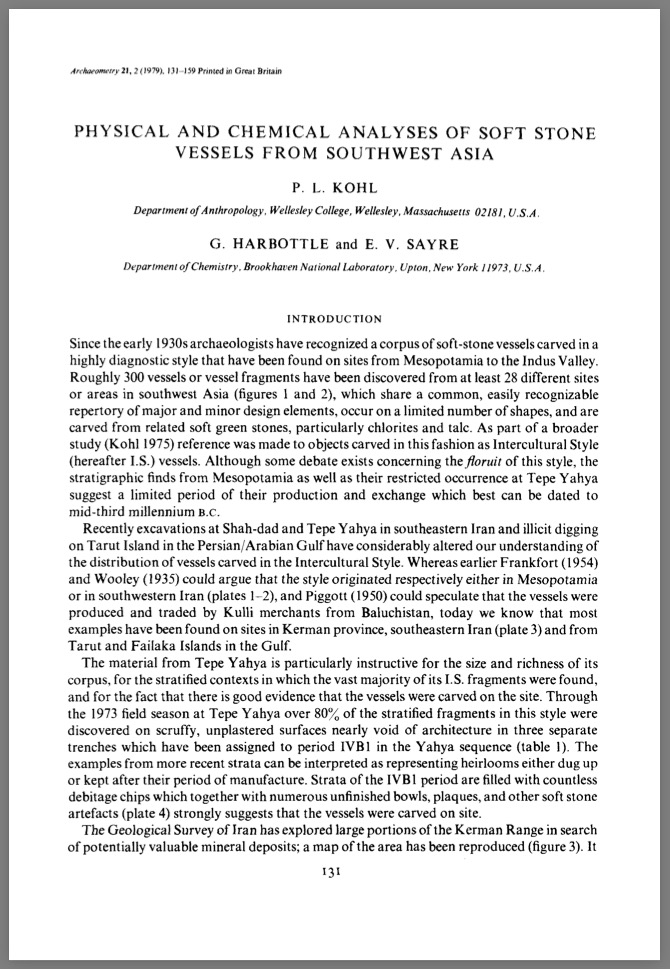
Kohl, P.L., Harbottle, G. and Sayre, E.V. (1979) Physical and chemical analyses of soft stone vessels from Southwest Asia.Archaeometry, Vol. 21, No. 2, pp. 131–159.
gems, archaeology, archaeogemology, India, Indus River Civilization, Harappa, Pakistan, Iran
Since the early 1930s, archaeologists have identified a corpus of soft-stone vessels carved in a highly diagnostic style, found at sites ranging from Mesopotamia to the Indus Valley. Approximately 300 vessels or fragments have been recovered from at least 28 locations across Southwest Asia (figures 1 and 2), all sharing a common and easily recognizable repertoire of design elements, limited shape types, and a consistent use of related soft green stones, particularly chlorite and talc. In a broader study (Kohl 1975), these objects were termed Intercultural Style (IS) vessels. Although the origins of the style remain debated, stratigraphic evidence from Mesopotamia and the concentrated presence at Tepe Yahya suggest a relatively brief period of production and circulation, best dated to the mid-third millennium B.C. More recent excavations at Shahdad and Tepe Yahya in southeastern Iran, along with illicit digs on Tarut Island in the Persian/Arabian Gulf, have significantly reshaped our understanding of their distribution. While earlier scholars such as Frankfort (1954), Woolley (1935), and Piggott (1950) proposed origins in Mesopotamia, southwestern Iran, or Baluchistan, current evidence shows that the majority of finds come from Kerman province in southeastern Iran (plate 3), as well as from Tarut and Failaka Islands in the Gulf.
Developments and highlights at GIA’s Lab in New York: Treated blue sapphires
Journal Article
Crowningshield, G.R. (1979) Developments and highlights at GIA’s Lab in New York: Treated blue sapphires.Gems & Gemology, Vol. 16, No. 5, Spring, p. 147.
Takubo, H. (1979) Characteristics of synthetic hydrothermal emeralds from USA and USSR. [米国およびソ連の水熱合成エメラルドの特徴]Journal of The Gemmological Society of Japan [宝石学会誌], Vol. 6, No. 4, pp. 3–18.
Record No. 2391 | Sinkankas/Born No.: NIS/NIB | Language: in Japanese with English abstract | RWHL
Reference copied to clipboard!
synthetic beryl, emerald, gems
As-grown and faceted crystals of synthetic hydrothermal emeralds from the USA and USSR were compared in terms of morphology, internal features, and physical properties. The USSR emeralds are notably closer to natural emeralds in physical and optical properties, although both types differ from natural stones primarily in their internal features. USA emeralds (SG: 2.67–2.68, RI: ω 1.572–1.574, ε 1.568–1.569) display bright red fluorescence under 365 nm UV, show Chelsea filter reactions (red), and often contain optical strain, “earthworm” cracks, phenacite, and 2- or 3-phase inclusions—often originating from natural beryl seed plates. USSR emeralds (SG: 2.70–2.71, RI: ω 1.583–1.586, ε 1.577–1.579) are slightly softer (H 7–7.5), show weaker UV fluorescence and pleochroism closer to natural emeralds, and lack spikes or strong zonation. Their inclusions include more naturalistic features like “wheat-head” textures, 2- and 3-phase inclusions, and reddish-brown plates. Growth habits differ slightly, with the USSR stones typically showing multiple growth planes ({112̅1} and {112̅0}) and shorter estimated growth times. Overall, USSR hydrothermal emeralds reach ~90% similarity to natural emeralds, versus ~80% for USA stones and 40–60% for flux-grown emeralds.
Recent activities in GIA’s research department; clarification of composition of Maw-sit-sit
Journal Article
Manson, D.V. (1979) Recent activities in GIA’s research department; clarification of composition of Maw-sit-sit.Gems & Gemology, Vol. 16, No. 7, Fall, pp. 217–218.
Gübelin, E.J. (1979) Tell-tale inclusions in a phenakite from Brazil.Journal of Gemmology, Vol. 16, No. 6, April, pp. 357–362.
Record No. 2139 | ISBN/ISSN: 221252 | RWHL
Reference copied to clipboard!
inclusions, gems
Australia adds rubies to its mineral riches
Journal Article
Scambary, R. (1979) Australia adds rubies to its mineral riches.Gems & Gemology, Vol. 16, No. 7, Fall, pp. 220–221.
Record No. 1534 | ISBN/ISSN: 0016626X | RWHL
Reference copied to clipboard!
corundum, Australia.12, gems
Report from Thailand, 1978
Journal Article
Findlay, K.W. (1979) Report from Thailand, 1978.Journal of Gemmology, Vol. 16, No. 8, October, pp. 516–520.
Record No. 767 | ISBN/ISSN: 221252 | RWHL
Reference copied to clipboard!
corundum, Thailand.12, gems
Building a Gemological Library
Gemological books range from general identification manuals and textbooks to specialized works on individual gems, mineralogy, jewelry, treatments, synthesis, history and gem-producing regions.
Four Treasures is Lotus Gemology's freely accessible gemological reference database. Use the full database to search by author, title or keyword and explore literature on gemology, mineralogy, jewelry and related fields. Where available, hyperlinks on titles may lead directly to the full publication.


![Gem News: Sapphires [Kashmir]](/media/publications/4271259401 COVER SP81 25650.jpg "Gem News: Sapphires [Kashmir]")
![Gem News: Sapphire [Queensland]](/media/publications/3415621385 COVER SU81 82252.jpg "Gem News: Sapphire [Queensland]")