Natural Ruby Inclusions
Explore ruby inclusions in Hyperion, the Lotus Gemology inclusion database. Hyperion contains photomicrographs of inclusions and internal features in natural ruby, documented with information on geographic origin, treatment, lighting conditions, field of view, photographer and published references.
A lovely thin film inclusion is seen in reflected light within this untreated ruby from the Thai/Cambodian border mines. The hexagonal healing pattern betrays the fact that this inclusion lies in the plane of the basal pinacoid.
Natural Ruby •
Thailand/Cambodia •
Enhancements:
None Detected (None) •
Lighting Conditions:
Fiber Optic: Oblique
Photographer:
John I. Koivula •
Image Number:
R-001-3864-1
Gübelin, E.J. and Koivula, J.I. (2005) Photoatlas of Inclusions in Gemstones, Volume 3. Basel, Switzerland, Opinio Publishers, 672 pp.; RWHL*.
Koivula, J.I. (1980) “Thin films”: elusive beauty in the world of inclusions. Gems & Gemology, Vol. 16, No. 9, pp. 326–330; RWHL*.
Hughes, R.W. (1997) Ruby & Sapphire. Boulder, CO, RWH Publishing, 512 pp.; RWHL*.
This platelet in a Mozambique ruby shows clear signs of heat treatment. Note the spotted, mottled appearance where the platelet has begun to break down.
Natural Ruby •
Mozambique •
Enhancements:
Heat + Fissure Healing (H-FH) •
Lighting Conditions:
Fiber Optic: Diffuse Oblique
Photographer:
E. Billie Hughes •
Image Number:
A-001-3425-1
Pardieu, V., Saeseaw, S. et al. (2015) "Low temperature" heat treatment of Mozambique ruby: Results report. Gemological Institute of America, 16 April, 34 pp.; RWHL*.
Pardieu, V., Sangsawong, S. et al. (2013) Rubies from the Montepuez area (Mozambique). Gemological Institute of America, October 5, 84 pp.; RWHL*.
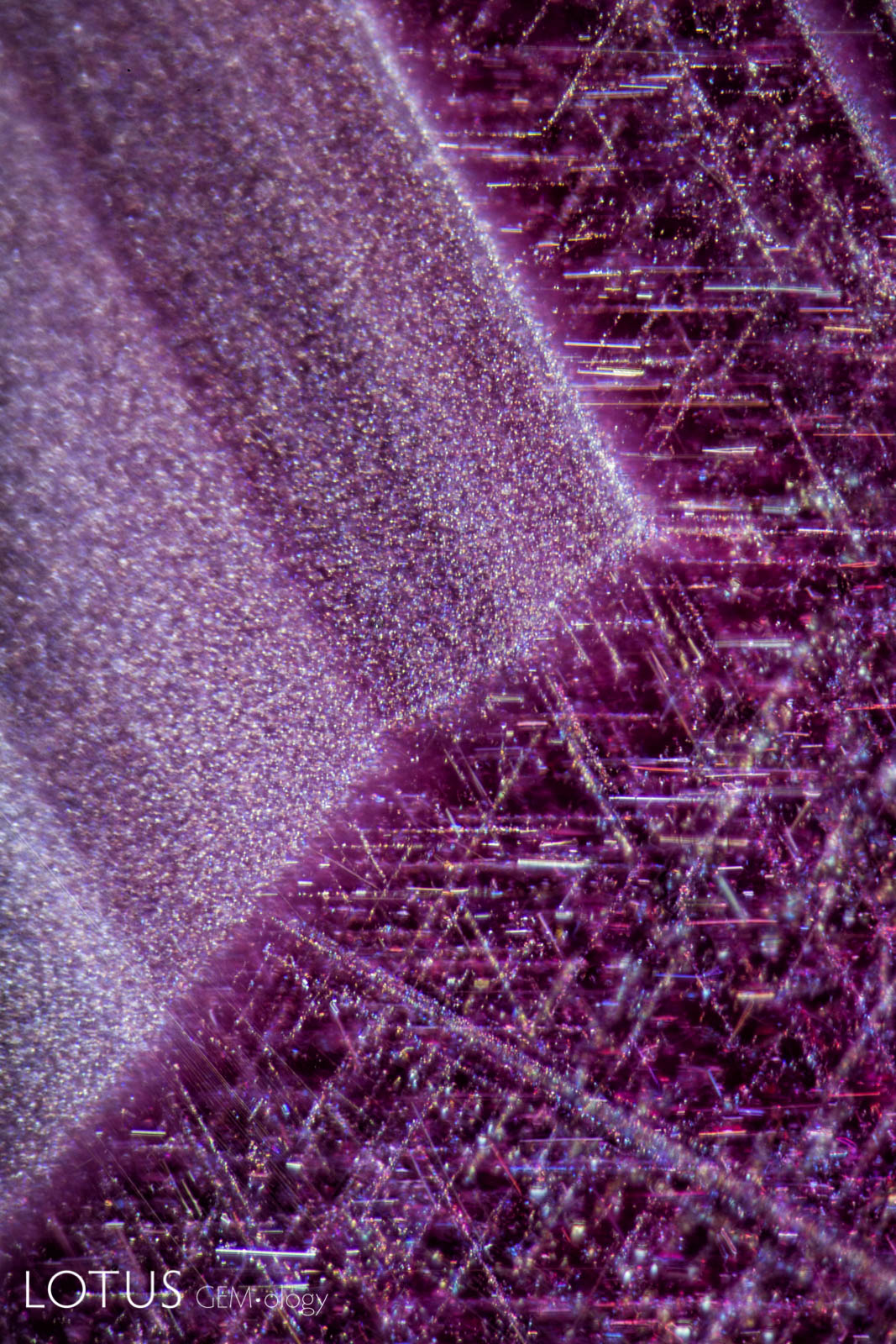
In Mozambique rubies, rutile silk typically occurs in different forms, and here we can see two. At left is a zoned cloud of fine particles, while on the right, well developed needles are seen.
Natural Ruby •
Mozambique •
Enhancements:
None Detected (None) •
Lighting Conditions:
Fiber Optic: Overhead
Photographer:
Richard W. Hughes •
Image Number:
A-001-3427-1
Tschermak, G. (1878) Optisches Verhalten von Korund-Krystallen [Optical behavior of corundum crystals]. Mineralogische und Petrographische Mittheilungen, Vol. 1, No. 4, pp. 362–364; RWHL*.
Pardieu, V., Sangsawong, S. et al. (2013) Rubies from the Montepuez area (Mozambique). Gemological Institute of America, October 5, 84 pp.; RWHL*.
Koivula, J.I. and Hughes, R.W. (2005) Following the Silk Road: Rutile in corundum. Bangkok, Lotusgemology.com, RWHL*.
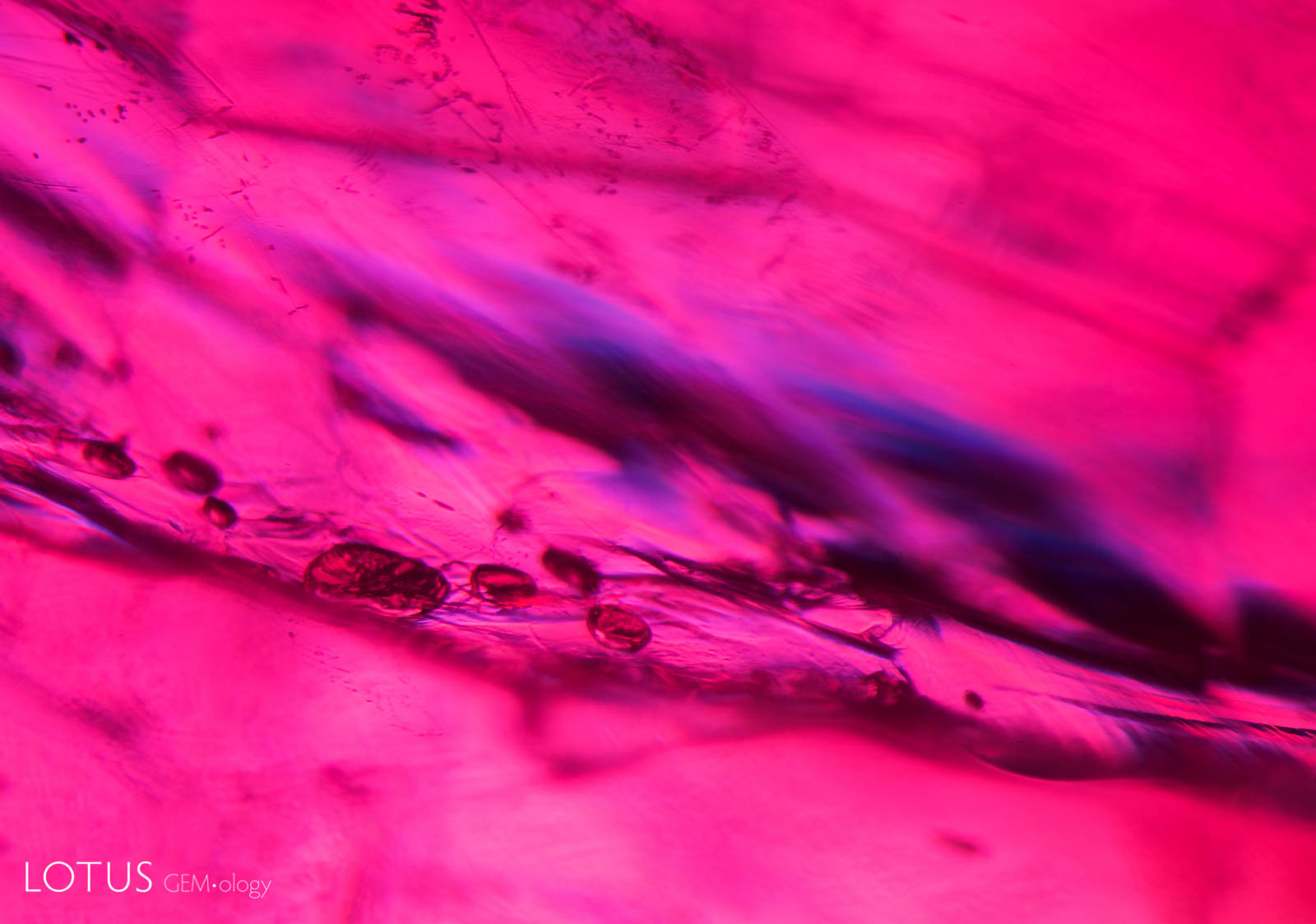
The elongated, melted droplets are part of a flux-healed fingerprint in a flux-heated ruby.
Natural Ruby •
Not Determinable •
Enhancements:
Heat + Fissure Healing (H-FH) •
Lighting Conditions:
Diffuse Light Field (Transmitted Light)
Photographer:
E. Billie Hughes •
Image Number:
A-001-3278-1
Hughes, R.W. and Emmett, J.L. (2004) Fluxed up: The fracture healing of ruby. The Guide, Vol. 23, Issue 5, Part 1, Sept.–Oct., pp. 1, 4–9; RWHL*.
Hughes, R.W. and Galibert, O. (1998) Foreign affairs: Fracture healing/filling of Möng Hsu ruby. Australian Gemmologist, Vol. 20, No. 2, April–June, pp. 70–74; RWHL*.
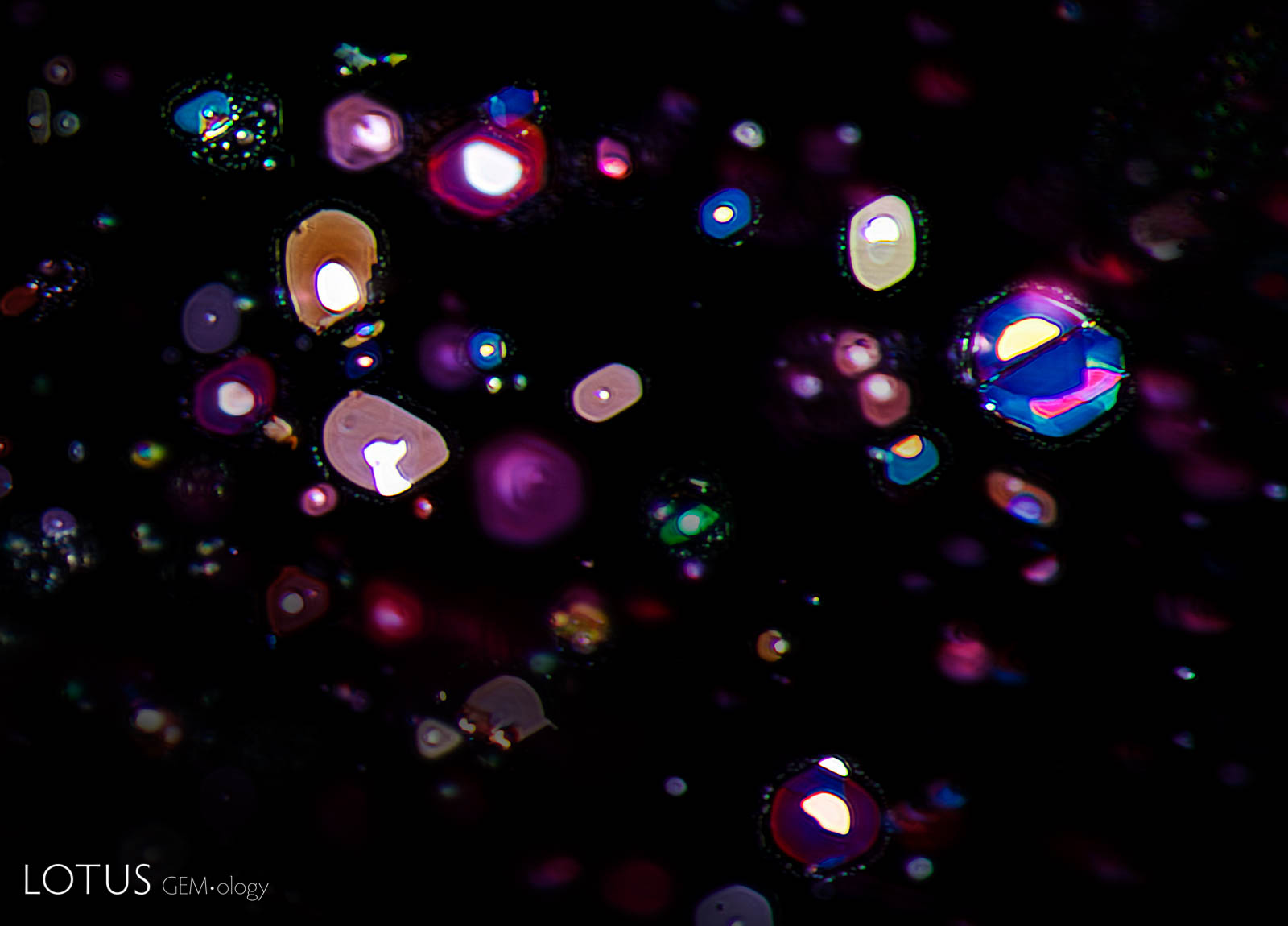
This mica crystal has a glassy tension fissure surrounding it, providing evidence that the stone was heated.
Natural Ruby •
Mozambique •
Enhancements:
Heat (H) •
Lighting Conditions:
Fiber Optic: Oblique
Photographer:
E. Billie Hughes •
Image Number:
A-001-3245-1
Pardieu, V., Saeseaw, S. et al. (2015) "Low temperature" heat treatment of Mozambique ruby: Results report. Gemological Institute of America, 16 April, 34 pp.; RWHL*.
Pardieu, V., Sangsawong, S. et al. (2013) Rubies from the Montepuez area (Mozambique). Gemological Institute of America, October 5, 84 pp.; RWHL*.
Thin film inclusions in the basal plane of a Thai/Cambodian ruby.
Natural Ruby •
Thailand/Cambodia •
Enhancements:
Heat (H) •
Lighting Conditions:
Fiber Optic: Diffuse Oblique
Photographer:
E. Billie Hughes •
Image Number:
A-001-3076-7
Gübelin, E.J. and Koivula, J.I. (2005) Photoatlas of Inclusions in Gemstones, Volume 3. Basel, Switzerland, Opinio Publishers, 672 pp.; RWHL*.
Hughes, R.W. (1997) Ruby & Sapphire. Boulder, CO, RWH Publishing, 512 pp.; RWHL*.
Thin film inclusions in the basal plane of a Thai/Cambodian ruby.
Natural Ruby •
Thailand/Cambodia •
Enhancements:
Heat (H) •
Lighting Conditions:
Fiber Optic: Diffuse Oblique
Photographer:
E. Billie Hughes •
Image Number:
A-001-3076-6
Gübelin, E.J. and Koivula, J.I. (2005) Photoatlas of Inclusions in Gemstones, Volume 3. Basel, Switzerland, Opinio Publishers, 672 pp.; RWHL*.
Hughes, R.W. (1997) Ruby & Sapphire. Boulder, CO, RWH Publishing, 512 pp.; RWHL*.
Thin film inclusions in the basal plane of a Thai/Cambodian ruby.
Natural Ruby •
Thailand/Cambodia •
Enhancements:
Heat (H) •
Lighting Conditions:
Fiber Optic: Diffuse Oblique
Photographer:
E. Billie Hughes •
Image Number:
A-001-3076-5
Gübelin, E.J. and Koivula, J.I. (2005) Photoatlas of Inclusions in Gemstones, Volume 3. Basel, Switzerland, Opinio Publishers, 672 pp.; RWHL*.
Hughes, R.W. (1997) Ruby & Sapphire. Boulder, CO, RWH Publishing, 512 pp.; RWHL*.
A melted crystal and surrounding fingerprint form a "Saturn inclusion" in this heated ruby from the Thai/Cambodian border. Thin films are also seen in the background and lie in the plane of the basal pinacoid.
Natural Ruby •
Thailand/Cambodia •
Enhancements:
Heat (H) •
Lighting Conditions:
Fiber Optic: Diffuse Oblique
Photographer:
E. Billie Hughes •
Image Number:
A-001-3076-4
Gübelin, E.J. and Koivula, J.I. (2005) Photoatlas of Inclusions in Gemstones, Volume 3. Basel, Switzerland, Opinio Publishers, 672 pp.; RWHL*.
Hughes, R.W. (1997) Ruby & Sapphire. Boulder, CO, RWH Publishing, 512 pp.; RWHL*.
458 Total Images
Results: 277 – 288 | Page 24 of 39 Pages
Natural ruby inclusions may include mineral crystals, rutile silk, healed fissures, fluid inclusions, negative crystals, color zoning and other features formed during or after crystal growth. Such features are important to gemologists because they can provide evidence useful in identifying ruby, understanding its geological history, recognizing treatment and, in some cases, determining geographic origin.
Natural Ruby Inclusion Photomicrographs
The Hyperion natural ruby gallery includes microscopic features found in rubies from major deposits around the world. Each entry is accompanied by descriptive information and, where available, references to the gemological literature.
What Inclusions Can Reveal About Natural Ruby
Inclusions are an important part of ruby identification. Their form, composition, orientation and alteration can help gemologists distinguish natural ruby from synthetic material, recognize evidence of heat treatment, and study the geological environment in which the ruby formed.
Hyperion combines inclusion photomicrography with supporting gemological information so that individual features can be compared with documented examples from known ruby deposits.
About Hyperion
Hyperion is the Lotus Gemology searchable inclusion database. It allows users to browse gemstone inclusions by gem type, geographic origin, treatment and keyword.
Search the Complete Hyperion Database