Natural Ruby Inclusions
Explore ruby inclusions in Hyperion, the Lotus Gemology inclusion database. Hyperion contains photomicrographs of inclusions and internal features in natural ruby, documented with information on geographic origin, treatment, lighting conditions, field of view, photographer and published references.
A melted crystal and surrounding fingerprint form a "Saturn inclusion" in this heated ruby from the Thai/Cambodian border. Thin films are also seen in the background and lie in the plane of the basal pinacoid.
Natural Ruby •
Thailand/Cambodia •
Enhancements:
Heat (H) •
Lighting Conditions:
Fiber Optic: Diffuse Oblique
Photographer:
E. Billie Hughes •
Image Number:
A-001-3076-2
Gübelin, E.J. and Koivula, J.I. (2005) Photoatlas of Inclusions in Gemstones, Volume 3. Basel, Switzerland, Opinio Publishers, 672 pp.; RWHL*.
Hughes, R.W. (1997) Ruby & Sapphire. Boulder, CO, RWH Publishing, 512 pp.; RWHL*.
A melted crystal with a frosted surface surrounded by a fingerprint with melted channels. Often known as a "saturn inclusions,” these melted crystals are common in heated Thai ruby.
Natural Ruby •
Thailand/Cambodia •
Enhancements:
Heat (H) •
Lighting Conditions:
Dark Field + Oblique Fiber Optic
Photographer:
E. Billie Hughes •
Image Number:
A-001-3076-1
Gübelin, E.J. and Koivula, J.I. (2005) Photoatlas of Inclusions in Gemstones, Volume 3. Basel, Switzerland, Opinio Publishers, 672 pp.; RWHL*.
Hughes, R.W. (1997) Ruby & Sapphire. Boulder, CO, RWH Publishing, 512 pp.; RWHL*.
Negative crystals filled with a transparent birefringent material (probably calcite) stand out in high relied when viewed between crossed polars in this Tajik ruby.
Natural Ruby •
Tajikistan •
Enhancements:
None Detected (None) •
Lighting Conditions:
Diffuse Light Field + Crossed Polars
Photographer:
Richard W. Hughes •
Image Number:
R-001-3277-1
Sorokina, E.S., Litvinenko, A.K. et al. (2015) Rubies and Sapphires from Snezhnoe, Tajikistan. Gems & Gemology, Vol. 51, No. 2, pp. 160–175; RWHL.
Hughes, R.W., Pardieu, V. et al. (2006) Moon over the Pamirs: Chasing ruby and spinel in Tajikistan. LotusGemology.com, RWHL*.
Polysynthetic twinning and fingerprints are both common features in rubies from Tajikistan.
Natural Ruby •
Tajikistan •
Enhancements:
Heat (H) •
Lighting Conditions:
Diffuse Light Field + Crossed Polars
Photographer:
Richard W. Hughes •
Image Number:
R-001-3276-3
Sorokina, E.S., Litvinenko, A.K. et al. (2015) Rubies and Sapphires from Snezhnoe, Tajikistan. Gems & Gemology, Vol. 51, No. 2, pp. 160–175; RWHL.
Hughes, R.W., Pardieu, V. et al. (2006) Moon over the Pamirs: Chasing ruby and spinel in Tajikistan. LotusGemology.com, RWHL*.
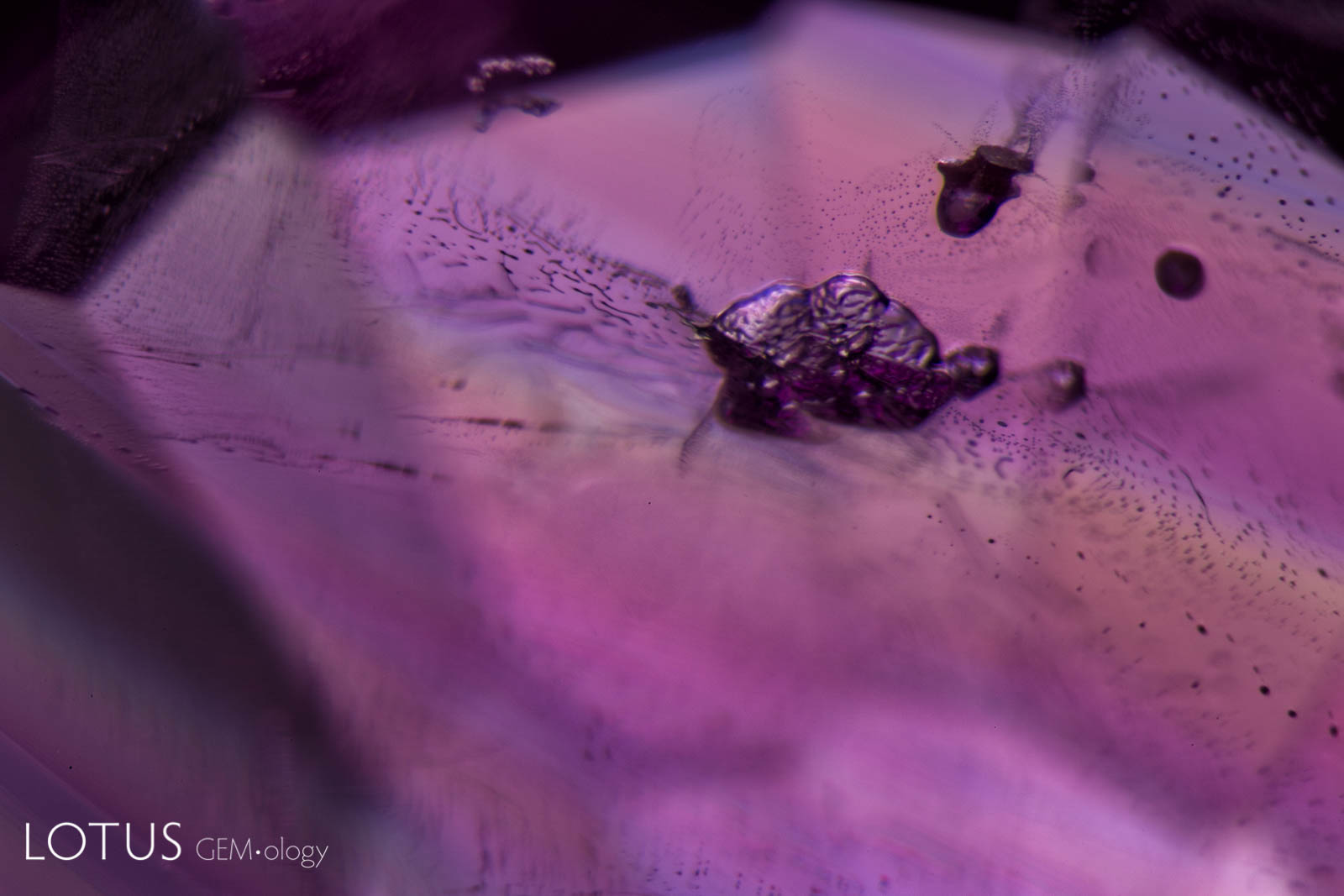
A heat-altered fingerprint lies just below the surface of this Tajikistan ruby.
Natural Ruby •
Tajikistan •
Enhancements:
Heat (H) •
Lighting Conditions:
Fiber Optic: Oblique
Photographer:
Richard W. Hughes •
Image Number:
R-001-3276-2
Sorokina, E.S., Litvinenko, A.K. et al. (2015) Rubies and Sapphires from Snezhnoe, Tajikistan. Gems & Gemology, Vol. 51, No. 2, pp. 160–175; RWHL.
Hughes, R.W., Pardieu, V. et al. (2006) Moon over the Pamirs: Chasing ruby and spinel in Tajikistan. LotusGemology.com, RWHL*.
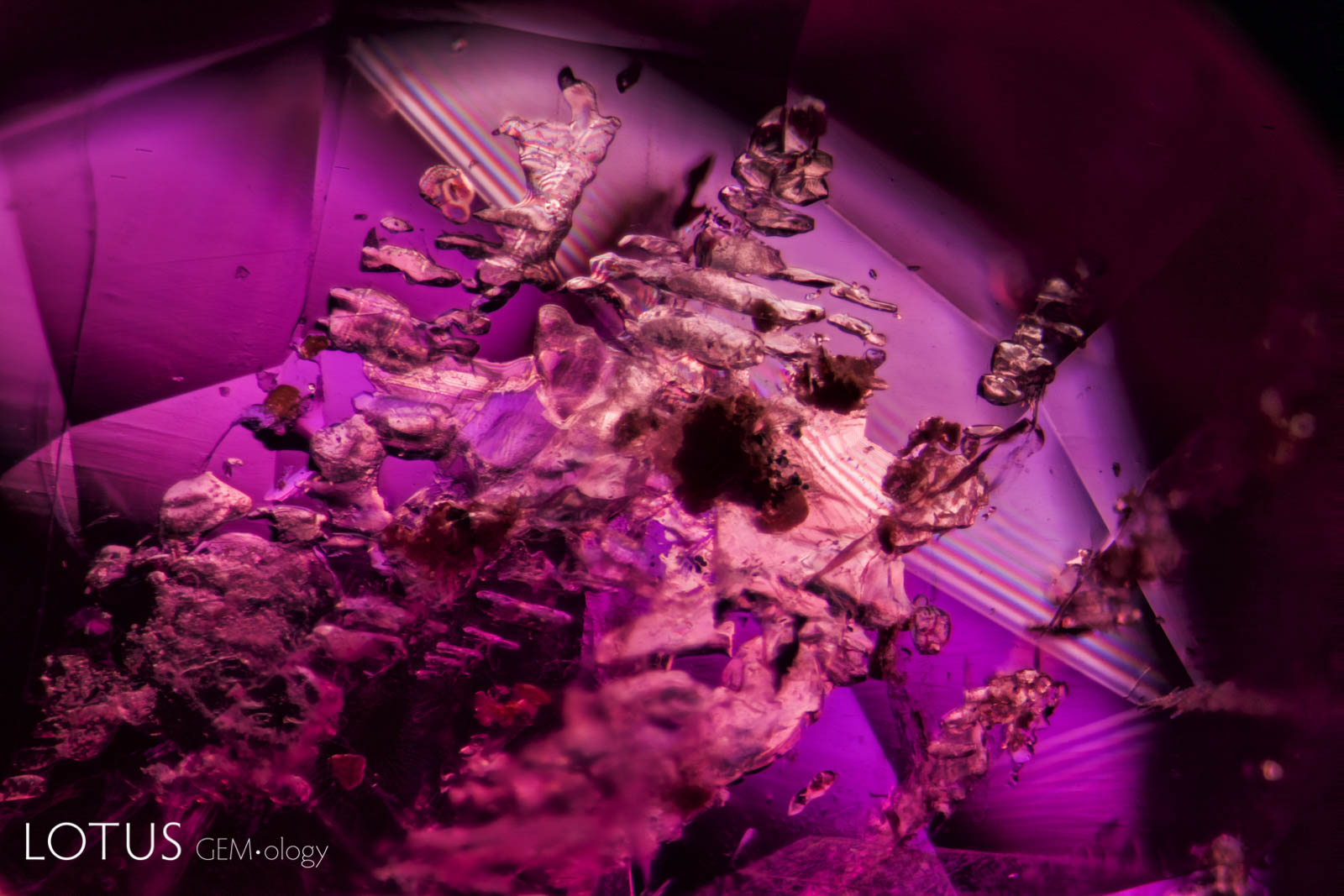
A melted crystal betrays the heat-treated origin of this ruby from Tajikistan.
Natural Ruby •
Tajikistan •
Enhancements:
Heat (H) •
Lighting Conditions:
Diffuse Light Field + Crossed Polars
Photographer:
Richard W. Hughes •
Image Number:
R-001-3276-1
Sorokina, E.S., Litvinenko, A.K. et al. (2015) Rubies and Sapphires from Snezhnoe, Tajikistan. Gems & Gemology, Vol. 51, No. 2, pp. 160–175; RWHL.
Hughes, R.W., Pardieu, V. et al. (2006) Moon over the Pamirs: Chasing ruby and spinel in Tajikistan. LotusGemology.com, RWHL*.
This undamaged negative crystal offers proof of untreated origin in this ruby from Tajikistan.
Natural Ruby •
Tajikistan •
Enhancements:
None Detected (None) •
Lighting Conditions:
Fiber Optic: Oblique
Photographer:
Richard W. Hughes •
Image Number:
R-001-3275-1
Hughes, R.W., Pardieu, V. et al. (2006) Moon over the Pamirs: Chasing ruby and spinel in Tajikistan. LotusGemology.com, RWHL*.
Sorokina, E.S., Litvinenko, A.K. et al. (2015) Rubies and Sapphires from Snezhnoe, Tajikistan. Gems & Gemology, Vol. 51, No. 2, pp. 160–175; RWHL.
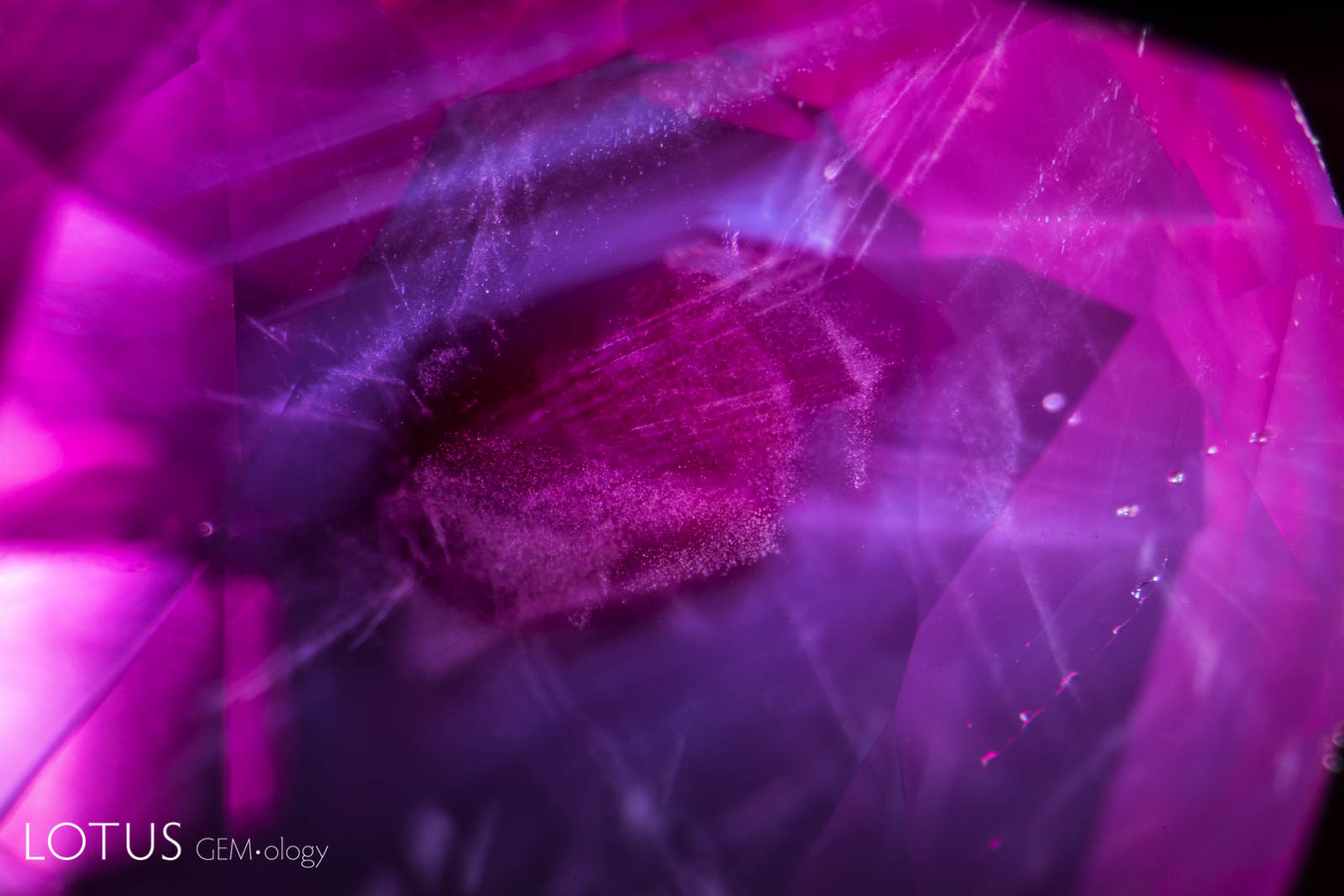
Angular growth zoning, along with fine texture clouds and exsolved particles.
Natural Ruby •
Tajikistan •
Enhancements:
None Detected (None) •
Lighting Conditions:
Fiber Optic: Oblique
Photographer:
Richard W. Hughes •
Image Number:
R-001-3274-1
Sorokina, E.S., Litvinenko, A.K. et al. (2015) Rubies and Sapphires from Snezhnoe, Tajikistan. Gems & Gemology, Vol. 51, No. 2, pp. 160–175; RWHL.
Hughes, R.W., Pardieu, V. et al. (2006) Moon over the Pamirs: Chasing ruby and spinel in Tajikistan. LotusGemology.com, RWHL*.
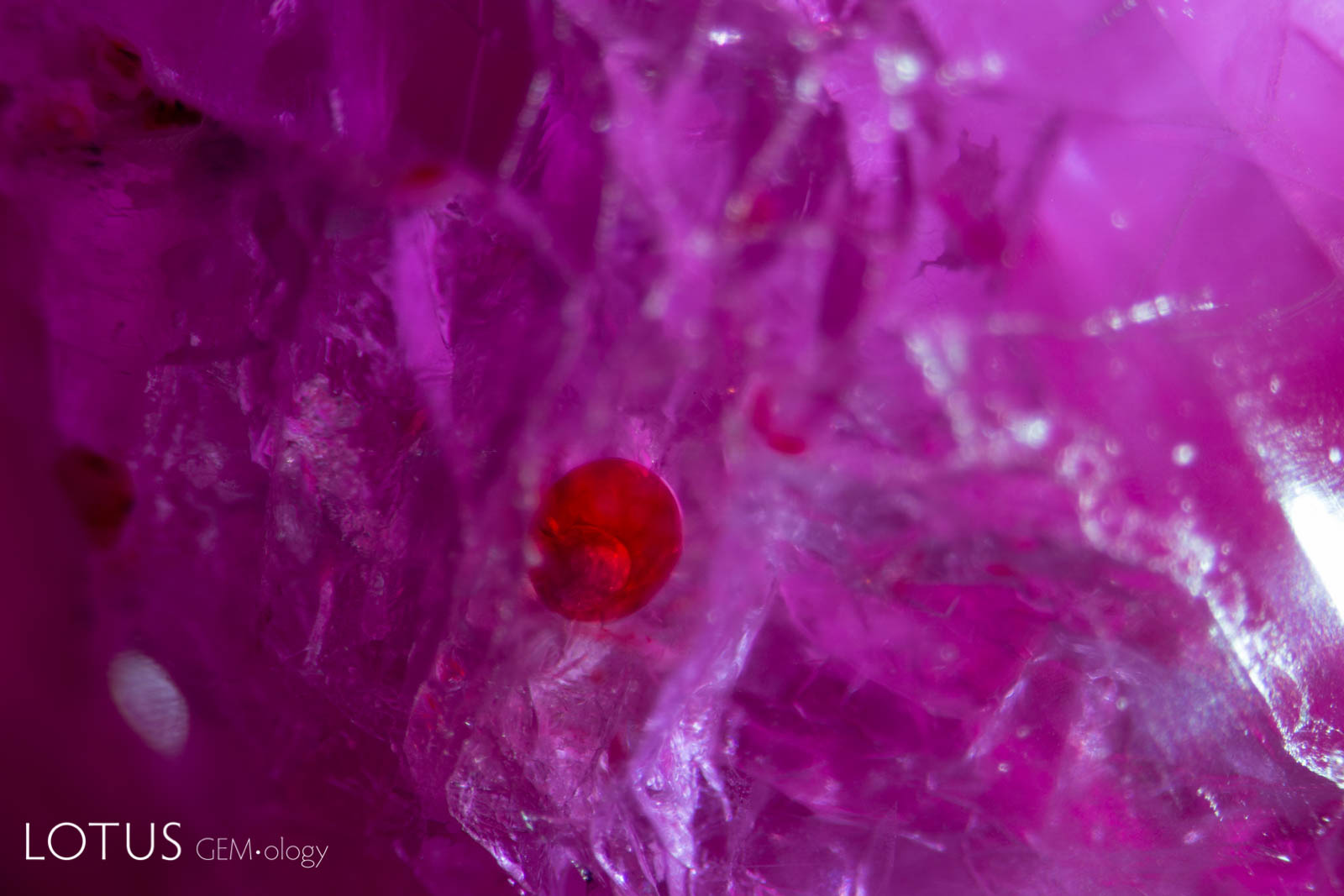
This high-temperature ruby bead necklace was impregnated with red wax. Here the wax has filled a small cavity in one of the ruby beads. One can clearly see a gas bubble in the red wax.
Natural Ruby •
Myanmar (Burma); Mogok/Namya •
Enhancements:
Heat + Fissure Healing (H-FH); Fissure Filling with Dyed Filler (FF-DF1) •
Lighting Conditions:
Fiber Optic: Oblique
Photographer:
Richard W. Hughes •
Image Number:
A-001-2997-2
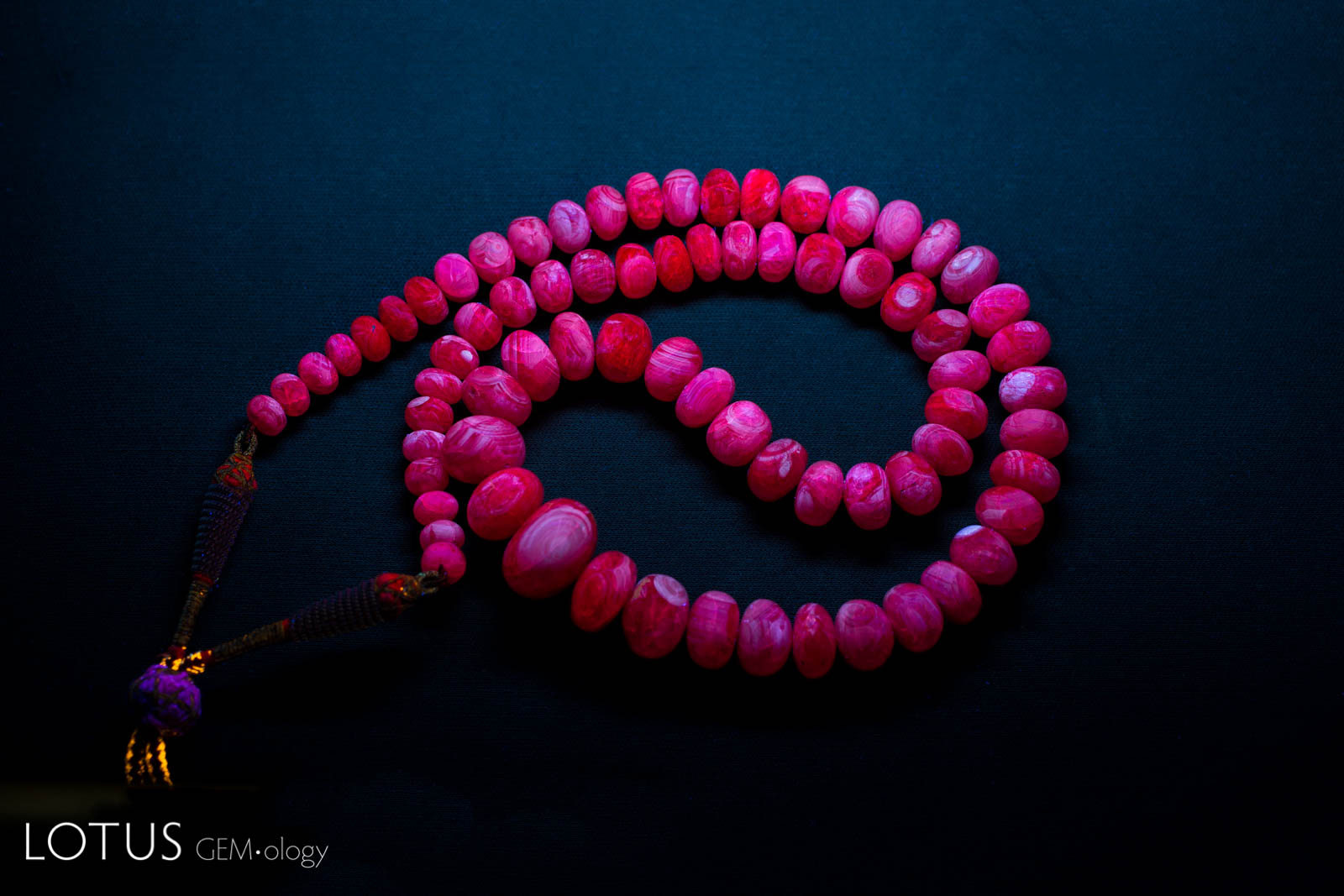
This necklace of ruby beads from Mogok, Burma was high-temperature heat treated. The treatment was easily unmasked by examination in short-wave ultraviolet light, where the beads displayed a characteristic zoned chalky red fluorescence.
Natural Ruby •
Myanmar (Burma); Mogok/Namya •
Enhancements:
Heat + Fissure Healing (H-FH); Fissure Filling with Dyed Filler (FF-DF1) •
Lighting Conditions:
Ultraviolet: Shortwave
Photographer:
Richard W. Hughes •
Image Number:
A-001-2997-1
Hughes, R.W. and Emmett, J.L. (2005) Heat Seeker: UV fluorescence as a gemological tool. The Guide, Vol. 24, No. 5, Part 1, Sept.–Oct., pp. 1, 4–7; RWHL*.
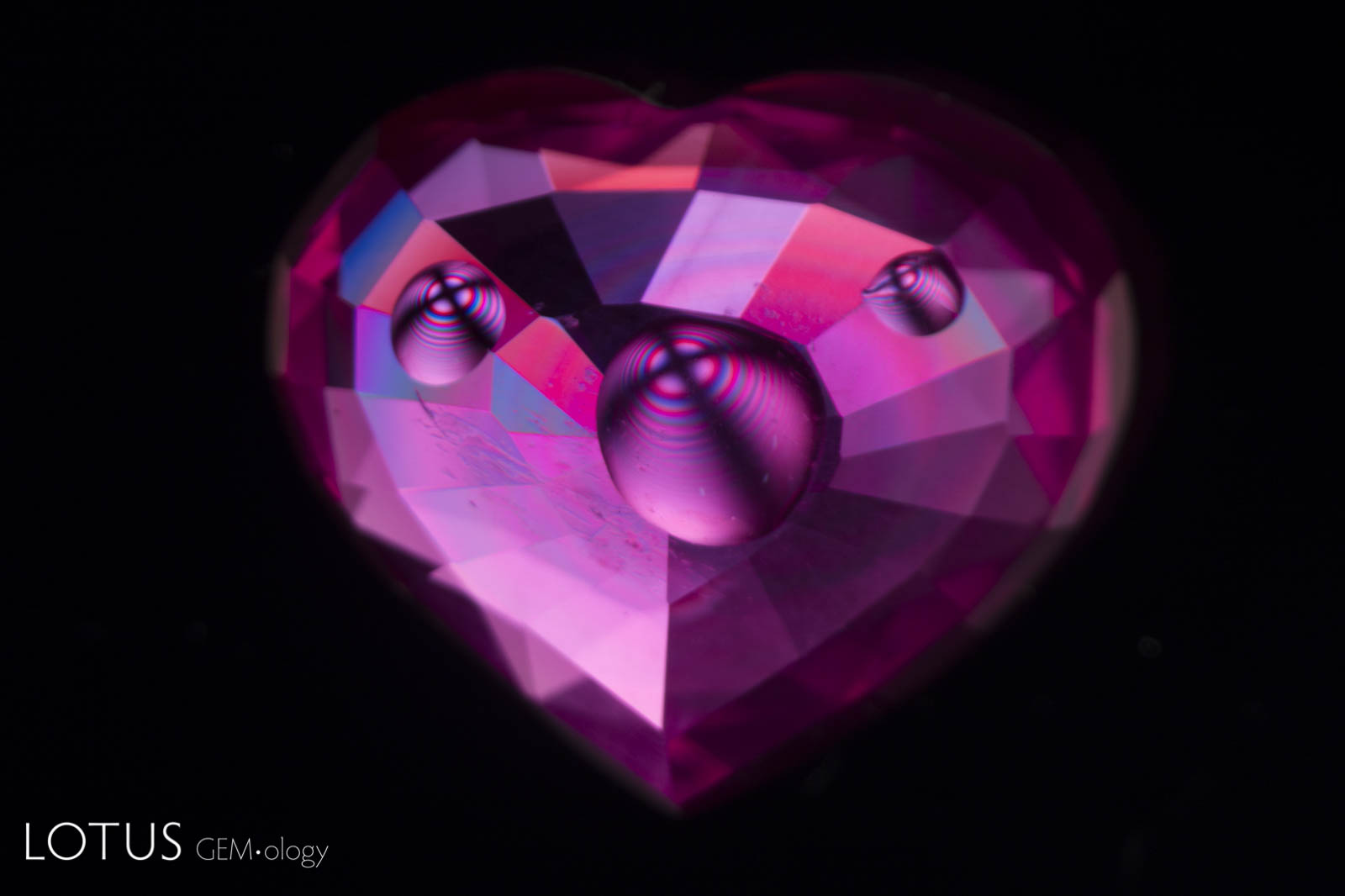
When drops of di-iodomethane are placed on the surface of this rather shallow Mozambique ruby and it is examined between crossed polars, small uniaxial interference figures are readily resolved.
Natural Ruby •
Mozambique •
Enhancements:
None Detected (None) •
Lighting Conditions:
Diffuse Light Field + Crossed Polars
Photographer:
Richard W. Hughes •
Image Number:
A-001-3126-1
Hughes, R.W. (1997) Ruby & Sapphire. Boulder, CO, RWH Publishing, 512 pp.; RWHL*.
458 Total Images
Results: 289 – 300 | Page 25 of 39 Pages
Natural ruby inclusions may include mineral crystals, rutile silk, healed fissures, fluid inclusions, negative crystals, color zoning and other features formed during or after crystal growth. Such features are important to gemologists because they can provide evidence useful in identifying ruby, understanding its geological history, recognizing treatment and, in some cases, determining geographic origin.
Natural Ruby Inclusion Photomicrographs
The Hyperion natural ruby gallery includes microscopic features found in rubies from major deposits around the world. Each entry is accompanied by descriptive information and, where available, references to the gemological literature.
What Inclusions Can Reveal About Natural Ruby
Inclusions are an important part of ruby identification. Their form, composition, orientation and alteration can help gemologists distinguish natural ruby from synthetic material, recognize evidence of heat treatment, and study the geological environment in which the ruby formed.
Hyperion combines inclusion photomicrography with supporting gemological information so that individual features can be compared with documented examples from known ruby deposits.
About Hyperion
Hyperion is the Lotus Gemology searchable inclusion database. It allows users to browse gemstone inclusions by gem type, geographic origin, treatment and keyword.
Search the Complete Hyperion Database